z
Patterns and
Regularities
z
PATTERNS AND REGULARITIES
Mathematics is all around us.
The beauty of flower, the majestic tree, even the rock
formation, exhibits nature’s sense of symmetry.
A. Symmetry
- It is a sense of harmonious and beautiful proportion of
balance or an object is invariant to any of various
transformation (reflection, rotation or scaling).
z
Two Main Types of Symmetry
1. Bilateral symmetry – is a symmetry in which the left and
right sides of the organism can be divided into approximately
mirror image of each other along the midline.
PATTERNS AND REGULARITIES
z
2. Radial Symmetry (rotational symmetry) – is a
type of symmetry around a fixed point known as
the center and it can be classified as either
cyclic or dihedral.
PATTERNS AND REGULARITIES
z
B. FRACTALS
Fractal is curve or geometric figure, each part of which has
the same statistical character as the whole.
This is useful for modeling structures in which similar
patterns recur at progressively smaller scales, and in
describing partly random or chaotic phenomena such as
crystal growth, fluid turbulence, and galaxy formation
PATTERNS AND REGULARITIES
z
z
C. SPIRALS
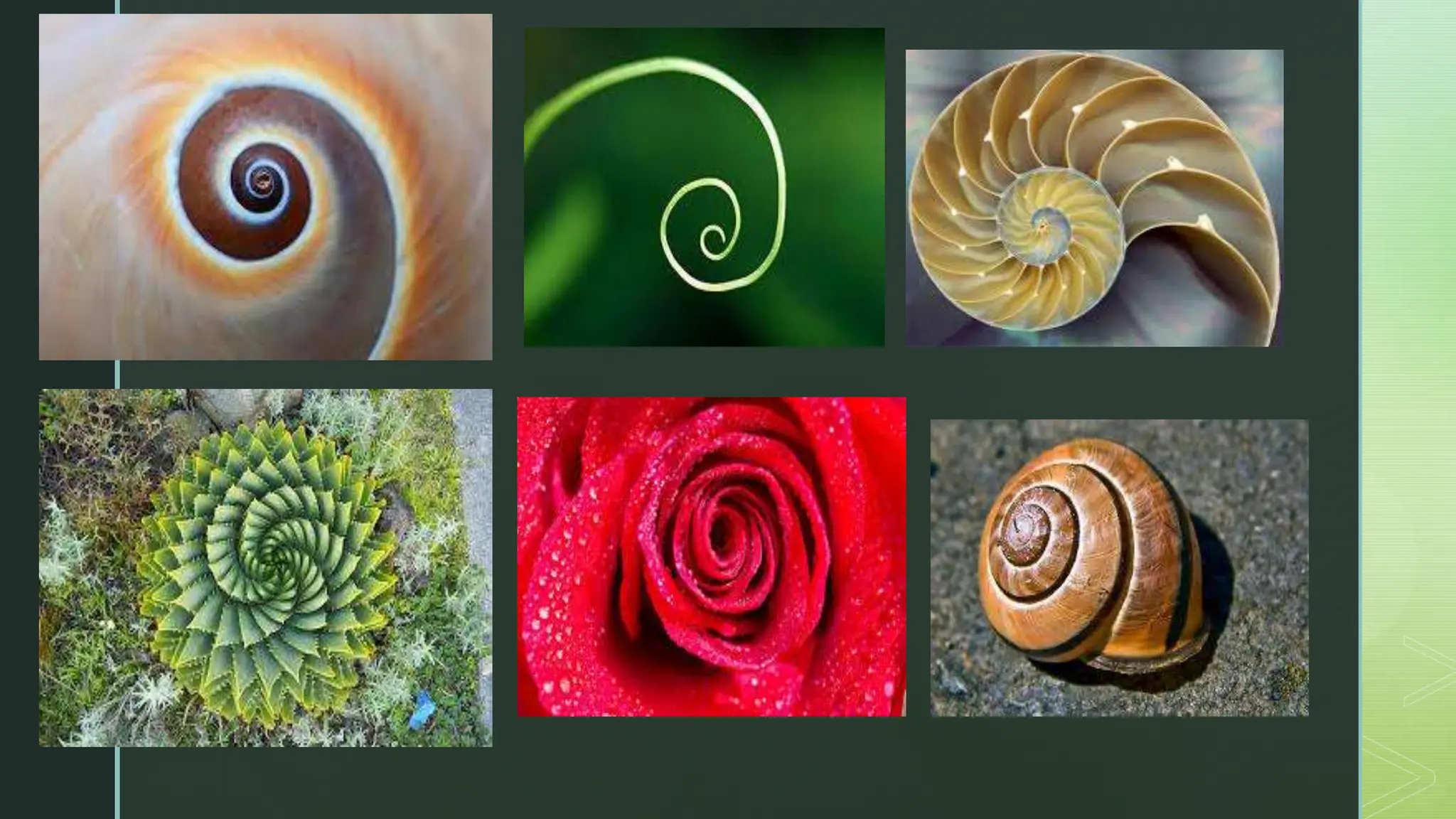
A logarithmic spiral (or growth spiral) is a self-similar
spiral curve which often appears in nature.
Spirals are more evident in plants.
We also see spiral in typhoon, whirlpool, galaxy, tail
of chameleon, and shell among other.
PATTERNS AND
REGULARITIES
z
z
Question 1
 What is the difference between Bilateral and
Radial Symmetry?
Write your explanation on the space below
________________________________________
________________________________________
___________________________________
z
Fibonacci Sequence
 Look at this sequence…
 1, 1, 2, 3, 5, 8, 13, 21, 34, 55, 89, . . .
 Can you tell how it was created?
 Start with the numbers 1 and 1.
 To get the next number add the
previous two numbers together.
z
 The numbers 3,5,8, 13 and 21 are all parts of
the Fibonacci sequence.
 The man behind this sequence is Leonardo
Pisano Bogollo nickname is ( Fibonacci)
z
Daisy
Euphorbia Trillium
Columbine
White Calla Lily
z
Question 2
 Who discovered the Fibonacci
sequence?
________________________________
________________________________
________________________________
________________________________
z
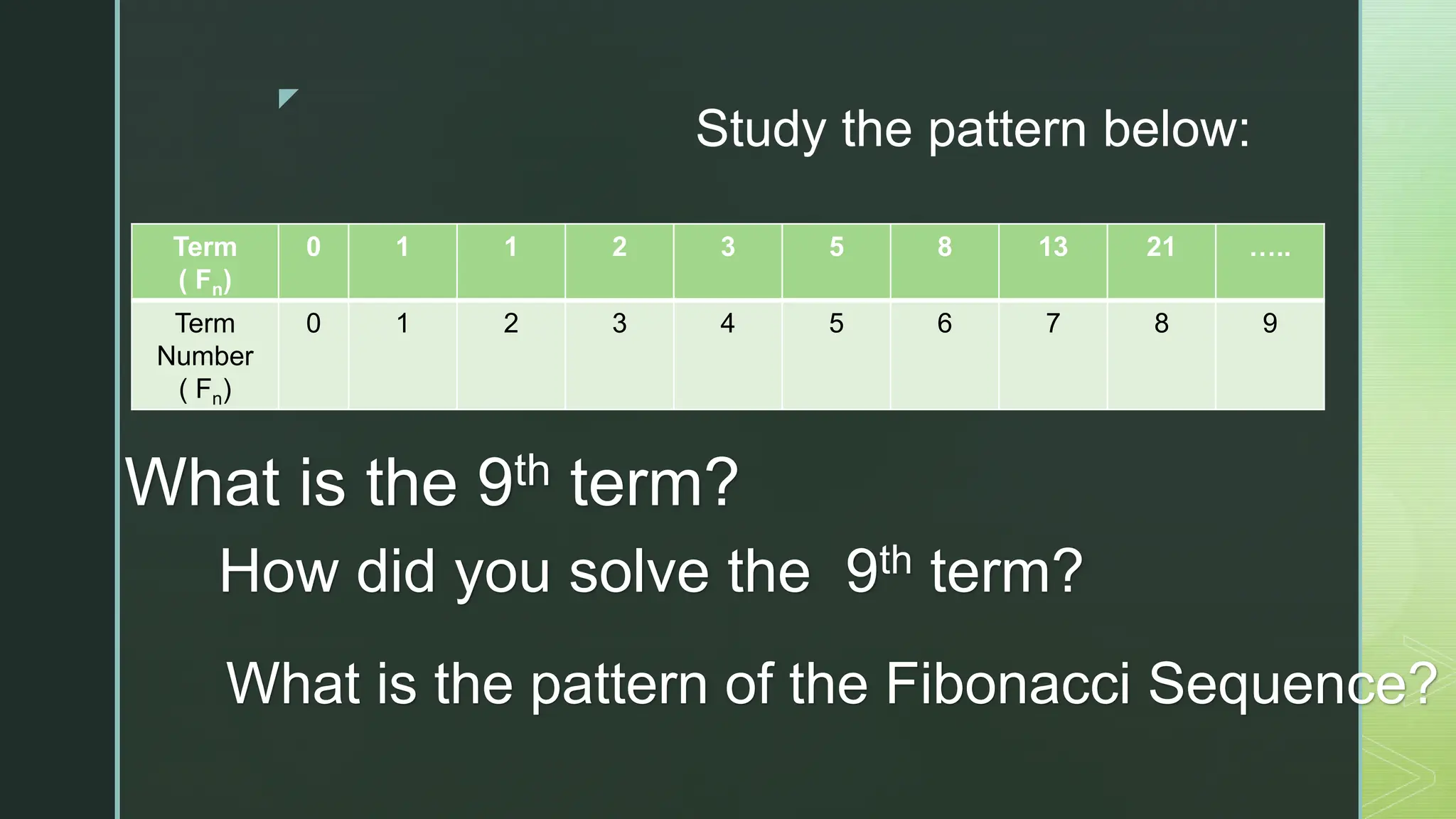
Study the pattern below:
Term
( Fn)
0 1 1 2 3 5 8 13 21 …..
Term
Number
( Fn)
0 1 2 3 4 5 6 7 8 9
What is the 9th term?
How did you solve the 9th term?
What is the pattern of the Fibonacci Sequence?
z
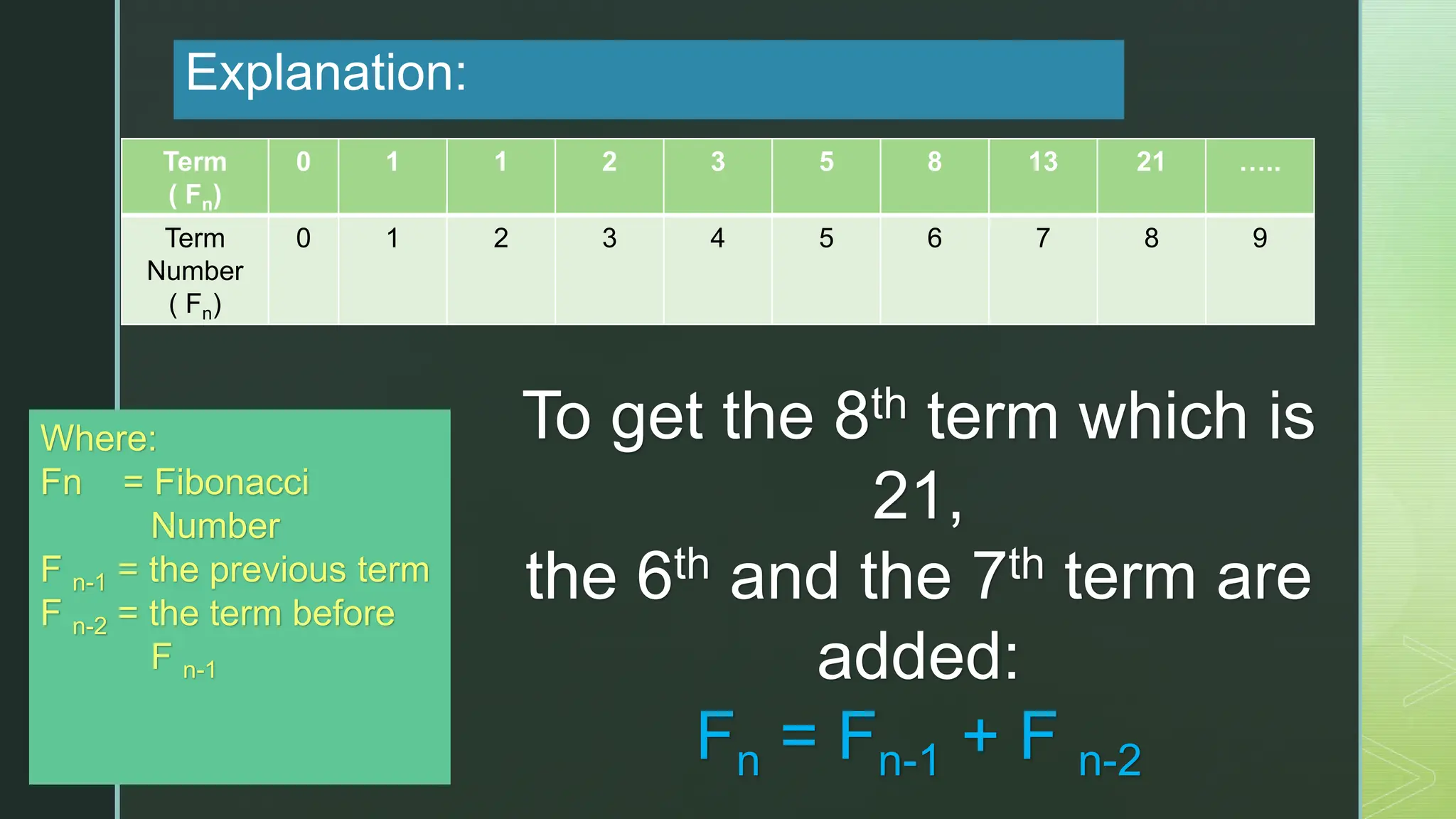
Explanation:
Term
( Fn)
0 1 1 2 3 5 8 13 21 …..
Term
Number
( Fn)
0 1 2 3 4 5 6 7 8 9
To get the 8th term which is
21,
the 6th and the 7th term are
added:
Fn = Fn-1 + F n-2
Where:
Fn = Fibonacci
Number
F n-1 = the previous term
F n-2 = the term before
F n-1
z
Question 3
Term
( Fn)
0 1 1 2 3 5 8 13 21 …..
Term
Number
( Fn)
0 1 2 3 4 5 6 7 8 9
1.Find the 11
th
term: ___________
2. Find the 12
th
term: ___________
3. Find the 13
th
term: ___________
4. Find the 14
th
term: ___________
5. Find the 15
th
term: ___________
z
What about if you need to find the 80th
term?
Binet’s
Formula
𝐹𝑛 = (
z
Question 4
Term
( Fn)
0 1 1 2 3 5 8 13 21 …..
Term
Number
( Fn)
0 1 2 3 4 5 6 7 8 9
1. Find the 25
th
term: ___________
2. Find the 34
th
term: ___________
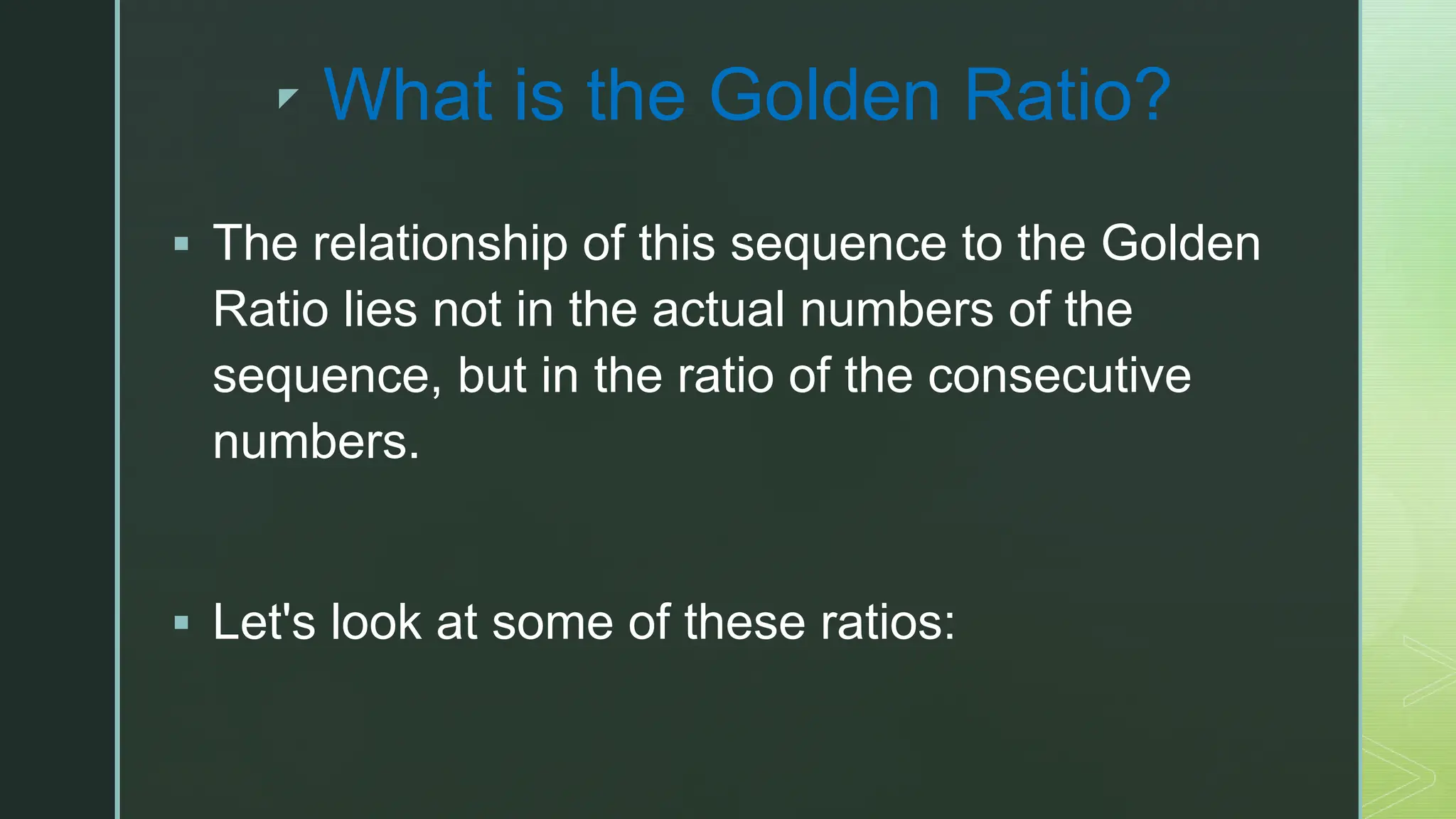
z What is the Golden Ratio?
 The relationship of this sequence to the Golden
Ratio lies not in the actual numbers of the
sequence, but in the ratio of the consecutive
numbers.
 Let's look at some of these ratios:
z What is the Golden
Ratio?
 5/3 = 1.67
 8/5 = 1.6
 13/8 = 1.625
 21/13 = 1.615
 34/21 = 1.619
 55/34 = 1.618
 89/55 = 1.618
What number do
the ratios appear
to approach?
The Golden Ratio
 The Golden Ratio is an irrational number
 It is represented the Greek letter phi (or
, the capital letter: ), after Phidias, who
is said to have employed it.
The Golden Ratio
Golden Ratio goes on
forever so it is usually
rounded to three
decimal places, or 1.618
z
Question 5
 What is the value of phi?
________________________________
________________________________
________________________________
________________________________
z
Irrational Family
 pi, or 
 3.141592653 …
 e, the natural logarithm
 2.718281828 …
 phi, or 
 1.61803399 …
z
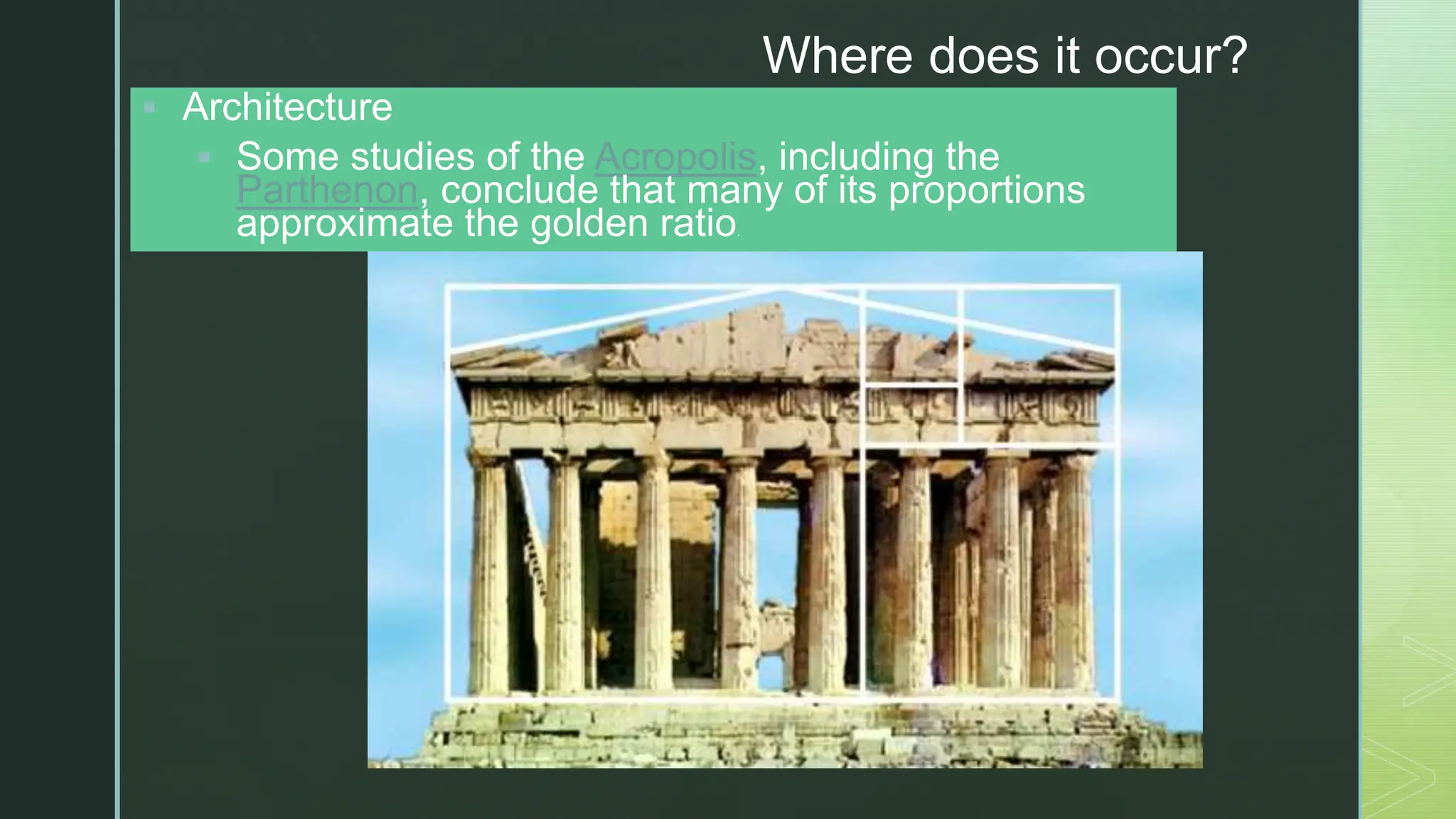
Where does it occur?
 Architecture
 Some studies of the Acropolis, including the
Parthenon, conclude that many of its proportions
approximate the golden ratio.
z
Where does it occur?
 Art
 Salvador Dalí used the
golden ratio in his
masterpiece, The
Sacrament of the Last
Supper.
 The dimensions of the
canvas
 A huge dodecahedron,
with edges in golden ratio
to one another
 Mondrian used the
golden section
extensively in his
geometrical paintings.
z
 Music
 In Béla Bartók's Music for Strings,
Percussion and Celesta the xylophone
progression occurs at the intervals
1:2:3:5:8:5:3:2:1.
 The golden ratio is also apparent in the
organization of the sections in the music
of Debussy's Image, Reflections in Water,
in which the sequence of keys is marked
out by the intervals 34, 21, 13 and 8.
z
Where does it occur?
 Nature - Plants
 A pinecone: spirals from
the center have 5 and 8
arms, respectively (or of
8 and 13, depending on
the size)- again, two
Fibonacci numbers
 Scientists speculate that
plants that grow in spiral
formation do so in
Fibonacci numbers
because this
arrangement makes for
the perfect spacing for
growth.
z
Where does it occur?
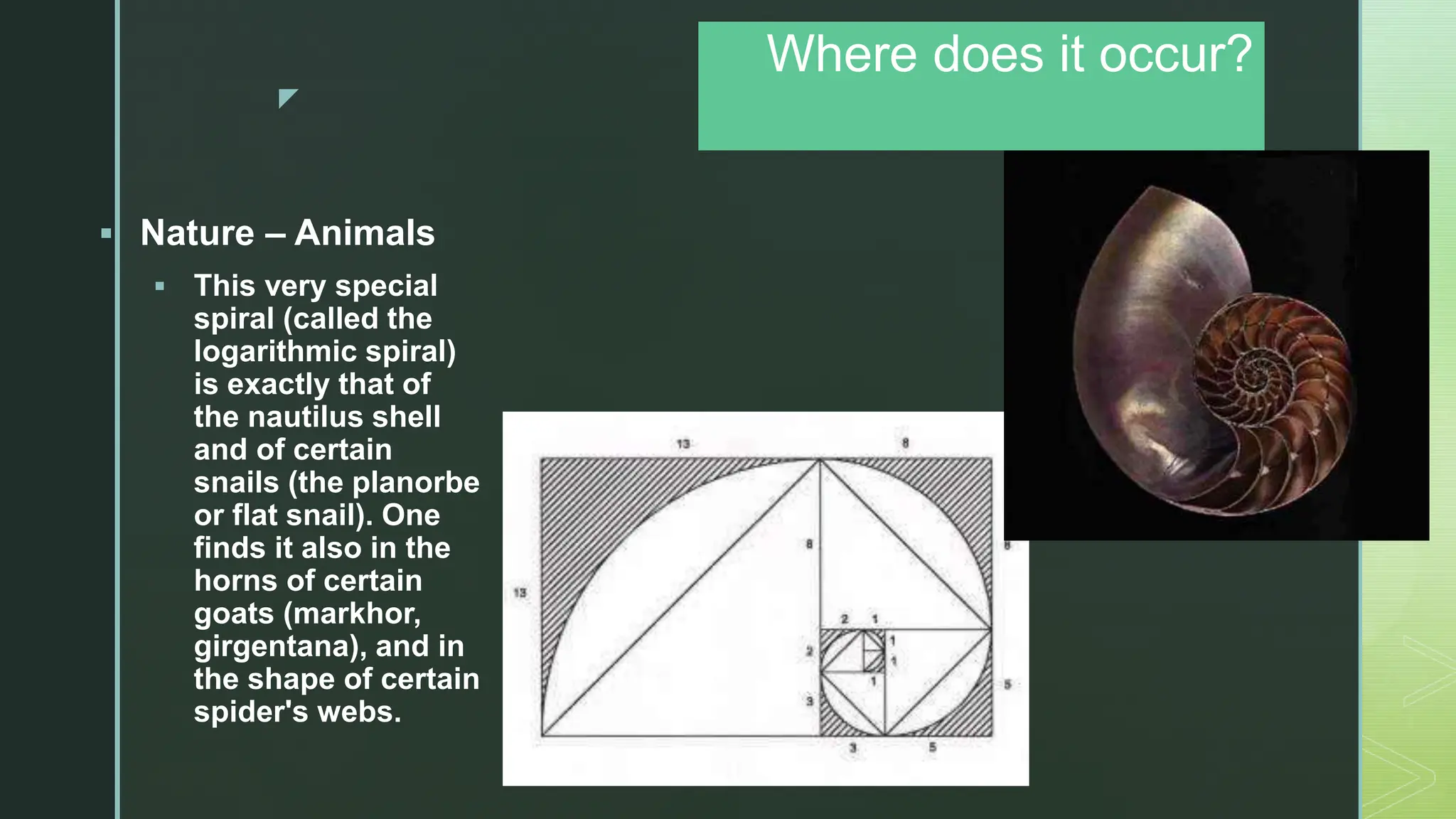
 Nature – Animals
 This very special
spiral (called the
logarithmic spiral)
is exactly that of
the nautilus shell
and of certain
snails (the planorbe
or flat snail). One
finds it also in the
horns of certain
goats (markhor,
girgentana), and in
the shape of certain
spider's webs.
z
Question 6
Give 1 example of Golden ratio and explain.
_______________________________________________________________
_______________________________________________________________
_________________________________

Fibonnaci sequence and Golden Ratio.pptx

  • 1.
  • 2.
    z PATTERNS AND REGULARITIES Mathematicsis all around us. The beauty of flower, the majestic tree, even the rock formation, exhibits nature’s sense of symmetry. A. Symmetry - It is a sense of harmonious and beautiful proportion of balance or an object is invariant to any of various transformation (reflection, rotation or scaling).
  • 3.
    z Two Main Typesof Symmetry 1. Bilateral symmetry – is a symmetry in which the left and right sides of the organism can be divided into approximately mirror image of each other along the midline. PATTERNS AND REGULARITIES
  • 4.
    z 2. Radial Symmetry(rotational symmetry) – is a type of symmetry around a fixed point known as the center and it can be classified as either cyclic or dihedral. PATTERNS AND REGULARITIES
  • 5.
    z B. FRACTALS Fractal iscurve or geometric figure, each part of which has the same statistical character as the whole. This is useful for modeling structures in which similar patterns recur at progressively smaller scales, and in describing partly random or chaotic phenomena such as crystal growth, fluid turbulence, and galaxy formation PATTERNS AND REGULARITIES
  • 6.
  • 7.
    z C. SPIRALS A logarithmicspiral (or growth spiral) is a self-similar spiral curve which often appears in nature. Spirals are more evident in plants. We also see spiral in typhoon, whirlpool, galaxy, tail of chameleon, and shell among other. PATTERNS AND REGULARITIES
  • 8.
  • 9.
    z Question 1  Whatis the difference between Bilateral and Radial Symmetry? Write your explanation on the space below ________________________________________ ________________________________________ ___________________________________
  • 10.
    z Fibonacci Sequence  Lookat this sequence…  1, 1, 2, 3, 5, 8, 13, 21, 34, 55, 89, . . .  Can you tell how it was created?  Start with the numbers 1 and 1.  To get the next number add the previous two numbers together.
  • 11.
    z  The numbers3,5,8, 13 and 21 are all parts of the Fibonacci sequence.  The man behind this sequence is Leonardo Pisano Bogollo nickname is ( Fibonacci)
  • 12.
  • 13.
    z Question 2  Whodiscovered the Fibonacci sequence? ________________________________ ________________________________ ________________________________ ________________________________
  • 14.
    z Study the patternbelow: Term ( Fn) 0 1 1 2 3 5 8 13 21 ….. Term Number ( Fn) 0 1 2 3 4 5 6 7 8 9 What is the 9th term? How did you solve the 9th term? What is the pattern of the Fibonacci Sequence?
  • 15.
    z Explanation: Term ( Fn) 0 11 2 3 5 8 13 21 ….. Term Number ( Fn) 0 1 2 3 4 5 6 7 8 9 To get the 8th term which is 21, the 6th and the 7th term are added: Fn = Fn-1 + F n-2 Where: Fn = Fibonacci Number F n-1 = the previous term F n-2 = the term before F n-1
  • 16.
    z Question 3 Term ( Fn) 01 1 2 3 5 8 13 21 ….. Term Number ( Fn) 0 1 2 3 4 5 6 7 8 9 1.Find the 11 th term: ___________ 2. Find the 12 th term: ___________ 3. Find the 13 th term: ___________ 4. Find the 14 th term: ___________ 5. Find the 15 th term: ___________
  • 17.
    z What about ifyou need to find the 80th term? Binet’s Formula 𝐹𝑛 = (
  • 18.
    z Question 4 Term ( Fn) 01 1 2 3 5 8 13 21 ….. Term Number ( Fn) 0 1 2 3 4 5 6 7 8 9 1. Find the 25 th term: ___________ 2. Find the 34 th term: ___________
  • 19.
    z What isthe Golden Ratio?  The relationship of this sequence to the Golden Ratio lies not in the actual numbers of the sequence, but in the ratio of the consecutive numbers.  Let's look at some of these ratios:
  • 20.
    z What isthe Golden Ratio?  5/3 = 1.67  8/5 = 1.6  13/8 = 1.625  21/13 = 1.615  34/21 = 1.619  55/34 = 1.618  89/55 = 1.618 What number do the ratios appear to approach?
  • 21.
    The Golden Ratio The Golden Ratio is an irrational number  It is represented the Greek letter phi (or , the capital letter: ), after Phidias, who is said to have employed it.
  • 22.
    The Golden Ratio GoldenRatio goes on forever so it is usually rounded to three decimal places, or 1.618
  • 23.
    z Question 5  Whatis the value of phi? ________________________________ ________________________________ ________________________________ ________________________________
  • 24.
    z Irrational Family  pi,or   3.141592653 …  e, the natural logarithm  2.718281828 …  phi, or   1.61803399 …
  • 25.
    z Where does itoccur?  Architecture  Some studies of the Acropolis, including the Parthenon, conclude that many of its proportions approximate the golden ratio.
  • 26.
    z Where does itoccur?  Art  Salvador Dalí used the golden ratio in his masterpiece, The Sacrament of the Last Supper.  The dimensions of the canvas  A huge dodecahedron, with edges in golden ratio to one another  Mondrian used the golden section extensively in his geometrical paintings.
  • 27.
    z  Music  InBéla Bartók's Music for Strings, Percussion and Celesta the xylophone progression occurs at the intervals 1:2:3:5:8:5:3:2:1.  The golden ratio is also apparent in the organization of the sections in the music of Debussy's Image, Reflections in Water, in which the sequence of keys is marked out by the intervals 34, 21, 13 and 8.
  • 28.
    z Where does itoccur?  Nature - Plants  A pinecone: spirals from the center have 5 and 8 arms, respectively (or of 8 and 13, depending on the size)- again, two Fibonacci numbers  Scientists speculate that plants that grow in spiral formation do so in Fibonacci numbers because this arrangement makes for the perfect spacing for growth.
  • 29.
    z Where does itoccur?  Nature – Animals  This very special spiral (called the logarithmic spiral) is exactly that of the nautilus shell and of certain snails (the planorbe or flat snail). One finds it also in the horns of certain goats (markhor, girgentana), and in the shape of certain spider's webs.
  • 30.
    z Question 6 Give 1example of Golden ratio and explain. _______________________________________________________________ _______________________________________________________________ _________________________________