Ruhulla Abdul
IFF 1-2 students
Moscow 2015
The Golden Ratio
Financial University under the Government of the Russian
Federation
SO WHAT IS A RATIO?
Remember this?
A straight line is said to have been cut in extreme and mean ratio when, as the whole line
is to the greater segment, so is the greater to the lesser.
What?
That statement makes no sense to my right brain at all!
OK, I get it about ratio and proportion. But
what’s the “golden” part?
That is a quote from Plato living between 428 and 348 BC in Greece. Euclid had a great
influence on philosophy, mathematics and geometry, who lived in Egypt. Both of these
men were so brilliant and they set the groundwork for millennia of thinkers and
discoverers, as well as later geniuses in the Renaissance and into our modern times.
the ratio of the length of the entire line (A)
to the length of larger line segment (B)
is the same as
the ratio of the length of the larger line segment (B)
to the length of the smaller line segment (C).
This happens only at the point where:
A is 1.618 … times B and B is 1.618 … times C.
Alternatively, C is 0.618… of B and B is 0.618… of A.
Just as p is the ratio of the circumference of a circle to its diameter, Φ (phi) is
simply the ratio of the line segments that result when a line is divided in
one very special and unique way. Divide a line so that:
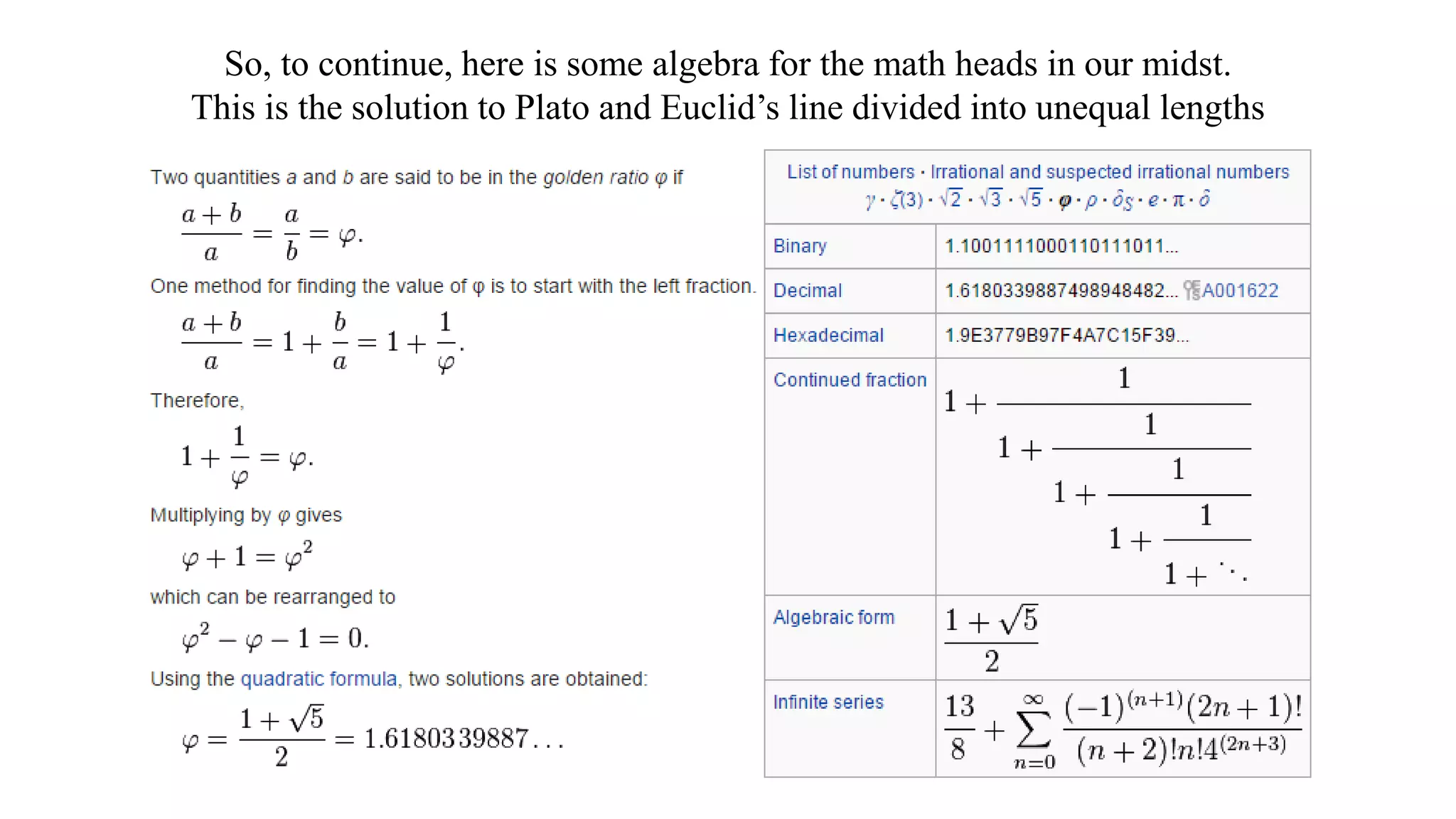
So, to continue, here is some algebra for the math heads in our midst.
This is the solution to Plato and Euclid’s line divided into unequal lengths
Phi 1.6180339887…..the Golden Number!
Fibonacci was born in 1170 in Pisa, and was known as
Leonardo Bonacci or Leonard of Pisa, which was shorted to
Fibonacci, or son of Bonacci. He was a mathematical genius
who wrote, in the early 13th century the Liber Abaci, or Book of
Calculation. Having traveled extensively he concluded that
trying to do arithmetic with Roman Numerals was much more
difficult than using the Hindu-Arabic number system. He spread
the word through his teachings and book. Centuries later this
numerical sequence was named after him. We are lucky to have
been saved by Fibonacci from having to add and subtract, or
horrors, divide using Roman Numerals!
0, 1, 1, 2, 3, 5, 8, 13, 21, 34, 55, 89, 144, 233,
377....etc.
FIBONACCI
Liber Abaci also posed, and solved, a
problem involving the growth of a
population of rabbits based on idealized
assumptions. The solution, generation by
generation, was a sequence of numbers
later known as Fibonacci numbers.
Although Fibonacci's Liber Abaci contains
the earliest known description of the
sequence outside of India, the sequence
had been noted by Indian mathematicians
as early as the sixth century.
THE FIBONACCI RABBITS
This famous problem was first presented to the world in 1202 where we find on pages 123-128 of the
manuscript of Fibonacci’s Liber Abacci
Suppose a newly-born pair of rabbits, one male, one female, are put in a
field. Rabbits are able to mate at the age of one month so that at the end
of its second month a female can produce another pair of rabbits.
Suppose that our rabbits never die and that the female always produces
one new pair (one male, one female)every month from the second
month on. The puzzle that Fibonacci posed was...
How many pairs will there be in one year?
The original problem
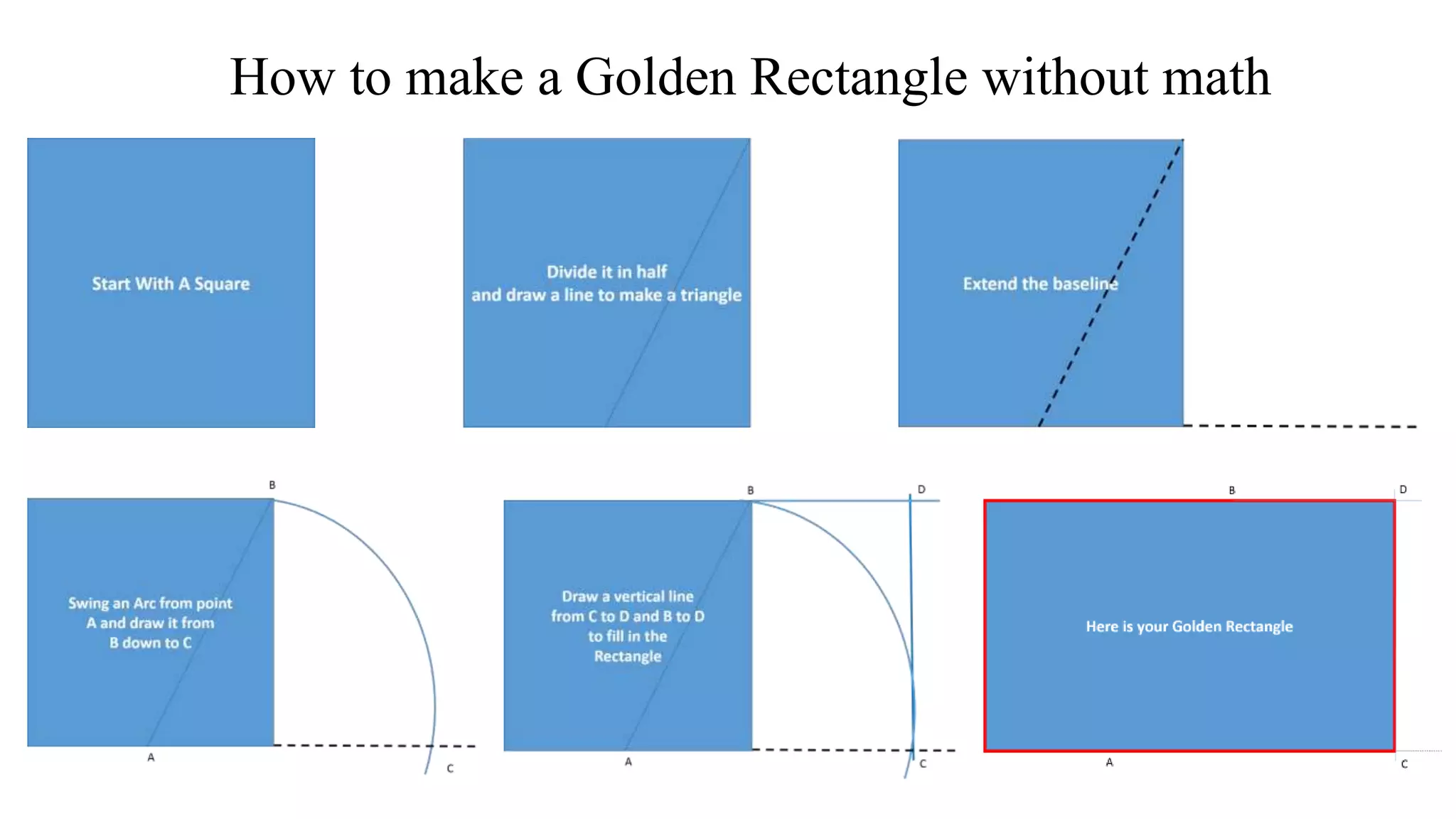
How to make a Golden Rectangle without math
We can do this exercise an infinite number of times but I don’t have a
microscope! The divisions go on and on forever, but for our purposes we
are going to stop now….it is sort of tiresome making these golden
rectangles!
PUTTING THEM ALL BACK TOGETHER
HERE IS A GOLDEN SPIRAL
EACH LINE IS ALSO A
GOLDEN RATIO
HERE IS THE INFINITY POINT
Suppose you have some stretcher bars for a 16 x 20
canvas, but you want to make Golden Rectangles
instead. How do I find out how long I need to make
the new stretcher bars?
Multiply by 1.618 (yeah, you have to use a
calculator to do this!) So I decide to have one side
be 16 cm. So the other side has to be 25.8888…, or
roughly 26 cm.
Now you have your Golden Ratio 16 to 26
But there is an easier way to make a golden rectangle!
Golden Rectangle Calculator
http://www.miniwebtool.com/golden-rectangle-calculator/?a=30
Ф in pentagram
And for the fanatic Golden Ratio addict
you can buy an instrument to measure
your distances.
Evidently Dentists and Surgeons use these tools to measure body parts and teeth.
Or do it by your own
All sorts of interesting things follow this sequence; in
nature, certain sea shells follow the Fibonacci
sequence, as do breeding pairs of rabbits, certain
plants grow leaves in a perfect Fibonacci sequence
and the sunflower seeds follow the Fibonacci spiral
sequence and astronomers see the Fibonacci spiral in
black holes and galaxies! There are hundreds, or
perhaps thousands of examples. Here are a few…
The Golden Spiral constructed from a Golden Rectangle
http://jwilson.coe.uga.edu/emat6680/parveen/Fib_nature.htm
By dividing a circle into Golden proportions,
where the ratio of the arc length are equal to
the Golden Ratio, we find the angle of the arcs
to be 137.5 degrees. In fact, this is the angle at
which adjacent leaves are positioned around the
stem. This phenomenon is observed in many
types of plants.
PETALARRANGEMENTS
In the pinecone pictured, eight spirals can be seen to be
ascending up the cone in a clockwise direction
while thirteen spirals ascend more steeply in a
counterclockwise direction.http://britton.disted.camosun.bc.ca/fibslide/jbfibslide.htm
PINECONES
One set of 5
parallel spirals
ascends at a
shallow angle to
the right
a second set of
8 parallel
spirals ascends
more steeply to
the left
and the third set of
13 parallel spirals
ascends very steeply
to the right
http://britton.disted.camosun.bc.ca/fibslide/jbfibslide.htm
PINEAPPLES
DAISY
2. we can see the phenomenon in almost two-dimensional form.
3. The eye sees twenty-one counterclockwise 4. and thirty-four logarithmic or equiangular spirals. In any daisy, the
combination of counterclockwise and clockwise spirals generally consists of
successive terms of the Fibonacci sequence.
1
http://britton.disted.camosun.bc.ca/fibslide/jbfibslide.htm
Sunflower
Right spirals Left Spirals
Echinacea purpura
A
B
C
DNA
http://www.goldennumber.net/dna/
THE HUMAN BODY
http://jwilson.coe.uga.edu/emat6680/parveen/Fib_nature.htm
The ratio between the forearm and the hand is the Golden Ratio!
LEONARDO - THE VITRUVIAN MAN
http://en.wikipedia.org/wiki/Vitruvian_Man
The drawing is based on the correlations of ideal
human proportions with geometry described by the
ancient Roman architect Vitruvius in Book III of his
treatise De Architectura. Vitruvius described the
human figure as being the principal source of
proportion among the Classical orders of
architecture. Vitruvius determined that the ideal body
should be eight heads high. Leonardo’s drawing is
traditionally named in honor of the architect. This
image demonstrates the blend of art and science
during the Renaissance and provides the perfect
example of Leonardo’s deep understanding of
proportion.
SOLAR SYSTEM AND THE UNIVERSE
New findings reveal that the universe itself is in the shape
of a dodecahedron, a twelve-sided geometric solid
with pentagon faces, all based on phi.
http://www.goldennumber.net/cosmology/
Saturn’s magnificent rings show a division at a golden
section of the width of the rings
Curiously, even the relative distances of the ten planets and the largest asteroid average to phi
http://www.mnn.com/earth-matters/climate-weather/blogs/finding-the-fibonacci-sequence-in-hurricane-sandy
HURRICANE SANDY
SPIRAL GALAXY
ARCHITECTURE
NOTRE DAME CATHEDRAL
THE TAJ MAHAL
LE CORBUSIER
The Great Pyramid of
Egypt closely embodies
Golden Ratio
proportions.
http://www.goldennumber.net/phi-pi-great-pyramid-egypt/
There is debate as to the geometry used in the
design of the Great Pyramid of Giza in Egypt.
Built around 2560 BC, its once flat, smooth outer
shell is gone and all that remains is the roughly-
shaped inner core, so it is difficult to know with
certainty.
There is evidence, however, that the design of the
pyramid embodies these foundations of
mathematics and geometry:
•Phi, the Golden Ratio that appears throughout
nature.
•Pi, the circumference of a circle in relation to its
diameter.
•The Pythagorean Theorem – Credited by
tradition to mathematician Pythagoras (about 570
– 495 BC), which can be expressed as a² + b² =
c².
EGYPT
The CN Tower in Toronto, the tallest tower and
freestanding structure in the world, contains the
golden ratio in its design. The ratio of observation
deck at 342 meters to the total height of 553.33 is
0.618 or phi, the reciprocal of Phi!
John Hamilton Andrews, architect
Here is Plato’s divided line!
DESIGN
Upper case Phi is Φ and lower case phi is φ
http://www.goldennumber.net/logo-design/
FASHION CAR DESIGN
MEDICAL
HANDWRITING
http://jwilson.coe.uga.edu/emat6680/parveen/ubi_phi.htm
and http://www.goldennumber.net
Musical scales are based on Fibonacci numbers
Note how the piano keyboard of C to C above of 13 keys has 8 white keys and 5 black keys,
split into groups of 3 and 2
There are 13 notes in the span of any note through its octave.
A scale is comprised of 8 notes, of which the
5th and 3rd notes create the basic foundation of all chords, and are based on whole tone which is
2 steps from the root tone, that is the
1st note of the scale.
MUSIC
Here is a Fibonacci reminder
0, 1, 1, 2, 3, 5, 8, 13, 21, 34, 55, 89, 144, 233, 377....etc.
http://www.goldennumber.net/music/
MOZART AND DEBUSSY BOTH USED THE GOLDEN RATIO IN THEIR
COMPOSITIONS, AS DID MANY OTHER COMPOSERS AND POETS
Musical instruments are often based on phi
http://jwilson.coe.uga.edu/emat6680/parveen/GR_in_art.htm
ART
Leonardo The Last Supper. Golden Sections all over the place!
Note on Da Vinci’s “The Annunciation” that the brick wall of the courtyard is at exact
golden ratio proportions in relation to the top and bottom of the painting see the diagram
on the next slide
I don’t know if Leonardo planned on all the Golden Ratios in this painting, but it is fun to see how many
associations we can fine. The Painting seems to be double Golden Rectangles, and that spiral joins the hand of the
angel with the hand of Mary perfectly!
http://abyss.uoregon.edu/~js/glossary/golden_rectangle.html
This self-portrait by Rembrandt (1606-1669) is an example of a triangular composition.
A perpendicular line from the apex of the triangle to the base cut the base in golden
section. Did he mean to do this?
http://jwilson.coe.uga.edu/emat6680/parveen/Golden_Triangle.htm
Michelangelo's Holy Family ... and Raphael Crucifixion are other examples, wherein the
principle figure outlines the Golden triangle which can be used to locate one of its
underlying pentagrams. The arms of the star form divided lines in Golden Ratios
PENTAGRAMS
Hans Hofmann, The Gate. 1959 Piet Mondrian, Composition in Red,
Yellow and Blue. 1935. $50,565,000 Mark Rothko, Violet, Green, Red.
1951
Matisse L’Escargot
Escargot is the French word for snail. Many mollusk shells follow some form of the Fibonacci sequence or are in
some way allied with the Golden Ratio. Here Is a golden spiral superimposed on top of Matisse’s artwork
Sacrament of the Last Supper by Salvador Dali
This is not “accidental”. Dali was fascinated by mathematics and geometry and
many of his monumental works are based on geometry and the Golden Ratio
M.C. ESCHER
Escher was one of the most famous of the mathematically inspired artists. His extraordinary tessellations,
Platonic Solids, polyhedrons, and other geometrically arranged shapes are fascinating to observe and in my
opinion he is not as well known as he should be.
Many of Escher's works contain impossible constructions, made using geometrical objects that cannot exist but
are pleasant to the human sight. Some of Escher's tessellation drawings were inspired by conversations with the
mathematician H. S. M. Coxeter concerning hyperbolic geometry. Relationships between the works of
mathematician Kurt Gödel, artist Escher, and composer Johann Sebastian Bach are explored in Gödel, Escher,
Bach, a Pulitzer Prize-winning book.
http://en.wikipedia.org/wiki/Mathematics_and_art#M.C._Escher
Henri Cartier-Bresson
Photography
Golden spiral Rule of thirds Infinity points
On the left is Monet’s Landscape at Vétheuil. Measure the short side of the canvas and flop it down to the long side
and you will have a square. That imaginary line is the Rabatment and it is used over and over by artists through the
centuries to design their canvases. Obviously when a canvas is all ready square finding the Rabatment is not possible.
So using the Rule of Thirds on Monet’s Houses of Parliament we find that he actually knew what he was doing!
Monet was well trained in classical techniques and these compositions are no accident.
RABATMENT RULE OF THIRDS
Renaissance Art Composition and
the Ukrainian Parliament Fight
August 7, 2014 by Gary Meisner
http://www.goldennumber.net/renaissance-art-composition-ukranian-parliament-
fight/
This photo and article was
all over the internet a month
Anatomy
The British contest in 2012 to find “Britain’s Perfect Face”
Thank you
RESOURCES
The Internet has hundreds, maybe more, websites and blogs with diagrams and photographs
about the Golden Ratio and Golden Rectangles. I have used many of them and I did not
remember to give every image a credit. There is so much online about the Golden Ratio and its
allied fields of mathematics it is overwhelming. I am not going to list all of them as a Google
search can bring all this wealth to your own computer. But here are a few I found useful….
www.goldennumber.net by Gary Meisner. Some of you might be interested in his software for
finding phi in your own compositions and photographs. Go to this website
www.phimatrix.com
http://jwilson.coe.uga.edu/emat6680/parveen/golden_rectangle.htm and many other articles are
here
http://www.museumofthegoldenratio.org/ Great information here as well as many links to art
related websites
http://britton.disted.camosun.bc.ca/fibslide/jbfibslide.htm some interesting diagrams and
information on phi in nature
http://www.maths.surrey.ac.uk/hosted-sites/R.Knott/Fibonacci/fibnat.html
Most of the information was taken from: http://www.authorstream.com/Presentation/gerinzhills-
2279358-golden-ratio/
1. http://en.wikipedia.org/wiki/Golden_ratio
2. http://en.wikipedia.org/wiki/List_of_works_designed_with_the_golden_ratio
3. http://io9.com/5985588/15-uncanny-examples-of-the-golden-ratio-in-nature
4. http://www.livescience.com/37704-phi-golden-ratio.html
5. http://www.abc-people.com/data/leonardov/zolot_sech-txt.htm
6. http://russian7.ru/2014/09/zolotoe-sechenie-kak-ehto-rabotaet/
7. http://n-t.ru/tp/iz/zs.htm
8. http://ustierechi.ucoz.ru/publ/14-1-0-168
9. http://zhitanska.com/content/sakralnaya-geometriya
10. http://en.wikipedia.org/wiki/Fibonacci
11. https://ru.wikipedia.org/wiki/%D0%97%D0%BE%D0%BB%D0%BE%D1%82%D0%BE%D0%B5_%D1%81%D0%B5%D1%87%D0%B5%
D0%BD%D0%B8%D0%B5
12. https://en.wikipedia.org/wiki/Rule_of_thirds
13. https://ru.wikipedia.org/wiki/%D0%A7%D0%B8%D1%81%D0%BB%D0%B0_%D0%A4%D0%B8%D0%B1%D0%BE%D0%BD%D0%B0
%D1%87%D1%87%D0%B8
14. http://mathworld.wolfram.com/GoldenRatio.html
15. http://www.goldennumber.net/facial-beauty-golden-ratio-florence-colgate/
16. http://www.goldennumber.net/golden-ratio-myth/
17. http://www.fastcodesign.com/3044877/the-golden-ratio-designs-biggest-myth#4
18. http://www.tutoronline.ru/blog/chisla-fibonachchi-ishhem-sekret-mirozdanija
19. !!! http://log-in.ru/articles/zolotoe-sechenie/
20. http://habrahabr.ru/post/154087/
21. !!! http://www.authorstream.com/Presentation/gerinzhills-2279358-golden-ratio/
22. !!! https://www.khanacademy.org/math/algebra/ratio-proportion-topic/advanced-ratios/v/the-golden-ratio
23. !!! http://www.maths.surrey.ac.uk/hosted-sites/R.Knott/Fibonacci/phi.html
24. !!! http://www.maths.surrey.ac.uk/hosted-sites/R.Knott/Fibonacci/fibnat.html

The Golden Ratio

  • 1.
    Ruhulla Abdul IFF 1-2students Moscow 2015 The Golden Ratio Financial University under the Government of the Russian Federation
  • 2.
    SO WHAT ISA RATIO? Remember this?
  • 3.
    A straight lineis said to have been cut in extreme and mean ratio when, as the whole line is to the greater segment, so is the greater to the lesser. What? That statement makes no sense to my right brain at all! OK, I get it about ratio and proportion. But what’s the “golden” part? That is a quote from Plato living between 428 and 348 BC in Greece. Euclid had a great influence on philosophy, mathematics and geometry, who lived in Egypt. Both of these men were so brilliant and they set the groundwork for millennia of thinkers and discoverers, as well as later geniuses in the Renaissance and into our modern times.
  • 4.
    the ratio ofthe length of the entire line (A) to the length of larger line segment (B) is the same as the ratio of the length of the larger line segment (B) to the length of the smaller line segment (C). This happens only at the point where: A is 1.618 … times B and B is 1.618 … times C. Alternatively, C is 0.618… of B and B is 0.618… of A. Just as p is the ratio of the circumference of a circle to its diameter, Φ (phi) is simply the ratio of the line segments that result when a line is divided in one very special and unique way. Divide a line so that:
  • 5.
    So, to continue,here is some algebra for the math heads in our midst. This is the solution to Plato and Euclid’s line divided into unequal lengths
  • 6.
  • 7.
    Fibonacci was bornin 1170 in Pisa, and was known as Leonardo Bonacci or Leonard of Pisa, which was shorted to Fibonacci, or son of Bonacci. He was a mathematical genius who wrote, in the early 13th century the Liber Abaci, or Book of Calculation. Having traveled extensively he concluded that trying to do arithmetic with Roman Numerals was much more difficult than using the Hindu-Arabic number system. He spread the word through his teachings and book. Centuries later this numerical sequence was named after him. We are lucky to have been saved by Fibonacci from having to add and subtract, or horrors, divide using Roman Numerals! 0, 1, 1, 2, 3, 5, 8, 13, 21, 34, 55, 89, 144, 233, 377....etc. FIBONACCI
  • 8.
    Liber Abaci alsoposed, and solved, a problem involving the growth of a population of rabbits based on idealized assumptions. The solution, generation by generation, was a sequence of numbers later known as Fibonacci numbers. Although Fibonacci's Liber Abaci contains the earliest known description of the sequence outside of India, the sequence had been noted by Indian mathematicians as early as the sixth century. THE FIBONACCI RABBITS This famous problem was first presented to the world in 1202 where we find on pages 123-128 of the manuscript of Fibonacci’s Liber Abacci
  • 9.
    Suppose a newly-bornpair of rabbits, one male, one female, are put in a field. Rabbits are able to mate at the age of one month so that at the end of its second month a female can produce another pair of rabbits. Suppose that our rabbits never die and that the female always produces one new pair (one male, one female)every month from the second month on. The puzzle that Fibonacci posed was... How many pairs will there be in one year? The original problem
  • 10.
    How to makea Golden Rectangle without math
  • 15.
    We can dothis exercise an infinite number of times but I don’t have a microscope! The divisions go on and on forever, but for our purposes we are going to stop now….it is sort of tiresome making these golden rectangles!
  • 16.
    PUTTING THEM ALLBACK TOGETHER
  • 17.
    HERE IS AGOLDEN SPIRAL
  • 18.
    EACH LINE ISALSO A GOLDEN RATIO HERE IS THE INFINITY POINT
  • 19.
    Suppose you havesome stretcher bars for a 16 x 20 canvas, but you want to make Golden Rectangles instead. How do I find out how long I need to make the new stretcher bars? Multiply by 1.618 (yeah, you have to use a calculator to do this!) So I decide to have one side be 16 cm. So the other side has to be 25.8888…, or roughly 26 cm. Now you have your Golden Ratio 16 to 26 But there is an easier way to make a golden rectangle!
  • 20.
  • 21.
  • 22.
    And for thefanatic Golden Ratio addict you can buy an instrument to measure your distances. Evidently Dentists and Surgeons use these tools to measure body parts and teeth. Or do it by your own
  • 23.
    All sorts ofinteresting things follow this sequence; in nature, certain sea shells follow the Fibonacci sequence, as do breeding pairs of rabbits, certain plants grow leaves in a perfect Fibonacci sequence and the sunflower seeds follow the Fibonacci spiral sequence and astronomers see the Fibonacci spiral in black holes and galaxies! There are hundreds, or perhaps thousands of examples. Here are a few…
  • 24.
    The Golden Spiralconstructed from a Golden Rectangle
  • 25.
    http://jwilson.coe.uga.edu/emat6680/parveen/Fib_nature.htm By dividing acircle into Golden proportions, where the ratio of the arc length are equal to the Golden Ratio, we find the angle of the arcs to be 137.5 degrees. In fact, this is the angle at which adjacent leaves are positioned around the stem. This phenomenon is observed in many types of plants. PETALARRANGEMENTS
  • 26.
    In the pineconepictured, eight spirals can be seen to be ascending up the cone in a clockwise direction while thirteen spirals ascend more steeply in a counterclockwise direction.http://britton.disted.camosun.bc.ca/fibslide/jbfibslide.htm PINECONES
  • 27.
    One set of5 parallel spirals ascends at a shallow angle to the right a second set of 8 parallel spirals ascends more steeply to the left and the third set of 13 parallel spirals ascends very steeply to the right http://britton.disted.camosun.bc.ca/fibslide/jbfibslide.htm PINEAPPLES
  • 28.
    DAISY 2. we cansee the phenomenon in almost two-dimensional form. 3. The eye sees twenty-one counterclockwise 4. and thirty-four logarithmic or equiangular spirals. In any daisy, the combination of counterclockwise and clockwise spirals generally consists of successive terms of the Fibonacci sequence. 1 http://britton.disted.camosun.bc.ca/fibslide/jbfibslide.htm
  • 29.
  • 30.
  • 31.
  • 32.
    THE HUMAN BODY http://jwilson.coe.uga.edu/emat6680/parveen/Fib_nature.htm Theratio between the forearm and the hand is the Golden Ratio!
  • 33.
    LEONARDO - THEVITRUVIAN MAN http://en.wikipedia.org/wiki/Vitruvian_Man The drawing is based on the correlations of ideal human proportions with geometry described by the ancient Roman architect Vitruvius in Book III of his treatise De Architectura. Vitruvius described the human figure as being the principal source of proportion among the Classical orders of architecture. Vitruvius determined that the ideal body should be eight heads high. Leonardo’s drawing is traditionally named in honor of the architect. This image demonstrates the blend of art and science during the Renaissance and provides the perfect example of Leonardo’s deep understanding of proportion.
  • 34.
    SOLAR SYSTEM ANDTHE UNIVERSE New findings reveal that the universe itself is in the shape of a dodecahedron, a twelve-sided geometric solid with pentagon faces, all based on phi. http://www.goldennumber.net/cosmology/ Saturn’s magnificent rings show a division at a golden section of the width of the rings Curiously, even the relative distances of the ten planets and the largest asteroid average to phi
  • 35.
  • 36.
  • 37.
  • 38.
  • 39.
    The Great Pyramidof Egypt closely embodies Golden Ratio proportions. http://www.goldennumber.net/phi-pi-great-pyramid-egypt/ There is debate as to the geometry used in the design of the Great Pyramid of Giza in Egypt. Built around 2560 BC, its once flat, smooth outer shell is gone and all that remains is the roughly- shaped inner core, so it is difficult to know with certainty. There is evidence, however, that the design of the pyramid embodies these foundations of mathematics and geometry: •Phi, the Golden Ratio that appears throughout nature. •Pi, the circumference of a circle in relation to its diameter. •The Pythagorean Theorem – Credited by tradition to mathematician Pythagoras (about 570 – 495 BC), which can be expressed as a² + b² = c². EGYPT
  • 40.
    The CN Towerin Toronto, the tallest tower and freestanding structure in the world, contains the golden ratio in its design. The ratio of observation deck at 342 meters to the total height of 553.33 is 0.618 or phi, the reciprocal of Phi! John Hamilton Andrews, architect Here is Plato’s divided line!
  • 41.
    DESIGN Upper case Phiis Φ and lower case phi is φ http://www.goldennumber.net/logo-design/
  • 42.
  • 43.
    Musical scales arebased on Fibonacci numbers Note how the piano keyboard of C to C above of 13 keys has 8 white keys and 5 black keys, split into groups of 3 and 2 There are 13 notes in the span of any note through its octave. A scale is comprised of 8 notes, of which the 5th and 3rd notes create the basic foundation of all chords, and are based on whole tone which is 2 steps from the root tone, that is the 1st note of the scale. MUSIC Here is a Fibonacci reminder 0, 1, 1, 2, 3, 5, 8, 13, 21, 34, 55, 89, 144, 233, 377....etc. http://www.goldennumber.net/music/
  • 44.
    MOZART AND DEBUSSYBOTH USED THE GOLDEN RATIO IN THEIR COMPOSITIONS, AS DID MANY OTHER COMPOSERS AND POETS Musical instruments are often based on phi http://jwilson.coe.uga.edu/emat6680/parveen/GR_in_art.htm
  • 45.
  • 46.
    Leonardo The LastSupper. Golden Sections all over the place!
  • 47.
    Note on DaVinci’s “The Annunciation” that the brick wall of the courtyard is at exact golden ratio proportions in relation to the top and bottom of the painting see the diagram on the next slide
  • 48.
    I don’t knowif Leonardo planned on all the Golden Ratios in this painting, but it is fun to see how many associations we can fine. The Painting seems to be double Golden Rectangles, and that spiral joins the hand of the angel with the hand of Mary perfectly! http://abyss.uoregon.edu/~js/glossary/golden_rectangle.html
  • 49.
    This self-portrait byRembrandt (1606-1669) is an example of a triangular composition. A perpendicular line from the apex of the triangle to the base cut the base in golden section. Did he mean to do this? http://jwilson.coe.uga.edu/emat6680/parveen/Golden_Triangle.htm
  • 50.
    Michelangelo's Holy Family... and Raphael Crucifixion are other examples, wherein the principle figure outlines the Golden triangle which can be used to locate one of its underlying pentagrams. The arms of the star form divided lines in Golden Ratios PENTAGRAMS
  • 51.
    Hans Hofmann, TheGate. 1959 Piet Mondrian, Composition in Red, Yellow and Blue. 1935. $50,565,000 Mark Rothko, Violet, Green, Red. 1951
  • 52.
    Matisse L’Escargot Escargot isthe French word for snail. Many mollusk shells follow some form of the Fibonacci sequence or are in some way allied with the Golden Ratio. Here Is a golden spiral superimposed on top of Matisse’s artwork
  • 53.
    Sacrament of theLast Supper by Salvador Dali This is not “accidental”. Dali was fascinated by mathematics and geometry and many of his monumental works are based on geometry and the Golden Ratio
  • 54.
    M.C. ESCHER Escher wasone of the most famous of the mathematically inspired artists. His extraordinary tessellations, Platonic Solids, polyhedrons, and other geometrically arranged shapes are fascinating to observe and in my opinion he is not as well known as he should be. Many of Escher's works contain impossible constructions, made using geometrical objects that cannot exist but are pleasant to the human sight. Some of Escher's tessellation drawings were inspired by conversations with the mathematician H. S. M. Coxeter concerning hyperbolic geometry. Relationships between the works of mathematician Kurt Gödel, artist Escher, and composer Johann Sebastian Bach are explored in Gödel, Escher, Bach, a Pulitzer Prize-winning book. http://en.wikipedia.org/wiki/Mathematics_and_art#M.C._Escher
  • 55.
  • 56.
    Golden spiral Ruleof thirds Infinity points
  • 57.
    On the leftis Monet’s Landscape at Vétheuil. Measure the short side of the canvas and flop it down to the long side and you will have a square. That imaginary line is the Rabatment and it is used over and over by artists through the centuries to design their canvases. Obviously when a canvas is all ready square finding the Rabatment is not possible. So using the Rule of Thirds on Monet’s Houses of Parliament we find that he actually knew what he was doing! Monet was well trained in classical techniques and these compositions are no accident. RABATMENT RULE OF THIRDS
  • 58.
    Renaissance Art Compositionand the Ukrainian Parliament Fight August 7, 2014 by Gary Meisner http://www.goldennumber.net/renaissance-art-composition-ukranian-parliament- fight/ This photo and article was all over the internet a month
  • 60.
  • 61.
    The British contestin 2012 to find “Britain’s Perfect Face”
  • 62.
  • 63.
    RESOURCES The Internet hashundreds, maybe more, websites and blogs with diagrams and photographs about the Golden Ratio and Golden Rectangles. I have used many of them and I did not remember to give every image a credit. There is so much online about the Golden Ratio and its allied fields of mathematics it is overwhelming. I am not going to list all of them as a Google search can bring all this wealth to your own computer. But here are a few I found useful…. www.goldennumber.net by Gary Meisner. Some of you might be interested in his software for finding phi in your own compositions and photographs. Go to this website www.phimatrix.com http://jwilson.coe.uga.edu/emat6680/parveen/golden_rectangle.htm and many other articles are here http://www.museumofthegoldenratio.org/ Great information here as well as many links to art related websites http://britton.disted.camosun.bc.ca/fibslide/jbfibslide.htm some interesting diagrams and information on phi in nature http://www.maths.surrey.ac.uk/hosted-sites/R.Knott/Fibonacci/fibnat.html Most of the information was taken from: http://www.authorstream.com/Presentation/gerinzhills- 2279358-golden-ratio/
  • 64.
    1. http://en.wikipedia.org/wiki/Golden_ratio 2. http://en.wikipedia.org/wiki/List_of_works_designed_with_the_golden_ratio 3.http://io9.com/5985588/15-uncanny-examples-of-the-golden-ratio-in-nature 4. http://www.livescience.com/37704-phi-golden-ratio.html 5. http://www.abc-people.com/data/leonardov/zolot_sech-txt.htm 6. http://russian7.ru/2014/09/zolotoe-sechenie-kak-ehto-rabotaet/ 7. http://n-t.ru/tp/iz/zs.htm 8. http://ustierechi.ucoz.ru/publ/14-1-0-168 9. http://zhitanska.com/content/sakralnaya-geometriya 10. http://en.wikipedia.org/wiki/Fibonacci 11. https://ru.wikipedia.org/wiki/%D0%97%D0%BE%D0%BB%D0%BE%D1%82%D0%BE%D0%B5_%D1%81%D0%B5%D1%87%D0%B5% D0%BD%D0%B8%D0%B5 12. https://en.wikipedia.org/wiki/Rule_of_thirds 13. https://ru.wikipedia.org/wiki/%D0%A7%D0%B8%D1%81%D0%BB%D0%B0_%D0%A4%D0%B8%D0%B1%D0%BE%D0%BD%D0%B0 %D1%87%D1%87%D0%B8 14. http://mathworld.wolfram.com/GoldenRatio.html 15. http://www.goldennumber.net/facial-beauty-golden-ratio-florence-colgate/ 16. http://www.goldennumber.net/golden-ratio-myth/ 17. http://www.fastcodesign.com/3044877/the-golden-ratio-designs-biggest-myth#4 18. http://www.tutoronline.ru/blog/chisla-fibonachchi-ishhem-sekret-mirozdanija 19. !!! http://log-in.ru/articles/zolotoe-sechenie/ 20. http://habrahabr.ru/post/154087/ 21. !!! http://www.authorstream.com/Presentation/gerinzhills-2279358-golden-ratio/ 22. !!! https://www.khanacademy.org/math/algebra/ratio-proportion-topic/advanced-ratios/v/the-golden-ratio 23. !!! http://www.maths.surrey.ac.uk/hosted-sites/R.Knott/Fibonacci/phi.html 24. !!! http://www.maths.surrey.ac.uk/hosted-sites/R.Knott/Fibonacci/fibnat.html