
The Magic of Fibonacci
Group Members
Name : Hassan Shahzad Aheer
Roll # : 15SBSCS25
Name : Syed Habib
Roll # : 15SBSCS63
Name : Saadat Ali
Roll # : 15SBSCS55
Name : Hafsa Akram
Roll # : 15SBSCS23
Name : Ati
Roll # : 15SBSCS05
Topic
 Way do we learn math
 Introduction
 The Fibonacci Number
 In term of calculation
 In Term of application
 In term of inspiration
Why do we learn
mathematic ?
Essentially for three reasons :
1. Calculation
2. Application
3. Inspiration
With the help of this three essential
reasons we describe the Fibonacci
sequence .
Fibonacci
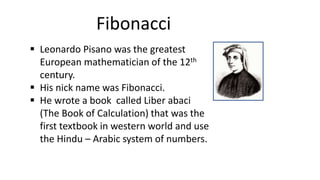
 Leonardo Pisano was the greatest
European mathematician of the 12th
century.
 His nick name was Fibonacci.
 He wrote a book called Liber abaci
(The Book of Calculation) that was the
first textbook in western world and use
the Hindu – Arabic system of numbers.
In term of calculation
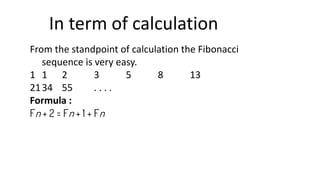
From the standpoint of calculation the Fibonacci
sequence is very easy.
1 1 2 3 5 8 13
2134 55 . . . .
Formula :
Fn + 2 = Fn + 1 + Fn
In term of Application
There are many application of Fibonacci.
1. In Nature
2. In computer science
3. In animals and more . .
Fibonacci number in
Nature things
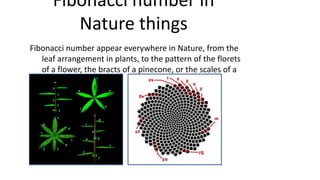
Fibonacci number appear everywhere in Nature, from the
leaf arrangement in plants, to the pattern of the florets
of a flower, the bracts of a pinecone, or the scales of a
pineapple.
Fibonacci number in
Computer program
• Fibonacci numbers are used in Fibonacci
heaps, which are a data structure that can be
used to speed up some very practical
algorithms.
• Fibonacci numbers give a model for
designing recursive programming algorithms
where the time for any routine is the time
within the routine itself, plus the time for the
recursive calls.
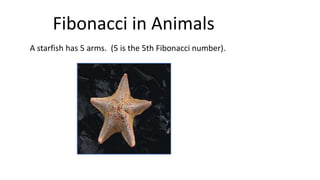
Fibonacci in Animals
A starfish has 5 arms. (5 is the 5th Fibonacci number).
In term of Inspiration
• The inspirational thing about Fibonacci
number is they display beautiful
number patterns.
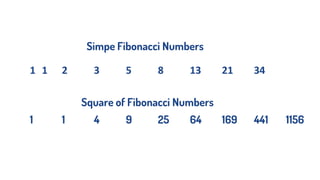
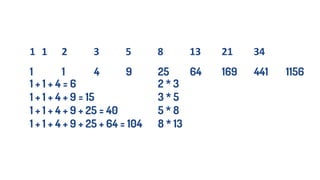
• Suppose we like to square the Fibonacci
number
1 1 2 3 5 8 13 21 34
1 1 4 9 25 64 169 441 1156
Simpe Fibonacci Numbers
Square of Fibonacci Numbers
1 1 2 3 5 8 13 21 34
1 1 4 9 25 64 169 441 1156
1 + 1 + 4 = 6 2 * 3
1 + 1 + 4 + 9 = 15 3 * 5
1 + 1 + 4 + 9 + 25 = 40 5 * 8
1 + 1 + 4 + 9 + 25 + 64 = 104 8 * 13
Fibonacci numbers and
the golden rectangle
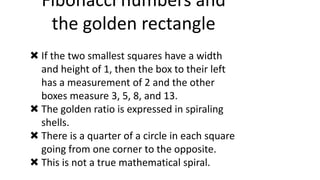
 If the two smallest squares have a width
and height of 1, then the box to their left
has a measurement of 2 and the other
boxes measure 3, 5, 8, and 13.
 The golden ratio is expressed in spiraling
shells.
 There is a quarter of a circle in each square
going from one corner to the opposite.
 This is not a true mathematical spiral.
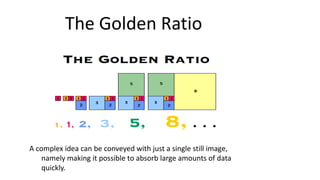
The Golden Ratio
A complex idea can be conveyed with just a single still image,
namely making it possible to absorb large amounts of data
quickly.
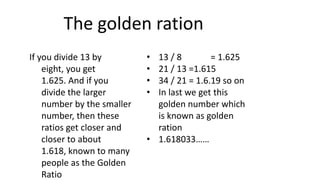
The golden ration
If you divide 13 by
eight, you get
1.625. And if you
divide the larger
number by the smaller
number, then these
ratios get closer and
closer to about
1.618, known to many
people as the Golden
Ratio
• 13 / 8 = 1.625
• 21 / 13 =1.615
• 34 / 21 = 1.6.19 so on
• In last we get this
golden number which
is known as golden
ration
• 1.618033……
THANKS!
Any questions?
You can us at
• hassanshahzadaheer@gmail.com
• saadatali.achakzai@gmail.com
• syedhabib3333@gmail.com
Credits
Special thanks to all the people who made and
released these awesome resources for free:
• Arthur Benjamin
• The magic of Fibonacci numbers
• The book of calculation

Fibonacci series by saadat ali achakzai

  • 1.
    The Magic ofFibonacci
  • 2.
    Group Members Name :Hassan Shahzad Aheer Roll # : 15SBSCS25 Name : Syed Habib Roll # : 15SBSCS63 Name : Saadat Ali Roll # : 15SBSCS55 Name : Hafsa Akram Roll # : 15SBSCS23 Name : Ati Roll # : 15SBSCS05
  • 3.
    Topic  Way dowe learn math  Introduction  The Fibonacci Number  In term of calculation  In Term of application  In term of inspiration
  • 4.
    Why do welearn mathematic ? Essentially for three reasons : 1. Calculation 2. Application 3. Inspiration With the help of this three essential reasons we describe the Fibonacci sequence .
  • 5.
    Fibonacci  Leonardo Pisanowas the greatest European mathematician of the 12th century.  His nick name was Fibonacci.  He wrote a book called Liber abaci (The Book of Calculation) that was the first textbook in western world and use the Hindu – Arabic system of numbers.
  • 6.
    In term ofcalculation From the standpoint of calculation the Fibonacci sequence is very easy. 1 1 2 3 5 8 13 2134 55 . . . . Formula : Fn + 2 = Fn + 1 + Fn
  • 7.
    In term ofApplication There are many application of Fibonacci. 1. In Nature 2. In computer science 3. In animals and more . .
  • 8.
    Fibonacci number in Naturethings Fibonacci number appear everywhere in Nature, from the leaf arrangement in plants, to the pattern of the florets of a flower, the bracts of a pinecone, or the scales of a pineapple.
  • 9.
    Fibonacci number in Computerprogram • Fibonacci numbers are used in Fibonacci heaps, which are a data structure that can be used to speed up some very practical algorithms. • Fibonacci numbers give a model for designing recursive programming algorithms where the time for any routine is the time within the routine itself, plus the time for the recursive calls.
  • 10.
    Fibonacci in Animals Astarfish has 5 arms. (5 is the 5th Fibonacci number).
  • 11.
    In term ofInspiration • The inspirational thing about Fibonacci number is they display beautiful number patterns. • Suppose we like to square the Fibonacci number
  • 12.
    1 1 23 5 8 13 21 34 1 1 4 9 25 64 169 441 1156 Simpe Fibonacci Numbers Square of Fibonacci Numbers
  • 13.
    1 1 23 5 8 13 21 34 1 1 4 9 25 64 169 441 1156 1 + 1 + 4 = 6 2 * 3 1 + 1 + 4 + 9 = 15 3 * 5 1 + 1 + 4 + 9 + 25 = 40 5 * 8 1 + 1 + 4 + 9 + 25 + 64 = 104 8 * 13
  • 14.
    Fibonacci numbers and thegolden rectangle  If the two smallest squares have a width and height of 1, then the box to their left has a measurement of 2 and the other boxes measure 3, 5, 8, and 13.  The golden ratio is expressed in spiraling shells.  There is a quarter of a circle in each square going from one corner to the opposite.  This is not a true mathematical spiral.
  • 15.
    The Golden Ratio Acomplex idea can be conveyed with just a single still image, namely making it possible to absorb large amounts of data quickly.
  • 16.
    The golden ration Ifyou divide 13 by eight, you get 1.625. And if you divide the larger number by the smaller number, then these ratios get closer and closer to about 1.618, known to many people as the Golden Ratio • 13 / 8 = 1.625 • 21 / 13 =1.615 • 34 / 21 = 1.6.19 so on • In last we get this golden number which is known as golden ration • 1.618033……
  • 17.
    THANKS! Any questions? You canus at • hassanshahzadaheer@gmail.com • saadatali.achakzai@gmail.com • syedhabib3333@gmail.com
  • 18.
    Credits Special thanks toall the people who made and released these awesome resources for free: • Arthur Benjamin • The magic of Fibonacci numbers • The book of calculation