Fibonacci
numbers
Month 0
1 pair
Month 1
1 pair
Month 2
2 pairs
Month 3
3 pairs
18 April, 2023
Jenny Gage
University of Cambridge
Introductions and preliminary task
Humphrey Davy – flowers
Seven Kings – flowers
John of Gaunt – pine cones or
pineapples
Ellen Wilkinson – pine cones or
pineapples
Fibonacci numbers in art and nature
Fibonacci numbers in nature
An example of efficiency in nature.
As each row of seeds in a sunflower or
pine cone, or petals on a flower grows,
it tries to put the maximum number in
the smallest space.
Fibonacci numbers are the whole
numbers which express the golden
ratio, which corresponds to the angle
which maximises number of items in
the smallest space.
Why are they called Fibonnaci numbers?
Leonardo of Pisa, c1175 – c1250
Liber Abaci, 1202, one of the first books to be
published by a European
One of the first people to introduce the decimal
number system into Europe
On his travels saw the advantage of the Hindu-
Arabic numbers compared to Roman numerals
Rabbit problem – in the follow-up work
About how maths is related to all kinds of things
you’d never have thought of
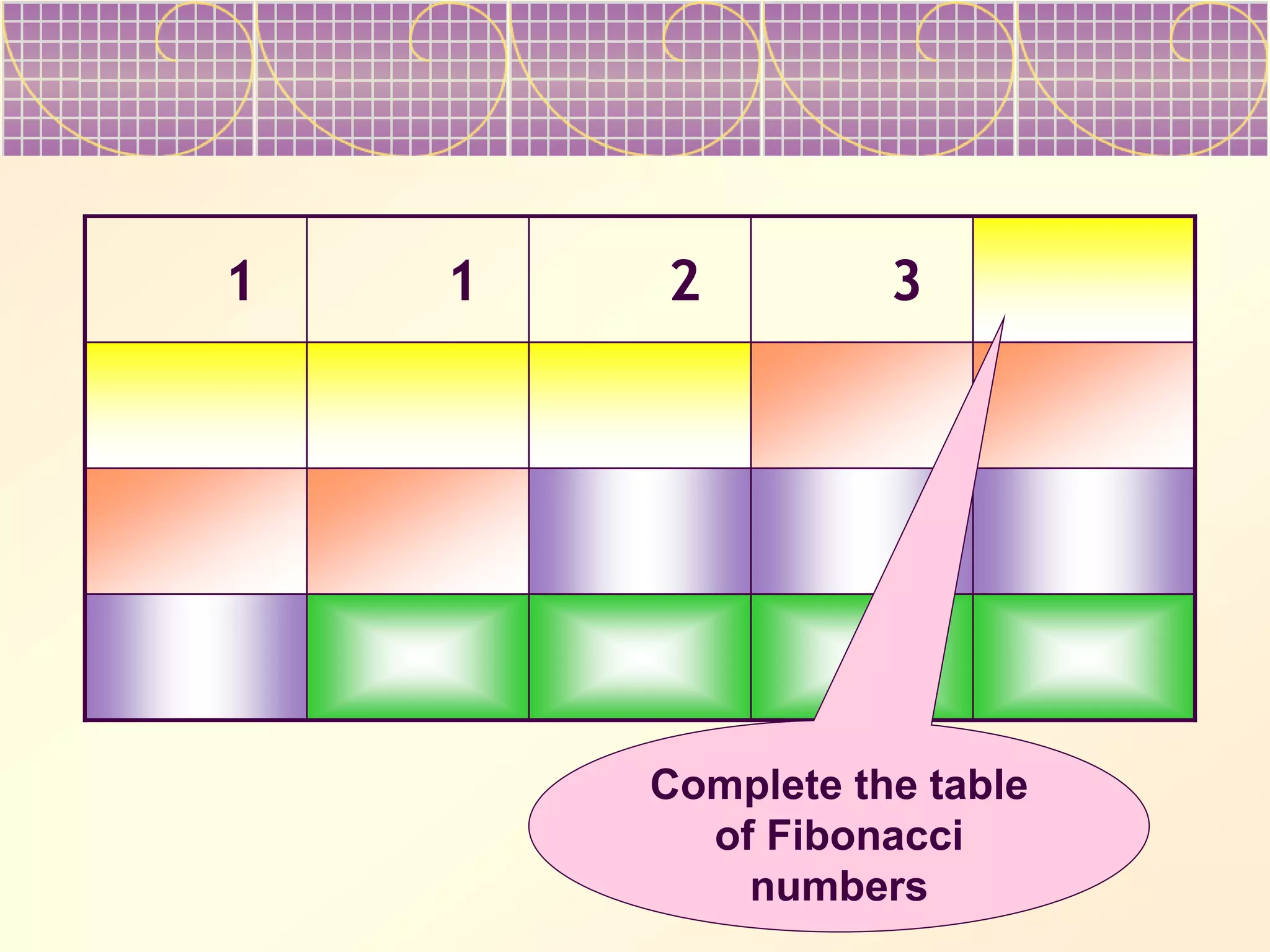
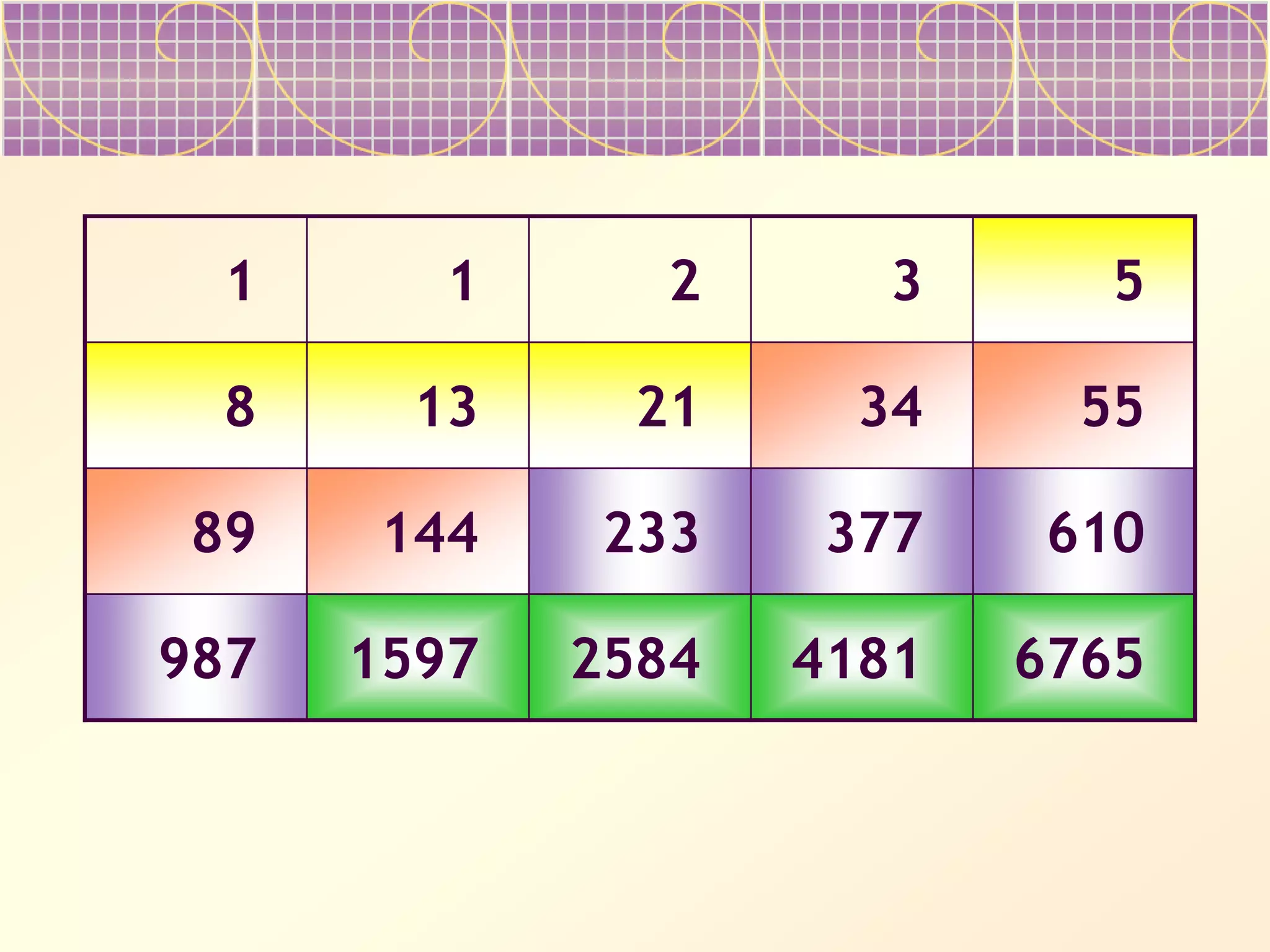
1 1 2 3
Complete the table
of Fibonacci
numbers
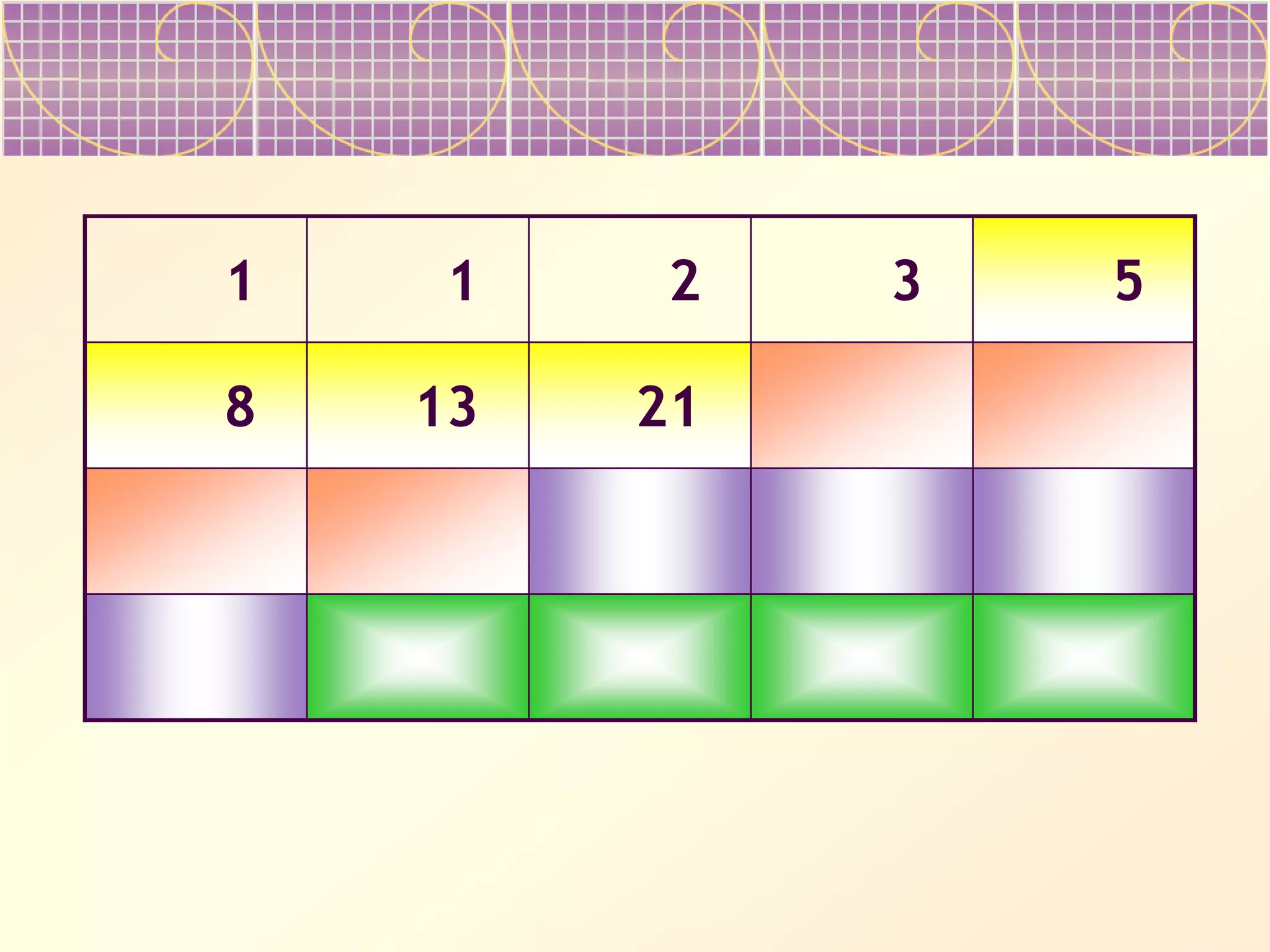
1 1 2 3 5
8 13 21
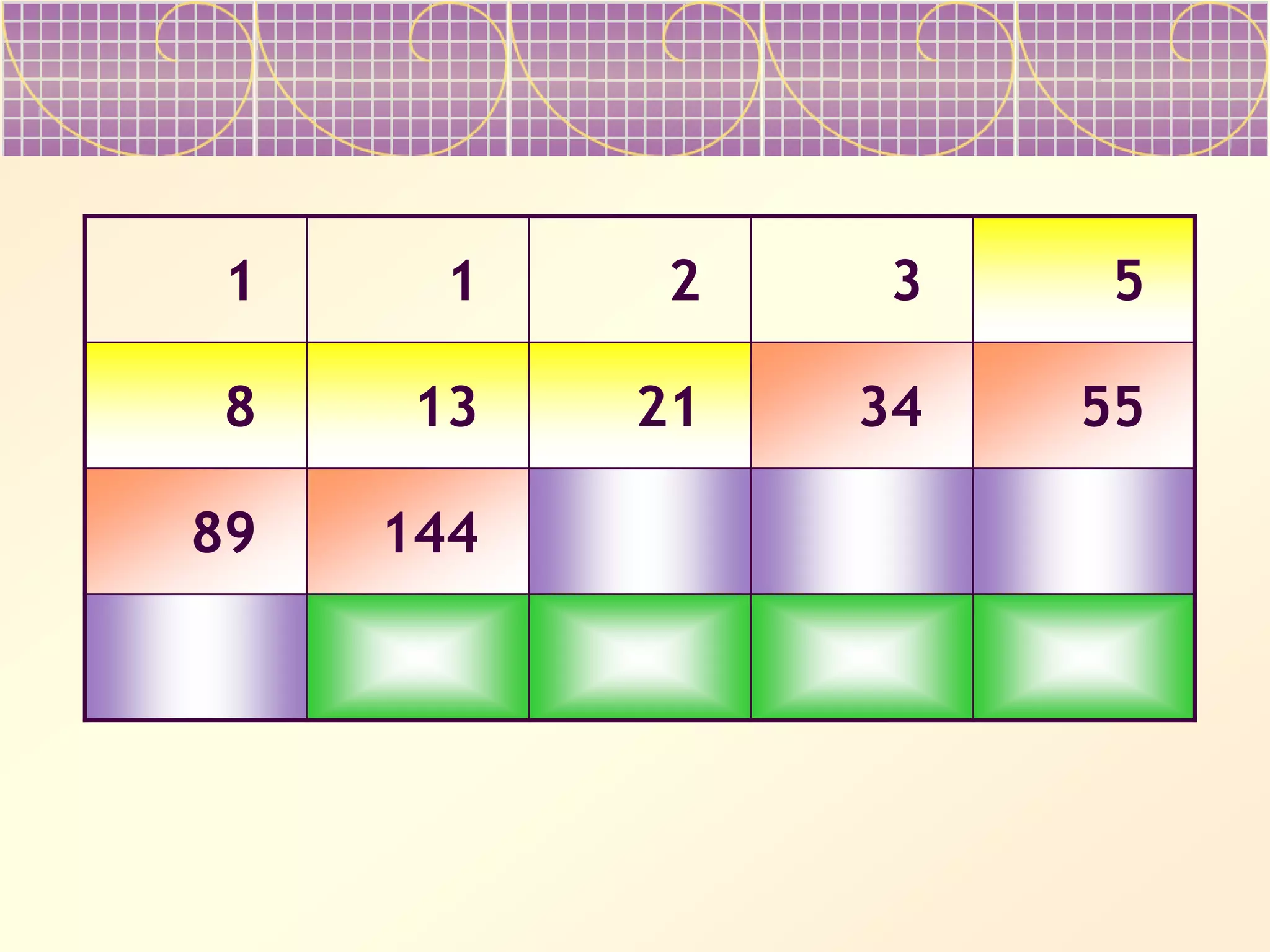
1 1 2 3 5
8 13 21 34 55
89 144
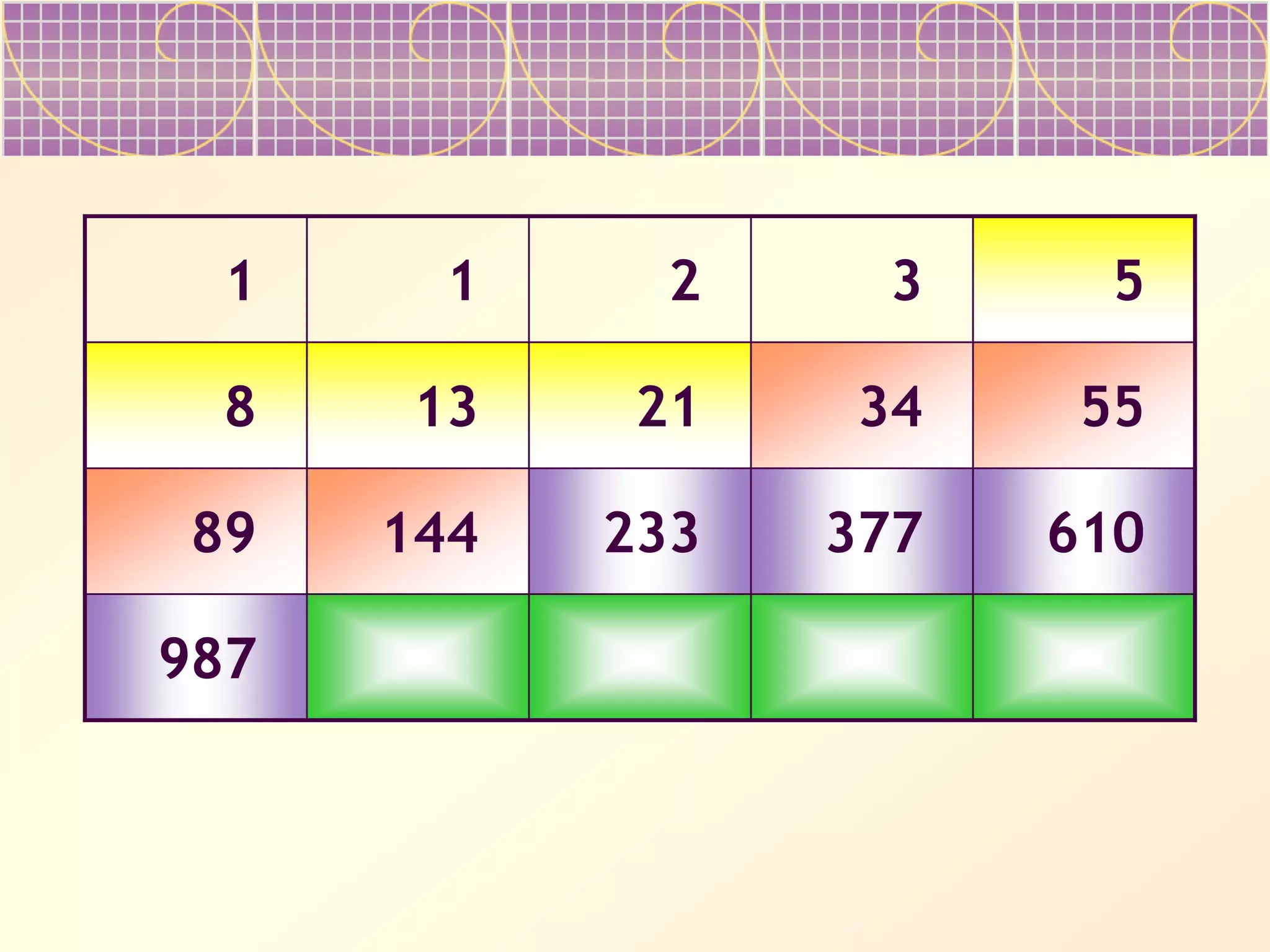
1 1 2 3 5
8 13 21 34 55
89 144 233 377 610
987
1 1 2 3 5
8 13 21 34 55
89 144 233 377 610
987 1597 2584 4181 6765
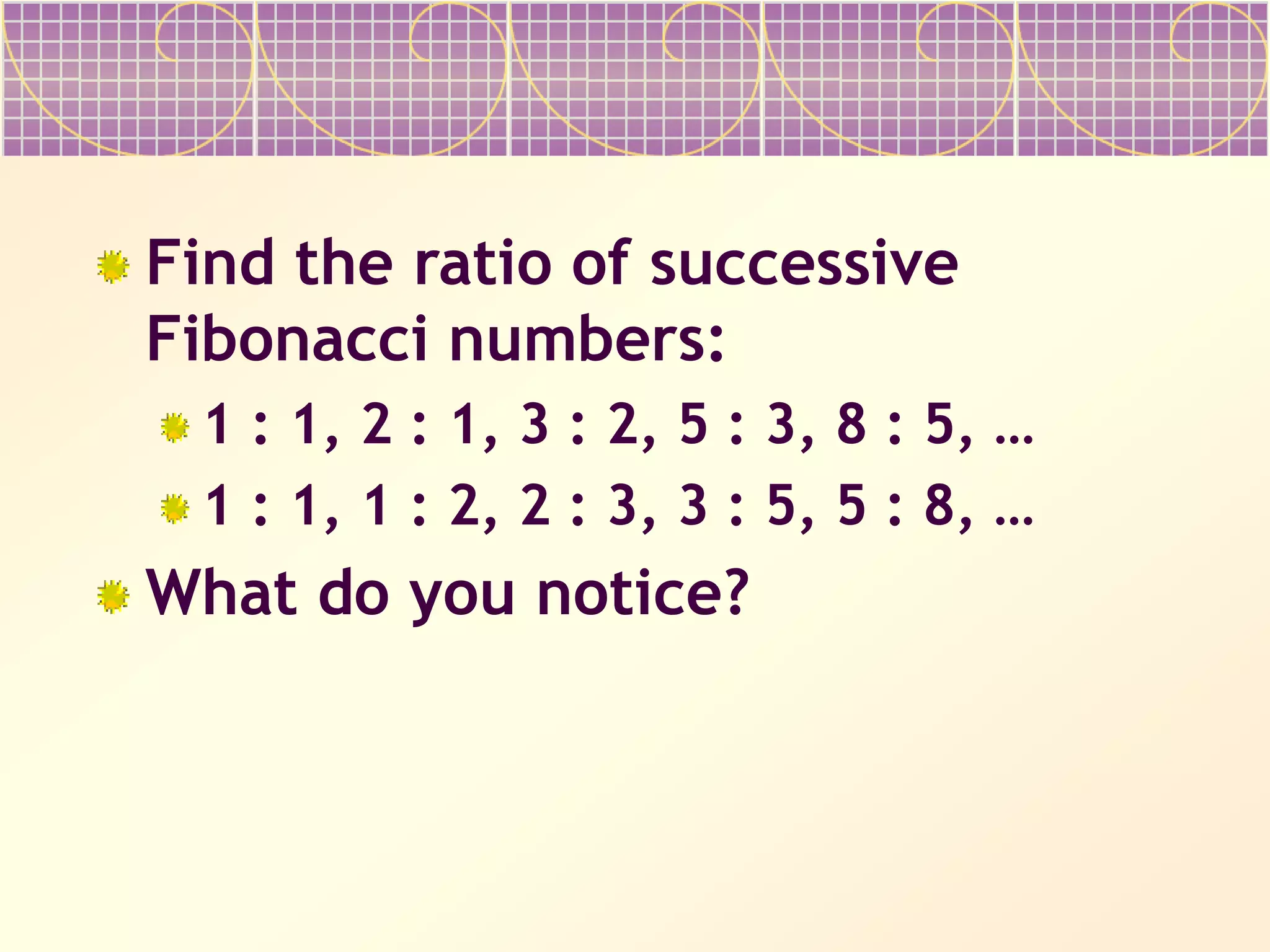
Find the ratio of successive
Fibonacci numbers:
1 : 1, 2 : 1, 3 : 2, 5 : 3, 8 : 5, …
1 : 1, 1 : 2, 2 : 3, 3 : 5, 5 : 8, …
What do you notice?
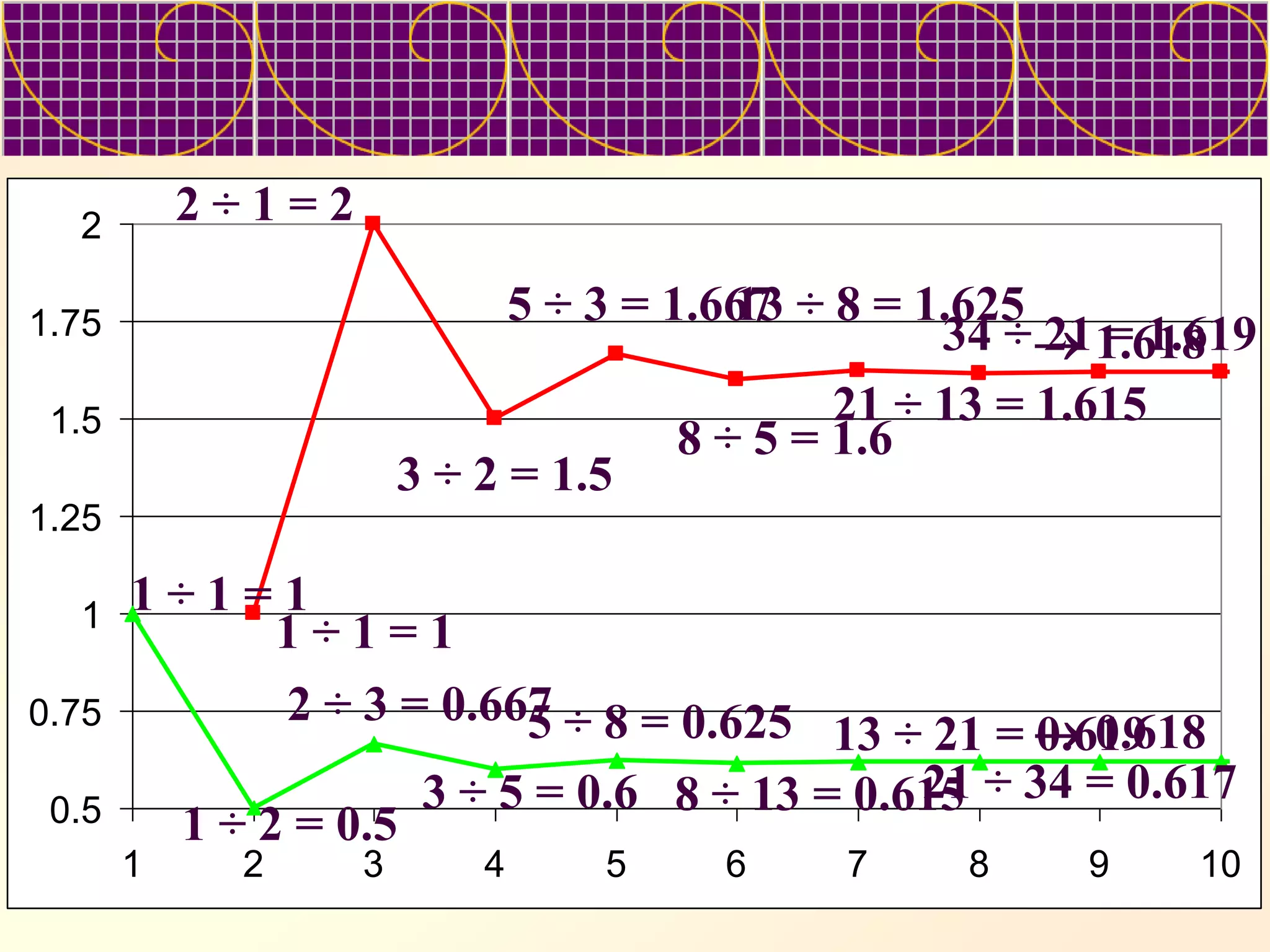
0.5
0.75
1
1.25
1.5
1.75
2
1 2 3 4 5 6 7 8 9 10
1 ÷ 1 = 1
2 ÷ 1 = 2
3 ÷ 2 = 1.5
5 ÷ 3 = 1.667
8 ÷ 5 = 1.6
13 ÷ 8 = 1.625
21 ÷ 13 = 1.615
34 ÷ 21 = 1.619
1 ÷ 1 = 1
1 ÷ 2 = 0.5
2 ÷ 3 = 0.667
3 ÷ 5 = 0.6
5 ÷ 8 = 0.625
8 ÷ 13 = 0.615
13 ÷ 21 = 0.619
21 ÷ 34 = 0.617
 1.618
 0.618
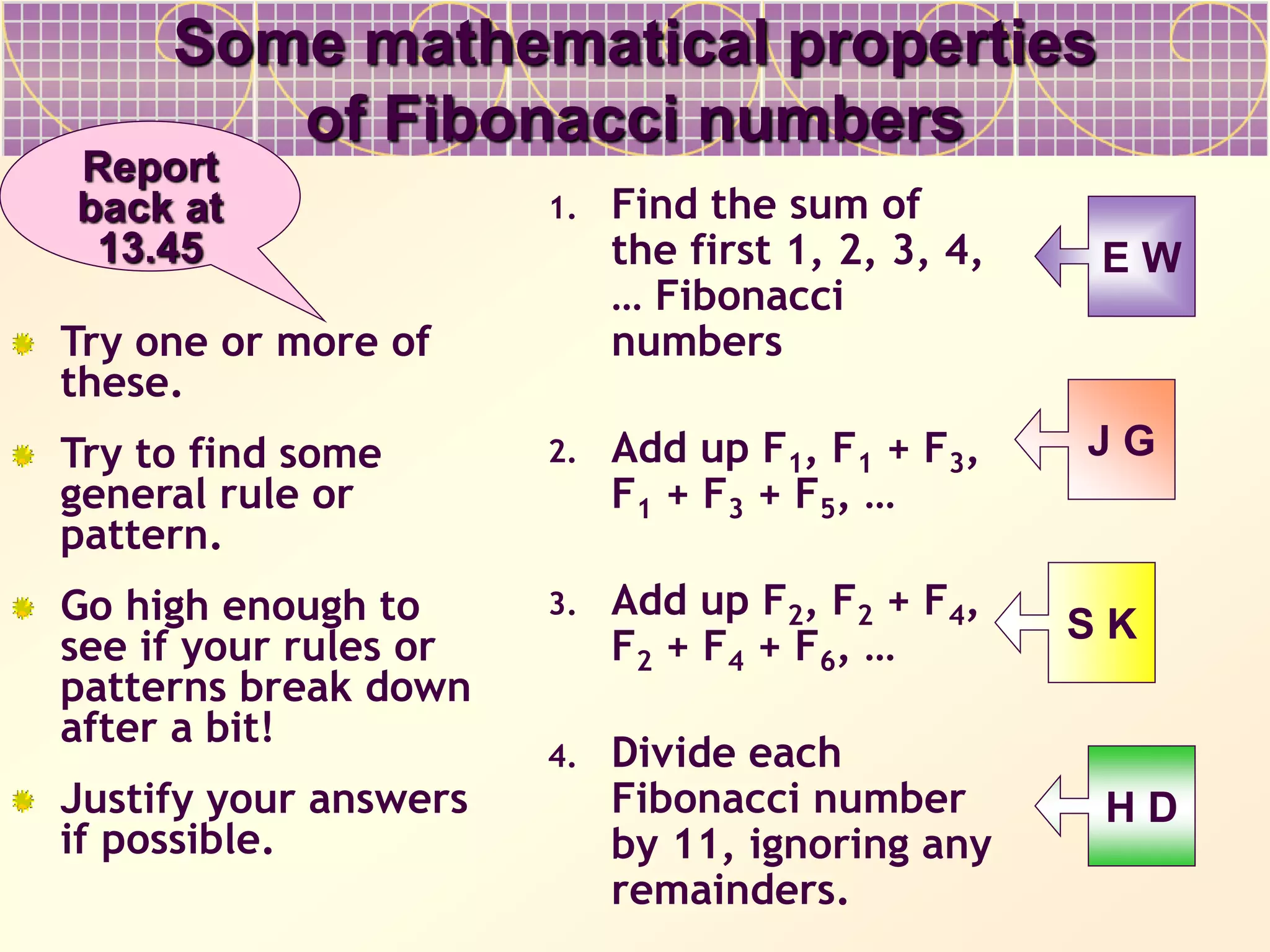
Some mathematical properties
of Fibonacci numbers
Try one or more of
these.
Try to find some
general rule or
pattern.
Go high enough to
see if your rules or
patterns break down
after a bit!
Justify your answers
if possible.
1. Find the sum of
the first 1, 2, 3, 4,
… Fibonacci
numbers
2. Add up F1, F1 + F3,
F1 + F3 + F5, …
3. Add up F2, F2 + F4,
F2 + F4 + F6, …
4. Divide each
Fibonacci number
by 11, ignoring any
remainders.
Report
back at
13.45 E W
J G
S K
H D
Are our bodies based on
Fibonacci numbers?
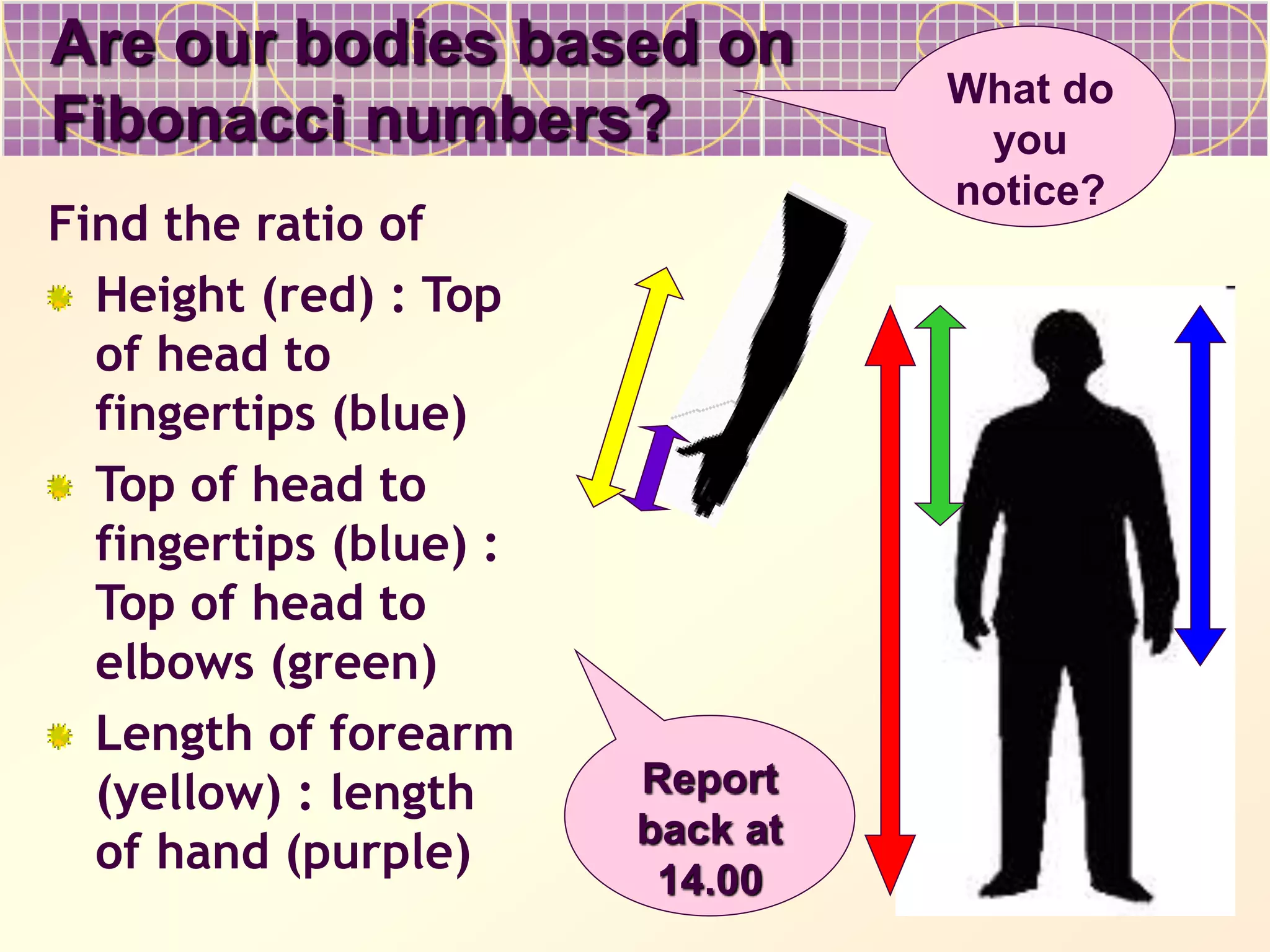
Find the ratio of
Height (red) : Top
of head to
fingertips (blue)
Top of head to
fingertips (blue) :
Top of head to
elbows (green)
Length of forearm
(yellow) : length
of hand (purple)
What do
you
notice?
Report
back at
14.00
Spirals
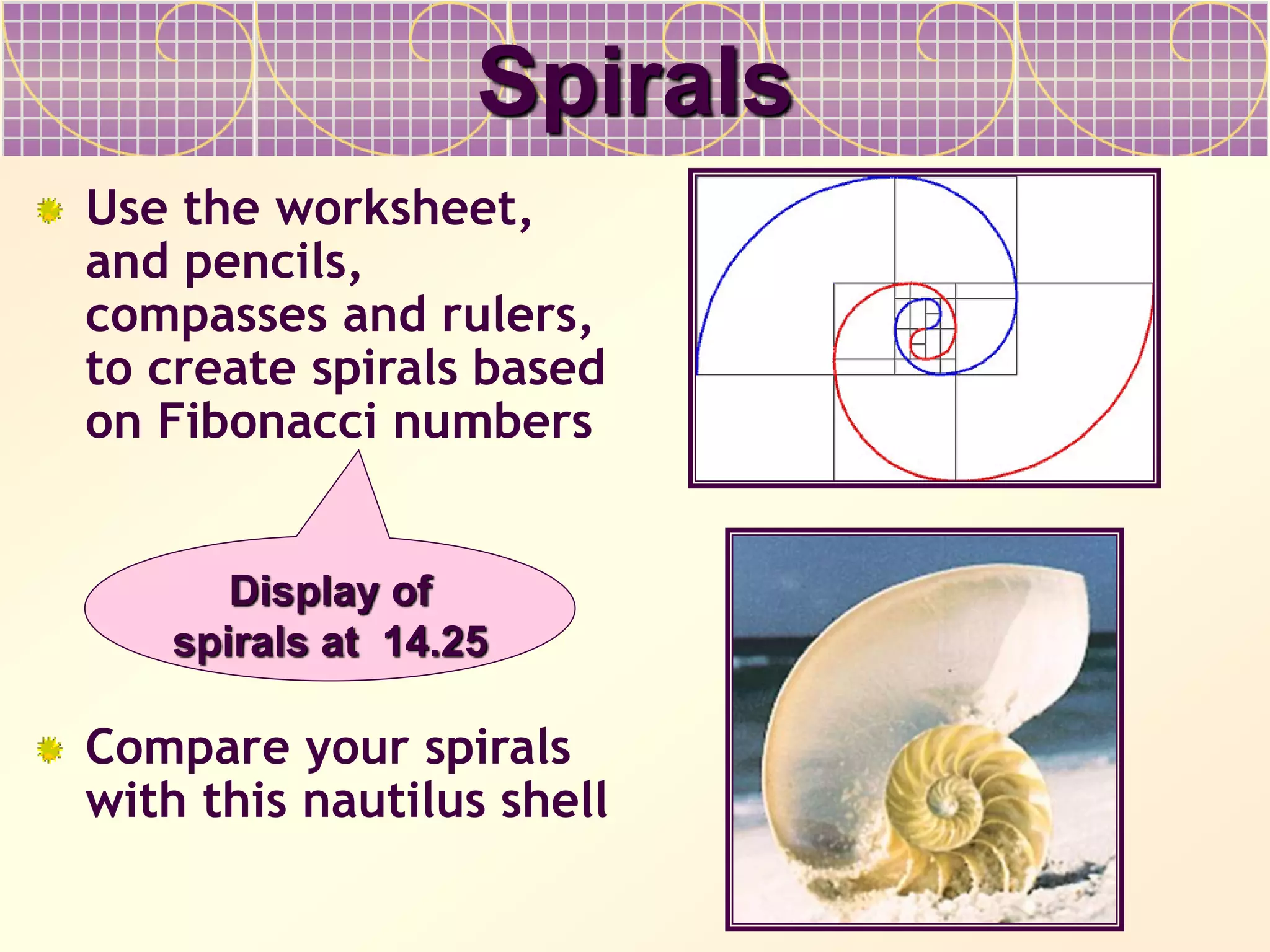
Use the worksheet,
and pencils,
compasses and rulers,
to create spirals based
on Fibonacci numbers
Compare your spirals
with this nautilus shell
Display of
spirals at 14.25
What have Fibonacci numbers got
to do with:
Pascal’s triangle
Coin combinations
Brick walls
Rabbits eating lettuces
Combine all that you want to say
into one report
Report
back at
14.53

Fibonacci-Feb10.ppt

  • 1.
    Fibonacci numbers Month 0 1 pair Month1 1 pair Month 2 2 pairs Month 3 3 pairs 18 April, 2023 Jenny Gage University of Cambridge
  • 2.
    Introductions and preliminarytask Humphrey Davy – flowers Seven Kings – flowers John of Gaunt – pine cones or pineapples Ellen Wilkinson – pine cones or pineapples
  • 3.
    Fibonacci numbers inart and nature
  • 4.
    Fibonacci numbers innature An example of efficiency in nature. As each row of seeds in a sunflower or pine cone, or petals on a flower grows, it tries to put the maximum number in the smallest space. Fibonacci numbers are the whole numbers which express the golden ratio, which corresponds to the angle which maximises number of items in the smallest space.
  • 5.
    Why are theycalled Fibonnaci numbers? Leonardo of Pisa, c1175 – c1250 Liber Abaci, 1202, one of the first books to be published by a European One of the first people to introduce the decimal number system into Europe On his travels saw the advantage of the Hindu- Arabic numbers compared to Roman numerals Rabbit problem – in the follow-up work About how maths is related to all kinds of things you’d never have thought of
  • 6.
    1 1 23 Complete the table of Fibonacci numbers
  • 7.
    1 1 23 5 8 13 21
  • 8.
    1 1 23 5 8 13 21 34 55 89 144
  • 9.
    1 1 23 5 8 13 21 34 55 89 144 233 377 610 987
  • 10.
    1 1 23 5 8 13 21 34 55 89 144 233 377 610 987 1597 2584 4181 6765
  • 11.
    Find the ratioof successive Fibonacci numbers: 1 : 1, 2 : 1, 3 : 2, 5 : 3, 8 : 5, … 1 : 1, 1 : 2, 2 : 3, 3 : 5, 5 : 8, … What do you notice?
  • 12.
    0.5 0.75 1 1.25 1.5 1.75 2 1 2 34 5 6 7 8 9 10 1 ÷ 1 = 1 2 ÷ 1 = 2 3 ÷ 2 = 1.5 5 ÷ 3 = 1.667 8 ÷ 5 = 1.6 13 ÷ 8 = 1.625 21 ÷ 13 = 1.615 34 ÷ 21 = 1.619 1 ÷ 1 = 1 1 ÷ 2 = 0.5 2 ÷ 3 = 0.667 3 ÷ 5 = 0.6 5 ÷ 8 = 0.625 8 ÷ 13 = 0.615 13 ÷ 21 = 0.619 21 ÷ 34 = 0.617  1.618  0.618
  • 13.
    Some mathematical properties ofFibonacci numbers Try one or more of these. Try to find some general rule or pattern. Go high enough to see if your rules or patterns break down after a bit! Justify your answers if possible. 1. Find the sum of the first 1, 2, 3, 4, … Fibonacci numbers 2. Add up F1, F1 + F3, F1 + F3 + F5, … 3. Add up F2, F2 + F4, F2 + F4 + F6, … 4. Divide each Fibonacci number by 11, ignoring any remainders. Report back at 13.45 E W J G S K H D
  • 14.
    Are our bodiesbased on Fibonacci numbers? Find the ratio of Height (red) : Top of head to fingertips (blue) Top of head to fingertips (blue) : Top of head to elbows (green) Length of forearm (yellow) : length of hand (purple) What do you notice? Report back at 14.00
  • 15.
    Spirals Use the worksheet, andpencils, compasses and rulers, to create spirals based on Fibonacci numbers Compare your spirals with this nautilus shell Display of spirals at 14.25
  • 16.
    What have Fibonaccinumbers got to do with: Pascal’s triangle Coin combinations Brick walls Rabbits eating lettuces Combine all that you want to say into one report Report back at 14.53