Kiran Vinu
1MS19MSE01-T
 A composite material is a material made from two
or more constituent materials with significantly
different physical or chemical properties that, when
combined, produce a material with characteristics
different from the individual components.
 The individual components remain separate and
distinct within the finished structure.
 Different from mixtures and solid solutions.
 Composite materials - two phases:
i. Matrix
ii. Fiber or dispersed phase
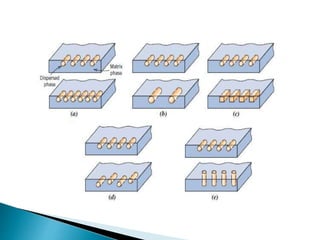
 Composite properties are a function of the
properties of the constituent phases, their relative
amounts, and the geometry of the dispersed phase.
 Dispersed phase geometry in this context means
the shape of the particles and the particle size,
distribution, and orientation
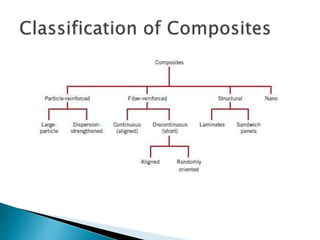
 Particle reinforced composite:
Consist of particles of one material dispersed in a
matrix of a second material.
 Fiber reinforced composite:
Fibers of one material are surrounded by a matrix.
 Structural composite:
Multi-layered and low density composite used in
applications requiring structural integrity, ordinarily
high tensile, compressive, and torsional strengths and
stiffness.
 Nanocomposite:
Multiphase solid material where at least one dimension
of the reinforcing phase is in nanolevel (less than 100
nm).
 Weight reduction
 Durability
 Low maintenance
 Design freedom
 Concrete is a common large-particle composite in
which both matrix and dispersed phases are
ceramic materials.
 Concrete implies a composite material consisting
of an aggregate of particles that are bound
together in a solid body by some type of binding
medium, that is, a cement.
 Portland and asphaltic cement concrete :
 Aggregate – gravel or sand
 Medium – Cement
 The ingredients for this concrete are Portland
cement, a fine aggregate (sand), a coarse
aggregate (gravel), and water.
 Dense packing of the aggregate and good
interfacial contact are achieved by having particles
of two different sizes
 Can be poured in place and hardens at room
temperature and even when submerged in water.
 Portland cement concrete is relatively weak and
extremely brittle.
 Tensile strength is approximately one-fifteenth to
one-tenth its compressive strength.
 Large concrete structures can experience
considerable thermal expansion and contraction
with temperature fluctuations.
 Water penetrates into external pores, which can
cause severe cracking in cold weather.
 The strength of Portland cement concrete may be
increased by additional reinforcement.
 This is usually accomplished by means of steel
rods, wires, bars, or mesh, which are embedded
into the fresh and uncured concrete.
 Thus, the reinforcement renders the hardened
structure capable of supporting greater tensile,
compressive, and shear stresses.
 Coefficient of thermal expansion of steel is nearly
the same as that of concrete – hence good
reinforcement.
 Steel is not rapidly corroded in the cement
environment.
 Another reinforcement method – pre-stressed
concrete.
 This method uses one characteristic of brittle
ceramics; that they are stronger in compression
than in tension.
Glass Fiber–Reinforced Polymer (GFRP) Composites
 It is easily drawn into high-strength fibers from the molten
state.
 When fiber is embedded in a plastic matrix, it produces a
composite having a very high specific strength.
 It possesses a chemical inertness that renders the
composite useful in a variety of corrosive environments.
Carbon Fiber–Reinforced Polymer (CFRP) Composites
 Carbon fibers have high specific moduli and specific
strengths.
 They retain their high tensile modulus and high strength
at elevated temperatures.
 At room temperature, carbon fibers are not affected by
moisture or a wide variety of solvents, acids, and bases.
Aramid Fiber–Reinforced Polymer (AFRP) Composites
 Aramid fibers - high strength and modulus.
 Outstanding strength-to-weight ratio, which is superior
to that of metals.
 High toughness, impact resistance, and resistance to
creep and fatigue failure.
 Resistant to combustion and stable to relatively high
temperatures between -200°C and 200°C.
 A structural composite is a multi-layered and
normally low-density composite used in
applications requiring structural integrity,
ordinarily high tensile, compressive, and torsional
strengths and stiffness.
 The properties of these composites depend not
only on the properties of the constituent materials,
but also on the geometrical design of the structural
elements.
 Laminar composites and sandwich panels are two
of the most common structural composites
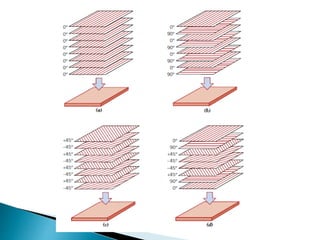
 A laminar composite is composed of two-dimensional
sheets or panels (lamina) bonded to one another.
 A multi layered structure such as this is termed a
laminate
 In this regard, there are four classes of laminar
composites: unidirectional, cross-ply, angle-ply and
multidirectional.
 Most laminate fiber materials are carbon, glass, and
aramid.
 Laminations may also be constructed using fabric
material such as cotton, paper, or woven-glass fibers
embedded in a plastic matrix.
 A class of structural composites designed to be
lightweight beams or panels having relatively high
stiffness and strengths.
 Consists of two outer sheets or faces that are
separated by and adhesively bonded to a thicker
core.
 The core material is lightweight and normally has a
low modulus of elasticity.
 Core materials typically fall within three categories:
rigid polymeric foams, wood, and honeycombs.
 Both thermoplastic and thermosetting polymers are
used as rigid foam materials.
 Balsa wood as core : Low Density (0.10 to 0.25
g/𝑐𝑚3
), Relatively inexpensive, Relatively high
compression and shear strengths.
 Honeycomb structure: Tensile and compressive
strengths are greatest in a direction parallel to the
cell axis and shear strength is highest in the plane
of the panel.
 Honeycomb structures also have excellent sound
and vibration damping characteristics.

Structural applications of composites

  • 1.
  • 2.
     A compositematerial is a material made from two or more constituent materials with significantly different physical or chemical properties that, when combined, produce a material with characteristics different from the individual components.  The individual components remain separate and distinct within the finished structure.  Different from mixtures and solid solutions.
  • 3.
     Composite materials- two phases: i. Matrix ii. Fiber or dispersed phase  Composite properties are a function of the properties of the constituent phases, their relative amounts, and the geometry of the dispersed phase.  Dispersed phase geometry in this context means the shape of the particles and the particle size, distribution, and orientation
  • 6.
     Particle reinforcedcomposite: Consist of particles of one material dispersed in a matrix of a second material.  Fiber reinforced composite: Fibers of one material are surrounded by a matrix.  Structural composite: Multi-layered and low density composite used in applications requiring structural integrity, ordinarily high tensile, compressive, and torsional strengths and stiffness.  Nanocomposite: Multiphase solid material where at least one dimension of the reinforcing phase is in nanolevel (less than 100 nm).
  • 7.
     Weight reduction Durability  Low maintenance  Design freedom
  • 8.
     Concrete isa common large-particle composite in which both matrix and dispersed phases are ceramic materials.  Concrete implies a composite material consisting of an aggregate of particles that are bound together in a solid body by some type of binding medium, that is, a cement.  Portland and asphaltic cement concrete :  Aggregate – gravel or sand  Medium – Cement
  • 9.
     The ingredientsfor this concrete are Portland cement, a fine aggregate (sand), a coarse aggregate (gravel), and water.  Dense packing of the aggregate and good interfacial contact are achieved by having particles of two different sizes  Can be poured in place and hardens at room temperature and even when submerged in water.  Portland cement concrete is relatively weak and extremely brittle.  Tensile strength is approximately one-fifteenth to one-tenth its compressive strength.
  • 10.
     Large concretestructures can experience considerable thermal expansion and contraction with temperature fluctuations.  Water penetrates into external pores, which can cause severe cracking in cold weather.
  • 11.
     The strengthof Portland cement concrete may be increased by additional reinforcement.  This is usually accomplished by means of steel rods, wires, bars, or mesh, which are embedded into the fresh and uncured concrete.  Thus, the reinforcement renders the hardened structure capable of supporting greater tensile, compressive, and shear stresses.  Coefficient of thermal expansion of steel is nearly the same as that of concrete – hence good reinforcement.
  • 12.
     Steel isnot rapidly corroded in the cement environment.  Another reinforcement method – pre-stressed concrete.  This method uses one characteristic of brittle ceramics; that they are stronger in compression than in tension.
  • 13.
    Glass Fiber–Reinforced Polymer(GFRP) Composites  It is easily drawn into high-strength fibers from the molten state.  When fiber is embedded in a plastic matrix, it produces a composite having a very high specific strength.  It possesses a chemical inertness that renders the composite useful in a variety of corrosive environments. Carbon Fiber–Reinforced Polymer (CFRP) Composites  Carbon fibers have high specific moduli and specific strengths.  They retain their high tensile modulus and high strength at elevated temperatures.  At room temperature, carbon fibers are not affected by moisture or a wide variety of solvents, acids, and bases.
  • 14.
    Aramid Fiber–Reinforced Polymer(AFRP) Composites  Aramid fibers - high strength and modulus.  Outstanding strength-to-weight ratio, which is superior to that of metals.  High toughness, impact resistance, and resistance to creep and fatigue failure.  Resistant to combustion and stable to relatively high temperatures between -200°C and 200°C.
  • 15.
     A structuralcomposite is a multi-layered and normally low-density composite used in applications requiring structural integrity, ordinarily high tensile, compressive, and torsional strengths and stiffness.  The properties of these composites depend not only on the properties of the constituent materials, but also on the geometrical design of the structural elements.  Laminar composites and sandwich panels are two of the most common structural composites
  • 16.
     A laminarcomposite is composed of two-dimensional sheets or panels (lamina) bonded to one another.  A multi layered structure such as this is termed a laminate  In this regard, there are four classes of laminar composites: unidirectional, cross-ply, angle-ply and multidirectional.  Most laminate fiber materials are carbon, glass, and aramid.  Laminations may also be constructed using fabric material such as cotton, paper, or woven-glass fibers embedded in a plastic matrix.
  • 18.
     A classof structural composites designed to be lightweight beams or panels having relatively high stiffness and strengths.  Consists of two outer sheets or faces that are separated by and adhesively bonded to a thicker core.  The core material is lightweight and normally has a low modulus of elasticity.  Core materials typically fall within three categories: rigid polymeric foams, wood, and honeycombs.
  • 20.
     Both thermoplasticand thermosetting polymers are used as rigid foam materials.  Balsa wood as core : Low Density (0.10 to 0.25 g/𝑐𝑚3 ), Relatively inexpensive, Relatively high compression and shear strengths.  Honeycomb structure: Tensile and compressive strengths are greatest in a direction parallel to the cell axis and shear strength is highest in the plane of the panel.  Honeycomb structures also have excellent sound and vibration damping characteristics.