

FRP
Fiber Reinforced Pervious
“Pervious in Paradise”
National Pervious Concrete Pavement Association
San Diego, CA
August 5, 2014
“Pervious in Paradise”
National Pervious Concrete Pavement Association
San Diego, CA
August 5, 2014
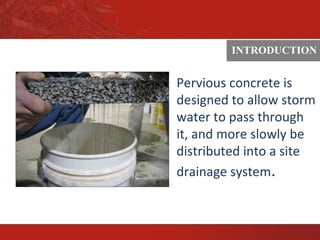
Pervious concrete is
designed to allow storm
water to pass through
it, and more slowly be
distributed into a site
drainage system.
INTRODUCTION
INTRODUCTION
The void structure is achieved by removing the
sand/cement/water paste fraction of the mix.
What remains is cement-covered coarse
aggregates stacked together, allowing 15% to
30% voids.
INTRODUCTION
The very void system that allows pervious to
be permeable reduces its strength – paste is
stronger than air!
The constant challenge is a durable
balance between permeability
and strength.
INTRODUCTION
Owners, designers, contractors and
researchers continue to search for
methods and materials that will add back
toughness and durability to all types
of pervious pavements.
ASTM
Synthetic Fiber History and Background
►Founded in 1978, FORTA Corporation was the first to bring
synthetic fiber technology to the U.S. and has pioneered
manufacturing, testing and projects around the world.
►Over 30 years of research, practice and experience have
helped FORTA®
develop new applications and technology.
►FORTA®
developed a fiber-characteristic formula to help guide
fiber parameters for new applications.
FIBER: BACKGROUND
ASTM
Fiber Characteristic Formula: 4-C’s
►CONFIGURATION
Fiber shape and configuration affect both performance and
mixability
►CHEMISTRY
Fiber make-up determines strength and long-term durability
►CONTENTS
Dosage affects performance and user friendliness
►CORRECT LENGTH
Fiber length affects performance, mixability and friendliness.
FIBER: BACKGROUND
ASTM
FIBER: PERVIOUS
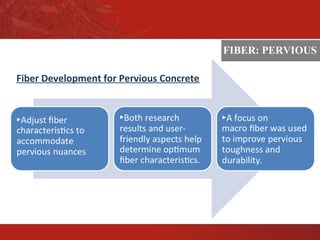
Fiber Development for Pervious Concrete
ASTM
Optimum Fiber Characteristics for Pervious
C - CONFIGURATION
blend of heavy-duty macro-filaments with small amount of
micro-fibrillated.
C - CHEMISTRY
high-strength co-polymer and recycled polypropylene
C - CONTENTS
2.5 to 7.5 lbs. / cu. yd.
C – CORRECT LENGTH
1 ½” – 2 ¼”
FIBER: PERVIOUS
ASTM
FORTA®
FERRO-GREEN®
► Unique blend of twisted-bundle macro fibers and
recycled polypropylene
► Specifically designed to mix, distribute and
finish well in pervious concrete
► Dosage ranges from 0.17% to 0.5% by volume
-2.5 lbs. / cu. yd., curbs and sidewalks
-5.0 lbs. / cu. yd., light-duty car park lots
-7.5 lbs. / cu. yd., high traffic paving lanes
FIBER: PERVIOUS
ASTM
Various research programs have been
performed for low dosages of micro fibers.
FORTA®
research focused on potential
enhancements to toughness and durability
offered by synthetic macro fibers.
FRP ResearchFRP RESEARCH
ASTM
Durability research program
► University of Missouri – Kansas City
► Dr. John Kevern, P.E. Assistant Professor of Civil
Engineering
► March 2013
► “Investigating the Durability of Pervious Concrete
Reinforced with FORTA®
FERRO-GREEN®
Macro Fibers”
FRP RESEARCH
ASTM
Goal was to determine optimum fiber length and
dosage to enhance durability issues:
► Tensile strength
► Abrasion resistance
► Freeze-thaw durability
FRP RESEARCH
ASTM
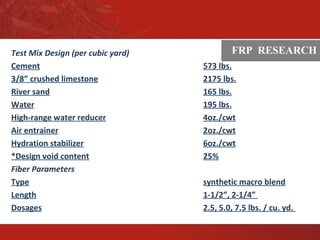
Test Mix Design (per cubic yard)
Cement 573 lbs.
3/8” crushed limestone 2175 lbs.
River sand 165 lbs.
Water 195 lbs.
High-range water reducer 4oz./cwt
Air entrainer 2oz./cwt
Hydration stabilizer 6oz./cwt
*Design void content 25%
Fiber Parameters
Type synthetic macro blend
Length 1-1/2”, 2-1/4”
Dosages 2.5, 5.0, 7.5 lbs. / cu. yd.
FRP RESEARCH
ASTM
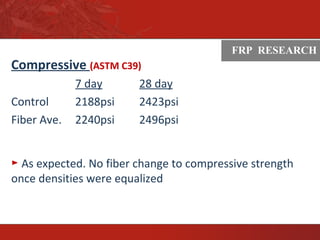
Compressive (ASTM C39)
7 day 28 day
Control 2188psi 2423psi
Fiber Ave. 2240psi 2496psi
► As expected. No fiber change to compressive strength
once densities were equalized
FRP RESEARCH
ASTM
Splitting Tensile Strength (ASTM C496)
► Higher fiber dosage – higher strength
► Longer fiber length = higher strength
► 7.5 lb. / cu. yd. of 2.25” fiber = +44%
FRP RESEARCH
ASTM
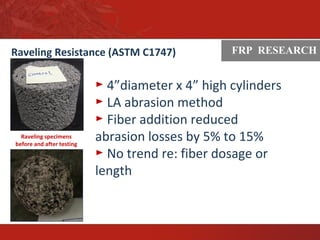
Raveling Resistance (ASTM C1747) FRP RESEARCH
Raveling specimens
before and after testing
► 4”diameter x 4” high cylinders
► LA abrasion method
► Fiber addition reduced
abrasion losses by 5% to 15%
► No trend re: fiber dosage or
length
ASTM
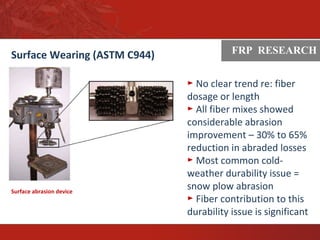
Surface Wearing (ASTM C944)
Surface abrasion device
FRP RESEARCH
► No clear trend re: fiber
dosage or length
► All fiber mixes showed
considerable abrasion
improvement – 30% to 65%
reduction in abraded losses
► Most common cold-
weather durability issue =
snow plow abrasion
► Fiber contribution to this
durability issue is significant
ASTM
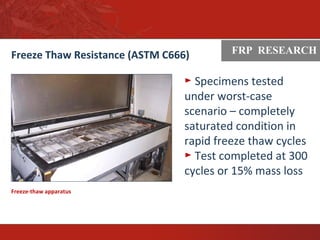
Freeze Thaw Resistance (ASTM C666)
Freeze-thaw apparatus
FRP RESEARCH
► Specimens tested
under worst-case
scenario – completely
saturated condition in
rapid freeze thaw cycles
► Test completed at 300
cycles or 15% mass loss
ASTM
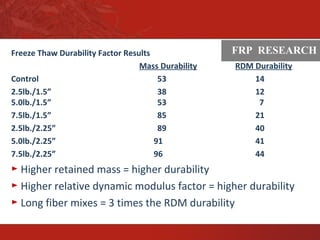
Freeze Thaw Durability Factor Results
Mass Durability RDM Durability
Control 53 14
2.5lb./1.5” 38 12
5.0lb./1.5” 53 7
7.5lb./1.5” 85 21
2.5lb./2.25” 89 40
5.0lb./2.25” 91 41
7.5lb./2.25” 96 44
► Higher retained mass = higher durability
► Higher relative dynamic modulus factor = higher durability
► Long fiber mixes = 3 times the RDM durability
FRP RESEARCH
ASTM
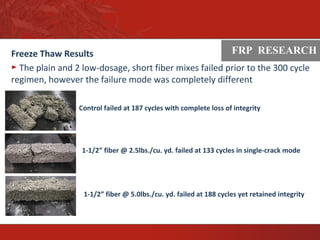
Freeze Thaw Results
► The plain and 2 low-dosage, short fiber mixes failed prior to the 300 cycle
regimen, however the failure mode was completely different
Control failed at 187 cycles with complete loss of integrity
1-1/2” fiber @ 2.5lbs./cu. yd. failed at 133 cycles in single-crack mode
1-1/2” fiber @ 5.0lbs./cu. yd. failed at 188 cycles yet retained integrity
FRP RESEARCH
ASTM
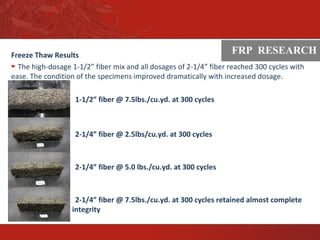
Freeze Thaw Results
► The high-dosage 1-1/2” fiber mix and all dosages of 2-1/4” fiber reached 300 cycles with
ease. The condition of the specimens improved dramatically with increased dosage.
1-1/2” fiber @ 7.5lbs./cu.yd. at 300 cycles
2-1/4” fiber @ 2.5lbs/cu.yd. at 300 cycles
2-1/4” fiber @ 5.0 lbs./cu.yd. at 300 cycles
2-1/4” fiber @ 7.5lbs./cu.yd. at 300 cycles retained almost complete
integrity
FRP RESEARCH
ASTM
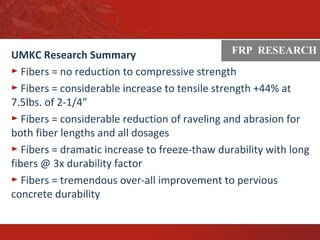
UMKC Research Summary
► Fibers = no reduction to compressive strength
► Fibers = considerable increase to tensile strength +44% at
7.5lbs. of 2-1/4”
► Fibers = considerable reduction of raveling and abrasion for
both fiber lengths and all dosages
► Fibers = dramatic increase to freeze-thaw durability with long
fibers @ 3x durability factor
► Fibers = tremendous over-all improvement to pervious
concrete durability
FRP RESEARCH
ASTM
Current Performance Levels and Fiber Recommendations
Level 1: Shrinkage crack control
1.0 lb. / cu. yd., short ½” – ¾”, monofilament
Level 2: Shrinkage crack control, stability contributions
1.5 lb. / cu. yd., ¾” -1 ½”, fibrillated-net recycled
polypropylene
Level 3: Crack control, considerable stability enhancements, improved
post-crack toughness and durability
2.5, 5.0 or 7.5 lbs. / cu. yd., 1 ½”-2 ¼”, twisted-bundle macro-
filament blended with recycled polypropylene
FIBER: SUMMARY
ASTM
FRP: CONCLUSIONS
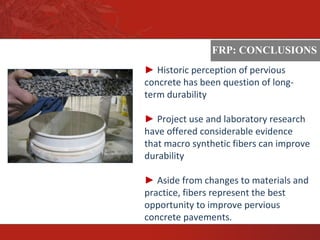
► Historic perception of pervious
concrete has been question of long-
term durability
► Project use and laboratory research
have offered considerable evidence
that macro synthetic fibers can improve
durability
► Aside from changes to materials and
practice, fibers represent the best
opportunity to improve pervious
concrete pavements.
Thank You!
FORTA Corporation
100 Forta Drive
Grove City, PA 16127
800-245-0306
www.forta-corp.com

Fiber Reinforced Pervious

  • 1.
    FRP Fiber Reinforced Pervious “Perviousin Paradise” National Pervious Concrete Pavement Association San Diego, CA August 5, 2014 “Pervious in Paradise” National Pervious Concrete Pavement Association San Diego, CA August 5, 2014
  • 2.
    Pervious concrete is designedto allow storm water to pass through it, and more slowly be distributed into a site drainage system. INTRODUCTION
  • 3.
    INTRODUCTION The void structureis achieved by removing the sand/cement/water paste fraction of the mix. What remains is cement-covered coarse aggregates stacked together, allowing 15% to 30% voids.
  • 4.
    INTRODUCTION The very voidsystem that allows pervious to be permeable reduces its strength – paste is stronger than air! The constant challenge is a durable balance between permeability and strength.
  • 5.
    INTRODUCTION Owners, designers, contractorsand researchers continue to search for methods and materials that will add back toughness and durability to all types of pervious pavements.
  • 6.
    ASTM Synthetic Fiber Historyand Background ►Founded in 1978, FORTA Corporation was the first to bring synthetic fiber technology to the U.S. and has pioneered manufacturing, testing and projects around the world. ►Over 30 years of research, practice and experience have helped FORTA® develop new applications and technology. ►FORTA® developed a fiber-characteristic formula to help guide fiber parameters for new applications. FIBER: BACKGROUND
  • 7.
    ASTM Fiber Characteristic Formula:4-C’s ►CONFIGURATION Fiber shape and configuration affect both performance and mixability ►CHEMISTRY Fiber make-up determines strength and long-term durability ►CONTENTS Dosage affects performance and user friendliness ►CORRECT LENGTH Fiber length affects performance, mixability and friendliness. FIBER: BACKGROUND
  • 8.
  • 9.
    ASTM Optimum Fiber Characteristicsfor Pervious C - CONFIGURATION blend of heavy-duty macro-filaments with small amount of micro-fibrillated. C - CHEMISTRY high-strength co-polymer and recycled polypropylene C - CONTENTS 2.5 to 7.5 lbs. / cu. yd. C – CORRECT LENGTH 1 ½” – 2 ¼” FIBER: PERVIOUS
  • 10.
    ASTM FORTA® FERRO-GREEN® ► Unique blendof twisted-bundle macro fibers and recycled polypropylene ► Specifically designed to mix, distribute and finish well in pervious concrete ► Dosage ranges from 0.17% to 0.5% by volume -2.5 lbs. / cu. yd., curbs and sidewalks -5.0 lbs. / cu. yd., light-duty car park lots -7.5 lbs. / cu. yd., high traffic paving lanes FIBER: PERVIOUS
  • 11.
    ASTM Various research programshave been performed for low dosages of micro fibers. FORTA® research focused on potential enhancements to toughness and durability offered by synthetic macro fibers. FRP ResearchFRP RESEARCH
  • 12.
    ASTM Durability research program ►University of Missouri – Kansas City ► Dr. John Kevern, P.E. Assistant Professor of Civil Engineering ► March 2013 ► “Investigating the Durability of Pervious Concrete Reinforced with FORTA® FERRO-GREEN® Macro Fibers” FRP RESEARCH
  • 13.
    ASTM Goal was todetermine optimum fiber length and dosage to enhance durability issues: ► Tensile strength ► Abrasion resistance ► Freeze-thaw durability FRP RESEARCH
  • 14.
    ASTM Test Mix Design(per cubic yard) Cement 573 lbs. 3/8” crushed limestone 2175 lbs. River sand 165 lbs. Water 195 lbs. High-range water reducer 4oz./cwt Air entrainer 2oz./cwt Hydration stabilizer 6oz./cwt *Design void content 25% Fiber Parameters Type synthetic macro blend Length 1-1/2”, 2-1/4” Dosages 2.5, 5.0, 7.5 lbs. / cu. yd. FRP RESEARCH
  • 15.
    ASTM Compressive (ASTM C39) 7day 28 day Control 2188psi 2423psi Fiber Ave. 2240psi 2496psi ► As expected. No fiber change to compressive strength once densities were equalized FRP RESEARCH
  • 16.
    ASTM Splitting Tensile Strength(ASTM C496) ► Higher fiber dosage – higher strength ► Longer fiber length = higher strength ► 7.5 lb. / cu. yd. of 2.25” fiber = +44% FRP RESEARCH
  • 17.
    ASTM Raveling Resistance (ASTMC1747) FRP RESEARCH Raveling specimens before and after testing ► 4”diameter x 4” high cylinders ► LA abrasion method ► Fiber addition reduced abrasion losses by 5% to 15% ► No trend re: fiber dosage or length
  • 18.
    ASTM Surface Wearing (ASTMC944) Surface abrasion device FRP RESEARCH ► No clear trend re: fiber dosage or length ► All fiber mixes showed considerable abrasion improvement – 30% to 65% reduction in abraded losses ► Most common cold- weather durability issue = snow plow abrasion ► Fiber contribution to this durability issue is significant
  • 19.
    ASTM Freeze Thaw Resistance(ASTM C666) Freeze-thaw apparatus FRP RESEARCH ► Specimens tested under worst-case scenario – completely saturated condition in rapid freeze thaw cycles ► Test completed at 300 cycles or 15% mass loss
  • 20.
    ASTM Freeze Thaw DurabilityFactor Results Mass Durability RDM Durability Control 53 14 2.5lb./1.5” 38 12 5.0lb./1.5” 53 7 7.5lb./1.5” 85 21 2.5lb./2.25” 89 40 5.0lb./2.25” 91 41 7.5lb./2.25” 96 44 ► Higher retained mass = higher durability ► Higher relative dynamic modulus factor = higher durability ► Long fiber mixes = 3 times the RDM durability FRP RESEARCH
  • 21.
    ASTM Freeze Thaw Results ►The plain and 2 low-dosage, short fiber mixes failed prior to the 300 cycle regimen, however the failure mode was completely different Control failed at 187 cycles with complete loss of integrity 1-1/2” fiber @ 2.5lbs./cu. yd. failed at 133 cycles in single-crack mode 1-1/2” fiber @ 5.0lbs./cu. yd. failed at 188 cycles yet retained integrity FRP RESEARCH
  • 22.
    ASTM Freeze Thaw Results ►The high-dosage 1-1/2” fiber mix and all dosages of 2-1/4” fiber reached 300 cycles with ease. The condition of the specimens improved dramatically with increased dosage. 1-1/2” fiber @ 7.5lbs./cu.yd. at 300 cycles 2-1/4” fiber @ 2.5lbs/cu.yd. at 300 cycles 2-1/4” fiber @ 5.0 lbs./cu.yd. at 300 cycles 2-1/4” fiber @ 7.5lbs./cu.yd. at 300 cycles retained almost complete integrity FRP RESEARCH
  • 23.
    ASTM UMKC Research Summary ►Fibers = no reduction to compressive strength ► Fibers = considerable increase to tensile strength +44% at 7.5lbs. of 2-1/4” ► Fibers = considerable reduction of raveling and abrasion for both fiber lengths and all dosages ► Fibers = dramatic increase to freeze-thaw durability with long fibers @ 3x durability factor ► Fibers = tremendous over-all improvement to pervious concrete durability FRP RESEARCH
  • 24.
    ASTM Current Performance Levelsand Fiber Recommendations Level 1: Shrinkage crack control 1.0 lb. / cu. yd., short ½” – ¾”, monofilament Level 2: Shrinkage crack control, stability contributions 1.5 lb. / cu. yd., ¾” -1 ½”, fibrillated-net recycled polypropylene Level 3: Crack control, considerable stability enhancements, improved post-crack toughness and durability 2.5, 5.0 or 7.5 lbs. / cu. yd., 1 ½”-2 ¼”, twisted-bundle macro- filament blended with recycled polypropylene FIBER: SUMMARY
  • 25.
    ASTM FRP: CONCLUSIONS ► Historicperception of pervious concrete has been question of long- term durability ► Project use and laboratory research have offered considerable evidence that macro synthetic fibers can improve durability ► Aside from changes to materials and practice, fibers represent the best opportunity to improve pervious concrete pavements.
  • 26.
    Thank You! FORTA Corporation 100Forta Drive Grove City, PA 16127 800-245-0306 www.forta-corp.com