











GLASS FIBERS
REINFORCED CONCRETE
AMJAD ANSARI
INTRODUCTION
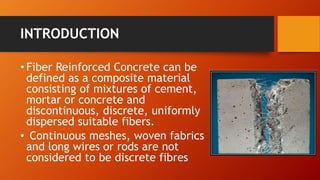
• Fiber Reinforced Concrete can be
defined as a composite material
consisting of mixtures of cement,
mortar or concrete and
discontinuous, discrete, uniformly
dispersed suitable fibers.
• Continuous meshes, woven fabrics
and long wires or rods are not
considered to be discrete fibres
EFFECT OF FIBERS IN CONCRETE
• They control plastic shrinkage cracking and
drying shrinkage cracking.
• They also lower the permeability of concrete
and thus reduce bleeding of water.
• If the modulus of elasticity of the fiber is
higher than the matrix (concrete or mortar
binder), they help to carry the load by
increasing the tensile strength of the material.
• Some fibers reduce the strength of concrete.
NECESSITY
• It reduce the air voids and water voids the
inherent porosity of gel.
• It increases the durability of the concrete.
• Fibers such as graphite and glass have
excellent resistance to creep.
• The addition of small, closely spaced and
uniformly dispersed fibers to concrete would
act as crack arrester and would substantially
improve its static and dynamic properties.
FACTORS EFFECTING PROPERTIES OF FRC
• Relative fiber matrix.
• Volume of fiber.
• Aspect ratio of fiber.
• Orientation of fiber.
• Workability and compaction of concrete.
• Size of coarse aggregate.
• Mixing.
GLASS FIBER REINFORCED CONCRETE
• GFRC is actually cement mortar with countless
strands of embedded glass fiber.
• GFRC has a dramatically reduced ballistic
debris profile.
• Fibers are the principal load-carrying members
TYPES OF GLASS FIBERS
• A-glass (close to normal glass).
• C-glass (resist chemical attacks).
• E-glass (insulation to electricity).
• AE-glass (alkali resistance).
• S-glass (high strength fiber)
PROPERTIES OF GLASS FIBER
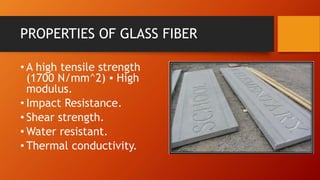
• A high tensile strength
(1700 N/mm^2) ▪ High
modulus.
• Impact Resistance.
• Shear strength.
• Water resistant.
• Thermal conductivity.
PROPERTIES OF GLASS FIBER (COTD.)
• Low thermal expansion.
• Less creep with increase in time.
• Light weight and Low density.
• Resistance to corrosion and Fire endurance.
• Resistance to cracks in concrete
CASTING OF GFRC
• Spray-Up (very strong GFRC due to the high
fiber load and long fiber length).
• Premix (less strength than spray-up).
• Hybrid Spray-up GFRC.
APPLICATIONS
• Exterior
Ornamentation.
• Interior Details.
APPLICATIONS
• Landscape Furnishings.
• Architectural projects.
• Airfields and Runways.
• In Rocket launch pads.
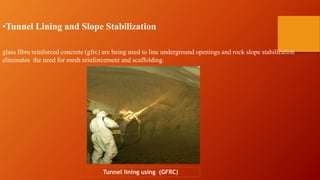
•Tunnel Lining and Slope Stabilization
glass fibre reinforced concrete (gfrc) are being used to line underground openings and rock slope stabilization
eliminates the need for mesh reinforcement and scaffolding.
Tunnel lining using (GFRC)
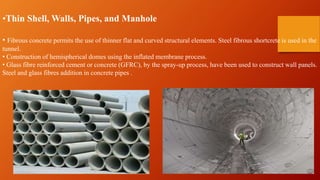
•Thin Shell, Walls, Pipes, and Manhole
• Fibrous concrete permits the use of thinner flat and curved structural elements. Steel fibrous shortcrete is used in the
tunnel.
• Construction of hemispherical domes using the inflated membrane process.
• Glass fibre reinforced cement or concrete (GFRC), by the spray-up process, have been used to construct wall panels.
Steel and glass fibres addition in concrete pipes .
•Other Applications
These include machine tool frames, lighting poles, water and oil tanks and concrete
repairs.
•Dams and Hydraulic Structure
FRC is being used for the construction and repair of dams and other hydraulic structures to provide
resistance to cavitation
and severe erosion caused by the Impact of large Waterboro debris.
AIM AND OBJECTIVES OF STUDY
• Study the mix design aspects of the GRC.
• Understand the various applications involving GRC.
• Compare GRC with Normal concrete.
• Perform laboratory tests that are related to compressive,
tensile and flexure by use of glass fibre in the concrete
pour.
AIM AND OBJECTIVES OF STUDY
• The proposed of study aims at analysing the characteristics of
glass fiber reinforced concrete.
• Use a glass fiber reinforced concrete with ordinary Portland
cement and decrease the maximum use of ordinary Portland
cement.
• As a new construction material (gfrc), we can achieve maximum
benefits and different properties of glass fiber reinforced concrete.
• We also compare GFRC, with other cladding materials in different
section like quality , cost , properties , benefits etc.
Tests on cement and aggregate
Fineness of Cement
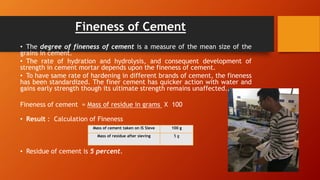
• The degree of fineness of cement is a measure of the mean size of the
grains in cement.
• The rate of hydration and hydrolysis, and consequent development of
strength in cement mortar depends upon the fineness of cement.
• To have same rate of hardening in different brands of cement, the fineness
has been standardized. The finer cement has quicker action with water and
gains early strength though its ultimate strength remains unaffected.
Fineness of cement = Mass of residue in grams X 100
Mass
• Result : Calculation of Fineness
• Residue of cement is 5 percent.
Mass of cement taken on IS Sieve 100 g
Mass of residue after sieving 5 g
Specific Gravity of Cement
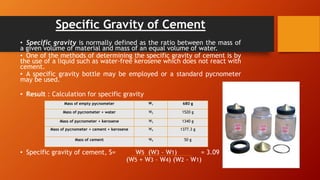
• Specific gravity is normally defined as the ratio between the mass of
a given volume of material and mass of an equal volume of water.
• One of the methods of determining the specific gravity of cement is by
the use of a liquid such as water-free kerosene which does not react with
cement.
• A specific gravity bottle may be employed or a standard pycnometer
may be used.
• Result : Calculation for specific gravity
• Specific gravity of cement, S= W5 (W3 – W1) = 3.09
(W5 + W3 – W4) (W2 – W1)
Mass of empty pycnometer W1 680 g
Mass of pycnometer + water W2 1520 g
Mass of pycnometer + kerosene W3 1340 g
Mass of pycnometer + cement + kerosene W4 1377.3 g
Mass of cement W5 50 g
Standard Consistency and Setting Time
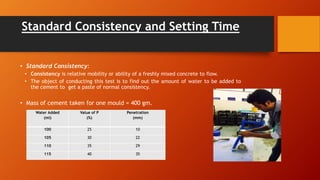
• Standard Consistency:
• Consistency is relative mobility or ability of a freshly mixed concrete to flow.
• The object of conducting this test is to find out the amount of water to be added to
the cement to get a paste of normal consistency.
• Mass of cement taken for one mould = 400 gm.
Water Added
(ml)
Value of P
(%)
Penetration
(mm)
100 25 10
105 30 22
110 35 29
115 40 35
• Setting Time:
The Initial Setting Time may be defined as the time at which the matrix is looses it plasticity.
The Final Setting Time is a stage when the matrix becomes the hard mass.
The concrete is set to be finally set when it has obtained sufficient strength and hardness.
Mass of cement taken = 400 gm.
Mass of water taken = 0.85 P x 400 gm.
= 0.85(0.4) x 400
= 128 ml
Result :
- Standard consistency of cement = 40 per cent.
- Initial setting time of cement = 200 minutes.
- Final setting time of cement = 395 minutes.
Compressive Strength
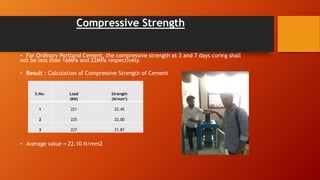
• For Ordinary Portland Cement, the compressive strength at 3 and 7 days curing shall
not be less than 16MPa and 22MPa respectively.
• Result : Calculation of Compressive Strength of Cement
• Average value = 22.10 N/mm2
S.No. Load
(KN)
Strength
(N/mm2)
1 221 22.45
2 225 22.00
3 227 21.87
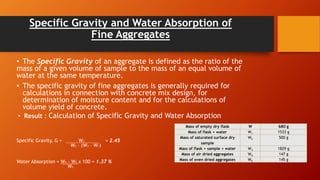
Specific Gravity and Water Absorption of
Fine Aggregates
• The Specific Gravity of an aggregate is defined as the ratio of the
mass of a given volume of sample to the mass of an equal volume of
water at the same temperature.
• The specific gravity of fine aggregates is generally required for
calculations in connection with concrete mix design, for
determination of moisture content and for the calculations of
volume yield of concrete.
• Result : Calculation of Specific Gravity and Water Absorption
Specific Gravity, G = W2 = 2.45
W2 – (W3 – W1)
Water Absorption = W4 – W5 x 100 = 1.37 %
W5
Mass of empty dry flask W 680 g
Mass of flask + water W1 1533 g
Mass of saturated surface dry
sample
W2 500 g
Mass of flask + sample + water W3 1829 g
Mass of air dried aggregates W4 147 g
Mass of oven dried aggregates W5 145 g
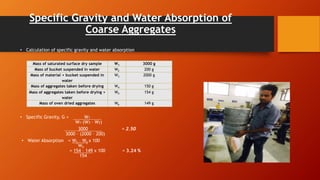
Specific Gravity and Water Absorption of
Coarse Aggregates
• Calculation of specific gravity and water absorption
• Specific Gravity, G = W1
W1–(W3 – W2)
3000 = 2.50
3000 – (2000 – 200)
• Water Absorption = W5 – W6 x 100
W5
= 154 – 149 x 100 = 3.24 %
154
Mass of saturated surface dry sample W1 3000 g
Mass of bucket suspended in water W2 200 g
Mass of material + bucket suspended in
water
W3 2000 g
Mass of aggregates taken before drying W4 150 g
Mass of aggregates taken before drying +
water
W5 154 g
Mass of oven dried aggregates W6 149 g
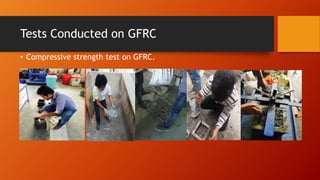
Tests Conducted on GFRC
• Compressive strength test on GFRC.
Pictures related to project work
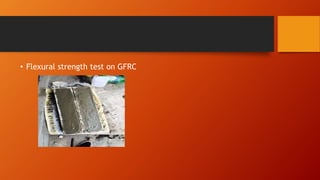
• Flexural strength test on GFRC
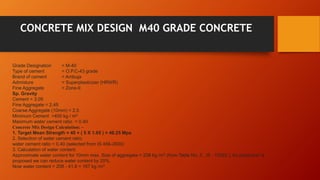
CONCRETE MIX DESIGN M40 GRADE CONCRETE
Grade Designation = M-40
Type of cement = O.P.C-43 grade
Brand of cement = Ambuja
Admixture = Superplasticizer (HRWR)
Fine Aggregate = Zone-II
Sp. Gravity
Cement = 3.09
Fine Aggregate = 2.45
Coarse Aggregate (10mm) = 2.5
Minimum Cement =400 kg / m3
Maximum water cement ratio = 0.40
Concrete Mix Design Calculation: –
1. Target Mean Strength = 40 + ( 5 X 1.65 ) = 48.25 Mpa
2. Selection of water cement ratio:
water cement ratio = 0.40 (selected from IS 456-2000)
3. Calculation of water content:
Approximate water content for 10mm max. Size of aggregate = 208 kg /m3 (from Table No. 5 , IS : 10262 ). As plasticizer is
proposed we can reduce water content by 20%.
Now water content = 208 - 41.6 = 167 kg /m3
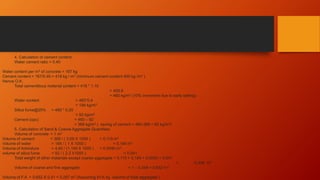
4. Calculation of cement content:
Water cement ratio = 0.40
Water content per m3 of concrete = 167 kg
Cement content = 167/0.40 = 418 kg / m3 (minimum cement content 400 kg /m3 )
Hence O.K.
Total cementitious material content = 418 * 1.10
= 459.8
= 460 kg/m3 (10% increment due to early setting)
Water content = 460*0.4
= 184 kg/m3
Silica fume@20% = 460 * 0.20
= 92 kg/m3
Cement (opc) = 460 – 92
= 368 kg/m3 ( saving of cement = 460-368 = 92 kg/m3)
5. Calculation of Sand & Coarse Aggregate Quantities:
Volume of concrete = 1 m3
Volume of cement = 368 / ( 3.09 X 1000 ) = 0.119 m3
Volume of water = 184 / ( 1 X 1000 ) = 0.184 m3
Volume of Admixture = 4.60 / (1.145 X 1000 ) = 0.0040 m3
volume of silica fume = 92 / ( 2.2 X1000 ) = 0.041
Total weight of other materials except coarse aggregate = 0.119 + 0.184 + 0.0040 + 0.041
= 0.348 m3
Volume of coarse and fine aggregate = 1 – 0.348 = 0.652 m3
Volume of F.A = 0.652 X 0.41 = 0.267 m3 (Assuming 41% by volume of total aggregate )
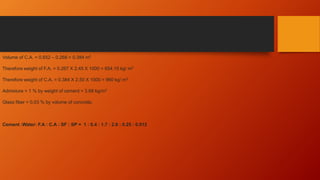
Volume of C.A. = 0.652 – 0.268 = 0.384 m3
Therefore weight of F.A. = 0.267 X 2.45 X 1000 = 654.15 kg/ m3
Therefore weight of C.A. = 0.384 X 2.50 X 1000 = 960 kg/ m3
Admixture = 1 % by weight of cement = 3.68 kg/m3
Glass fiber = 0.03 % by volume of concrete.
Cement :Water: F.A : C.A : SF : SP = 1 : 0.4 : 1.7 : 2.6 : 0.25 : 0.012
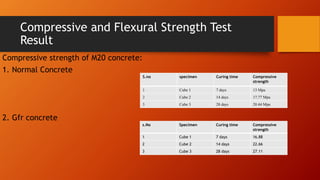
Compressive and Flexural Strength Test
Result
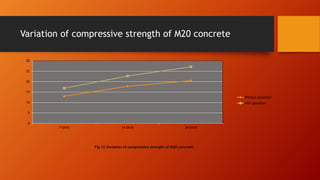
Compressive strength of M20 concrete:
1. Normal Concrete
2. Gfr concrete
S.no specimen Curing time Compressive
strength
1 Cube 1 7 days 13 Mpa
2 Cube 2 14 days 17.77 Mpa
3 Cube 3 28 days 20.44 Mpa
s.No Specimen Curing time Compressive
strength
1 Cube 1 7 days 16.88
2 Cube 2 14 days 22.66
3 Cube 3 28 days 27.11
Variation of compressive strength of M20 concrete
Fig 12 Variation of compressive strength of M20 concrete
0
5
10
15
20
25
30
7 DAYS 14 DAYS 28 DAYS
Without glassfiber
with glassfiber
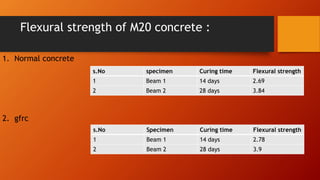
Flexural strength of M20 concrete :
1. Normal concrete
2. gfrc
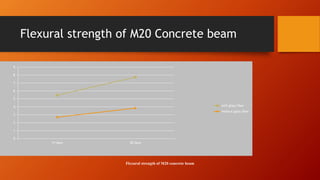
s.No specimen Curing time Flexural strength
1 Beam 1 14 days 2.69
2 Beam 2 28 days 3.84
s.No Specimen Curing time Flexural strength
1 Beam 1 14 days 2.78
2 Beam 2 28 days 3.9
Flexural strength of M20 Concrete beam
0
1
2
3
4
5
6
7
8
9
14 days 28 days
with glass fiber
without glass fiber
Flexural strength of M20 concrete beam
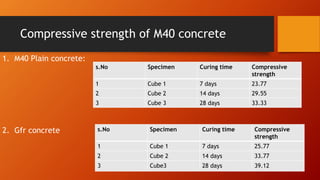
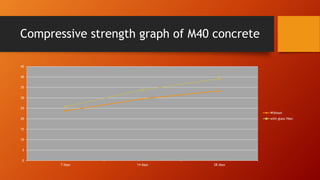
Compressive strength of M40 concrete
1. M40 Plain concrete:
2. Gfr concrete
s.No Specimen Curing time Compressive
strength
1 Cube 1 7 days 23.77
2 Cube 2 14 days 29.55
3 Cube 3 28 days 33.33
s.No Specimen Curing time Compressive
strength
1 Cube 1 7 days 25.77
2 Cube 2 14 days 33.77
3 Cube3 28 days 39.12
Compressive strength graph of M40 concrete
0
5
10
15
20
25
30
35
40
45
7 days 14 days 28 days
Without
with glass fiber
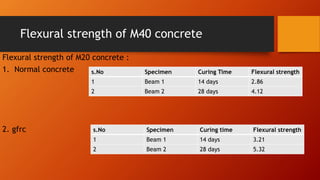
Flexural strength of M40 concrete
Flexural strength of M20 concrete :
1. Normal concrete
2. gfrc
s.No Specimen Curing Time Flexural strength
1 Beam 1 14 days 2.86
2 Beam 2 28 days 4.12
s.No Specimen Curing time Flexural strength
1 Beam 1 14 days 3.21
2 Beam 2 28 days 5.32
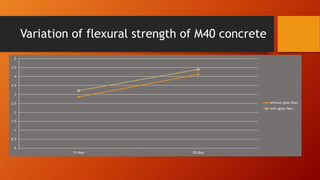
Variation of flexural strength of M40 concrete
0
0.5
1
1.5
2
2.5
3
3.5
4
4.5
5
14 days 28 days
without glass fiber
with glass fiber
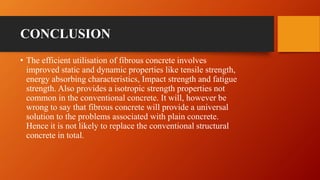
CONCLUSION
• The efficient utilisation of fibrous concrete involves
improved static and dynamic properties like tensile strength,
energy absorbing characteristics, Impact strength and fatigue
strength. Also provides a isotropic strength properties not
common in the conventional concrete. It will, however be
wrong to say that fibrous concrete will provide a universal
solution to the problems associated with plain concrete.
Hence it is not likely to replace the conventional structural
concrete in total.
• Superior crack resistance and greater ductility with distinct post
cracking behavior are some of the important static properties of
GFRC. The enormous increase in impact resistance and fatigue
resistance allow the new material to be used in some specified
applications where conventional concrete is at a disadvantage.
• A new approach in design and in the utilization of this material, to
account for both increase in performance and economics is
therefore,needed. www.studymafia.org
REFERENCES
• www.studymafia.org
• www.google.com
• www.wikipedia.com
• http://www.advancedarchitecturalstone.com
• IS 10262-2009
•IS 456- 2000
•I-ISSN097643945
THANKYOU!

Amjad ppt copy

  • 1.
  • 2.
    INTRODUCTION • Fiber ReinforcedConcrete can be defined as a composite material consisting of mixtures of cement, mortar or concrete and discontinuous, discrete, uniformly dispersed suitable fibers. • Continuous meshes, woven fabrics and long wires or rods are not considered to be discrete fibres
  • 3.
    EFFECT OF FIBERSIN CONCRETE • They control plastic shrinkage cracking and drying shrinkage cracking. • They also lower the permeability of concrete and thus reduce bleeding of water. • If the modulus of elasticity of the fiber is higher than the matrix (concrete or mortar binder), they help to carry the load by increasing the tensile strength of the material. • Some fibers reduce the strength of concrete.
  • 4.
    NECESSITY • It reducethe air voids and water voids the inherent porosity of gel. • It increases the durability of the concrete. • Fibers such as graphite and glass have excellent resistance to creep. • The addition of small, closely spaced and uniformly dispersed fibers to concrete would act as crack arrester and would substantially improve its static and dynamic properties.
  • 5.
    FACTORS EFFECTING PROPERTIESOF FRC • Relative fiber matrix. • Volume of fiber. • Aspect ratio of fiber. • Orientation of fiber. • Workability and compaction of concrete. • Size of coarse aggregate. • Mixing.
  • 6.
    GLASS FIBER REINFORCEDCONCRETE • GFRC is actually cement mortar with countless strands of embedded glass fiber. • GFRC has a dramatically reduced ballistic debris profile. • Fibers are the principal load-carrying members
  • 7.
    TYPES OF GLASSFIBERS • A-glass (close to normal glass). • C-glass (resist chemical attacks). • E-glass (insulation to electricity). • AE-glass (alkali resistance). • S-glass (high strength fiber)
  • 8.
    PROPERTIES OF GLASSFIBER • A high tensile strength (1700 N/mm^2) ▪ High modulus. • Impact Resistance. • Shear strength. • Water resistant. • Thermal conductivity.
  • 9.
    PROPERTIES OF GLASSFIBER (COTD.) • Low thermal expansion. • Less creep with increase in time. • Light weight and Low density. • Resistance to corrosion and Fire endurance. • Resistance to cracks in concrete
  • 10.
    CASTING OF GFRC •Spray-Up (very strong GFRC due to the high fiber load and long fiber length). • Premix (less strength than spray-up). • Hybrid Spray-up GFRC.
  • 11.
  • 12.
    APPLICATIONS • Landscape Furnishings. •Architectural projects. • Airfields and Runways. • In Rocket launch pads.
  • 13.
    •Tunnel Lining andSlope Stabilization glass fibre reinforced concrete (gfrc) are being used to line underground openings and rock slope stabilization eliminates the need for mesh reinforcement and scaffolding. Tunnel lining using (GFRC)
  • 14.
    •Thin Shell, Walls,Pipes, and Manhole • Fibrous concrete permits the use of thinner flat and curved structural elements. Steel fibrous shortcrete is used in the tunnel. • Construction of hemispherical domes using the inflated membrane process. • Glass fibre reinforced cement or concrete (GFRC), by the spray-up process, have been used to construct wall panels. Steel and glass fibres addition in concrete pipes .
  • 15.
    •Other Applications These includemachine tool frames, lighting poles, water and oil tanks and concrete repairs. •Dams and Hydraulic Structure FRC is being used for the construction and repair of dams and other hydraulic structures to provide resistance to cavitation and severe erosion caused by the Impact of large Waterboro debris.
  • 16.
    AIM AND OBJECTIVESOF STUDY • Study the mix design aspects of the GRC. • Understand the various applications involving GRC. • Compare GRC with Normal concrete. • Perform laboratory tests that are related to compressive, tensile and flexure by use of glass fibre in the concrete pour.
  • 17.
    AIM AND OBJECTIVESOF STUDY • The proposed of study aims at analysing the characteristics of glass fiber reinforced concrete. • Use a glass fiber reinforced concrete with ordinary Portland cement and decrease the maximum use of ordinary Portland cement. • As a new construction material (gfrc), we can achieve maximum benefits and different properties of glass fiber reinforced concrete. • We also compare GFRC, with other cladding materials in different section like quality , cost , properties , benefits etc.
  • 18.
    Tests on cementand aggregate
  • 19.
    Fineness of Cement •The degree of fineness of cement is a measure of the mean size of the grains in cement. • The rate of hydration and hydrolysis, and consequent development of strength in cement mortar depends upon the fineness of cement. • To have same rate of hardening in different brands of cement, the fineness has been standardized. The finer cement has quicker action with water and gains early strength though its ultimate strength remains unaffected. Fineness of cement = Mass of residue in grams X 100 Mass • Result : Calculation of Fineness • Residue of cement is 5 percent. Mass of cement taken on IS Sieve 100 g Mass of residue after sieving 5 g
  • 20.
    Specific Gravity ofCement • Specific gravity is normally defined as the ratio between the mass of a given volume of material and mass of an equal volume of water. • One of the methods of determining the specific gravity of cement is by the use of a liquid such as water-free kerosene which does not react with cement. • A specific gravity bottle may be employed or a standard pycnometer may be used. • Result : Calculation for specific gravity • Specific gravity of cement, S= W5 (W3 – W1) = 3.09 (W5 + W3 – W4) (W2 – W1) Mass of empty pycnometer W1 680 g Mass of pycnometer + water W2 1520 g Mass of pycnometer + kerosene W3 1340 g Mass of pycnometer + cement + kerosene W4 1377.3 g Mass of cement W5 50 g
  • 21.
    Standard Consistency andSetting Time • Standard Consistency: • Consistency is relative mobility or ability of a freshly mixed concrete to flow. • The object of conducting this test is to find out the amount of water to be added to the cement to get a paste of normal consistency. • Mass of cement taken for one mould = 400 gm. Water Added (ml) Value of P (%) Penetration (mm) 100 25 10 105 30 22 110 35 29 115 40 35
  • 22.
    • Setting Time: TheInitial Setting Time may be defined as the time at which the matrix is looses it plasticity. The Final Setting Time is a stage when the matrix becomes the hard mass. The concrete is set to be finally set when it has obtained sufficient strength and hardness. Mass of cement taken = 400 gm. Mass of water taken = 0.85 P x 400 gm. = 0.85(0.4) x 400 = 128 ml Result : - Standard consistency of cement = 40 per cent. - Initial setting time of cement = 200 minutes. - Final setting time of cement = 395 minutes.
  • 23.
    Compressive Strength • ForOrdinary Portland Cement, the compressive strength at 3 and 7 days curing shall not be less than 16MPa and 22MPa respectively. • Result : Calculation of Compressive Strength of Cement • Average value = 22.10 N/mm2 S.No. Load (KN) Strength (N/mm2) 1 221 22.45 2 225 22.00 3 227 21.87
  • 24.
    Specific Gravity andWater Absorption of Fine Aggregates • The Specific Gravity of an aggregate is defined as the ratio of the mass of a given volume of sample to the mass of an equal volume of water at the same temperature. • The specific gravity of fine aggregates is generally required for calculations in connection with concrete mix design, for determination of moisture content and for the calculations of volume yield of concrete. • Result : Calculation of Specific Gravity and Water Absorption Specific Gravity, G = W2 = 2.45 W2 – (W3 – W1) Water Absorption = W4 – W5 x 100 = 1.37 % W5 Mass of empty dry flask W 680 g Mass of flask + water W1 1533 g Mass of saturated surface dry sample W2 500 g Mass of flask + sample + water W3 1829 g Mass of air dried aggregates W4 147 g Mass of oven dried aggregates W5 145 g
  • 25.
    Specific Gravity andWater Absorption of Coarse Aggregates • Calculation of specific gravity and water absorption • Specific Gravity, G = W1 W1–(W3 – W2) 3000 = 2.50 3000 – (2000 – 200) • Water Absorption = W5 – W6 x 100 W5 = 154 – 149 x 100 = 3.24 % 154 Mass of saturated surface dry sample W1 3000 g Mass of bucket suspended in water W2 200 g Mass of material + bucket suspended in water W3 2000 g Mass of aggregates taken before drying W4 150 g Mass of aggregates taken before drying + water W5 154 g Mass of oven dried aggregates W6 149 g
  • 26.
    Tests Conducted onGFRC • Compressive strength test on GFRC.
  • 27.
    Pictures related toproject work
  • 28.
  • 29.
    CONCRETE MIX DESIGNM40 GRADE CONCRETE Grade Designation = M-40 Type of cement = O.P.C-43 grade Brand of cement = Ambuja Admixture = Superplasticizer (HRWR) Fine Aggregate = Zone-II Sp. Gravity Cement = 3.09 Fine Aggregate = 2.45 Coarse Aggregate (10mm) = 2.5 Minimum Cement =400 kg / m3 Maximum water cement ratio = 0.40 Concrete Mix Design Calculation: – 1. Target Mean Strength = 40 + ( 5 X 1.65 ) = 48.25 Mpa 2. Selection of water cement ratio: water cement ratio = 0.40 (selected from IS 456-2000) 3. Calculation of water content: Approximate water content for 10mm max. Size of aggregate = 208 kg /m3 (from Table No. 5 , IS : 10262 ). As plasticizer is proposed we can reduce water content by 20%. Now water content = 208 - 41.6 = 167 kg /m3
  • 30.
    4. Calculation ofcement content: Water cement ratio = 0.40 Water content per m3 of concrete = 167 kg Cement content = 167/0.40 = 418 kg / m3 (minimum cement content 400 kg /m3 ) Hence O.K. Total cementitious material content = 418 * 1.10 = 459.8 = 460 kg/m3 (10% increment due to early setting) Water content = 460*0.4 = 184 kg/m3 Silica fume@20% = 460 * 0.20 = 92 kg/m3 Cement (opc) = 460 – 92 = 368 kg/m3 ( saving of cement = 460-368 = 92 kg/m3) 5. Calculation of Sand & Coarse Aggregate Quantities: Volume of concrete = 1 m3 Volume of cement = 368 / ( 3.09 X 1000 ) = 0.119 m3 Volume of water = 184 / ( 1 X 1000 ) = 0.184 m3 Volume of Admixture = 4.60 / (1.145 X 1000 ) = 0.0040 m3 volume of silica fume = 92 / ( 2.2 X1000 ) = 0.041 Total weight of other materials except coarse aggregate = 0.119 + 0.184 + 0.0040 + 0.041 = 0.348 m3 Volume of coarse and fine aggregate = 1 – 0.348 = 0.652 m3 Volume of F.A = 0.652 X 0.41 = 0.267 m3 (Assuming 41% by volume of total aggregate )
  • 31.
    Volume of C.A.= 0.652 – 0.268 = 0.384 m3 Therefore weight of F.A. = 0.267 X 2.45 X 1000 = 654.15 kg/ m3 Therefore weight of C.A. = 0.384 X 2.50 X 1000 = 960 kg/ m3 Admixture = 1 % by weight of cement = 3.68 kg/m3 Glass fiber = 0.03 % by volume of concrete. Cement :Water: F.A : C.A : SF : SP = 1 : 0.4 : 1.7 : 2.6 : 0.25 : 0.012
  • 32.
    Compressive and FlexuralStrength Test Result Compressive strength of M20 concrete: 1. Normal Concrete 2. Gfr concrete S.no specimen Curing time Compressive strength 1 Cube 1 7 days 13 Mpa 2 Cube 2 14 days 17.77 Mpa 3 Cube 3 28 days 20.44 Mpa s.No Specimen Curing time Compressive strength 1 Cube 1 7 days 16.88 2 Cube 2 14 days 22.66 3 Cube 3 28 days 27.11
  • 33.
    Variation of compressivestrength of M20 concrete Fig 12 Variation of compressive strength of M20 concrete 0 5 10 15 20 25 30 7 DAYS 14 DAYS 28 DAYS Without glassfiber with glassfiber
  • 34.
    Flexural strength ofM20 concrete : 1. Normal concrete 2. gfrc s.No specimen Curing time Flexural strength 1 Beam 1 14 days 2.69 2 Beam 2 28 days 3.84 s.No Specimen Curing time Flexural strength 1 Beam 1 14 days 2.78 2 Beam 2 28 days 3.9
  • 35.
    Flexural strength ofM20 Concrete beam 0 1 2 3 4 5 6 7 8 9 14 days 28 days with glass fiber without glass fiber Flexural strength of M20 concrete beam
  • 36.
    Compressive strength ofM40 concrete 1. M40 Plain concrete: 2. Gfr concrete s.No Specimen Curing time Compressive strength 1 Cube 1 7 days 23.77 2 Cube 2 14 days 29.55 3 Cube 3 28 days 33.33 s.No Specimen Curing time Compressive strength 1 Cube 1 7 days 25.77 2 Cube 2 14 days 33.77 3 Cube3 28 days 39.12
  • 37.
    Compressive strength graphof M40 concrete 0 5 10 15 20 25 30 35 40 45 7 days 14 days 28 days Without with glass fiber
  • 38.
    Flexural strength ofM40 concrete Flexural strength of M20 concrete : 1. Normal concrete 2. gfrc s.No Specimen Curing Time Flexural strength 1 Beam 1 14 days 2.86 2 Beam 2 28 days 4.12 s.No Specimen Curing time Flexural strength 1 Beam 1 14 days 3.21 2 Beam 2 28 days 5.32
  • 39.
    Variation of flexuralstrength of M40 concrete 0 0.5 1 1.5 2 2.5 3 3.5 4 4.5 5 14 days 28 days without glass fiber with glass fiber
  • 40.
    CONCLUSION • The efficientutilisation of fibrous concrete involves improved static and dynamic properties like tensile strength, energy absorbing characteristics, Impact strength and fatigue strength. Also provides a isotropic strength properties not common in the conventional concrete. It will, however be wrong to say that fibrous concrete will provide a universal solution to the problems associated with plain concrete. Hence it is not likely to replace the conventional structural concrete in total.
  • 41.
    • Superior crackresistance and greater ductility with distinct post cracking behavior are some of the important static properties of GFRC. The enormous increase in impact resistance and fatigue resistance allow the new material to be used in some specified applications where conventional concrete is at a disadvantage. • A new approach in design and in the utilization of this material, to account for both increase in performance and economics is therefore,needed. www.studymafia.org
  • 42.
    REFERENCES • www.studymafia.org • www.google.com •www.wikipedia.com • http://www.advancedarchitecturalstone.com • IS 10262-2009 •IS 456- 2000 •I-ISSN097643945
  • 43.