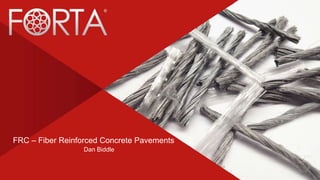
FRC – Fiber Reinforced Concrete Pavements
Dan Biddle
This presentation is protected by U.S. and
International copyright laws. Reproduction,
distribution, display and use of the presentation
without written permission of the speaker is
prohibited.
©FORTA
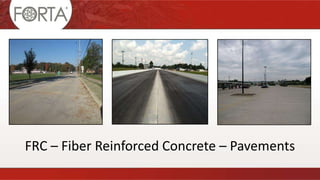
FRC – Fiber Reinforced Concrete – Pavements
FRC Pavements
OVERVIEW
• Pavement problems
• Pavement design
• Fiber options
• LTRC research
• Projects – normal joints
• Projects – extended joints
• Fiber option review
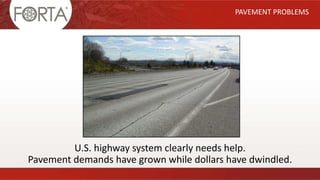
U.S. highway system clearly needs help.
Pavement demands have grown while dollars have dwindled.
PAVEMENT PROBLEMS
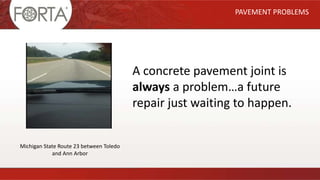
A concrete pavement joint is
always a problem…a future
repair just waiting to happen.
PAVEMENT PROBLEMS
Michigan State Route 23 between Toledo
and Ann Arbor
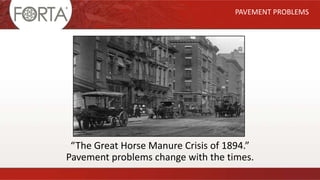
“The Great Horse Manure Crisis of 1894.”
Pavement problems change with the times.
PAVEMENT PROBLEMS
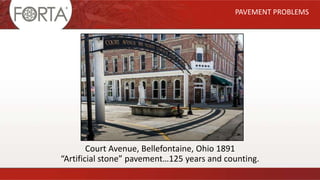
Court Avenue, Bellefontaine, Ohio 1891
“Artificial stone” pavement…125 years and counting.
PAVEMENT PROBLEMS
Poor pavements are expensive for motorists:
• Faster vehicle wear & tear
• Reduced vehicle value
• Higher repair & maintenance costs
• Higher fuel consumption & tire wear
• Cost average driver $516 per year
PAVEMENT PROBLEMS
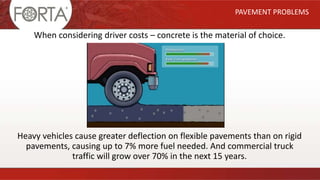
When considering driver costs – concrete is the material of choice.
Heavy vehicles cause greater deflection on flexible pavements than on rigid
pavements, causing up to 7% more fuel needed. And commercial truck
traffic will grow over 70% in the next 15 years.
PAVEMENT PROBLEMS
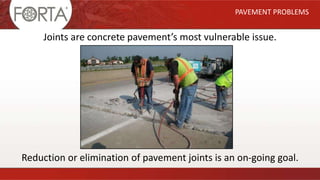
Joints are concrete pavement’s most vulnerable issue.
Reduction or elimination of pavement joints is an on-going goal.
PAVEMENT PROBLEMS
PAVEMENT PROBLEMS
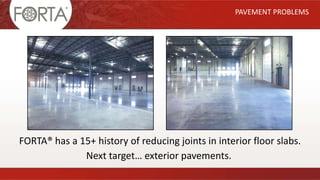
Next target… exterior pavements.
FORTA® has a 15+ history of reducing joints in interior floor slabs.
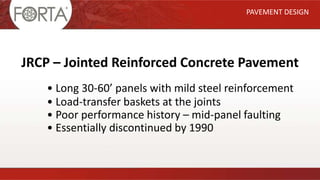
• Long 30-60’ panels with mild steel reinforcement
• Load-transfer baskets at the joints
• Poor performance history – mid-panel faulting
• Essentially discontinued by 1990
PAVEMENT DESIGN
JRCP – Jointed Reinforced Concrete Pavement
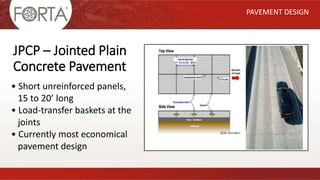
JPCP – Jointed Plain
Concrete Pavement
PAVEMENT DESIGN
• Short unreinforced panels,
15 to 20’ long
• Load-transfer baskets at the
joints
• Currently most economical
pavement design
PAVEMENT DESIGN
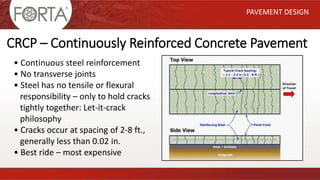
• Continuous steel reinforcement
• No transverse joints
• Steel has no tensile or flexural
responsibility – only to hold cracks
tightly together: Let-it-crack
philosophy
• Cracks occur at spacing of 2-8 ft.,
generally less than 0.02 in.
• Best ride – most expensive
CRCP – Continuously Reinforced Concrete Pavement
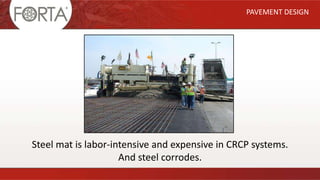
Steel mat is labor-intensive and expensive in CRCP systems.
And steel corrodes.
PAVEMENT DESIGN
FRC pavement designs are dependent on dosage.
FIBER OPTIONS
1. Low dosage: 3-4 lbs. /cu. yd.
• Add-on to conventional jointed design
• Reduce cracking
• Improve toughness
Higher dosage = more opportunities
FIBER OPTIONS
2. Medium dosage: 4-7 lbs. /cu. yd.
• Reduce cracking – improve toughness
• Used in jointed designs
• Consideration of longer joint spacing is valid
FIBER OPTIONS
3. High dosage: 7.5+ lbs. /cu. yd.
• Reduce crack width opening
• Large improvement to toughness
• Dramatic increase to joint spacing
• Consider ‘joint-free’ pavement?
CFRCP – Continuously Fiber Reinforced Concrete
Pavement
FIBER OPTIONS
• Brainchild of Dr. John Kevern, Associate Professor of Civil
Engineering, University of Missouri at Kansas City
• Same concept as CRCP – enough reinforcement to allow
frequent tight cracks
• BUT…fibers must prove to hold cracks tight, i.e. < 0.02 in.,
under typical pavement conditions such as fatigue
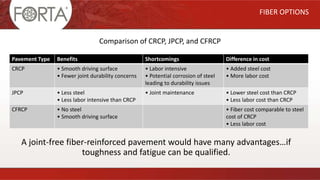
A joint-free fiber-reinforced pavement would have many advantages…if
toughness and fatigue can be qualified.
FIBER OPTIONS
Comparison of CRCP, JPCP, and CFRCP
Pavement Type Benefits Shortcomings Difference in cost
CRCP • Smooth driving surface
• Fewer joint durability concerns
• Labor intensive
• Potential corrosion of steel
leading to durability issues
• Added steel cost
• More labor cost
JPCP • Less steel
• Less labor intensive than CRCP
• Joint maintenance • Lower steel cost than CRCP
• Less labor cost than CRCP
CFRCP • No steel
• Smooth driving surface
• Fiber cost comparable to steel
cost of CRCP
• Less labor cost
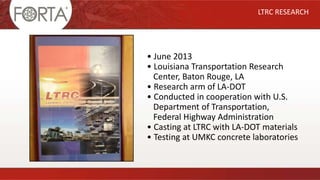
• June 2013
• Louisiana Transportation Research
Center, Baton Rouge, LA
• Research arm of LA-DOT
• Conducted in cooperation with U.S.
Department of Transportation,
Federal Highway Administration
• Casting at LTRC with LA-DOT materials
• Testing at UMKC concrete laboratories
LTRC RESEARCH
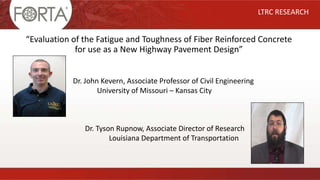
“Evaluation of the Fatigue and Toughness of Fiber Reinforced Concrete
for use as a New Highway Pavement Design”
LTRC RESEARCH
Dr. John Kevern, Associate Professor of Civil Engineering
University of Missouri – Kansas City
Dr. Tyson Rupnow, Associate Director of Research
Louisiana Department of Transportation
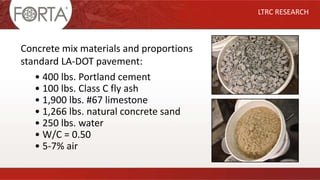
• 400 lbs. Portland cement
• 100 lbs. Class C fly ash
• 1,900 lbs. #67 limestone
• 1,266 lbs. natural concrete sand
• 250 lbs. water
• W/C = 0.50
• 5-7% air
LTRC RESEARCH
Concrete mix materials and proportions
standard LA-DOT pavement:
LTRC RESEARCH
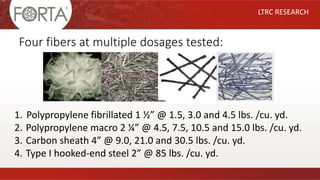
Four fibers at multiple dosages tested:
1. Polypropylene fibrillated 1 ½” @ 1.5, 3.0 and 4.5 lbs. /cu. yd.
2. Polypropylene macro 2 ¼” @ 4.5, 7.5, 10.5 and 15.0 lbs. /cu. yd.
3. Carbon sheath 4” @ 9.0, 21.0 and 30.5 lbs. /cu. yd.
4. Type I hooked-end steel 2” @ 85 lbs. /cu. yd.
LTRC RESEARCH
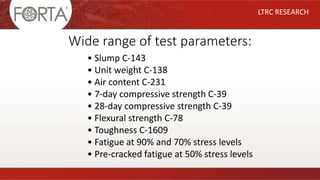
Wide range of test parameters:
• Slump C-143
• Unit weight C-138
• Air content C-231
• 7-day compressive strength C-39
• 28-day compressive strength C-39
• Flexural strength C-78
• Toughness C-1609
• Fatigue at 90% and 70% stress levels
• Pre-cracked fatigue at 50% stress levels
LTRC RESEARCH
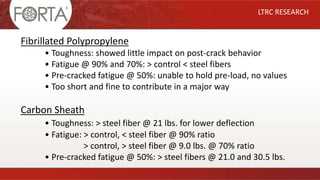
Fibrillated Polypropylene
• Toughness: showed little impact on post-crack behavior
• Fatigue @ 90% and 70%: > control < steel fibers
• Pre-cracked fatigue @ 50%: unable to hold pre-load, no values
• Too short and fine to contribute in a major way
Carbon Sheath
• Toughness: > steel fiber @ 21 lbs. for lower deflection
• Fatigue: > control, < steel fiber @ 90% ratio
> control, > steel fiber @ 9.0 lbs. @ 70% ratio
• Pre-cracked fatigue @ 50%: > steel fibers @ 21.0 and 30.5 lbs.
LTRC RESEARCH
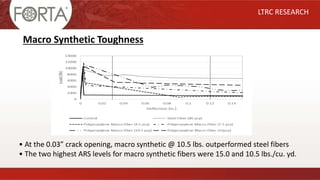
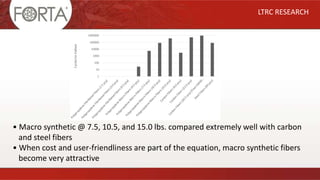
Macro Synthetic Toughness
• At the 0.03” crack opening, macro synthetic @ 10.5 lbs. outperformed steel fibers
• The two highest ARS levels for macro synthetic fibers were 15.0 and 10.5 lbs./cu. yd.
LTRC RESEARCH
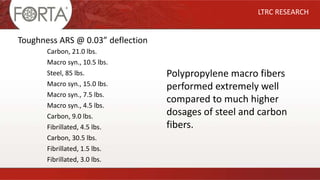
Toughness ARS @ 0.03” deflection
Polypropylene macro fibers
performed extremely well
compared to much higher
dosages of steel and carbon
fibers.
Carbon, 21.0 lbs.
Macro syn., 10.5 lbs.
Steel, 85 lbs.
Macro syn., 15.0 lbs.
Macro syn., 7.5 lbs.
Macro syn., 4.5 lbs.
Carbon, 9.0 lbs.
Fibrillated, 4.5 lbs.
Carbon, 30.5 lbs.
Fibrillated, 1.5 lbs.
Fibrillated, 3.0 lbs.
LTRC RESEARCH
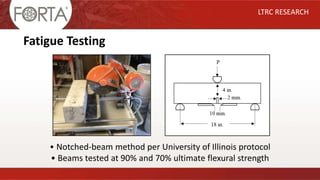
Fatigue Testing
• Notched-beam method per University of Illinois protocol
• Beams tested at 90% and 70% ultimate flexural strength
LTRC RESEARCH
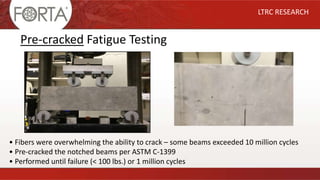
Pre-cracked Fatigue Testing
• Fibers were overwhelming the ability to crack – some beams exceeded 10 million cycles
• Pre-cracked the notched beams per ASTM C-1399
• Performed until failure (< 100 lbs.) or 1 million cycles
LTRC RESEARCH
Macro Synthetic Fatigue @ 90% Stress Ratio:
• All dosages > control
• 15.0 lb. dosage > 85 lb. steel fiber
LTRC RESEARCH
Macro Synthetic Fatigue @ 70% Stress Ratio:
• Began to show a more ductile mode of failure
• All four dosages > steel fibers
• Ex: Synthetic @ 4.5 lbs. = 6,400 cycles
Steel @ 85 lbs. = 500 cycles
LTRC RESEARCH
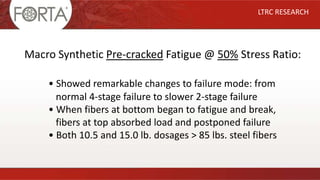
Macro Synthetic Pre-cracked Fatigue @ 50% Stress Ratio:
• Showed remarkable changes to failure mode: from
normal 4-stage failure to slower 2-stage failure
• When fibers at bottom began to fatigue and break,
fibers at top absorbed load and postponed failure
• Both 10.5 and 15.0 lb. dosages > 85 lbs. steel fibers
LTRC RESEARCH
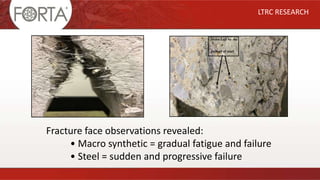
Fracture face observations revealed:
• Macro synthetic = gradual fatigue and failure
• Steel = sudden and progressive failure
Holes Left by the
pullout of steel
LTRC RESEARCH
• Macro synthetic @ 7.5, 10.5, and 15.0 lbs. compared extremely well with carbon
and steel fibers
• When cost and user-friendliness are part of the equation, macro synthetic fibers
become very attractive
LTRC RESEARCH
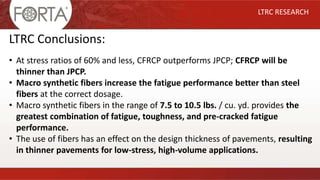
LTRC Conclusions:
• At stress ratios of 60% and less, CFRCP outperforms JPCP; CFRCP will be
thinner than JPCP.
• Macro synthetic fibers increase the fatigue performance better than steel
fibers at the correct dosage.
• Macro synthetic fibers in the range of 7.5 to 10.5 lbs. / cu. yd. provides the
greatest combination of fatigue, toughness, and pre-cracked fatigue
performance.
• The use of fibers has an effect on the design thickness of pavements, resulting
in thinner pavements for low-stress, high-volume applications.
LTRC RESEARCH
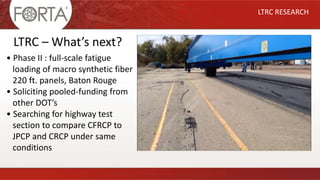
LTRC – What’s next?
• Phase II : full-scale fatigue
loading of macro synthetic fiber
220 ft. panels, Baton Rouge
• Soliciting pooled-funding from
other DOT’s
• Searching for highway test
section to compare CFRCP to
JPCP and CRCP under same
conditions
PROJECTS: NORMAL JOINTS
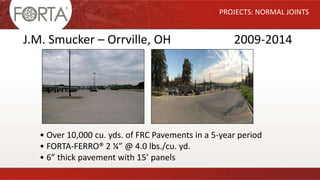
J.M. Smucker – Orrville, OH 2009-2014
• Over 10,000 cu. yds. of FRC Pavements in a 5-year period
• FORTA-FERRO® 2 ¼” @ 4.0 lbs./cu. yd.
• 6” thick pavement with 15’ panels
PROJECTS: NORMAL JOINTS
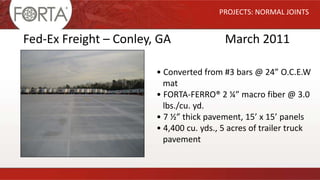
Fed-Ex Freight – Conley, GA March 2011
• Converted from #3 bars @ 24” O.C.E.W
mat
• FORTA-FERRO® 2 ¼” macro fiber @ 3.0
lbs./cu. yd.
• 7 ½” thick pavement, 15’ x 15’ panels
• 4,400 cu. yds., 5 acres of trailer truck
pavement
PROJECTS: NORMAL JOINTS
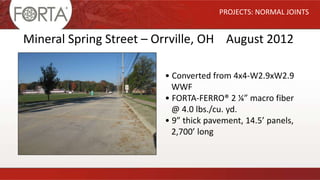
Mineral Spring Street – Orrville, OH August 2012
• Converted from 4x4-W2.9xW2.9
WWF
• FORTA-FERRO® 2 ¼” macro fiber
@ 4.0 lbs./cu. yd.
• 9” thick pavement, 14.5’ panels,
2,700’ long
PROJECTS: NORMAL JOINTS
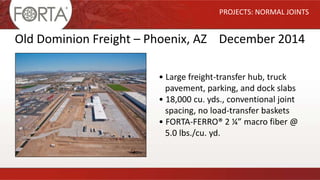
Old Dominion Freight – Phoenix, AZ December 2014
• Large freight-transfer hub, truck
pavement, parking, and dock slabs
• 18,000 cu. yds., conventional joint
spacing, no load-transfer baskets
• FORTA-FERRO® 2 ¼” macro fiber @
5.0 lbs./cu. yd.
PROJECTS: NORMAL JOINTS
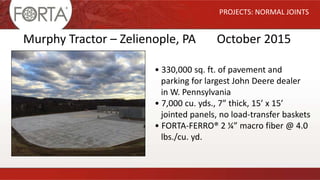
Murphy Tractor – Zelienople, PA October 2015
• 330,000 sq. ft. of pavement and
parking for largest John Deere dealer
in W. Pennsylvania
• 7,000 cu. yds., 7” thick, 15’ x 15’
jointed panels, no load-transfer baskets
• FORTA-FERRO® 2 ¼” macro fiber @ 4.0
lbs./cu. yd.
PROJECTS: EXTENDED JOINTS
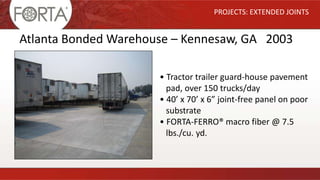
Atlanta Bonded Warehouse – Kennesaw, GA 2003
• Tractor trailer guard-house pavement
pad, over 150 trucks/day
• 40’ x 70’ x 6” joint-free panel on poor
substrate
• FORTA-FERRO® macro fiber @ 7.5
lbs./cu. yd.
PROJECTS: EXTENDED JOINTS
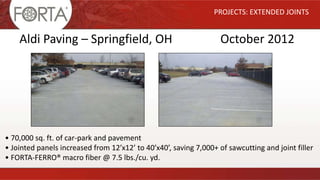
Aldi Paving – Springfield, OH October 2012
• 70,000 sq. ft. of car-park and pavement
• Jointed panels increased from 12’x12’ to 40’x40’, saving 7,000+ of sawcutting and joint filler
• FORTA-FERRO® macro fiber @ 7.5 lbs./cu. yd.
PROJECTS: EXTENDED JOINTS
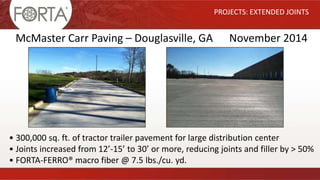
McMaster Carr Paving – Douglasville, GA November 2014
• 300,000 sq. ft. of tractor trailer pavement for large distribution center
• Joints increased from 12’-15’ to 30’ or more, reducing joints and filler by > 50%
• FORTA-FERRO® macro fiber @ 7.5 lbs./cu. yd.
PROJECTS: EXTENDED JOINTS
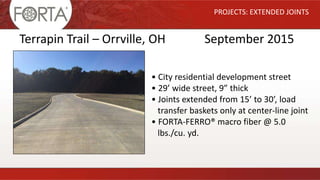
Terrapin Trail – Orrville, OH September 2015
• City residential development street
• 29’ wide street, 9” thick
• Joints extended from 15’ to 30’, load
transfer baskets only at center-line joint
• FORTA-FERRO® macro fiber @ 5.0
lbs./cu. yd.
FIBER OPTION REVIEW
Current Pavement Design Issues:
• Joint deterioration is a major problem
• Steel corrosion is a major problem
• Pavement smoothness caused by curling is a major problem
• Durability and longevity are major problems
FIBER OPTION REVIEW
Macro Fiber Options:
1. Low dosage 3-4 lbs. = alternate to temperature steel,
reduced cracking, normal joint spacing
2. Medium dosage 5.0-7.5 lbs. = alternate to temperature
steel, added toughness, longer joint spacing
3. High dosage 9.0 lbs. = considerable fatigue
improvement, improvement to ride-ability, goal of
joint-free pavements
FIBER OPTION REVIEW
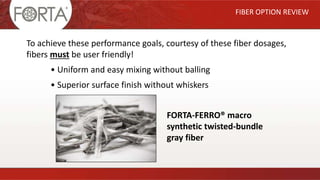
To achieve these performance goals, courtesy of these fiber dosages,
fibers must be user friendly!
• Uniform and easy mixing without balling
• Superior surface finish without whiskers
FORTA-FERRO® macro
synthetic twisted-bundle
gray fiber
FIBER OPTION REVIEW
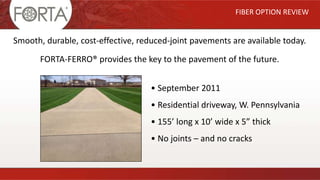
Smooth, durable, cost-effective, reduced-joint pavements are available today.
FORTA-FERRO® provides the key to the pavement of the future.
• September 2011
• Residential driveway, W. Pennsylvania
• 155’ long x 10’ wide x 5” thick
• No joints – and no cracks
To learn more about FRC Pavements……
FORTA Corporation
100 Forta Drive
Grove City, PA 16127-6399 U.S.A
www.forta-ferro.com
1-800-245-0306

FRC Pavements

  • 1.
    FRC – FiberReinforced Concrete Pavements Dan Biddle
  • 2.
    This presentation isprotected by U.S. and International copyright laws. Reproduction, distribution, display and use of the presentation without written permission of the speaker is prohibited. ©FORTA
  • 3.
    FRC – FiberReinforced Concrete – Pavements
  • 4.
    FRC Pavements OVERVIEW • Pavementproblems • Pavement design • Fiber options • LTRC research • Projects – normal joints • Projects – extended joints • Fiber option review
  • 5.
    U.S. highway systemclearly needs help. Pavement demands have grown while dollars have dwindled. PAVEMENT PROBLEMS
  • 6.
    A concrete pavementjoint is always a problem…a future repair just waiting to happen. PAVEMENT PROBLEMS Michigan State Route 23 between Toledo and Ann Arbor
  • 7.
    “The Great HorseManure Crisis of 1894.” Pavement problems change with the times. PAVEMENT PROBLEMS
  • 8.
    Court Avenue, Bellefontaine,Ohio 1891 “Artificial stone” pavement…125 years and counting. PAVEMENT PROBLEMS
  • 9.
    Poor pavements areexpensive for motorists: • Faster vehicle wear & tear • Reduced vehicle value • Higher repair & maintenance costs • Higher fuel consumption & tire wear • Cost average driver $516 per year PAVEMENT PROBLEMS
  • 10.
    When considering drivercosts – concrete is the material of choice. Heavy vehicles cause greater deflection on flexible pavements than on rigid pavements, causing up to 7% more fuel needed. And commercial truck traffic will grow over 70% in the next 15 years. PAVEMENT PROBLEMS
  • 11.
    Joints are concretepavement’s most vulnerable issue. Reduction or elimination of pavement joints is an on-going goal. PAVEMENT PROBLEMS
  • 12.
    PAVEMENT PROBLEMS Next target…exterior pavements. FORTA® has a 15+ history of reducing joints in interior floor slabs.
  • 13.
    • Long 30-60’panels with mild steel reinforcement • Load-transfer baskets at the joints • Poor performance history – mid-panel faulting • Essentially discontinued by 1990 PAVEMENT DESIGN JRCP – Jointed Reinforced Concrete Pavement
  • 14.
    JPCP – JointedPlain Concrete Pavement PAVEMENT DESIGN • Short unreinforced panels, 15 to 20’ long • Load-transfer baskets at the joints • Currently most economical pavement design
  • 15.
    PAVEMENT DESIGN • Continuoussteel reinforcement • No transverse joints • Steel has no tensile or flexural responsibility – only to hold cracks tightly together: Let-it-crack philosophy • Cracks occur at spacing of 2-8 ft., generally less than 0.02 in. • Best ride – most expensive CRCP – Continuously Reinforced Concrete Pavement
  • 16.
    Steel mat islabor-intensive and expensive in CRCP systems. And steel corrodes. PAVEMENT DESIGN
  • 17.
    FRC pavement designsare dependent on dosage. FIBER OPTIONS 1. Low dosage: 3-4 lbs. /cu. yd. • Add-on to conventional jointed design • Reduce cracking • Improve toughness Higher dosage = more opportunities
  • 18.
    FIBER OPTIONS 2. Mediumdosage: 4-7 lbs. /cu. yd. • Reduce cracking – improve toughness • Used in jointed designs • Consideration of longer joint spacing is valid
  • 19.
    FIBER OPTIONS 3. Highdosage: 7.5+ lbs. /cu. yd. • Reduce crack width opening • Large improvement to toughness • Dramatic increase to joint spacing • Consider ‘joint-free’ pavement?
  • 20.
    CFRCP – ContinuouslyFiber Reinforced Concrete Pavement FIBER OPTIONS • Brainchild of Dr. John Kevern, Associate Professor of Civil Engineering, University of Missouri at Kansas City • Same concept as CRCP – enough reinforcement to allow frequent tight cracks • BUT…fibers must prove to hold cracks tight, i.e. < 0.02 in., under typical pavement conditions such as fatigue
  • 21.
    A joint-free fiber-reinforcedpavement would have many advantages…if toughness and fatigue can be qualified. FIBER OPTIONS Comparison of CRCP, JPCP, and CFRCP Pavement Type Benefits Shortcomings Difference in cost CRCP • Smooth driving surface • Fewer joint durability concerns • Labor intensive • Potential corrosion of steel leading to durability issues • Added steel cost • More labor cost JPCP • Less steel • Less labor intensive than CRCP • Joint maintenance • Lower steel cost than CRCP • Less labor cost than CRCP CFRCP • No steel • Smooth driving surface • Fiber cost comparable to steel cost of CRCP • Less labor cost
  • 22.
    • June 2013 •Louisiana Transportation Research Center, Baton Rouge, LA • Research arm of LA-DOT • Conducted in cooperation with U.S. Department of Transportation, Federal Highway Administration • Casting at LTRC with LA-DOT materials • Testing at UMKC concrete laboratories LTRC RESEARCH
  • 23.
    “Evaluation of theFatigue and Toughness of Fiber Reinforced Concrete for use as a New Highway Pavement Design” LTRC RESEARCH Dr. John Kevern, Associate Professor of Civil Engineering University of Missouri – Kansas City Dr. Tyson Rupnow, Associate Director of Research Louisiana Department of Transportation
  • 24.
    • 400 lbs.Portland cement • 100 lbs. Class C fly ash • 1,900 lbs. #67 limestone • 1,266 lbs. natural concrete sand • 250 lbs. water • W/C = 0.50 • 5-7% air LTRC RESEARCH Concrete mix materials and proportions standard LA-DOT pavement:
  • 25.
    LTRC RESEARCH Four fibersat multiple dosages tested: 1. Polypropylene fibrillated 1 ½” @ 1.5, 3.0 and 4.5 lbs. /cu. yd. 2. Polypropylene macro 2 ¼” @ 4.5, 7.5, 10.5 and 15.0 lbs. /cu. yd. 3. Carbon sheath 4” @ 9.0, 21.0 and 30.5 lbs. /cu. yd. 4. Type I hooked-end steel 2” @ 85 lbs. /cu. yd.
  • 26.
    LTRC RESEARCH Wide rangeof test parameters: • Slump C-143 • Unit weight C-138 • Air content C-231 • 7-day compressive strength C-39 • 28-day compressive strength C-39 • Flexural strength C-78 • Toughness C-1609 • Fatigue at 90% and 70% stress levels • Pre-cracked fatigue at 50% stress levels
  • 27.
    LTRC RESEARCH Fibrillated Polypropylene •Toughness: showed little impact on post-crack behavior • Fatigue @ 90% and 70%: > control < steel fibers • Pre-cracked fatigue @ 50%: unable to hold pre-load, no values • Too short and fine to contribute in a major way Carbon Sheath • Toughness: > steel fiber @ 21 lbs. for lower deflection • Fatigue: > control, < steel fiber @ 90% ratio > control, > steel fiber @ 9.0 lbs. @ 70% ratio • Pre-cracked fatigue @ 50%: > steel fibers @ 21.0 and 30.5 lbs.
  • 28.
    LTRC RESEARCH Macro SyntheticToughness • At the 0.03” crack opening, macro synthetic @ 10.5 lbs. outperformed steel fibers • The two highest ARS levels for macro synthetic fibers were 15.0 and 10.5 lbs./cu. yd.
  • 29.
    LTRC RESEARCH Toughness ARS@ 0.03” deflection Polypropylene macro fibers performed extremely well compared to much higher dosages of steel and carbon fibers. Carbon, 21.0 lbs. Macro syn., 10.5 lbs. Steel, 85 lbs. Macro syn., 15.0 lbs. Macro syn., 7.5 lbs. Macro syn., 4.5 lbs. Carbon, 9.0 lbs. Fibrillated, 4.5 lbs. Carbon, 30.5 lbs. Fibrillated, 1.5 lbs. Fibrillated, 3.0 lbs.
  • 30.
    LTRC RESEARCH Fatigue Testing •Notched-beam method per University of Illinois protocol • Beams tested at 90% and 70% ultimate flexural strength
  • 31.
    LTRC RESEARCH Pre-cracked FatigueTesting • Fibers were overwhelming the ability to crack – some beams exceeded 10 million cycles • Pre-cracked the notched beams per ASTM C-1399 • Performed until failure (< 100 lbs.) or 1 million cycles
  • 32.
    LTRC RESEARCH Macro SyntheticFatigue @ 90% Stress Ratio: • All dosages > control • 15.0 lb. dosage > 85 lb. steel fiber
  • 33.
    LTRC RESEARCH Macro SyntheticFatigue @ 70% Stress Ratio: • Began to show a more ductile mode of failure • All four dosages > steel fibers • Ex: Synthetic @ 4.5 lbs. = 6,400 cycles Steel @ 85 lbs. = 500 cycles
  • 34.
    LTRC RESEARCH Macro SyntheticPre-cracked Fatigue @ 50% Stress Ratio: • Showed remarkable changes to failure mode: from normal 4-stage failure to slower 2-stage failure • When fibers at bottom began to fatigue and break, fibers at top absorbed load and postponed failure • Both 10.5 and 15.0 lb. dosages > 85 lbs. steel fibers
  • 35.
    LTRC RESEARCH Fracture faceobservations revealed: • Macro synthetic = gradual fatigue and failure • Steel = sudden and progressive failure Holes Left by the pullout of steel
  • 36.
    LTRC RESEARCH • Macrosynthetic @ 7.5, 10.5, and 15.0 lbs. compared extremely well with carbon and steel fibers • When cost and user-friendliness are part of the equation, macro synthetic fibers become very attractive
  • 37.
    LTRC RESEARCH LTRC Conclusions: •At stress ratios of 60% and less, CFRCP outperforms JPCP; CFRCP will be thinner than JPCP. • Macro synthetic fibers increase the fatigue performance better than steel fibers at the correct dosage. • Macro synthetic fibers in the range of 7.5 to 10.5 lbs. / cu. yd. provides the greatest combination of fatigue, toughness, and pre-cracked fatigue performance. • The use of fibers has an effect on the design thickness of pavements, resulting in thinner pavements for low-stress, high-volume applications.
  • 38.
    LTRC RESEARCH LTRC –What’s next? • Phase II : full-scale fatigue loading of macro synthetic fiber 220 ft. panels, Baton Rouge • Soliciting pooled-funding from other DOT’s • Searching for highway test section to compare CFRCP to JPCP and CRCP under same conditions
  • 39.
    PROJECTS: NORMAL JOINTS J.M.Smucker – Orrville, OH 2009-2014 • Over 10,000 cu. yds. of FRC Pavements in a 5-year period • FORTA-FERRO® 2 ¼” @ 4.0 lbs./cu. yd. • 6” thick pavement with 15’ panels
  • 40.
    PROJECTS: NORMAL JOINTS Fed-ExFreight – Conley, GA March 2011 • Converted from #3 bars @ 24” O.C.E.W mat • FORTA-FERRO® 2 ¼” macro fiber @ 3.0 lbs./cu. yd. • 7 ½” thick pavement, 15’ x 15’ panels • 4,400 cu. yds., 5 acres of trailer truck pavement
  • 41.
    PROJECTS: NORMAL JOINTS MineralSpring Street – Orrville, OH August 2012 • Converted from 4x4-W2.9xW2.9 WWF • FORTA-FERRO® 2 ¼” macro fiber @ 4.0 lbs./cu. yd. • 9” thick pavement, 14.5’ panels, 2,700’ long
  • 42.
    PROJECTS: NORMAL JOINTS OldDominion Freight – Phoenix, AZ December 2014 • Large freight-transfer hub, truck pavement, parking, and dock slabs • 18,000 cu. yds., conventional joint spacing, no load-transfer baskets • FORTA-FERRO® 2 ¼” macro fiber @ 5.0 lbs./cu. yd.
  • 43.
    PROJECTS: NORMAL JOINTS MurphyTractor – Zelienople, PA October 2015 • 330,000 sq. ft. of pavement and parking for largest John Deere dealer in W. Pennsylvania • 7,000 cu. yds., 7” thick, 15’ x 15’ jointed panels, no load-transfer baskets • FORTA-FERRO® 2 ¼” macro fiber @ 4.0 lbs./cu. yd.
  • 44.
    PROJECTS: EXTENDED JOINTS AtlantaBonded Warehouse – Kennesaw, GA 2003 • Tractor trailer guard-house pavement pad, over 150 trucks/day • 40’ x 70’ x 6” joint-free panel on poor substrate • FORTA-FERRO® macro fiber @ 7.5 lbs./cu. yd.
  • 45.
    PROJECTS: EXTENDED JOINTS AldiPaving – Springfield, OH October 2012 • 70,000 sq. ft. of car-park and pavement • Jointed panels increased from 12’x12’ to 40’x40’, saving 7,000+ of sawcutting and joint filler • FORTA-FERRO® macro fiber @ 7.5 lbs./cu. yd.
  • 46.
    PROJECTS: EXTENDED JOINTS McMasterCarr Paving – Douglasville, GA November 2014 • 300,000 sq. ft. of tractor trailer pavement for large distribution center • Joints increased from 12’-15’ to 30’ or more, reducing joints and filler by > 50% • FORTA-FERRO® macro fiber @ 7.5 lbs./cu. yd.
  • 47.
    PROJECTS: EXTENDED JOINTS TerrapinTrail – Orrville, OH September 2015 • City residential development street • 29’ wide street, 9” thick • Joints extended from 15’ to 30’, load transfer baskets only at center-line joint • FORTA-FERRO® macro fiber @ 5.0 lbs./cu. yd.
  • 48.
    FIBER OPTION REVIEW CurrentPavement Design Issues: • Joint deterioration is a major problem • Steel corrosion is a major problem • Pavement smoothness caused by curling is a major problem • Durability and longevity are major problems
  • 49.
    FIBER OPTION REVIEW MacroFiber Options: 1. Low dosage 3-4 lbs. = alternate to temperature steel, reduced cracking, normal joint spacing 2. Medium dosage 5.0-7.5 lbs. = alternate to temperature steel, added toughness, longer joint spacing 3. High dosage 9.0 lbs. = considerable fatigue improvement, improvement to ride-ability, goal of joint-free pavements
  • 50.
    FIBER OPTION REVIEW Toachieve these performance goals, courtesy of these fiber dosages, fibers must be user friendly! • Uniform and easy mixing without balling • Superior surface finish without whiskers FORTA-FERRO® macro synthetic twisted-bundle gray fiber
  • 51.
    FIBER OPTION REVIEW Smooth,durable, cost-effective, reduced-joint pavements are available today. FORTA-FERRO® provides the key to the pavement of the future. • September 2011 • Residential driveway, W. Pennsylvania • 155’ long x 10’ wide x 5” thick • No joints – and no cracks
  • 52.
    To learn moreabout FRC Pavements…… FORTA Corporation 100 Forta Drive Grove City, PA 16127-6399 U.S.A www.forta-ferro.com 1-800-245-0306