





















Presented By:
National Pervious Concrete Pavement Association
Presented By:
National Pervious Concrete Pavement Association
Troubleshooting Pervious Concrete ASCC Annual Conference 2011 ©2011 NPCPA
National Pervious Concrete Pavement Association Mission
•Expand and improve the use of PC.
•Partner together those who utilize PC.
•Authoritative voice of pervious concrete.
•Promote and advocate common positions.
•Represent before industry, government, and the public.
3
Troubleshooting Pervious Concrete ASCC Annual Conference 2011 ©2011 NPCPA 4
Troubleshooting Pervious Concrete ASCC Annual Conference 2011 ©2011 NPCPA
National Pervious Concrete Pavement Association
•Educational Partner of :
W.O.C.
ASLA
•ISBN Publisher
Design of Pervious Concrete Mixtures 2.0
•Certification & Accreditation
Design for Pervious Concrete Certification (DPC)
5
Troubleshooting Pervious Concrete ASCC Annual Conference 2011 ©2011 NPCPA
Upon completing this session, you should be able to:
Recognize quality PC mixtures;
Control the quality of a PC mix throughout a project; 
Identify the cause of failure of PC pavements; and
Provide options for the repair of PC pavement.
8
Troubleshooting Pervious Concrete ASCC Annual Conference 2011 ©2011 NPCPA
Pervious Concrete Mixes
•Interconnected voids are termed “porosity”
•Design Void Content (DVC), typically around 20%
•Quality controlled by the design unit weight for a
corresponding DVC
9
Troubleshooting Pervious Concrete ASCC Annual Conference 2011 ©2011 NPCPA
The primary considerations when determining a mixture design are:
•Strength for loading
•Freeze-thaw resistance
•Porosity
10
Troubleshooting Pervious Concrete ASCC Annual Conference 2011 ©2011 NPCPA
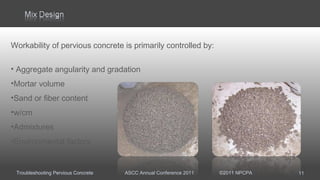
Workability of pervious concrete is primarily controlled by:
• Aggregate angularity and gradation
•Mortar volume
•Sand or fiber content
•w/cm
•Admixtures
•Environmental factors
11
Troubleshooting Pervious Concrete ASCC Annual Conference 2011 ©2011 NPCPA
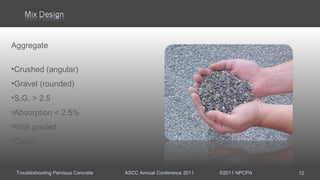
Aggregate
•Crushed (angular)
•Gravel (rounded)
•S.G. > 2.5
•Absorption < 2.5%
•Well graded
•Clean
12
Troubleshooting Pervious Concrete ASCC Annual Conference 2011 ©2011 NPCPA
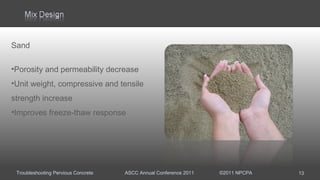
Sand
•Porosity and permeability decrease
•Unit weight, compressive and tensile
strength increase
•Improves freeze-thaw response
13
Troubleshooting Pervious Concrete ASCC Annual Conference 2011 ©2011 NPCPA
Fibers
•Permeability increases
•Unit weight, compressive and tensile
strength increase
•Improves freeze-thaw response
14
Troubleshooting Pervious Concrete ASCC Annual Conference 2011 ©2011 NPCPA
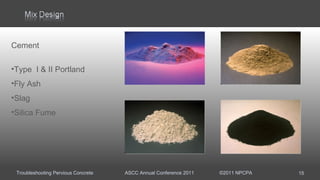
Cement
•Type I & II Portland
•Fly Ash
•Slag
•Silica Fume
15
Troubleshooting Pervious Concrete ASCC Annual Conference 2011 ©2011 NPCPA
Admixtures used in a pervious concrete mixture:
•Air entraining
•Viscosity modifying
•Water reducing
•Internal curing
•Hydration stabilizing
16
Troubleshooting Pervious Concrete ASCC Annual Conference 2011 ©2011 NPCPA
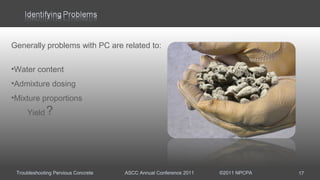
Generally problems with PC are related to:
•Water content
•Admixture dosing
•Mixture proportions
Yield
17
?
Troubleshooting Pervious Concrete ASCC Annual Conference 2011 ©2011 NPCPA 18
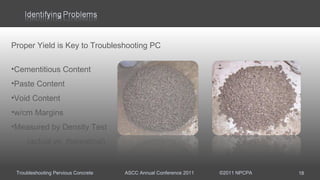
Proper Yield is Key to Troubleshooting PC
•Cementitious Content
•Paste Content
•Void Content
•w/cm Margins
•Measured by Density Test
(actual vs. theoretical)
Troubleshooting Pervious Concrete ASCC Annual Conference 2011 ©2011 NPCPA 19
Troubleshooting Pervious Concrete ASCC Annual Conference 2011 ©2011 NPCPA 20
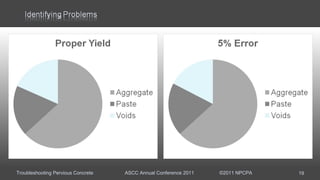
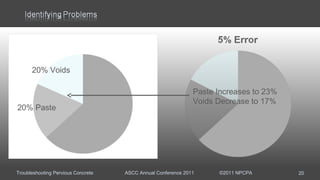
Paste Increases to 23%
Voids Decrease to 17%
20% Voids
20% Paste
Troubleshooting Pervious Concrete ASCC Annual Conference 2011 ©2011 NPCPA
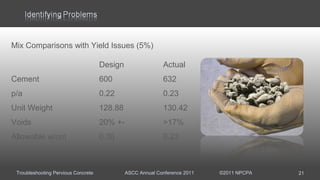
Mix Comparisons with Yield Issues (5%)
Design Actual
Cement 600 632
p/a 0.22 0.23
Unit Weight 128.88 130.42
Voids 20% +- >17%
Allowable w/cm 0.30 0.23
21
Troubleshooting Pervious Concrete ASCC Annual Conference 2011 ©2011 NPCPA 22
Troubleshooting Pervious Concrete ASCC Annual Conference 2011 ©2011 NPCPA 23
Mix Design
Total Weight in Mix Design
= Yield
Unit Weight (UW)
QC in Field
Total Weight Batched
/ UW = Yield
CY Batched
Troubleshooting Pervious Concrete ASCC Annual Conference 2011 ©2011 NPCPA
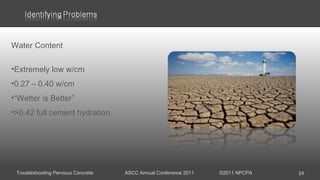
Water Content
•Extremely low w/cm
•0.27 – 0.40 w/cm
•“Wetter is Better”
•>0.42 full cement hydration
24
Troubleshooting Pervious Concrete ASCC Annual Conference 2011 ©2011 NPCPA 25
http://youtu.be/lTas3hbsk58
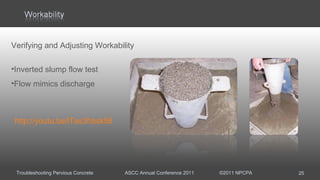
Verifying and Adjusting Workability
•Inverted slump flow test
•Flow mimics discharge
Troubleshooting Pervious Concrete ASCC Annual Conference 2011 ©2011 NPCPA 26
Event Late Fall parking lot placement
Main Issue Sticky mixture required re-tempering with water several time per
load to maintain workability.
Mixture Rounded-river gravel with sand and fibers, fly ash, 0.29 w/c, water
reducer, hydration stabilizer, and air entrainment.
Observations: Placement occurred during the fall and temperature had dropped
between the test pour and actual placement.
Hindsight: Pervious was batched with hot water.
Remediation: Do not use hot water; increase hydration stabilizer dosage; or
dose water reducer at the site.
Troubleshooting Pervious Concrete ASCC Annual Conference 2011 ©2011 NPCPA 27
Event Spring parking lot placement.
Main Issue Change in mixture workability as placement progressed.
Mixture Rounded-river gravel with sand and fibers, fly ash, 0.29 w/c, water
reducer, hydration stabilizer, and air entrainment.
Observations: At the start of placement workability was correct. As the
placement progressed water was added when truck first arrived and halfway
through each load.
Hindsight: Aggregate moisture was checked once at the beginning of the
placement, but changed throughout the day.
Remediation: When workability began to change aggregate moisture should
have been rechecked.
Troubleshooting Pervious Concrete ASCC Annual Conference 2011 ©2011 NPCPA 28
Event Early spring parking lot placement.
Main Issue Discharge rate was slow and the sticky mixture required re-
tempering several times per load.
Mixture Rounded river gravel with water reducer, air entrainment, and
hydration stabilizer.
Observations: Contractor had been told pervious was supposed to be
stiff and accepted the concrete.
Hindsight: The first truck should have been verified before batching additional
concrete. Contractor should have rejected the third truck.
Remediation: Do not use hot water; increase hydration stabilizer dosage; or add
additional water reducer at the site.
Troubleshooting Pervious Concrete ASCC Annual Conference 2011 ©2011 NPCPA 29
Event Fall parking lot placement
Main Issue Mixture was very dry and had severe next day raveling.
Mixture River gravel mixture with slag and hydration stabilizer.
Observations: Mixture was dry on arrival and required significant water addition.
During the second placement raveling occurred and it appeared the
previous days pour had not reached sufficient strength.
Hindsight: Combination of slag and hydration stabilizer delayed set time.
Remediation: Check aggregate moisture as the concrete is batched. Reduce the
amount of slag and or hydration stabilizer or postpone adjacent
placement.
Troubleshooting Pervious Concrete ASCC Annual Conference 2011 ©2011 NPCPA 30
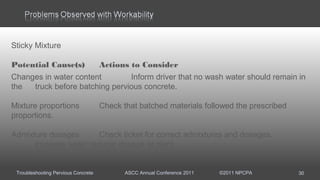
Sticky Mixture
Potential Cause(s) Actions to Consider
Changes in water content Inform driver that no wash water should remain in
the truck before batching pervious concrete.
Mixture proportions Check that batched materials followed the prescribed
proportions.
Admixture dosages Check ticket for correct admixtures and dosages.
Increase water reducer dosage at plant.
Add water reducer at the job site.
Troubleshooting Pervious Concrete ASCC Annual Conference 2011 ©2011 NPCPA 31
Sticky Mixture
Potential Cause(s) Actions to Consider
Admixture effectiveness Use a water reducer with a longer working time
Add additional water reducer at the job site.
Haul Time Increase w/c to higher end of allowable limit.
Increase hydration stabilizer dosage at the plant.
Add water reducer at the job site.
Ambient temperature Check that batch plant is not using warm/hot water.
Troubleshooting Pervious Concrete ASCC Annual Conference 2011 ©2011 NPCPA 32
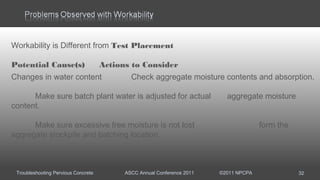
Workability is Different from Test Placement
Potential Cause(s) Actions to Consider
Changes in water content Check aggregate moisture contents and absorption.
Make sure batch plant water is adjusted for actual aggregate moisture
content.
Make sure excessive free moisture is not lost form the
aggregate stockpile and batching location.
Troubleshooting Pervious Concrete ASCC Annual Conference 2011 ©2011 NPCPA 33
Workability is Different from Test Placement
Potential Cause(s) Actions to Consider
Mixture proportions Check that batched materials followed the prescribed
proportions.
Admixture dosages Check batch plant/delivery ticket for correct admixtures
and dosages.
Change in admixtures Check that the correct admixtures were batched.
Troubleshooting Pervious Concrete ASCC Annual Conference 2011 ©2011 NPCPA 34
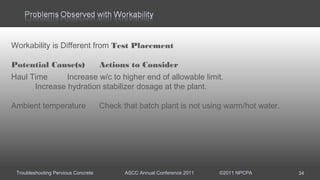
Workability is Different from Test Placement
Potential Cause(s) Actions to Consider
Haul Time Increase w/c to higher end of allowable limit.
Increase hydration stabilizer dosage at the plant.
Ambient temperature Check that batch plant is not using warm/hot water.
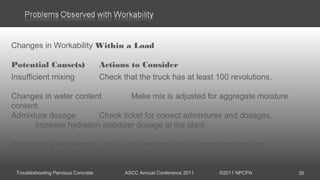
Troubleshooting Pervious Concrete ASCC Annual Conference 2011 ©2011 NPCPA 35
Changes in Workability Within a Load
Potential Cause(s) Actions to Consider
Insufficient mixing Check that the truck has at least 100 revolutions.
Changes in water content Make mix is adjusted for aggregate moisture
content.
Admixture dosage Check ticket for correct admixtures and dosages.
Increase hydration stabilizer dosage at the plant.
Admixture effectiveness Use a water reducer with a longer working time.
Use a moisture retaining admixture.
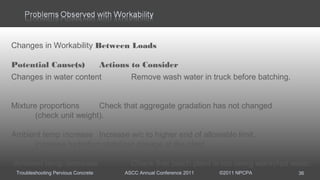
Troubleshooting Pervious Concrete ASCC Annual Conference 2011 ©2011 NPCPA 36
Changes in Workability Between Loads
Potential Cause(s) Actions to Consider
Changes in water content Remove wash water in truck before batching.
Mixture proportions Check that aggregate gradation has not changed
(check unit weight).
Ambient temp increase Increase w/c to higher end of allowable limit.
Increase hydration stabilizer dosage at the plant.
Ambient temp decrease Check that batch plant is not using warm/hot water.
Troubleshooting Pervious Concrete ASCC Annual Conference 2011 ©2011 NPCPA 37
Adding Water Does Not Improve Workability
Potential Cause(s) Actions to Consider
Admixture dosages Check ticket for correct admixtures and dosages.
Increase hydration stabilizer dosage at plant.
Add water reducer at the job site.
Mixture proportions Check that aggregate gradation has not changed
(check unit weight).
Ambient temperature Check that batch plant is not using warm/hot water.
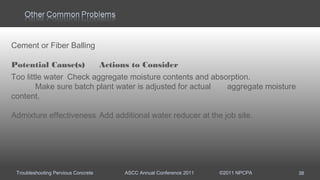
Troubleshooting Pervious Concrete ASCC Annual Conference 2011 ©2011 NPCPA 38
Cement or Fiber Balling
Potential Cause(s) Actions to Consider
Too little water Check aggregate moisture contents and absorption.
Make sure batch plant water is adjusted for actual aggregate moisture
content.
Admixture effectiveness Add additional water reducer at the job site.
Troubleshooting Pervious Concrete ASCC Annual Conference 2011 ©2011 NPCPA 39
Surface Closes
Potential Cause(s) Actions to Consider
Mixture proportions Check that batched materials followed the prescribed
proportions.
Check that aggregate gradation has not changed
(check unit weight).
Troubleshooting Pervious Concrete ASCC Annual Conference 2011 ©2011 NPCPA 40
Surface Ravels (also caused by poor construction and curing practices)
Potential Cause(s) Actions to Consider
Too little water Check aggregate moisture contents and absorption
Make sure batch plant water is adjusted for actual aggregate moisture
content.
Increased set time Reduce slag content.
Mixture proportions Check that batched materials followed the prescribed
proportions.
Troubleshooting Pervious Concrete ASCC Annual Conference 2011 ©2011 NPCPA 41
www.npcpa.org
National Pervious Concrete Pavement Association
For More Information Contact:
Dale Fisher
Executive Director, NPCPA
dfisher@npcpa.org

Troubleshooting Pervious Concrete

  • 1.
    Presented By: National PerviousConcrete Pavement Association
  • 2.
    Presented By: National PerviousConcrete Pavement Association
  • 3.
    Troubleshooting Pervious ConcreteASCC Annual Conference 2011 ©2011 NPCPA National Pervious Concrete Pavement Association Mission •Expand and improve the use of PC. •Partner together those who utilize PC. •Authoritative voice of pervious concrete. •Promote and advocate common positions. •Represent before industry, government, and the public. 3
  • 4.
    Troubleshooting Pervious ConcreteASCC Annual Conference 2011 ©2011 NPCPA 4
  • 5.
    Troubleshooting Pervious ConcreteASCC Annual Conference 2011 ©2011 NPCPA National Pervious Concrete Pavement Association •Educational Partner of : W.O.C. ASLA •ISBN Publisher Design of Pervious Concrete Mixtures 2.0 •Certification & Accreditation Design for Pervious Concrete Certification (DPC) 5
  • 8.
    Troubleshooting Pervious ConcreteASCC Annual Conference 2011 ©2011 NPCPA Upon completing this session, you should be able to: Recognize quality PC mixtures; Control the quality of a PC mix throughout a project;  Identify the cause of failure of PC pavements; and Provide options for the repair of PC pavement. 8
  • 9.
    Troubleshooting Pervious ConcreteASCC Annual Conference 2011 ©2011 NPCPA Pervious Concrete Mixes •Interconnected voids are termed “porosity” •Design Void Content (DVC), typically around 20% •Quality controlled by the design unit weight for a corresponding DVC 9
  • 10.
    Troubleshooting Pervious ConcreteASCC Annual Conference 2011 ©2011 NPCPA The primary considerations when determining a mixture design are: •Strength for loading •Freeze-thaw resistance •Porosity 10
  • 11.
    Troubleshooting Pervious ConcreteASCC Annual Conference 2011 ©2011 NPCPA Workability of pervious concrete is primarily controlled by: • Aggregate angularity and gradation •Mortar volume •Sand or fiber content •w/cm •Admixtures •Environmental factors 11
  • 12.
    Troubleshooting Pervious ConcreteASCC Annual Conference 2011 ©2011 NPCPA Aggregate •Crushed (angular) •Gravel (rounded) •S.G. > 2.5 •Absorption < 2.5% •Well graded •Clean 12
  • 13.
    Troubleshooting Pervious ConcreteASCC Annual Conference 2011 ©2011 NPCPA Sand •Porosity and permeability decrease •Unit weight, compressive and tensile strength increase •Improves freeze-thaw response 13
  • 14.
    Troubleshooting Pervious ConcreteASCC Annual Conference 2011 ©2011 NPCPA Fibers •Permeability increases •Unit weight, compressive and tensile strength increase •Improves freeze-thaw response 14
  • 15.
    Troubleshooting Pervious ConcreteASCC Annual Conference 2011 ©2011 NPCPA Cement •Type I & II Portland •Fly Ash •Slag •Silica Fume 15
  • 16.
    Troubleshooting Pervious ConcreteASCC Annual Conference 2011 ©2011 NPCPA Admixtures used in a pervious concrete mixture: •Air entraining •Viscosity modifying •Water reducing •Internal curing •Hydration stabilizing 16
  • 17.
    Troubleshooting Pervious ConcreteASCC Annual Conference 2011 ©2011 NPCPA Generally problems with PC are related to: •Water content •Admixture dosing •Mixture proportions Yield 17 ?
  • 18.
    Troubleshooting Pervious ConcreteASCC Annual Conference 2011 ©2011 NPCPA 18 Proper Yield is Key to Troubleshooting PC •Cementitious Content •Paste Content •Void Content •w/cm Margins •Measured by Density Test (actual vs. theoretical)
  • 19.
    Troubleshooting Pervious ConcreteASCC Annual Conference 2011 ©2011 NPCPA 19
  • 20.
    Troubleshooting Pervious ConcreteASCC Annual Conference 2011 ©2011 NPCPA 20 Paste Increases to 23% Voids Decrease to 17% 20% Voids 20% Paste
  • 21.
    Troubleshooting Pervious ConcreteASCC Annual Conference 2011 ©2011 NPCPA Mix Comparisons with Yield Issues (5%) Design Actual Cement 600 632 p/a 0.22 0.23 Unit Weight 128.88 130.42 Voids 20% +- >17% Allowable w/cm 0.30 0.23 21
  • 22.
    Troubleshooting Pervious ConcreteASCC Annual Conference 2011 ©2011 NPCPA 22
  • 23.
    Troubleshooting Pervious ConcreteASCC Annual Conference 2011 ©2011 NPCPA 23 Mix Design Total Weight in Mix Design = Yield Unit Weight (UW) QC in Field Total Weight Batched / UW = Yield CY Batched
  • 24.
    Troubleshooting Pervious ConcreteASCC Annual Conference 2011 ©2011 NPCPA Water Content •Extremely low w/cm •0.27 – 0.40 w/cm •“Wetter is Better” •>0.42 full cement hydration 24
  • 25.
    Troubleshooting Pervious ConcreteASCC Annual Conference 2011 ©2011 NPCPA 25 http://youtu.be/lTas3hbsk58 Verifying and Adjusting Workability •Inverted slump flow test •Flow mimics discharge
  • 26.
    Troubleshooting Pervious ConcreteASCC Annual Conference 2011 ©2011 NPCPA 26 Event Late Fall parking lot placement Main Issue Sticky mixture required re-tempering with water several time per load to maintain workability. Mixture Rounded-river gravel with sand and fibers, fly ash, 0.29 w/c, water reducer, hydration stabilizer, and air entrainment. Observations: Placement occurred during the fall and temperature had dropped between the test pour and actual placement. Hindsight: Pervious was batched with hot water. Remediation: Do not use hot water; increase hydration stabilizer dosage; or dose water reducer at the site.
  • 27.
    Troubleshooting Pervious ConcreteASCC Annual Conference 2011 ©2011 NPCPA 27 Event Spring parking lot placement. Main Issue Change in mixture workability as placement progressed. Mixture Rounded-river gravel with sand and fibers, fly ash, 0.29 w/c, water reducer, hydration stabilizer, and air entrainment. Observations: At the start of placement workability was correct. As the placement progressed water was added when truck first arrived and halfway through each load. Hindsight: Aggregate moisture was checked once at the beginning of the placement, but changed throughout the day. Remediation: When workability began to change aggregate moisture should have been rechecked.
  • 28.
    Troubleshooting Pervious ConcreteASCC Annual Conference 2011 ©2011 NPCPA 28 Event Early spring parking lot placement. Main Issue Discharge rate was slow and the sticky mixture required re- tempering several times per load. Mixture Rounded river gravel with water reducer, air entrainment, and hydration stabilizer. Observations: Contractor had been told pervious was supposed to be stiff and accepted the concrete. Hindsight: The first truck should have been verified before batching additional concrete. Contractor should have rejected the third truck. Remediation: Do not use hot water; increase hydration stabilizer dosage; or add additional water reducer at the site.
  • 29.
    Troubleshooting Pervious ConcreteASCC Annual Conference 2011 ©2011 NPCPA 29 Event Fall parking lot placement Main Issue Mixture was very dry and had severe next day raveling. Mixture River gravel mixture with slag and hydration stabilizer. Observations: Mixture was dry on arrival and required significant water addition. During the second placement raveling occurred and it appeared the previous days pour had not reached sufficient strength. Hindsight: Combination of slag and hydration stabilizer delayed set time. Remediation: Check aggregate moisture as the concrete is batched. Reduce the amount of slag and or hydration stabilizer or postpone adjacent placement.
  • 30.
    Troubleshooting Pervious ConcreteASCC Annual Conference 2011 ©2011 NPCPA 30 Sticky Mixture Potential Cause(s) Actions to Consider Changes in water content Inform driver that no wash water should remain in the truck before batching pervious concrete. Mixture proportions Check that batched materials followed the prescribed proportions. Admixture dosages Check ticket for correct admixtures and dosages. Increase water reducer dosage at plant. Add water reducer at the job site.
  • 31.
    Troubleshooting Pervious ConcreteASCC Annual Conference 2011 ©2011 NPCPA 31 Sticky Mixture Potential Cause(s) Actions to Consider Admixture effectiveness Use a water reducer with a longer working time Add additional water reducer at the job site. Haul Time Increase w/c to higher end of allowable limit. Increase hydration stabilizer dosage at the plant. Add water reducer at the job site. Ambient temperature Check that batch plant is not using warm/hot water.
  • 32.
    Troubleshooting Pervious ConcreteASCC Annual Conference 2011 ©2011 NPCPA 32 Workability is Different from Test Placement Potential Cause(s) Actions to Consider Changes in water content Check aggregate moisture contents and absorption. Make sure batch plant water is adjusted for actual aggregate moisture content. Make sure excessive free moisture is not lost form the aggregate stockpile and batching location.
  • 33.
    Troubleshooting Pervious ConcreteASCC Annual Conference 2011 ©2011 NPCPA 33 Workability is Different from Test Placement Potential Cause(s) Actions to Consider Mixture proportions Check that batched materials followed the prescribed proportions. Admixture dosages Check batch plant/delivery ticket for correct admixtures and dosages. Change in admixtures Check that the correct admixtures were batched.
  • 34.
    Troubleshooting Pervious ConcreteASCC Annual Conference 2011 ©2011 NPCPA 34 Workability is Different from Test Placement Potential Cause(s) Actions to Consider Haul Time Increase w/c to higher end of allowable limit. Increase hydration stabilizer dosage at the plant. Ambient temperature Check that batch plant is not using warm/hot water.
  • 35.
    Troubleshooting Pervious ConcreteASCC Annual Conference 2011 ©2011 NPCPA 35 Changes in Workability Within a Load Potential Cause(s) Actions to Consider Insufficient mixing Check that the truck has at least 100 revolutions. Changes in water content Make mix is adjusted for aggregate moisture content. Admixture dosage Check ticket for correct admixtures and dosages. Increase hydration stabilizer dosage at the plant. Admixture effectiveness Use a water reducer with a longer working time. Use a moisture retaining admixture.
  • 36.
    Troubleshooting Pervious ConcreteASCC Annual Conference 2011 ©2011 NPCPA 36 Changes in Workability Between Loads Potential Cause(s) Actions to Consider Changes in water content Remove wash water in truck before batching. Mixture proportions Check that aggregate gradation has not changed (check unit weight). Ambient temp increase Increase w/c to higher end of allowable limit. Increase hydration stabilizer dosage at the plant. Ambient temp decrease Check that batch plant is not using warm/hot water.
  • 37.
    Troubleshooting Pervious ConcreteASCC Annual Conference 2011 ©2011 NPCPA 37 Adding Water Does Not Improve Workability Potential Cause(s) Actions to Consider Admixture dosages Check ticket for correct admixtures and dosages. Increase hydration stabilizer dosage at plant. Add water reducer at the job site. Mixture proportions Check that aggregate gradation has not changed (check unit weight). Ambient temperature Check that batch plant is not using warm/hot water.
  • 38.
    Troubleshooting Pervious ConcreteASCC Annual Conference 2011 ©2011 NPCPA 38 Cement or Fiber Balling Potential Cause(s) Actions to Consider Too little water Check aggregate moisture contents and absorption. Make sure batch plant water is adjusted for actual aggregate moisture content. Admixture effectiveness Add additional water reducer at the job site.
  • 39.
    Troubleshooting Pervious ConcreteASCC Annual Conference 2011 ©2011 NPCPA 39 Surface Closes Potential Cause(s) Actions to Consider Mixture proportions Check that batched materials followed the prescribed proportions. Check that aggregate gradation has not changed (check unit weight).
  • 40.
    Troubleshooting Pervious ConcreteASCC Annual Conference 2011 ©2011 NPCPA 40 Surface Ravels (also caused by poor construction and curing practices) Potential Cause(s) Actions to Consider Too little water Check aggregate moisture contents and absorption Make sure batch plant water is adjusted for actual aggregate moisture content. Increased set time Reduce slag content. Mixture proportions Check that batched materials followed the prescribed proportions.
  • 41.
    Troubleshooting Pervious ConcreteASCC Annual Conference 2011 ©2011 NPCPA 41 www.npcpa.org
  • 42.
    National Pervious ConcretePavement Association For More Information Contact: Dale Fisher Executive Director, NPCPA dfisher@npcpa.org

Editor's Notes

  • #3 While pervious concrete is comprised of the same components as traditional concrete, its idiosyncrasies have forced the mixture proportioning to develop as an art form instead of a clear set of procedures. Although an unlimited number of variations on pervious concrete mixture proportions can exist, this program outlines procedures to produce pervious concrete for a wide-variety of applications. These procedures are developed based on research performed by the collective pervious concrete community in the United States, and from across the world. Field experience and troubleshooting sections are included to aid identifying potential mixture related issues and contains remediation methods.
  • #4 NPCPA is the only cross-industry alliance that partners together all those who utilize pervious concrete systems to achieve their sustainable goals.   The mission of the Association is to expand and improve the use of pervious concrete as a preferred paving method by providing education and resources that enhance quality and performance. The Association’s vision is to be the recognized and authoritative voice of pervious concrete. NPCPA resources include experienced, professional staff that, working with our members, will promote and advocate common positions and represent those interests before industry, government, and the public.  
  • #5 Membership categories include Owners, Designers, Producers, Regulators, Contractors, Developers, and Manufacturers. They represent the wide variety of private industry businesses and public entities that provide products, equipment, and services that benefit the public.
  • #9 This session will familiarize attendees with issues affecting successful production and placement of pervious concrete, including performance, testing, aspects of placement execution, and long term care and maintenance.  Attendees will learn to identify the tell-tell signs of problems with pervious concrete mixtures that effect proper placement, learn about testing methods that produce quality assurance, and learn methods and means for the repair and maintenance of pervious concrete pavements.  
  • #10 The purpose of pervious concrete for stormwater management is to transmit water through the pavement into the underlying holding layer where it either infiltrates into the ground or is discharged into a stormwater system. In an overlay situation the water infiltrates into the pervious pavement to reduce splash and spray, eliminates hydroplaning potential, improves skid resistance, and is drained away from the pavement system. This percolation of water is achieved through a series of interconnected voids which are termed the porosity. Void space that comprises porosity is interconnected and rapidly permeable to water movement and is fundamentally different than entrained air captured in the cement paste. Producing pervious concrete with a specific Design Void Content (DVC), typically around 20%, allows quality control by determining the design unit weight for a corresponding DVC.
  • #11 Similar to asphalt production, pervious concrete performance is influenced by the density. But unlike asphalt, using more force to compact a stiff, dry, unworkable, pervious concrete to the DVC will not produce a durable pavement. Production of a durable pavement requires consideration of both the workability of the pervious concrete mixture as well as to the method of placement. Hence, to achieve an optimal pervious concrete placement the producer must be aware of the site layout, the contractor’s experience, along with material properties associated with the pervious concrete. A mixture that had success for an experienced contractor on a straightforward site under ideal conditions might have significant problems for an inexperienced contractor or under more difficult site geometries or different weather conditions. Recognizing and understanding the differences in behavior between traditional and pervious concrete allows successful placements. The primary considerations when determining a mixture design are 1. Strength for loading. 2. Freeze-thaw resistance of the concrete and also durability against winter maintenance operations such as plowing and use of deicers. 3. Porosity to produce the desired permeability and maximize the required maintenance intervals.
  • #12 The goal of a pervious concrete placement is a smooth and durable surface with the desired void content produced at a given unit weight. These are obtained through proper mixture proportions which possess the necessary inherent workability. Pervious concrete material properties and workability are a function of aggregate angularity, aggregate gradation, cementitious volume, cementitious makeup, water-to-cement ratio, admixtures, and environmental factors such as mixing time, water temperature, and mixer/truck moisture state. In order to provide an understanding of some design decisions, the following overview of research discusses the relative effects of each of these components with respect to workability, strength, and freeze-thaw durability. As the porosity of PCPC increases the unit weight decreases linearly. Compressive strength decreases with increased porosity. Permeability tends to be very low (&amp;lt;10 in./hr) below 15% porosity and increases exponentially above 25%. An increased amount of cement paste creates a linear decrease in porosity for mixtures without sand. Permeability decreases with increased compaction level. Each particular mixture has an inherent set of compaction relationships which may be used for quality control purposes. Angular aggregates require more cementitious binder to produce similar workability and strength as the more self-compacting round aggregate.
  • #13 Aggregate comprises the largest volume of material in pervious concrete and consequently aggregate angularity has the largest influence on the ultimate unit weight. The size of the aggregate will vary depending on the application and use of the pervious concrete pavement being constructed. Both rounded aggregate (gravel) and angular aggregate (crushed stone) can be used to produce pervious concrete. Angular aggregate has more surface area than rounded aggregate and in order to produce similar cementitious paste coatings and load transfer, angular mixtures require more cementitious material. The use of good quality, clean, well-graded crushed aggregate has been observed to result in pervious concrete pavements with improved structural properties, reduced raveling and improved permeability. In freeze-thaw climates coarse aggregate should have a specific gravity greater than 2.5 and absorption less than 2.5%. Before determining the amount of fine aggregate required, the coarse aggregate must first be selected to achieve sufficient initial porosity to add mortar. Through experience, gradation requirements have been developed in which the lower gradation limit represents a point at which there is a likelihood of creating concrete without sufficient permeability and the upper gradation limit represents a level where the mixture is too harsh for rapid placement and compaction by conventional means. Also, the finer texture is more aesthetically pleasing and at the upper gradation and above the pavement resembles a cement-treated base.
  • #14 The addition of sand decreases the porosity and permeability while increasing the unit weight, and compressive and tensile strength.
  • #15 When fibers are used in pervious concrete the mixture responds with decreased porosity and increased unit weight, compressive, and flexural strength. However, permeability is maintained or increased contrary to the reduction in porosity by the additional connectivity of the hydraulic channels. While many factors control freeze-thaw durability in pervious concrete, the addition of fibers causes a large improvement in freeze-thaw response without additional sand.
  • #16 Cement paste coats the aggregate particles, providing lubrication for workability, and hardened contact area for load transfer. As more cement paste is incorporated, the mixture becomes more workable, although reducing porosity. With binder-to-aggregate contents of b/a = 0.18 to 0.22 by volume (depending on the aggregate gradation and ultimate strength required) the paste completely coats the aggregate particles without occupying too much of the pore space. Supplementary cementitious materials (SCMs) improve the cement hydration chemistry and provide greater durability along with other beneficial properties. Fly ash, slag and silica fume improve workability and the ultimate strength of pervious concrete, but may reduce the 7-day strengths which may be critical to durability upon opening.
  • #17 There are several types of admixtures used in a pervious concrete mixture; air entraining, viscosity modifying, water reducing, internal curing and hydration stabilizing. Pervious concrete can substantially reduce the working time of admixtures and many placements have shown that polycarboxylate type water reducers increase workability. Hydration stabilizer maintains workability by preventing premature cement hydration from heat build-up during mixing and by extending the working time of the water reducer. If a standard retarder is substituted for hydration stabilizer tests mixtures are required to determine the proper dosage rate for particular environmental and haul conditions. Internal curing admixture (ICA) maintains moisture conditions in a pervious concrete mixture to allow cement hydration to occur so that the potential properties of the mixture may develop. Within the normal dosage range, it will generally extend the hydration time of pervious concrete approximately 3 to 7 days. Viscosity modifying admixtures (VMA) produce better flow and easier placement and compaction of an otherwise dry, harsh mix. In addition, the use of a VMA provides insurance against paste drain down. Paste drain down is a condition in which too fluid a cement paste in pervious concrete migrates to the bottom of the slab, due to gravity, and seals it. This sealing of the bottom surface makes the pervious concrete functionally useless and can be avoided through use of a VMA.
  • #18 Some material-related issues can be remediated by changing construction practices, but for this section the suggested changes are only from the concrete producer’s perspective. Generally problems with pervious concrete are related to water content, mixture proportions, or admixture dosing. Additional troubleshooting techniques for traditional concrete can be found in the Integrated Materials and Construction Practices for Concrete Pavement: A State-of-the-Practice manual (Taylor et al. 2006).
  • #19 Proper yield is key to troubleshooting PC Cementitious content Paste content Void content w/cm margins Measured by density test (actual vs. Theoretical)
  • #20 Yield variations can have a large impact on mixture proportions.
  • #22 In this example, when yield is off by 5%, it produces a mixture overloaded with paste and reduced voids. The producer/installer is forced to place at a much lower w/cm in order to maintain permeability.
  • #23 Examples of low w/cm mixtures.
  • #24 Formula for calculating yield.
  • #25 Under normal conditions, w/cm less than 0.27 results in failure through surface raveling and w/cm greater than 0.35 causes draining of the cement paste producing an impermeable pervious concrete surface. Admixtures are used to increase the w/cm (up to 0.40) for better hydration of the cementitious. Correct aggregate moisture content is paramount for a successful pervious concrete placement. Excess moisture in the aggregate bin may be lost when conveyed to the batching location. An unexpected loss of 1% moisture will reduce a w/c of 0.30 below 0.27, resulting in a mixture susceptible to excessive raveling. Often for pervious concrete any extra aggregate moisture is disregarded in the batching process.
  • #26 When the truck arrives at the site, the workability must be checked and adjusted if needed. On-site workability of pervious concrete is determined by the inverse slump flow test. The flow behavior of pervious concrete through a slump cone closely reproduces the discharge ability from the concrete truck. 1. Fill an inverted slump cone with fresh concrete (do not to rod or compact) to roughly level with the top surface (Figure 9). 2. With one even motion, lift the slump cone to approximately knee level. If required, lightly tap the cone to initiate flow If concrete flows from the cone then it will discharge easily from the truck chute (Figure 11a). If the material sticks in the cone and requires substantial energy (vigorous shaking) to free the concrete, then the concrete is too stiff, will be difficult to discharge, have high porosity, low strength, and high raveling potential.
  • #27 Background Information: Well-known pervious concrete mixture
  • #28 Background Information: Placement was a short haul situation from plant to site.
  • #29 Background Information: Three concrete trucks were batched and sent to the site at once. Concrete plant was using hot water. It was the first pervious placement for the contractor.
  • #30 Background Information: Due to construction schedule, adjacent strips were placed the following day.
  • #38 Adding Water Does Not Improve Workability Potential Cause(s) Actions to Consider Admixture dosages Check delivery ticket for correct admixtures and dosages. Increase hydration stabilizer dosage at the plant. Add water reducer at the job site. Admixture effectiveness Use a water reducer with a longer working time Add additional water reducer at the job site. Mixture proportions Check that batched materials followed the prescribed proportions. Ambient temperature Check that batch plant is not using warm/hot water.
  • #43 References: American Concrete Institute (ACI) Pervious Concrete, ACI 522 Committee Report, Farmington Hills, MI: ACI, 2006. American Concrete Institute (ACI) Specification for Pervious Concrete Pavement, ACI 522.1-08, Farmington Hills, MI: ACI, 2008. Bax, N., van Duerzen, A., Molenaar, A. New Technique for Rapid Construction and Rehabilitation of Concrete Pavements, Proceedings of the International Conference on Optimizing Paving Concrete Mixtures and Accelerated Concrete Pavement Construction and Rehabilitation, Federal Highway Administration (FHWA), Atlanta, GA, pp. 283-293, 2007. Beeldens, A,. Van Gemert, D., and Caestecker, C. Porous Concrete: Laboratory Versus Field Experience. Proceedings 9th International Symposium on Concrete Roads, Istanbul, Turkey, 2003. Beeldens, A. Behavior of Porous PCC Under Freeze-Thaw Cycling. Paper presented at the Tenth International Congress on Polymers in Concrete, Honolulu, 2001. Bury, M. A., Mawby, C. A., and Fisher, D., 2006, &amp;quot;Making Pervious Concrete Placement Easy: Using a Novel Admixture System,&amp;quot; Concrete in Focus, V. 5, No. 3, pp. 55-59. Crouch, L., Smith, N., Walker, A., Dunn, T., and Sparkman, A. (2006) “Pervious PCC Compressive Strength in the Laboratory and the Field: The Effects of Aggregate Properties and Compactive Effort,” CD-ROM. Proceedings of the 2006 NRMCA Concrete Technology Forum – Focus on Pervious Concrete, Nashville, TN, 2006. Delatte, N., Miller, D., and Mrkajic, M. “Portland Cement Pervious Concrete: Field Performance Investigation on Parking Lot and Roadway Pavements.” Final Report of the RMC Research and Education Foundation, Silver Springs, MD, 2007. Kevern, J.T. Mix Design Determination for Freeze-thaw Resistant Portland Cement Pervious Concrete, Master’s Thesis, Ames, IA: Iowa State University, 2006. Kevern, J. T., Wang, K., Suleiman, M. T., and Schaefer, V. R. “Pervious Concrete Construction: Methods and Quality Control.” CD-ROM. Proceedings of the 2006 NRMCA Concrete Technology Forum – Focus on Pervious Concrete, Nashville, TN, 2006. Kevern, J.T., Schaefer, V.R., Wang, K., and Suleiman, M.T. “Pervious Concrete Mixture Proportions for Improved Freeze-Thaw Durability,” J. ASTM Int. Vol. 5, No. 2. 2008 (a). Kevern, J.T., Wang, K., and Schaefer, V. R. “A Synthesis of Pervious Concrete Freeze-Thaw Testing Results.” CD-ROM. Proceedings of the 2008 NRMCA Concrete Technology Forum – Focus on Sustainable Development, Denver, CO, 2008 (b). Kevern, J. T., Wang, K., and Schaefer, V. R. “Self-Consolidating Pervious Concrete.” Third North American Conference on the Design and Use of Self-Consolidating Concrete (SCC2008), Center for Advanced Cement-Based Materials at Northwestern University, 2008 (c). Kevern, J.T. Wang, K., and Schaefer, V.R. “The Effect of Aggregate Type on the Freeze-Thaw Durability of Pervious Concrete,” A Report from the Portland Cement Association Education Foundation, currently under review Feb 2008 (d). National Ready Mixed Concrete Association (NRMCA). (2005) “Text Reference for Pervious Concrete Contractor Certification.” NRMCA Publication #2PPCRT, Silver Springs, MD. Olek, J., W.J. Weiss, N. Neithalath, A. Marolf, E. Sell, and W.D. Thornton. Development of Quiet and Durable Porous Portland Cement Concrete Paving Materials. Final Report SQDH 2003-5. West Lafayette, IN: Purdue University. 2003. Schaefer, V.R., Wang, K., Sulieman, M.T., and Kevern, J. Mix Design Development for Pervious Concrete in Cold Weather Climates. A Report from the National Concrete Pavement Technology Center (CP Tech Center), Ames, IA: Iowa State University, 2006. Suleiman, M. T., Kevern, J. T., Schaefer, V. R., and Wang, K. “Effect of Compaction Energy on Pervious Concrete Properties.” Proceedings of the 2006 NRMCA Concrete Technology Forum – Focus on Pervious Concrete, Nashville, TN, CD-ROM. 2006. Tamai, M., and Yoshida, M. (2003) Durability of Porous Concrete. Paper presented at the Sixth International Conference on Durability of Concrete, Thessaloniki, Greece, 2003. Taylor, P.C., Kosmatka, S.H., Voigt, J.F., et al. “Integrated Materials and Construction Practices for Concrete Pavement: A State-of-the-Practice Manual.” A Report from the National Concrete Pavement Technology Center and Federal Highway Administration, Ames, IA: Iowa State University, 2006. Tennis, P.D., Leming, M.L., and Akers, D.J. “Pervious Concrete Pavements.” EB302, Portland Cement Association, Skokie, Illinois, and National Ready Mixed Concrete Association, Silver Spring, Maryland, 2004. Wang, K., Schaefer, V. R., Kevern, J. T., and Suleiman, M. T. Development of Mix Proportion for Functional and Durable Pervious Concrete. CD-ROM. Proceedings of the 2006 NRMCA Concrete Technology Forum – Focus on Pervious Concrete, Nashville, TN, 2006. Yang, J., and Jiang, G. Experimental Study on Properties of Pervious Concrete Pavement Materials. Cement and Concrete Research, V. 33, p. 381-386, 2003. Yang, Z., Brown, H., and Cheney, A. (2006) “Influence of Moisture Conditions on the Freeze-Thaw Durability of Portland Cement Pervious Concrete,” CD-ROM. Proceedings of the 2006 NRMCA Concrete Technology Forum – Focus on Pervious Concrete, Nashville, TN, 2006.