EPON N t
Network
k
Design Considerations

By SUN Telecom
http://www.suntelecom-cn.com/
Summarization
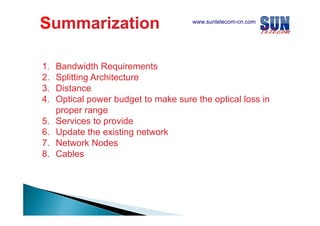
1.
2.
3.
3
4.
5.
6.
7.
8.

www.suntelecom-cn.com

Bandwidth Requirements
Splitting Architecture
Distance
Optical power budget to make sure the optical loss in
proper range
Services to provide
Update the existing network
Network Nodes
Cables
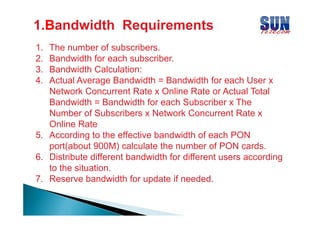
1.B
1.Bandwidth Requirements
1.
2.
3.
4.

The number of subscribers.
Bandwidth for each subscriber.
Bandwidth Calculation:
Actual Average Bandwidth = Bandwidth for each User x
Network Concurrent Rate x Online Rate or Actual Total
Bandwidth = Bandwidth for each Subscriber x The
Number of Subscribers x Network Concurrent Rate x
Online Rate
5. According to the effective bandwidth of each PON
g
port(about 900M) calculate the number of PON cards.
6. Distribute different bandwidth for different users according
to the situation.
7. Reserve bandwidth for update if needed.
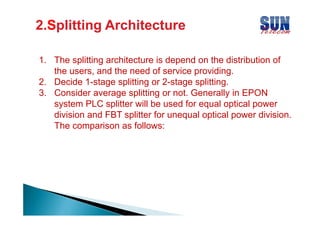
2.S
2.Splitting Architecture
1.
1 The splitting architecture is depend on the distribution of
the users, and the need of service providing.
2. Decide 1-stage splitting or 2-stage splitting.
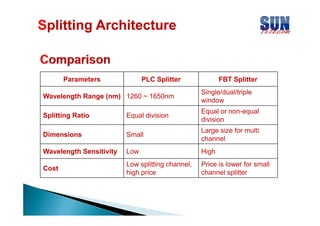
3. Consider average splitting or not. Generally in EPON
system PLC splitter will be used for equal optical power
division
di ision and FBT splitter for unequal optical po er di ision
neq al
power division.
The comparison as follows:
Splitting Architecture

Parameters

PLC Splitter

FBT Splitter

Wavelength Range (nm) 1260 ~ 1650nm

Single/dual/triple
window

Splitting Ratio
S litti R ti

Equal di i i
E
l division

Equal or non-equal
non equal
division

Dimensions

Small

Large size for multi
channel

Wavelength Sensitivity

Low

High

Cost

Low splitting channel
channel,
high price

Price is lower for small
channel splitter
Splitting Architecture

www.suntelecom-cn.com

4. For PLC splitter we have following splitting architectures:
p
g p
g
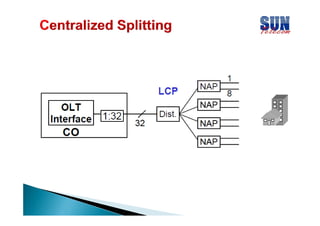
1. Distribution Splitting
2. Aggregation Splitting
3. Centralized Splitting
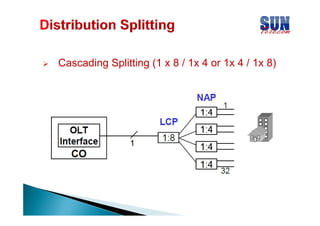
Cascading Splitting (1 x 8 / 1x 4 or 1x 4 / 1x 8)
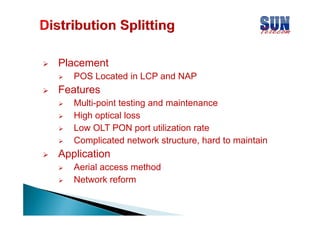
Placement
POS Located in LCP and NAP

Features
F t
Multi-point testing and maintenance
High ti l loss
Hi h optical l
Low OLT PON port utilization rate
Complicated net ork str ct re hard to maintain
network structure,

Application
A i l access method
th d
Aerial
Network reform
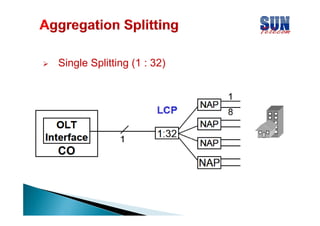
Single Splitting (1 : 32)
Placement
LCP

Features
Integrated link testing and user management
Low Optical loss
p
High OLT PON port utilization rate
Low cost for splitter
Simple network topology, easy to maintain

Application
Duct access method
New Project
Placement
CO

Features
Single point link testing and maintain
Low Optical loss
High OLT PON port utilization rate
Low cost for splitter
Dedicated cable for each house
Flexible topology
Huge infrastructure cost

Application
pp
Duct access, new project, user close to CO
1.
1 EPON can support a transmitting distance for about 20
km under 1:32 splitting ratio, and about 10 km under
1:64 splitting ratio.
2. The distance mainly depends on the optical loss. The
higher the optical loss is, the shorter the transmitting
distance will be
be.
3. If the transmitting distance of cable is more than 2 km,
fiber splicing should be taken into account.
4. For nodes in different distances we may use FBT
splitter to distribute more optical power for the further
node and less optical power for the nearer node thus
make sure all the nodes can get enough optical power.
5.O
5.Optical power budget
1. EPON System
2. CATV System
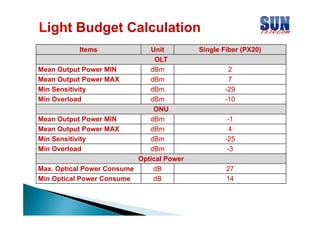
Light Budget Calculation
Items

Unit
OLT
Mean Output Power MIN
dBm
Mean Output Power MAX
dBm
Min Sensitivity
Mi S
iti it
dBm
dB
Min Overload
dBm
ONU
Mean Output Power MIN
dBm
Mean Output Power MAX
dBm
Min Sensitivity
dBm
Min Overload
dBm
Optical Power
Max. Optical Power Consume
dB
Min Optical Power Consume
dB

Single Fiber (PX20)
2
7
-29
29
-10
-1
4
-25
25
-3
27
14
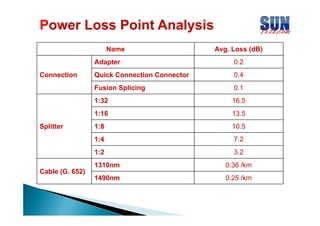
Power Loss Point Analysis
Name

Avg. Loss (dB)

Adapter

0.4
0.1
01

1:32

16.5

1:16

13.5
13 5

1:8

10.5

1:4

7.2
72

1:2

Splitter

Quick Connection Connector
Fusion Splicing

Connection

0.2
02

3.2

1310nm

0.36
0 36 /km

1490nm

0.25 /km

Cable (G. 652)
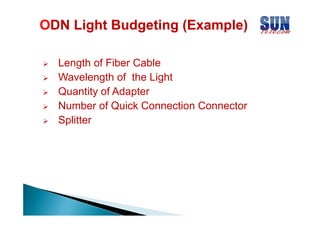
ODN Light Budgeting (Example)
Length of Fiber Cable
Wavelength of the Light
Quantity of Adapter
Q
f
Number of Quick Connection Connector
Splitter
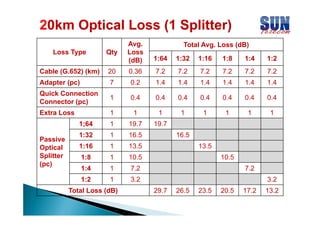
20km Optical Loss (1 Splitter)
Loss Type

Qty

Avg.
Loss
(dB)

1:64

1:32

1:16

1:8

1:4

1:2

Total Avg. Loss (dB)

Cable (G.652) (km)

20

0.36

7.2

7.2

7.2

7.2

7.2

7.2

Adapter (pc)

7

0.2

1.4

1.4

1.4

1.4

1.4

1.4

Quick Connection
Connector (pc)

1

0.4

0.4

0.4

0.4

0.4

0.4

0.4

Extra Loss

1

1

1

1

1

1

1

1

1;64

1

19.7

19.7

1:32

1

16.5

1:16

1

13.5

1:8

1

10.5

1:4

1

7.2

1:2

1

3.2

Passive
Optical
Splitter
(pc)

Total Loss (dB)

16.5
13.5
10.5
7.2
3.2
29.7
29 7

26.5
26 5

23.5
23 5

20.5
20 5

17.2
17 2

13.2
13 2
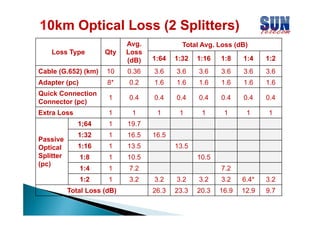
10km Optical Loss (2 Splitters)
(2
Loss Type

Qty

Avg.
Loss
(dB)

1:64

1:32

1:16

1:8

1:4

1:2

Total Avg. Loss (dB)

Cable (G.652) (km)

10

0.36

3.6

3.6

3.6

3.6

3.6

3.6

Adapter (pc)

8*

0.2

1.6

1.6

1.6

1.6

1.6

1.6

Quick Connection
Connector (pc)

1

0.4

0.4

0.4

0.4

0.4

0.4

0.4

Extra Loss

1

1

1

1

1

1

1

1

1;64

1

19.7

1:32

1

16.5

1:16

1

13.5

1:8

1

10.5

1:4

1

7.2

1:2

1

3.2

Passive
Optical
Splitter
(pc)

Total Loss (dB)

16.5
13.5
10.5
7.2
3.2

3.2

3.2

3.2

6.4*

3.2

26.3
26 3

23.3
23 3

20.3
20 3

16.9
16 9

12.9
12 9

9.7
97
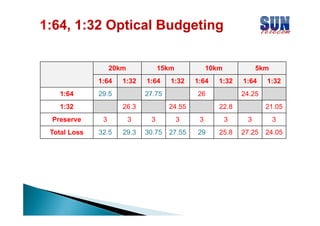
1:64, 1:32 Optical Budgeting
20km
1:64
1:64

15km

1:32

29.5

1:32

1:64

10km

1:32

27.75
26.3

1:64

5km

1:32

26
24.55

1:64

1:32

24.25
22.8

21.05

Preserve

3

3

3

3

3

3

3

3

Total Loss

32.5

29.3

30.75

27.55

29

25.8

27.25

24.05
www.suntelecom-cn.com

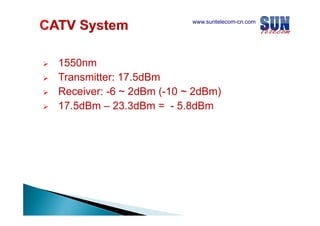
1550nm
Transmitter: 17.5dBm
Receiver: -6 ~ 2dBm (
(-10 ~ 2dBm)
)
17.5dBm – 23.3dBm = - 5.8dBm
5.S
5.Services to provide
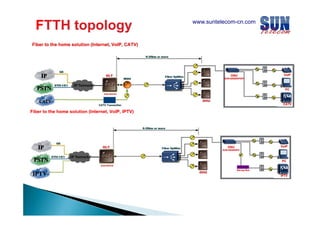
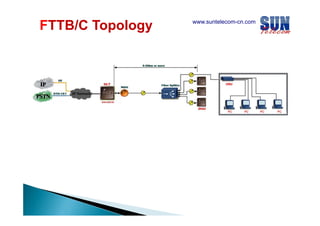
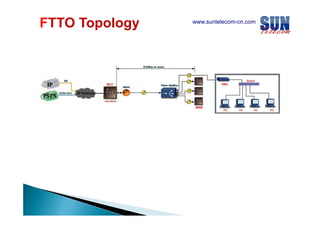
1. EPON provides services such as data, IPTV/CATV and VoIP,
widely used in various applications like FTTH, FTTB, FTTC,
triple pla sec rit s stem video surveillance s stem
play, security system, ideo s r eillance system,
intelligent community, city hotspot (airport, station, etc.), WiFi access, and even TDM over EPON
access
EPON.
2. FTTH topology.
3. FTTB/C topology.
4. FTTO topology.
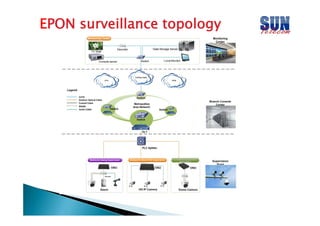
5. EPON surveillance topology.
FTTH topology

www.suntelecom-cn.com
FTTB/C Topology

www.suntelecom-cn.com
FTTO Topology

www.suntelecom-cn.com
EPON surveillance topology
1. Update the existing network by adding cables and devices
to provide new services.
2. CATV coaxial network can be upgraded to HFC network to
provide triple play service by adding EOC devices
devices.
3. Pure data EPON network can be upgraded to provide CATV
service by adding WDM devices.
4. CATV fiber optical network can be upgraded to provide triple
play service.
5. Former fiber optical network can also be upgraded to
provide services for a wider area and more users.
www.suntelecom-cn.com

1.Deployment
1 Deployment and design requirement
①OLT

central office should be easy to handling large
equipment
②Enough space for device installation and storage
③Good working environment (Temperature & Humidity)
④Central Office construction standard
⑤CO with fire safety equipment
ith fi
f t
i
t
⑥The CO should be far away from high-intensity vibration
source, noise source, electromagnetic interference, and
flammable and explosive materials
www.suntelecom-cn.com

2.Power
2 Power supply requirement
①Provide

-48V power supply
48V
②Highest power load requirement that the area can have
③Individual power line access dedicated power
access,
distribution box
④UPS power supply
www.suntelecom-cn.com

3.Grounding
3 Grounding requirement
①AC/DC

Power supply grounding
②Section size of grounding wire should greater than
25mm2
③Ground resistance should be less than 5 ohm
User aggregation point
Located in place that is easy to manage and
maintain
i t i
Building distributor, weak current vertical shaft,
outdoor optical cross-connection cabinet, man
d
i l
i
bi
hole, pole etc
Active connection, easy to inspect and
maintain
www.suntelecom-cn.com

Close to subscriber
The terminal device can not too big
Floor vertical shaft, staircase, electrical pole
f
Distribution cable spliced with drop cable
www.suntelecom-cn.com

For FTTH application, dedicated box for install
application
ONU, embedded on the wall
Local power supply
L
l
l
www.suntelecom-cn.com

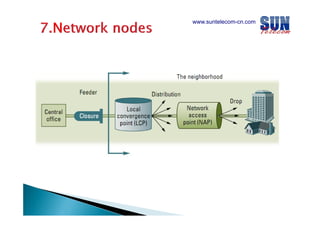
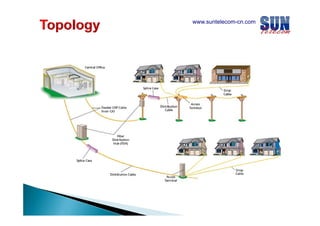
Feeder Fiber Cable
Feeder Cable for connection Cable from ODF in central
office and splitter distribution cabinet in LCP.
Direct burial duct, or aerial installation.
burial, duct
installation

Distribution Fiber Cable
For connection Splitter distribution point to fiber distribution point
point,
Indoor or outdoor application.

Drop Cable
The last-mile of the ODN, from fiber distribution point to user
terminal.
Direct burial duct, or aerial installation.
installation
burial, duct
www.suntelecom-cn.com

Thanks!

By SUN Telecom
http://www.suntelecom-cn.com/

PON design considerations for FTTH FTTx

  • 1.
    EPON N t Network k DesignConsiderations By SUN Telecom http://www.suntelecom-cn.com/
  • 2.
    Summarization 1. 2. 3. 3 4. 5. 6. 7. 8. www.suntelecom-cn.com Bandwidth Requirements Splitting Architecture Distance Opticalpower budget to make sure the optical loss in proper range Services to provide Update the existing network Network Nodes Cables
  • 3.
    1.B 1.Bandwidth Requirements 1. 2. 3. 4. The numberof subscribers. Bandwidth for each subscriber. Bandwidth Calculation: Actual Average Bandwidth = Bandwidth for each User x Network Concurrent Rate x Online Rate or Actual Total Bandwidth = Bandwidth for each Subscriber x The Number of Subscribers x Network Concurrent Rate x Online Rate 5. According to the effective bandwidth of each PON g port(about 900M) calculate the number of PON cards. 6. Distribute different bandwidth for different users according to the situation. 7. Reserve bandwidth for update if needed.
  • 4.
    2.S 2.Splitting Architecture 1. 1 Thesplitting architecture is depend on the distribution of the users, and the need of service providing. 2. Decide 1-stage splitting or 2-stage splitting. 3. Consider average splitting or not. Generally in EPON system PLC splitter will be used for equal optical power division di ision and FBT splitter for unequal optical po er di ision neq al power division. The comparison as follows:
  • 5.
    Splitting Architecture Parameters PLC Splitter FBTSplitter Wavelength Range (nm) 1260 ~ 1650nm Single/dual/triple window Splitting Ratio S litti R ti Equal di i i E l division Equal or non-equal non equal division Dimensions Small Large size for multi channel Wavelength Sensitivity Low High Cost Low splitting channel channel, high price Price is lower for small channel splitter
  • 6.
    Splitting Architecture www.suntelecom-cn.com 4. ForPLC splitter we have following splitting architectures: p g p g 1. Distribution Splitting 2. Aggregation Splitting 3. Centralized Splitting
  • 7.
    Cascading Splitting (1x 8 / 1x 4 or 1x 4 / 1x 8)
  • 8.
    Placement POS Located inLCP and NAP Features F t Multi-point testing and maintenance High ti l loss Hi h optical l Low OLT PON port utilization rate Complicated net ork str ct re hard to maintain network structure, Application A i l access method th d Aerial Network reform
  • 9.
  • 10.
    Placement LCP Features Integrated link testingand user management Low Optical loss p High OLT PON port utilization rate Low cost for splitter Simple network topology, easy to maintain Application Duct access method New Project
  • 12.
    Placement CO Features Single point linktesting and maintain Low Optical loss High OLT PON port utilization rate Low cost for splitter Dedicated cable for each house Flexible topology Huge infrastructure cost Application pp Duct access, new project, user close to CO
  • 13.
    1. 1 EPON cansupport a transmitting distance for about 20 km under 1:32 splitting ratio, and about 10 km under 1:64 splitting ratio. 2. The distance mainly depends on the optical loss. The higher the optical loss is, the shorter the transmitting distance will be be. 3. If the transmitting distance of cable is more than 2 km, fiber splicing should be taken into account. 4. For nodes in different distances we may use FBT splitter to distribute more optical power for the further node and less optical power for the nearer node thus make sure all the nodes can get enough optical power.
  • 14.
    5.O 5.Optical power budget 1.EPON System 2. CATV System
  • 15.
    Light Budget Calculation Items Unit OLT MeanOutput Power MIN dBm Mean Output Power MAX dBm Min Sensitivity Mi S iti it dBm dB Min Overload dBm ONU Mean Output Power MIN dBm Mean Output Power MAX dBm Min Sensitivity dBm Min Overload dBm Optical Power Max. Optical Power Consume dB Min Optical Power Consume dB Single Fiber (PX20) 2 7 -29 29 -10 -1 4 -25 25 -3 27 14
  • 16.
    Power Loss PointAnalysis Name Avg. Loss (dB) Adapter 0.4 0.1 01 1:32 16.5 1:16 13.5 13 5 1:8 10.5 1:4 7.2 72 1:2 Splitter Quick Connection Connector Fusion Splicing Connection 0.2 02 3.2 1310nm 0.36 0 36 /km 1490nm 0.25 /km Cable (G. 652)
  • 17.
    ODN Light Budgeting(Example) Length of Fiber Cable Wavelength of the Light Quantity of Adapter Q f Number of Quick Connection Connector Splitter
  • 18.
    20km Optical Loss(1 Splitter) Loss Type Qty Avg. Loss (dB) 1:64 1:32 1:16 1:8 1:4 1:2 Total Avg. Loss (dB) Cable (G.652) (km) 20 0.36 7.2 7.2 7.2 7.2 7.2 7.2 Adapter (pc) 7 0.2 1.4 1.4 1.4 1.4 1.4 1.4 Quick Connection Connector (pc) 1 0.4 0.4 0.4 0.4 0.4 0.4 0.4 Extra Loss 1 1 1 1 1 1 1 1 1;64 1 19.7 19.7 1:32 1 16.5 1:16 1 13.5 1:8 1 10.5 1:4 1 7.2 1:2 1 3.2 Passive Optical Splitter (pc) Total Loss (dB) 16.5 13.5 10.5 7.2 3.2 29.7 29 7 26.5 26 5 23.5 23 5 20.5 20 5 17.2 17 2 13.2 13 2
  • 19.
    10km Optical Loss(2 Splitters) (2 Loss Type Qty Avg. Loss (dB) 1:64 1:32 1:16 1:8 1:4 1:2 Total Avg. Loss (dB) Cable (G.652) (km) 10 0.36 3.6 3.6 3.6 3.6 3.6 3.6 Adapter (pc) 8* 0.2 1.6 1.6 1.6 1.6 1.6 1.6 Quick Connection Connector (pc) 1 0.4 0.4 0.4 0.4 0.4 0.4 0.4 Extra Loss 1 1 1 1 1 1 1 1 1;64 1 19.7 1:32 1 16.5 1:16 1 13.5 1:8 1 10.5 1:4 1 7.2 1:2 1 3.2 Passive Optical Splitter (pc) Total Loss (dB) 16.5 13.5 10.5 7.2 3.2 3.2 3.2 3.2 6.4* 3.2 26.3 26 3 23.3 23 3 20.3 20 3 16.9 16 9 12.9 12 9 9.7 97
  • 20.
    1:64, 1:32 OpticalBudgeting 20km 1:64 1:64 15km 1:32 29.5 1:32 1:64 10km 1:32 27.75 26.3 1:64 5km 1:32 26 24.55 1:64 1:32 24.25 22.8 21.05 Preserve 3 3 3 3 3 3 3 3 Total Loss 32.5 29.3 30.75 27.55 29 25.8 27.25 24.05
  • 21.
    www.suntelecom-cn.com 1550nm Transmitter: 17.5dBm Receiver: -6~ 2dBm ( (-10 ~ 2dBm) ) 17.5dBm – 23.3dBm = - 5.8dBm
  • 22.
    5.S 5.Services to provide 1.EPON provides services such as data, IPTV/CATV and VoIP, widely used in various applications like FTTH, FTTB, FTTC, triple pla sec rit s stem video surveillance s stem play, security system, ideo s r eillance system, intelligent community, city hotspot (airport, station, etc.), WiFi access, and even TDM over EPON access EPON. 2. FTTH topology. 3. FTTB/C topology. 4. FTTO topology. 5. EPON surveillance topology.
  • 23.
  • 24.
  • 25.
  • 26.
  • 27.
    1. Update theexisting network by adding cables and devices to provide new services. 2. CATV coaxial network can be upgraded to HFC network to provide triple play service by adding EOC devices devices. 3. Pure data EPON network can be upgraded to provide CATV service by adding WDM devices. 4. CATV fiber optical network can be upgraded to provide triple play service. 5. Former fiber optical network can also be upgraded to provide services for a wider area and more users.
  • 28.
  • 29.
    www.suntelecom-cn.com 1.Deployment 1 Deployment anddesign requirement ①OLT central office should be easy to handling large equipment ②Enough space for device installation and storage ③Good working environment (Temperature & Humidity) ④Central Office construction standard ⑤CO with fire safety equipment ith fi f t i t ⑥The CO should be far away from high-intensity vibration source, noise source, electromagnetic interference, and flammable and explosive materials
  • 30.
    www.suntelecom-cn.com 2.Power 2 Power supplyrequirement ①Provide -48V power supply 48V ②Highest power load requirement that the area can have ③Individual power line access dedicated power access, distribution box ④UPS power supply
  • 31.
    www.suntelecom-cn.com 3.Grounding 3 Grounding requirement ①AC/DC Powersupply grounding ②Section size of grounding wire should greater than 25mm2 ③Ground resistance should be less than 5 ohm
  • 32.
    User aggregation point Locatedin place that is easy to manage and maintain i t i Building distributor, weak current vertical shaft, outdoor optical cross-connection cabinet, man d i l i bi hole, pole etc Active connection, easy to inspect and maintain
  • 33.
    www.suntelecom-cn.com Close to subscriber Theterminal device can not too big Floor vertical shaft, staircase, electrical pole f Distribution cable spliced with drop cable
  • 34.
    www.suntelecom-cn.com For FTTH application,dedicated box for install application ONU, embedded on the wall Local power supply L l l
  • 35.
    www.suntelecom-cn.com Feeder Fiber Cable FeederCable for connection Cable from ODF in central office and splitter distribution cabinet in LCP. Direct burial duct, or aerial installation. burial, duct installation Distribution Fiber Cable For connection Splitter distribution point to fiber distribution point point, Indoor or outdoor application. Drop Cable The last-mile of the ODN, from fiber distribution point to user terminal. Direct burial duct, or aerial installation. installation burial, duct
  • 36.
  • 37.