Yamato Period: 300-710Yamato Period: 300-710
“Great Kings” era
Began promoting the adoptionBegan promoting the adoption
of Chinese culture:of Chinese culture:
 Confucianism.Confucianism.
 Language (Language (kanjikanji characters).characters).
 Buddhist sects.Buddhist sects.
 Chinese art & architecture.Chinese art & architecture.
 Government structure.Government structure.
Began promoting the adoptionBegan promoting the adoption
of Chinese culture:of Chinese culture:
 Confucianism.Confucianism.
 Language (Language (kanjikanji characters).characters).
 Buddhist sects.Buddhist sects.
 Chinese art & architecture.Chinese art & architecture.
 Government structure.Government structure.
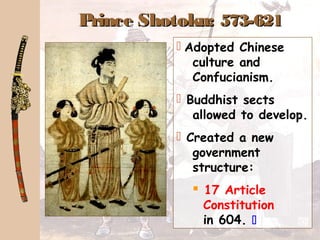
Prince Shotoku:Prince Shotoku: 573-621573-621
 Adopted Chinese
culture and
Confucianism.
 Buddhist sects
allowed to develop.
 Created a new
government
structure:
 17 Article
Constitution
in 604. 
Heian Period: 794-1156Heian Period: 794-1156
CharacteristicsCharacteristics::
 Growth of large landed estates.Growth of large landed estates.
 Arts & literature of ChinaArts & literature of China
flourished.flourished.
 Elaborate court life [highly refined]Elaborate court life [highly refined]
 ETIQUETTE.ETIQUETTE. 
 Personal diariesPersonal diaries
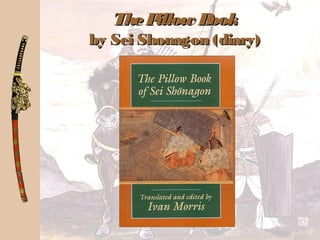
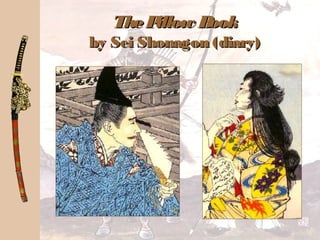
 The Pillow BookThe Pillow Book by Sei Shonagon [10c]by Sei Shonagon [10c]
 Great novelGreat novel
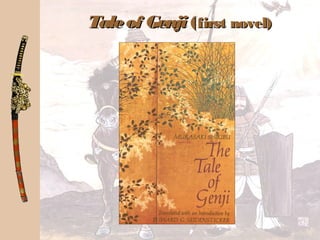
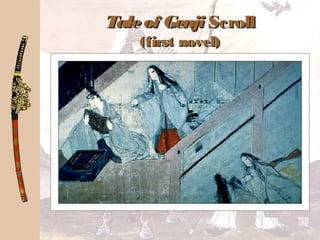
 The Tale of GenjiThe Tale of Genji byby Lady MurasakiLady Murasaki
ShikibuShikibu [1000 pgs.+][1000 pgs.+] 
 Moving away from Chinese models inMoving away from Chinese models in
religion, the arts, and government.religion, the arts, and government. 
CharacteristicsCharacteristics::
 Growth of large landed estates.Growth of large landed estates.
 Arts & literature of ChinaArts & literature of China
flourished.flourished.
 Elaborate court life [highly refined]Elaborate court life [highly refined]
 ETIQUETTE.ETIQUETTE. 
 Personal diariesPersonal diaries
 The Pillow BookThe Pillow Book by Sei Shonagon [10c]by Sei Shonagon [10c]
 Great novelGreat novel
 The Tale of GenjiThe Tale of Genji byby Lady MurasakiLady Murasaki
ShikibuShikibu [1000 pgs.+][1000 pgs.+] 
 Moving away from Chinese models inMoving away from Chinese models in
religion, the arts, and government.religion, the arts, and government. 
Heian Period:Heian Period:
Cultural BorrowingCultural Borrowing
1.1.Chinese writing.Chinese writing.
2.2.Chinese artistic styles.Chinese artistic styles.
3.3.Buddhism [in the form ofBuddhism [in the form of
ZEN].ZEN].
4.4.BUT, not the Chinese civilBUT, not the Chinese civil
service system!service system! 
1.1.Chinese writing.Chinese writing.
2.2.Chinese artistic styles.Chinese artistic styles.
3.3.Buddhism [in the form ofBuddhism [in the form of
ZEN].ZEN].
4.4.BUT, not the Chinese civilBUT, not the Chinese civil
service system!service system! 
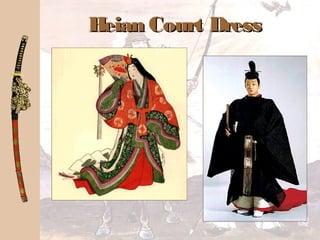
Heian Court DressHeian Court Dress
ThePillow BookThePillow Book
by Sei Shonagon (diary)by Sei Shonagon (diary)
ThePillow BookThePillow Book
by Sei Shonagon (diary)by Sei Shonagon (diary)
Taleof GenjiTaleof Genji ((first novel)first novel)
Taleof GenjiTaleof Genji ScrollScroll
(first novel)(first novel)
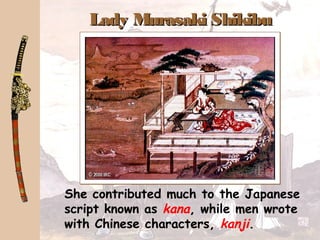
Lady Murasaki ShikibuLady Murasaki Shikibu
She contributed much to the Japanese
script known as kana, while men wrote
with Chinese characters, kanji.
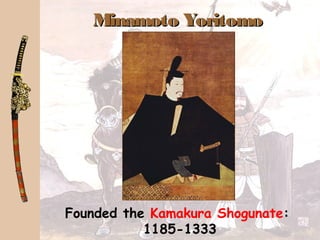
Minamoto YoritomoMinamoto Yoritomo
Founded the Kamakura Shogunate:
1185-1333
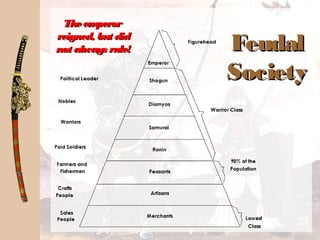
FeudalFeudal
SocietySociety
TheemperorTheemperor
reigned, but didreigned, but did
not always rule!not always rule!
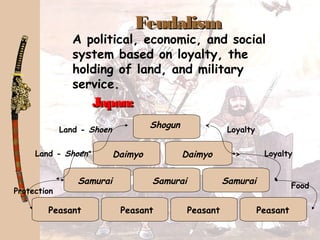
FeudalismFeudalism
A political, economic, and social
system based on loyalty, the
holding of land, and military
service.
Japan:Japan:
Shogun
Daimyo Daimyo
Samurai Samurai Samurai
Peasant PeasantPeasantPeasant
Land - Shoen
Land - Shoen
Protection
Loyalty
Loyalty
Food
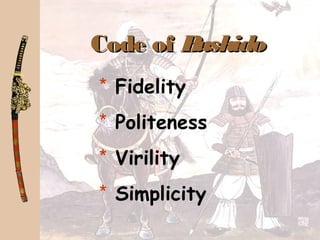
Code ofCode of BushidoBushido
* Fidelity
* Politeness
* Virility
* Simplicity
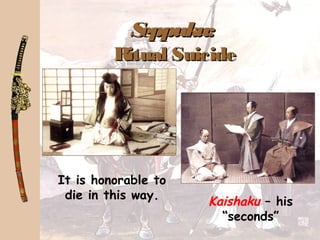
Seppuku:Seppuku:
Ritual SuicideRitual Suicide
Kaishaku – his
“seconds”
It is honorable to
die in this way.
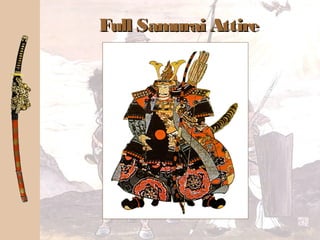
Full Samurai AttireFull Samurai Attire
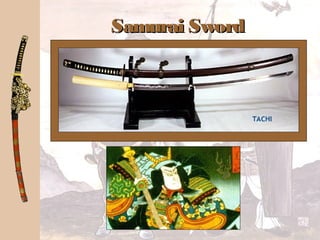
Samurai SwordSamurai Sword
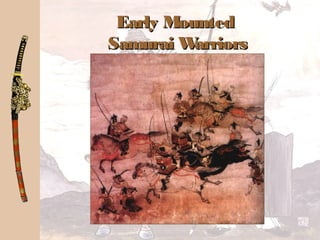
Early MountedEarly Mounted
Samurai WarriorsSamurai Warriors
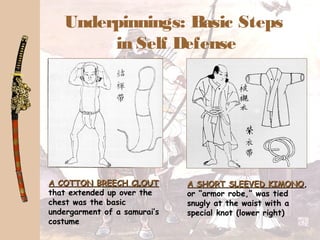
Underpinnings: Basic Steps
in Self Defense
A COTTON BREECH CLOUTA COTTON BREECH CLOUT
that extended up over the
chest was the basic
undergarment of a samurai’s
costume
A SHORT SLEEVED KIMONOA SHORT SLEEVED KIMONO,
or “armor robe,” was tied
snugly at the waist with a
special knot (lower right)
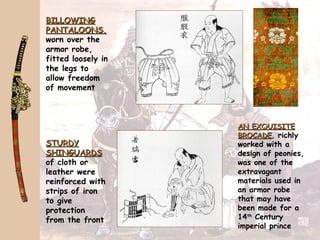
BILLOWINGBILLOWING
PANTALOONS,PANTALOONS,
worn over the
armor robe,
fitted loosely in
the legs to
allow freedom
of movement
STURDYSTURDY
SHINGUARDSSHINGUARDS
of cloth or
leather were
reinforced with
strips of iron
to give
protection
from the front
AN EXQUISITEAN EXQUISITE
BROCADEBROCADE, richly
worked with a
design of peonies,
was one of the
extravagant
materials used in
an armor robe
that may have
been made for a
14th
Century
imperial prince
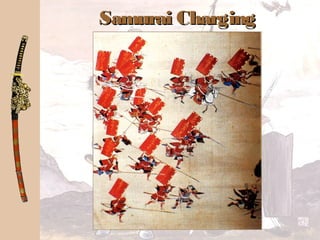
Samurai ChargingSamurai Charging
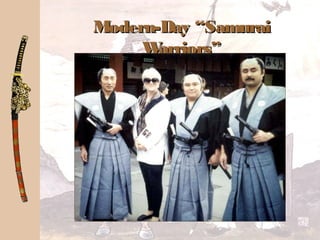
Modern-Day “SamuraiModern-Day “Samurai
Warriors”Warriors”
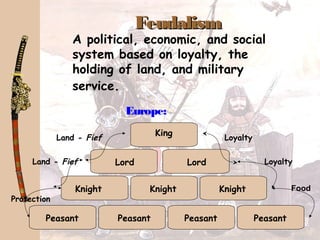
FeudalismFeudalism
A political, economic, and social
system based on loyalty, the
holding of land, and military
service.
Europe:
King
Lord Lord
Knight Knight Knight
Peasant PeasantPeasantPeasant
Land - Fief
Land - Fief
Protection
Loyalty
Loyalty
Food
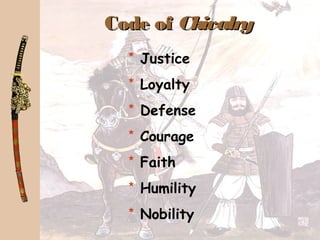
Code ofCode of ChivalryChivalry
* Justice
* Loyalty
* Defense
* Courage
* Faith
* Humility
* Nobility
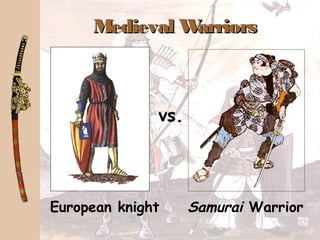
European knight Samurai Warrior
vs.
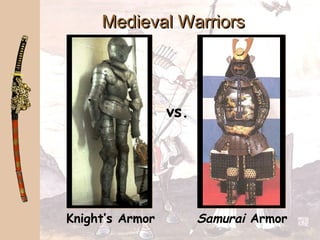
Medieval WarriorsMedieval Warriors
Knight’s Armor Samurai Armor
vs.
Medieval WarriorsMedieval Warriors
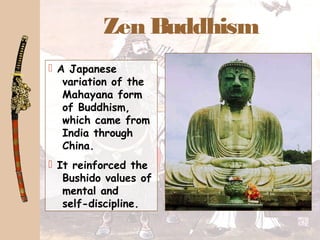
Zen Buddhism
 A Japanese
variation of the
Mahayana form
of Buddhism,
which came from
India through
China.
 It reinforced the
Bushido values of
mental and
self-discipline.
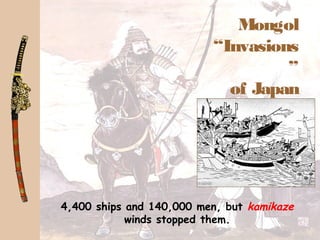
Mongol
“Invasions
”
of Japan
4,400 ships and 140,000 men, but kamikaze
winds stopped them.
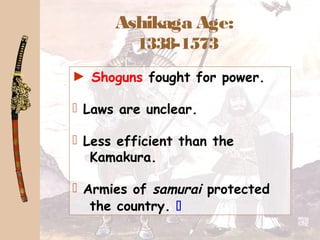
Ashikaga Age:
1338-1573
► Shoguns fought for power.
 Laws are unclear.
 Less efficient than the
Kamakura.
 Armies of samurai protected
the country. 
C
A
S
T
L
E
S
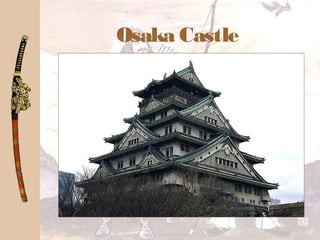
Osaka Castle
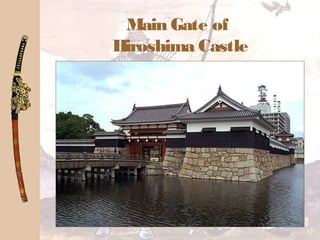
Main Gate of
Hiroshima Castle
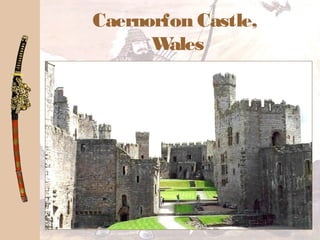
Caernorfon Castle,
Wales
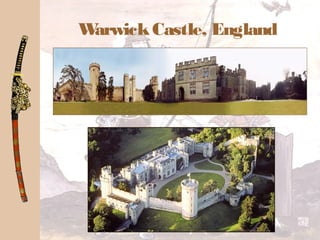
WarwickCastle, England
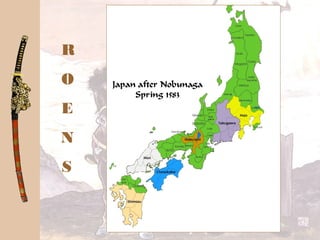
R
O
E
N
S
The Age of the Warring States:
(1467 - 1568)
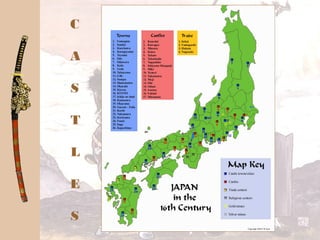
 Castles built on hills in different
provinces.
 Power shifts from above to
below.
 Europeans arrive in Japan 
bringing firearms & Christianity.
 Christianity & foreign trade
flourish.
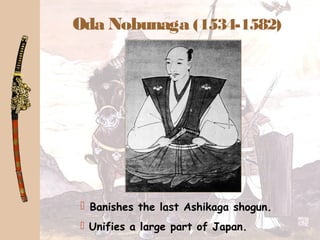
Oda Nobunaga (1534-1582)
 Banishes the last Ashikaga shogun.
 Unifies a large part of Japan.
Catholic Jesuits in JapanCatholic Jesuits in Japan
St. Francis Xavier
[First Catholic Missionaries in Asia][First Catholic Missionaries in Asia]
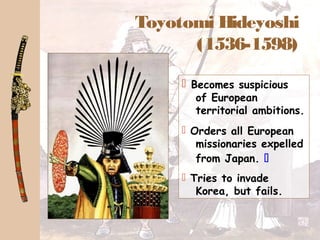
Toyotomi Hideyoshi
(1536-1598)
 Becomes suspicious
of European
territorial ambitions.
 Orders all European
missionaries expelled
from Japan. 
 Tries to invade
Korea, but fails.
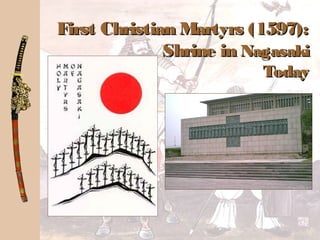
First Christian Martyrs (1597):First Christian Martyrs (1597):
Shrine inShrine in NagasakiNagasaki
TodayToday
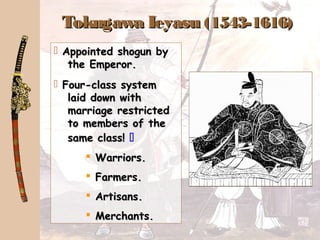
Tokugawa IeyasuTokugawa Ieyasu (1543-1616)(1543-1616)
 Appointed shogun byAppointed shogun by
the Emperor.the Emperor.
 Four-class systemFour-class system
laid down withlaid down with
marriage restrictedmarriage restricted
to members of theto members of the
same class!same class! 
 Warriors.Warriors.
 Farmers.Farmers.
 Artisans.Artisans.
 Merchants.Merchants.
Tokugawa Shogunate Period
 Japan closed off to all trade
[except to the Dutch and Chinese]. 
 The Dutch were restricted to a
small island in Nagasaki harbor.
 Japanese Christians persecuted
and Christianity is forbidden.
 The government is centralized with all
power in the hands of the shogun.
 Domestic trade flourishes.
 Towns, esp. castle towns, increase.
 Merchant class becomes rich! 
 New art forms  haiku poetry, kabuki
theater.

Feudal japan

  • 2.
    Yamato Period: 300-710YamatoPeriod: 300-710 “Great Kings” era Began promoting the adoptionBegan promoting the adoption of Chinese culture:of Chinese culture:  Confucianism.Confucianism.  Language (Language (kanjikanji characters).characters).  Buddhist sects.Buddhist sects.  Chinese art & architecture.Chinese art & architecture.  Government structure.Government structure. Began promoting the adoptionBegan promoting the adoption of Chinese culture:of Chinese culture:  Confucianism.Confucianism.  Language (Language (kanjikanji characters).characters).  Buddhist sects.Buddhist sects.  Chinese art & architecture.Chinese art & architecture.  Government structure.Government structure.
  • 3.
    Prince Shotoku:Prince Shotoku:573-621573-621  Adopted Chinese culture and Confucianism.  Buddhist sects allowed to develop.  Created a new government structure:  17 Article Constitution in 604. 
  • 4.
    Heian Period: 794-1156HeianPeriod: 794-1156 CharacteristicsCharacteristics::  Growth of large landed estates.Growth of large landed estates.  Arts & literature of ChinaArts & literature of China flourished.flourished.  Elaborate court life [highly refined]Elaborate court life [highly refined]  ETIQUETTE.ETIQUETTE.   Personal diariesPersonal diaries  The Pillow BookThe Pillow Book by Sei Shonagon [10c]by Sei Shonagon [10c]  Great novelGreat novel  The Tale of GenjiThe Tale of Genji byby Lady MurasakiLady Murasaki ShikibuShikibu [1000 pgs.+][1000 pgs.+]   Moving away from Chinese models inMoving away from Chinese models in religion, the arts, and government.religion, the arts, and government.  CharacteristicsCharacteristics::  Growth of large landed estates.Growth of large landed estates.  Arts & literature of ChinaArts & literature of China flourished.flourished.  Elaborate court life [highly refined]Elaborate court life [highly refined]  ETIQUETTE.ETIQUETTE.   Personal diariesPersonal diaries  The Pillow BookThe Pillow Book by Sei Shonagon [10c]by Sei Shonagon [10c]  Great novelGreat novel  The Tale of GenjiThe Tale of Genji byby Lady MurasakiLady Murasaki ShikibuShikibu [1000 pgs.+][1000 pgs.+]   Moving away from Chinese models inMoving away from Chinese models in religion, the arts, and government.religion, the arts, and government. 
  • 5.
    Heian Period:Heian Period: CulturalBorrowingCultural Borrowing 1.1.Chinese writing.Chinese writing. 2.2.Chinese artistic styles.Chinese artistic styles. 3.3.Buddhism [in the form ofBuddhism [in the form of ZEN].ZEN]. 4.4.BUT, not the Chinese civilBUT, not the Chinese civil service system!service system!  1.1.Chinese writing.Chinese writing. 2.2.Chinese artistic styles.Chinese artistic styles. 3.3.Buddhism [in the form ofBuddhism [in the form of ZEN].ZEN]. 4.4.BUT, not the Chinese civilBUT, not the Chinese civil service system!service system! 
  • 6.
  • 7.
    ThePillow BookThePillow Book bySei Shonagon (diary)by Sei Shonagon (diary)
  • 8.
    ThePillow BookThePillow Book bySei Shonagon (diary)by Sei Shonagon (diary)
  • 9.
    Taleof GenjiTaleof Genji((first novel)first novel)
  • 10.
    Taleof GenjiTaleof GenjiScrollScroll (first novel)(first novel)
  • 11.
    Lady Murasaki ShikibuLadyMurasaki Shikibu She contributed much to the Japanese script known as kana, while men wrote with Chinese characters, kanji.
  • 12.
    Minamoto YoritomoMinamoto Yoritomo Foundedthe Kamakura Shogunate: 1185-1333
  • 13.
  • 14.
    FeudalismFeudalism A political, economic,and social system based on loyalty, the holding of land, and military service. Japan:Japan: Shogun Daimyo Daimyo Samurai Samurai Samurai Peasant PeasantPeasantPeasant Land - Shoen Land - Shoen Protection Loyalty Loyalty Food
  • 15.
    Code ofCode ofBushidoBushido * Fidelity * Politeness * Virility * Simplicity
  • 16.
    Seppuku:Seppuku: Ritual SuicideRitual Suicide Kaishaku– his “seconds” It is honorable to die in this way.
  • 17.
  • 18.
  • 19.
    Early MountedEarly Mounted SamuraiWarriorsSamurai Warriors
  • 20.
    Underpinnings: Basic Steps inSelf Defense A COTTON BREECH CLOUTA COTTON BREECH CLOUT that extended up over the chest was the basic undergarment of a samurai’s costume A SHORT SLEEVED KIMONOA SHORT SLEEVED KIMONO, or “armor robe,” was tied snugly at the waist with a special knot (lower right)
  • 21.
    BILLOWINGBILLOWING PANTALOONS,PANTALOONS, worn over the armorrobe, fitted loosely in the legs to allow freedom of movement STURDYSTURDY SHINGUARDSSHINGUARDS of cloth or leather were reinforced with strips of iron to give protection from the front AN EXQUISITEAN EXQUISITE BROCADEBROCADE, richly worked with a design of peonies, was one of the extravagant materials used in an armor robe that may have been made for a 14th Century imperial prince
  • 22.
  • 23.
  • 24.
    FeudalismFeudalism A political, economic,and social system based on loyalty, the holding of land, and military service. Europe: King Lord Lord Knight Knight Knight Peasant PeasantPeasantPeasant Land - Fief Land - Fief Protection Loyalty Loyalty Food
  • 25.
    Code ofCode ofChivalryChivalry * Justice * Loyalty * Defense * Courage * Faith * Humility * Nobility
  • 26.
    European knight SamuraiWarrior vs. Medieval WarriorsMedieval Warriors
  • 27.
    Knight’s Armor SamuraiArmor vs. Medieval WarriorsMedieval Warriors
  • 28.
    Zen Buddhism  AJapanese variation of the Mahayana form of Buddhism, which came from India through China.  It reinforced the Bushido values of mental and self-discipline.
  • 29.
    Mongol “Invasions ” of Japan 4,400 shipsand 140,000 men, but kamikaze winds stopped them.
  • 30.
    Ashikaga Age: 1338-1573 ► Shogunsfought for power.  Laws are unclear.  Less efficient than the Kamakura.  Armies of samurai protected the country. 
  • 31.
  • 32.
  • 33.
  • 34.
  • 35.
  • 36.
  • 37.
    The Age ofthe Warring States: (1467 - 1568)  Castles built on hills in different provinces.  Power shifts from above to below.  Europeans arrive in Japan  bringing firearms & Christianity.  Christianity & foreign trade flourish.
  • 38.
    Oda Nobunaga (1534-1582) Banishes the last Ashikaga shogun.  Unifies a large part of Japan.
  • 39.
    Catholic Jesuits inJapanCatholic Jesuits in Japan St. Francis Xavier [First Catholic Missionaries in Asia][First Catholic Missionaries in Asia]
  • 40.
    Toyotomi Hideyoshi (1536-1598)  Becomessuspicious of European territorial ambitions.  Orders all European missionaries expelled from Japan.   Tries to invade Korea, but fails.
  • 41.
    First Christian Martyrs(1597):First Christian Martyrs (1597): Shrine inShrine in NagasakiNagasaki TodayToday
  • 42.
    Tokugawa IeyasuTokugawa Ieyasu(1543-1616)(1543-1616)  Appointed shogun byAppointed shogun by the Emperor.the Emperor.  Four-class systemFour-class system laid down withlaid down with marriage restrictedmarriage restricted to members of theto members of the same class!same class!   Warriors.Warriors.  Farmers.Farmers.  Artisans.Artisans.  Merchants.Merchants.
  • 43.
    Tokugawa Shogunate Period Japan closed off to all trade [except to the Dutch and Chinese].   The Dutch were restricted to a small island in Nagasaki harbor.  Japanese Christians persecuted and Christianity is forbidden.  The government is centralized with all power in the hands of the shogun.  Domestic trade flourishes.  Towns, esp. castle towns, increase.  Merchant class becomes rich!   New art forms  haiku poetry, kabuki theater.