ChandraguptaChandragupta:: 321 BCE-298321 BCE-298
BCEBCE
 Unified northern India.Unified northern India.
 Defeated the PersianDefeated the Persian
generalgeneral SeleucusSeleucus..
 Divided his empire intoDivided his empire into
provinces, then districtsprovinces, then districts
for tax assessments and lawfor tax assessments and law
enforcement.enforcement.
 He feared assassination [like SaddamHe feared assassination [like Saddam
Hussein]Hussein]  food tasters, slept in differentfood tasters, slept in different
rooms, etc.rooms, etc.
 301 BCE301 BCE  gave up his throne & becamegave up his throne & became
a Jain.a Jain.
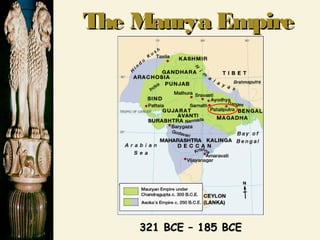
The Maurya EmpireThe Maurya Empire
321 BCE – 185 BCE321 BCE – 185 BCE
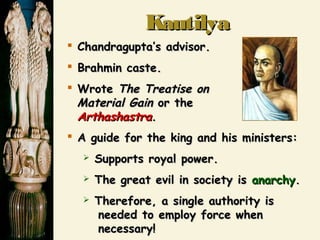
KautilyaKautilya
 Chandragupta’s advisor.Chandragupta’s advisor.
 Brahmin caste.Brahmin caste.
 WroteWrote The Treatise onThe Treatise on
Material GainMaterial Gain or theor the
ArthashastraArthashastra..
 A guide for the king and his ministers:A guide for the king and his ministers:
 Supports royal power.Supports royal power.
 The great evil in society isThe great evil in society is anarchyanarchy..
 Therefore, a single authority isTherefore, a single authority is
needed to employ force whenneeded to employ force when
necessary!necessary!
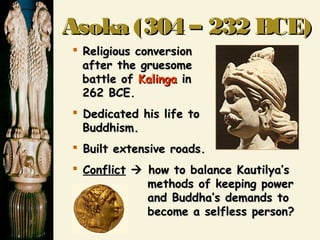
Asoka (304 – 232 BCE)Asoka (304 – 232 BCE)
 Religious conversionReligious conversion
after the gruesomeafter the gruesome
battle ofbattle of KalingaKalinga inin
262 BCE.262 BCE.
 Dedicated his life toDedicated his life to
Buddhism.Buddhism.
 Built extensive roads.Built extensive roads.
 ConflictConflict  how to balance Kautilya’show to balance Kautilya’s
methods of keeping powermethods of keeping power
and Buddha’s demands toand Buddha’s demands to
become a selfless person?become a selfless person?
Asoka’Asoka’
ss
EmpirEmpir
ee
Asoka’s law codeAsoka’s law code
 Edicts scattered inEdicts scattered in
more than 30 placesmore than 30 places
in India, Nepal,in India, Nepal,
Pakistan, & Afghanistan.Pakistan, & Afghanistan.
 Written mostly inWritten mostly in
Sanskrit, but one was inSanskrit, but one was in
Greek and Aramaic.Greek and Aramaic.
 10 rock edicts.10 rock edicts.
 Each pillar [Each pillar [stupastupa] is 40’-50’ high.] is 40’-50’ high.
 Buddhist principles dominate his laws.Buddhist principles dominate his laws.
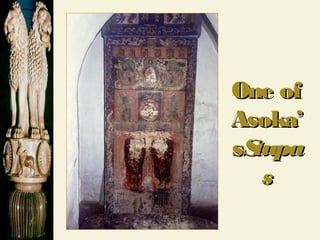
One ofOne of
Asoka’Asoka’
ssStupaStupa
ss
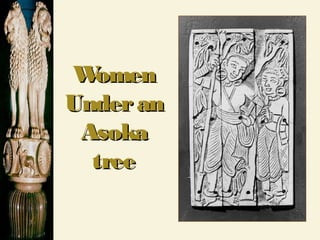
WomenWomen
UnderanUnderan
AsokaAsoka
treetree
Turmoil & a powerTurmoil & a power
Vacuum:Vacuum:
220 BCE – 320 CE220 BCE – 320 CE
Tamils
Tamils
The Maurya Empire is divided into many kingdoms.The Maurya Empire is divided into many kingdoms.
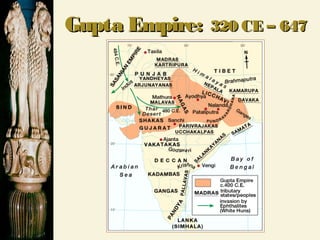
Gupta Empire:Gupta Empire: 320 CE – 647320 CE – 647
CECE
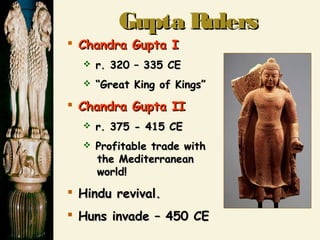
Gupta RulersGupta Rulers
 Chandra GuptaChandra Gupta II
 r. 320 – 335 CEr. 320 – 335 CE
 ““Great King of Kings”Great King of Kings”
 Chandra Gupta IIChandra Gupta II
 r. 375 - 415 CEr. 375 - 415 CE
 Profitable trade withProfitable trade with
the Mediterraneanthe Mediterranean
world!world!
 Hindu revival.Hindu revival.
 Huns invade – 450 CEHuns invade – 450 CE
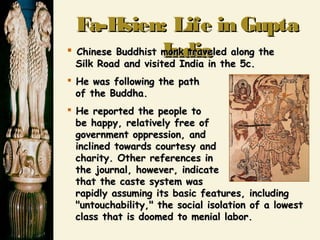
Fa-Hsien: Life in GuptaFa-Hsien: Life in Gupta
IndiaIndia Chinese Buddhist monk traveled along theChinese Buddhist monk traveled along the
Silk Road and visited India in the 5c.Silk Road and visited India in the 5c.
 He was following the pathHe was following the path
of the Buddha.of the Buddha.
 He reported the people toHe reported the people to
be happy, relatively free ofbe happy, relatively free of
government oppression, andgovernment oppression, and
inclined towards courtesy andinclined towards courtesy and
charity. Other references incharity. Other references in
the journal, however, indicatethe journal, however, indicate
that the caste system wasthat the caste system was
rapidly assuming its basic features, includingrapidly assuming its basic features, including
"untouchability," the social isolation of a lowest"untouchability," the social isolation of a lowest
class that is doomed to menial labor.class that is doomed to menial labor.
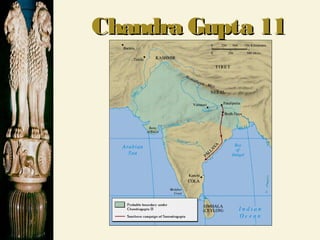
Chandra Gupta 11Chandra Gupta 11
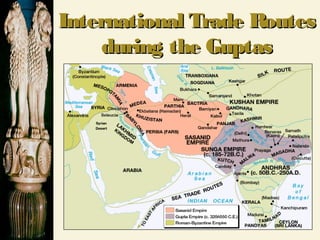
International Trade RoutesInternational Trade Routes
during the Guptasduring the Guptas
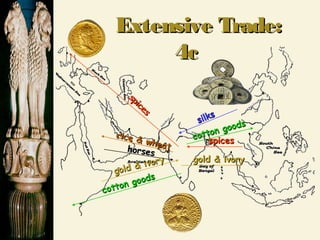
Extensive Trade:Extensive Trade:
4c4c
spices
spices
spicesspices
gold & ivory
gold & ivory gold & ivorygold & ivory
rice & wheat
rice & wheathorseshorses
cotton goods
cotton goods
cotton goods
cotton goodssilks
silks
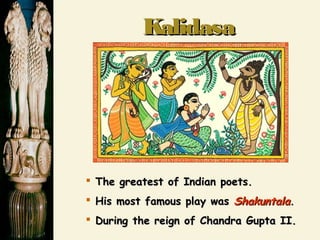
KalidasaKalidasa
 The greatest of Indian poets.The greatest of Indian poets.
 His most famous play wasHis most famous play was ShakuntalaShakuntala..
 During the reign of Chandra Gupta II.During the reign of Chandra Gupta II.
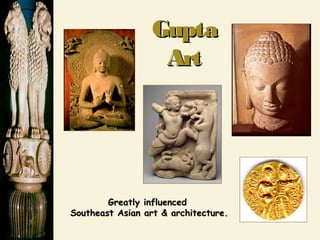
GuptaGupta
ArtArt
Greatly influencedGreatly influenced
Southeast Asian art & architecture.Southeast Asian art & architecture.
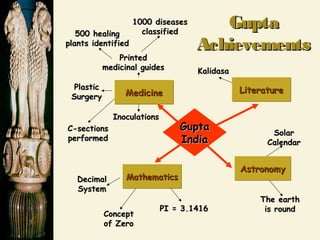
MedicineMedicineMedicineMedicine LiteratureLiteratureLiteratureLiterature
MathematicsMathematicsMathematicsMathematics
AstronomyAstronomyAstronomyAstronomy
PrintedPrinted
medicinal guidesmedicinal guides
1000 diseases1000 diseases
classifiedclassified
PlasticPlastic
SurgerySurgery
C-sectionsC-sections
performedperformed
InoculationsInoculations
500 healing500 healing
plants identifiedplants identified
DecimalDecimal
SystemSystem
ConceptConcept
of Zeroof Zero
PI = 3.1416PI = 3.1416
KalidasaKalidasa
SolarSolar
CalendarCalendar
The earthThe earth
is roundis round
GuptaGupta
IndiaIndia
GuptaGupta
AchievementsAchievements
The Decline of theThe Decline of the
GuptasGuptas Invasion of the White Huns in the 4c signaledInvasion of the White Huns in the 4c signaled
the end of the Gupta Golden Age, even thoughthe end of the Gupta Golden Age, even though
at first, the Guptas defeated them.at first, the Guptas defeated them.
 After the decline of the Gupta empire, northAfter the decline of the Gupta empire, north
India broke into a number of separate HinduIndia broke into a number of separate Hindu
kingdoms and was not really unified again untilkingdoms and was not really unified again until
the coming of the Muslims in the 7c.the coming of the Muslims in the 7c.
 QUESTIONQUESTION::
Is the best literature and art written asIs the best literature and art written as
the civilization is on the rise, at itsthe civilization is on the rise, at its
height, or in its decline?height, or in its decline?
BhartrhariBhartrhari
 5c India court poet and philosopher.5c India court poet and philosopher.
Knowledge is man's crowning mark,Knowledge is man's crowning mark,
A treasure secretly buried,A treasure secretly buried,
The source of luxury, fame, and bliss,The source of luxury, fame, and bliss,
A guru most venerable,A guru most venerable,
A friend on foreign journeys,A friend on foreign journeys,
The pinnacle of divinity.The pinnacle of divinity.
Knowledge is valued by kingsKnowledge is valued by kings
beyond wealth---beyond wealth---
When he lacks it, a man is a brute.When he lacks it, a man is a brute.

Maurya gupta empires

  • 2.
    ChandraguptaChandragupta:: 321 BCE-298321BCE-298 BCEBCE  Unified northern India.Unified northern India.  Defeated the PersianDefeated the Persian generalgeneral SeleucusSeleucus..  Divided his empire intoDivided his empire into provinces, then districtsprovinces, then districts for tax assessments and lawfor tax assessments and law enforcement.enforcement.  He feared assassination [like SaddamHe feared assassination [like Saddam Hussein]Hussein]  food tasters, slept in differentfood tasters, slept in different rooms, etc.rooms, etc.  301 BCE301 BCE  gave up his throne & becamegave up his throne & became a Jain.a Jain.
  • 3.
    The Maurya EmpireTheMaurya Empire 321 BCE – 185 BCE321 BCE – 185 BCE
  • 4.
    KautilyaKautilya  Chandragupta’s advisor.Chandragupta’sadvisor.  Brahmin caste.Brahmin caste.  WroteWrote The Treatise onThe Treatise on Material GainMaterial Gain or theor the ArthashastraArthashastra..  A guide for the king and his ministers:A guide for the king and his ministers:  Supports royal power.Supports royal power.  The great evil in society isThe great evil in society is anarchyanarchy..  Therefore, a single authority isTherefore, a single authority is needed to employ force whenneeded to employ force when necessary!necessary!
  • 5.
    Asoka (304 –232 BCE)Asoka (304 – 232 BCE)  Religious conversionReligious conversion after the gruesomeafter the gruesome battle ofbattle of KalingaKalinga inin 262 BCE.262 BCE.  Dedicated his life toDedicated his life to Buddhism.Buddhism.  Built extensive roads.Built extensive roads.  ConflictConflict  how to balance Kautilya’show to balance Kautilya’s methods of keeping powermethods of keeping power and Buddha’s demands toand Buddha’s demands to become a selfless person?become a selfless person?
  • 6.
  • 7.
    Asoka’s law codeAsoka’slaw code  Edicts scattered inEdicts scattered in more than 30 placesmore than 30 places in India, Nepal,in India, Nepal, Pakistan, & Afghanistan.Pakistan, & Afghanistan.  Written mostly inWritten mostly in Sanskrit, but one was inSanskrit, but one was in Greek and Aramaic.Greek and Aramaic.  10 rock edicts.10 rock edicts.  Each pillar [Each pillar [stupastupa] is 40’-50’ high.] is 40’-50’ high.  Buddhist principles dominate his laws.Buddhist principles dominate his laws.
  • 8.
  • 9.
  • 10.
    Turmoil & apowerTurmoil & a power Vacuum:Vacuum: 220 BCE – 320 CE220 BCE – 320 CE Tamils Tamils The Maurya Empire is divided into many kingdoms.The Maurya Empire is divided into many kingdoms.
  • 11.
    Gupta Empire:Gupta Empire:320 CE – 647320 CE – 647 CECE
  • 12.
    Gupta RulersGupta Rulers Chandra GuptaChandra Gupta II  r. 320 – 335 CEr. 320 – 335 CE  ““Great King of Kings”Great King of Kings”  Chandra Gupta IIChandra Gupta II  r. 375 - 415 CEr. 375 - 415 CE  Profitable trade withProfitable trade with the Mediterraneanthe Mediterranean world!world!  Hindu revival.Hindu revival.  Huns invade – 450 CEHuns invade – 450 CE
  • 13.
    Fa-Hsien: Life inGuptaFa-Hsien: Life in Gupta IndiaIndia Chinese Buddhist monk traveled along theChinese Buddhist monk traveled along the Silk Road and visited India in the 5c.Silk Road and visited India in the 5c.  He was following the pathHe was following the path of the Buddha.of the Buddha.  He reported the people toHe reported the people to be happy, relatively free ofbe happy, relatively free of government oppression, andgovernment oppression, and inclined towards courtesy andinclined towards courtesy and charity. Other references incharity. Other references in the journal, however, indicatethe journal, however, indicate that the caste system wasthat the caste system was rapidly assuming its basic features, includingrapidly assuming its basic features, including "untouchability," the social isolation of a lowest"untouchability," the social isolation of a lowest class that is doomed to menial labor.class that is doomed to menial labor.
  • 14.
  • 15.
    International Trade RoutesInternationalTrade Routes during the Guptasduring the Guptas
  • 16.
    Extensive Trade:Extensive Trade: 4c4c spices spices spicesspices gold& ivory gold & ivory gold & ivorygold & ivory rice & wheat rice & wheathorseshorses cotton goods cotton goods cotton goods cotton goodssilks silks
  • 17.
    KalidasaKalidasa  The greatestof Indian poets.The greatest of Indian poets.  His most famous play wasHis most famous play was ShakuntalaShakuntala..  During the reign of Chandra Gupta II.During the reign of Chandra Gupta II.
  • 18.
    GuptaGupta ArtArt Greatly influencedGreatly influenced SoutheastAsian art & architecture.Southeast Asian art & architecture.
  • 19.
    MedicineMedicineMedicineMedicine LiteratureLiteratureLiteratureLiterature MathematicsMathematicsMathematicsMathematics AstronomyAstronomyAstronomyAstronomy PrintedPrinted medicinal guidesmedicinalguides 1000 diseases1000 diseases classifiedclassified PlasticPlastic SurgerySurgery C-sectionsC-sections performedperformed InoculationsInoculations 500 healing500 healing plants identifiedplants identified DecimalDecimal SystemSystem ConceptConcept of Zeroof Zero PI = 3.1416PI = 3.1416 KalidasaKalidasa SolarSolar CalendarCalendar The earthThe earth is roundis round GuptaGupta IndiaIndia GuptaGupta AchievementsAchievements
  • 20.
    The Decline oftheThe Decline of the GuptasGuptas Invasion of the White Huns in the 4c signaledInvasion of the White Huns in the 4c signaled the end of the Gupta Golden Age, even thoughthe end of the Gupta Golden Age, even though at first, the Guptas defeated them.at first, the Guptas defeated them.  After the decline of the Gupta empire, northAfter the decline of the Gupta empire, north India broke into a number of separate HinduIndia broke into a number of separate Hindu kingdoms and was not really unified again untilkingdoms and was not really unified again until the coming of the Muslims in the 7c.the coming of the Muslims in the 7c.  QUESTIONQUESTION:: Is the best literature and art written asIs the best literature and art written as the civilization is on the rise, at itsthe civilization is on the rise, at its height, or in its decline?height, or in its decline?
  • 21.
    BhartrhariBhartrhari  5c Indiacourt poet and philosopher.5c India court poet and philosopher. Knowledge is man's crowning mark,Knowledge is man's crowning mark, A treasure secretly buried,A treasure secretly buried, The source of luxury, fame, and bliss,The source of luxury, fame, and bliss, A guru most venerable,A guru most venerable, A friend on foreign journeys,A friend on foreign journeys, The pinnacle of divinity.The pinnacle of divinity. Knowledge is valued by kingsKnowledge is valued by kings beyond wealth---beyond wealth--- When he lacks it, a man is a brute.When he lacks it, a man is a brute.