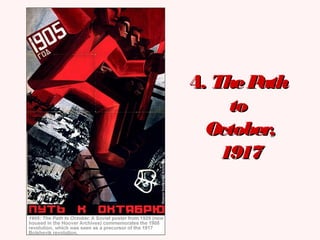
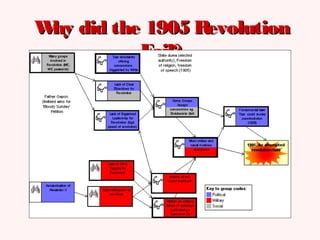
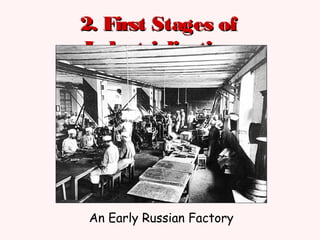
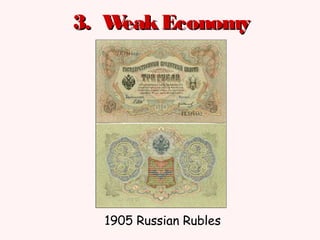
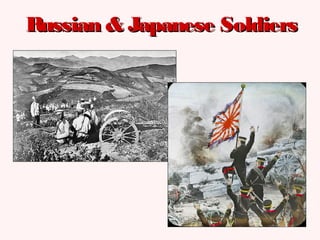
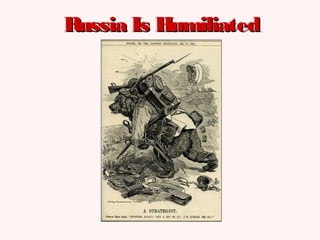
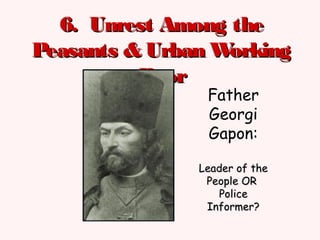
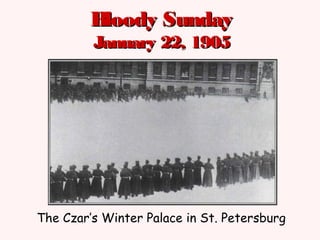
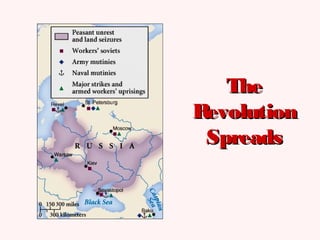
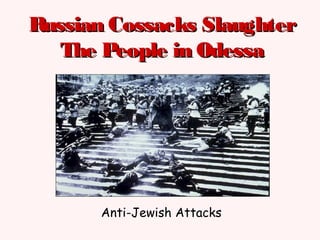
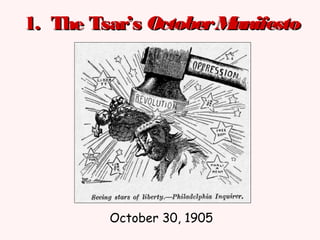
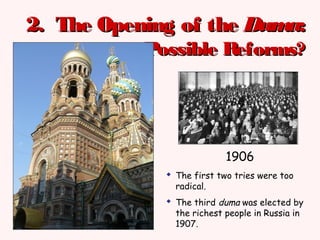
The 1905 Russian Revolution was sparked by several factors, including unrest among peasants and urban workers, a weak economy, Russia's humiliating defeat in the Russo-Japanese War, and extensive foreign investments in Russia. Major events included Bloody Sunday in January 1905, when Cossacks opened fire on peaceful protesters in St. Petersburg, and the mutiny on the battleship Potemkin in June 1905. In response to the unrest, Tsar Nicholas II issued the October Manifesto in 1905, which established basic civil liberties and agreed to the creation of an elected parliament, the Duma. However, the revolution ultimately failed to unseat the Tsar or establish a democratic government in Russia.

![Nicholas II: The Last RomanovNicholas II: The Last Romanov
TsarTsar
[r. 1894-1917][r. 1894-1917]](https://image.slidesharecdn.com/1905russianrevolution-150523044251-lva1-app6892/85/1905-russianrevolution-2-320.jpg)

![4. Extensive Foreign4. Extensive Foreign
Investments & InfluenceInvestments & Influence
Building the Trans-Siberian RR
[Economic benefits only in a few regions.]](https://image.slidesharecdn.com/1905russianrevolution-150523044251-lva1-app6892/85/1905-russianrevolution-10-320.jpg)
![5. Russo-Japanese War5. Russo-Japanese War [1904-[1904-
1905]1905]
The “Yellow Peril”](https://image.slidesharecdn.com/1905russianrevolution-150523044251-lva1-app6892/85/1905-russianrevolution-11-320.jpg)
![Russo-Japanese WarRusso-Japanese War [1904-1905][1904-1905]](https://image.slidesharecdn.com/1905russianrevolution-150523044251-lva1-app6892/85/1905-russianrevolution-12-320.jpg)
![Russo-Japanese WarRusso-Japanese War [1904-1905][1904-1905]](https://image.slidesharecdn.com/1905russianrevolution-150523044251-lva1-app6892/85/1905-russianrevolution-13-320.jpg)
![Treaty of PortsmouthTreaty of Portsmouth [NH] -[NH] -
19051905
President
Theodore
Roosevelt
Acts as the
Peacemaker
[He gets
the Nobel
Peace Prize
for his
efforts.]](https://image.slidesharecdn.com/1905russianrevolution-150523044251-lva1-app6892/85/1905-russianrevolution-16-320.jpg)
![7. The Battleship7. The Battleship PotemkinPotemkin
MutinyMutiny [June, 1905][June, 1905]](https://image.slidesharecdn.com/1905russianrevolution-150523044251-lva1-app6892/85/1905-russianrevolution-21-320.jpg)
![The Russian Constitution ofThe Russian Constitution of
19061906 Known as the Fundamental Laws
[April 23, 1906].
The autocracy of the Russian Tsar was
declared.
The Tsar was supreme over the law, the
church, and the Duma.
It confirmed the basic human rights
granted by the October Manifesto, BUT
made them subordinate to the supremacy
of the law.](https://image.slidesharecdn.com/1905russianrevolution-150523044251-lva1-app6892/85/1905-russianrevolution-25-320.jpg)