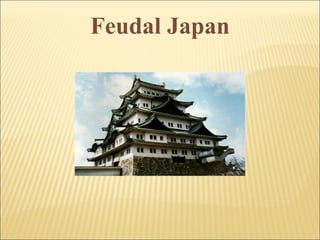
Feudal Japan
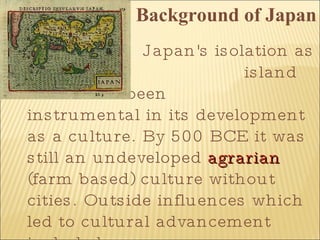
  Background of Japan   Japan's isolation as an      island nation has been    instrumental in its development as a culture. By 500 BCE it was still an undeveloped  agrarian   (farm based) culture without cities. Outside influences which led to cultural advancement included... Japan's isolation as an island nation has been instrumental in its development as a culture. By 500 BC it was still an undeveloped agrarian culture without cities. Outside influences which led to cultural advancement included (1) contacts with and importing of Chinese culture, especially in the areas of weaving, metals, art and government
Background of Japan cont . (1) contacts with and importing of  Chinese culture , especially in the areas of  weaving, metals, art and government , (2) the arrival in 200 CE of the  Korean horse soldier , and (3) the arrival of  Buddhism  as a religious and philosophical system merging with native  Shinto  beliefs.  Japan's isolation as an island nation has been instrumental in its development as a culture. By 500 BC it was still an undeveloped agrarian culture without cities. Outside influences which led to cultural advancement included (1) contacts with and importing of Chinese culture, especially in the areas of weaving, metals, art and government
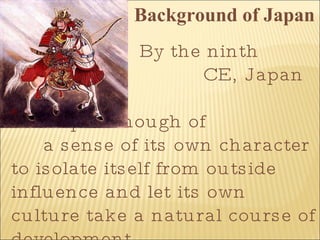
  Background of Japan By the ninth century  CE, Japan had  developed enough of  a sense of its own character to isolate itself from outside influence and let its own culture take a natural course of development. Japan's isolation as an island nation has been instrumental in its development as a culture. By 500 BC it was still an undeveloped agrarian culture without cities. Outside influences which led to cultural advancement included (1) contacts with and importing of Chinese culture, especially in the areas of weaving, metals, art and government
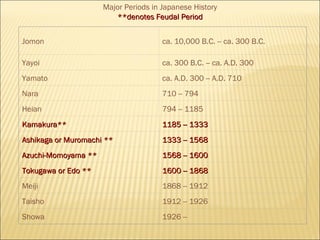
Major Periods in Japanese History **denotes Feudal Period Jomon ca. 10,000 B.C. -- ca. 300 B.C. Yayoi ca. 300 B.C. -- ca. A.D. 300 Yamato ca. A.D. 300 -- A.D. 710 Nara 710 -- 794 Heian 794 -- 1185 Kamakura** 1185 -- 1333 Ashikaga or Muromachi ** 1333 -- 1568 Azuchi-Momoyama ** 1568 -- 1600 Tokugawa or Edo ** 1600 -- 1868 Meiji 1868 -- 1912 Taisho 1912 -- 1926 Showa 1926 --
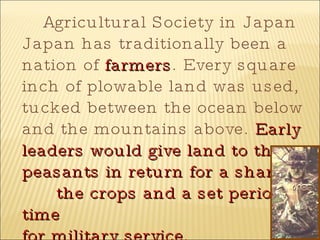
Agricultural Society in Japan Japan has traditionally been a nation of  farmers . Every square inch of plowable land was used, tucked between the ocean below and the mountains above.  Early leaders would give land to the peasants in return for a share of  the crops and a set period of time  for military service.
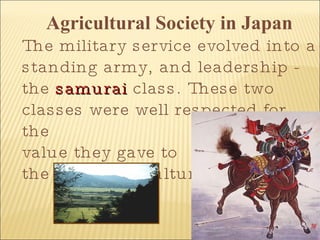
Agricultural Society in Japan The military service evolved into a standing army, and leadership - the  samurai  class. These two classes were well respected for the  value they gave to  the Japanese culture.
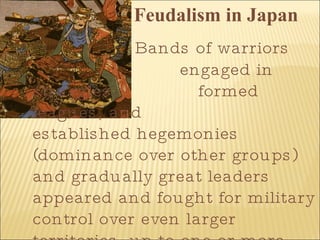
Feudalism in Japan   Bands of warriors    engaged in struggles,   formed leagues, and    established hegemonies (dominance over other groups) and gradually great leaders appeared and fought for military control over even larger territories, up to one or more provinces . Japan's isolation as an island nation has been instrumental in its development as a culture. By 500 BC it was still an undeveloped agrarian culture without cities. Outside influences which led to cultural advancement included (1) contacts with and importing of Chinese culture, especially in the areas of weaving, metals, art and government
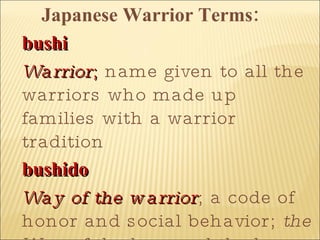
  Japanese Warrior Terms: bushi   Warrior ;  name given to all the warriors who made up families with a warrior tradition  bushido   Way of the warrior ; a code of honor and social behavior;  the Way of the bow and the horse  from China
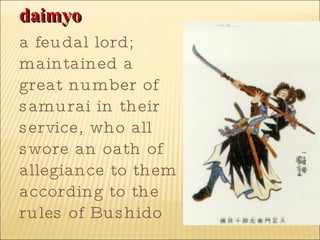
daimyo   a feudal lord; maintained a great number of samurai in their service, who all swore an oath of allegiance to them according to the rules of Bushido
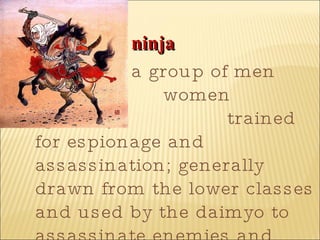
ninja   a group of men and  women specially  trained for espionage and assassination; generally drawn from the lower classes and used by the daimyo to assassinate enemies and penetrate enemy fortresses
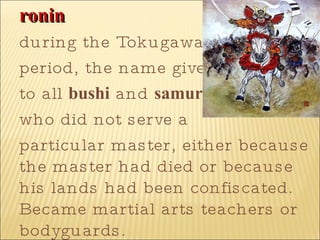
ronin   during the Tokugawa  period, the name given  to all  bushi  and  samurai  who did not serve a  particular master, either because the master had died or because his lands had been confiscated. Became martial arts teachers or bodyguards.
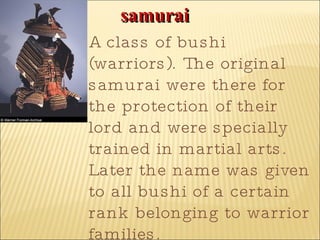
samurai   A class of bushi (warriors). The original samurai were there for the protection of their lord and were specially trained in martial arts. Later the name was given to all bushi of a certain rank belonging to warrior families.
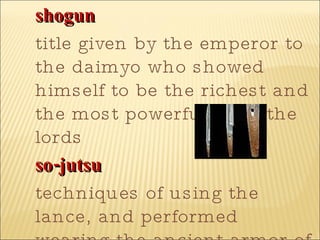
shogun   title given by the emperor to the daimyo who showed himself to be the richest and the most powerful of all the lords  so-jutsu   techniques of using the lance, and performed wearing the ancient armor of the samurai
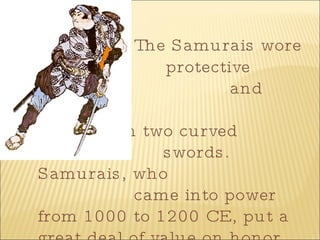
The Samurais wore  protective helmets  and armor and  fought with two curved  swords. Samurais, who  came into power from 1000 to 1200 CE, put a great deal of value on honor and discipline.
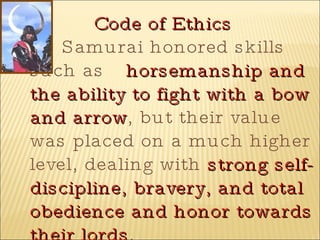
Code of Ethics Samurai honored skills such as  horsemanship and the ability to fight with a bow and arrow , but their value was placed on a much higher level, dealing with  strong self-discipline, bravery, and total obedience and honor towards their lords .
Ideals of the Samurai   Without knowledge of Learning, one will ultimately have no military victories.  One should not be envious of someone who has prospered by unjust deeds. Nor should he disdain someone who has fallen while adhering to the path of righteousness.  Imagawa Sadayo (1325-1420)
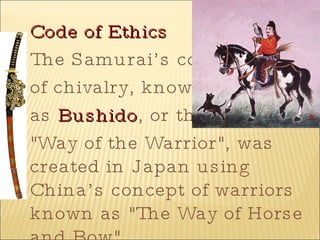
Code of Ethics The Samurai’s code  of chivalry, known  as  Bushido , or the "Way of the Warrior", was created in Japan using China’s concept of warriors known as "The Way of Horse and Bow".
Code of Ethics The philosophy behind Bushido is " freedom from fear ." This meant the samurai was not to fear any bout and to face death with honor. Bushido "gave [the samurai] the peace and power to serve his master faithfully and loyally and die if necessary "( Brief History of the Samurai ).
Role of Religion in Japan Shinto  ("the way of the gods") is the indigenous faith of the Japanese people and as old as Japan herself. It remains Japan's major religion besides Buddhism. Shinto does not have a founder nor does it have sacred scriptures like the sutras or the bible.
Role of Religion in Japan Shinto gods" are called  kami . They are sacred spirits which take the form of things and concepts important to life, such as wind, rain, mountains, trees, rivers and fertility. Humans become kami after they die and are revered by their families as ancestral kami.
Role of Religion in Japan In contrast to Christianity, there is no absolute right and wrong, and nobody is perfect. Shinto is an optimistic faith, as  humans are thought to be fundamentally good , and  evil is believed to be caused by evil spirits . The purpose of Shinto rituals is to keep away evil spirits.
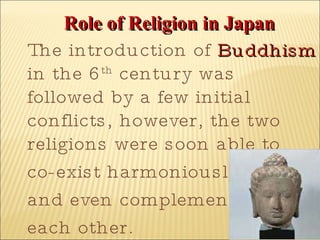
Role of Religion in Japan The introduction of  Buddhism  in the 6 th  century was followed by a few initial conflicts, however, the two religions were soon able to  co-exist harmoniously  and even complement  each other.
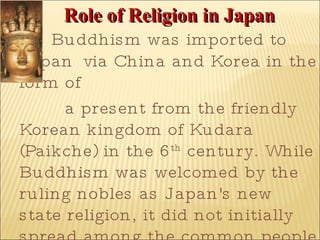
Role of Religion in Japan Buddhism was imported to Japan  via China and Korea in the form of  a present from the friendly Korean kingdom of Kudara (Paikche) in the 6 th  century. While Buddhism was welcomed by the ruling nobles as Japan's new state religion, it did not initially spread among the common people due to its complex theories.
Role of Religion in Japan The great philosopher  Confucius  (Kong Fu Zi) lived in China from 551 to 479 BCE. According to early Japanese writings, it was introduced to Japan via Korea in the year 285 CE. Some of the most important  Confucian  principles are humanity, loyalty, morality and consideration on an individual and political level.
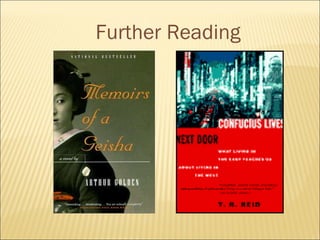
Further Reading
Bibliography http://www.jordan.palo-alto.ca.us/students/connections/japan/japanandwest.html http://www.womeninworldhistory.com/sample-08.html http://www.bellaonline.com/articles/art2282.asp http://www.globaled.org/japanproject/lessons/lesson03_3.php http://www.metmuseum.org/toah/hd/feud/hd_feud.htm http://www.learner.org/exhibits/middleages/feudal.html http://www.northnet.org/americankangdukwon/samurai.html http://www.japan-guide.com/e/e629.html http://www.angelfire.com/gundam/manji/page18.html http://www.adbio.com/science/agri-history.htm http://www.csuohio.edu/history/lectures/MAJ/majjpn02.html http://vrcoll.fa.pitt.edu/medart/image/England/General-categories/Castles-Edward-I/maincomp-Castles-EdwI.html http://jin.jcic.or.jp/museum/byobu/byobu01/byobu01.html http://www.cjn.or.jp/tokugawa/english/index.html               
Bibliography http://www.boglewood.com/timeline/attila.html http://www.siue.edu/COSTUMES/COSTUME3_INDEX.HTML http://www.romanhistorybooksandmore.freeservers.com/p_aug_a.htm http://www.rc.kyushu-u.ac.jp/~michel/serv/eujap/maps/munster/index.html http://www.onmarkproductions.com/html/kannon-photo-tour.shtml http://www.geocities.com/TheTropics/Shores/3377/indjapan.html               

Feudal Japan

  • 1.
  • 2.
    Backgroundof Japan Japan's isolation as an island nation has been instrumental in its development as a culture. By 500 BCE it was still an undeveloped agrarian (farm based) culture without cities. Outside influences which led to cultural advancement included... Japan's isolation as an island nation has been instrumental in its development as a culture. By 500 BC it was still an undeveloped agrarian culture without cities. Outside influences which led to cultural advancement included (1) contacts with and importing of Chinese culture, especially in the areas of weaving, metals, art and government
  • 3.
    Background of Japancont . (1) contacts with and importing of Chinese culture , especially in the areas of weaving, metals, art and government , (2) the arrival in 200 CE of the Korean horse soldier , and (3) the arrival of Buddhism as a religious and philosophical system merging with native Shinto beliefs. Japan's isolation as an island nation has been instrumental in its development as a culture. By 500 BC it was still an undeveloped agrarian culture without cities. Outside influences which led to cultural advancement included (1) contacts with and importing of Chinese culture, especially in the areas of weaving, metals, art and government
  • 4.
    Backgroundof Japan By the ninth century CE, Japan had developed enough of a sense of its own character to isolate itself from outside influence and let its own culture take a natural course of development. Japan's isolation as an island nation has been instrumental in its development as a culture. By 500 BC it was still an undeveloped agrarian culture without cities. Outside influences which led to cultural advancement included (1) contacts with and importing of Chinese culture, especially in the areas of weaving, metals, art and government
  • 5.
    Major Periods inJapanese History **denotes Feudal Period Jomon ca. 10,000 B.C. -- ca. 300 B.C. Yayoi ca. 300 B.C. -- ca. A.D. 300 Yamato ca. A.D. 300 -- A.D. 710 Nara 710 -- 794 Heian 794 -- 1185 Kamakura** 1185 -- 1333 Ashikaga or Muromachi ** 1333 -- 1568 Azuchi-Momoyama ** 1568 -- 1600 Tokugawa or Edo ** 1600 -- 1868 Meiji 1868 -- 1912 Taisho 1912 -- 1926 Showa 1926 --
  • 6.
    Agricultural Society inJapan Japan has traditionally been a nation of farmers . Every square inch of plowable land was used, tucked between the ocean below and the mountains above. Early leaders would give land to the peasants in return for a share of the crops and a set period of time for military service.
  • 7.
    Agricultural Society inJapan The military service evolved into a standing army, and leadership - the samurai class. These two classes were well respected for the value they gave to the Japanese culture.
  • 8.
    Feudalism in Japan Bands of warriors engaged in struggles, formed leagues, and established hegemonies (dominance over other groups) and gradually great leaders appeared and fought for military control over even larger territories, up to one or more provinces . Japan's isolation as an island nation has been instrumental in its development as a culture. By 500 BC it was still an undeveloped agrarian culture without cities. Outside influences which led to cultural advancement included (1) contacts with and importing of Chinese culture, especially in the areas of weaving, metals, art and government
  • 9.
    JapaneseWarrior Terms: bushi Warrior ; name given to all the warriors who made up families with a warrior tradition bushido Way of the warrior ; a code of honor and social behavior; the Way of the bow and the horse from China
  • 10.
    daimyo a feudal lord; maintained a great number of samurai in their service, who all swore an oath of allegiance to them according to the rules of Bushido
  • 11.
    ninja a group of men and women specially trained for espionage and assassination; generally drawn from the lower classes and used by the daimyo to assassinate enemies and penetrate enemy fortresses
  • 12.
    ronin during the Tokugawa period, the name given to all bushi and samurai who did not serve a particular master, either because the master had died or because his lands had been confiscated. Became martial arts teachers or bodyguards.
  • 13.
    samurai A class of bushi (warriors). The original samurai were there for the protection of their lord and were specially trained in martial arts. Later the name was given to all bushi of a certain rank belonging to warrior families.
  • 14.
    shogun title given by the emperor to the daimyo who showed himself to be the richest and the most powerful of all the lords so-jutsu techniques of using the lance, and performed wearing the ancient armor of the samurai
  • 15.
    The Samurais wore protective helmets and armor and fought with two curved swords. Samurais, who came into power from 1000 to 1200 CE, put a great deal of value on honor and discipline.
  • 16.
    Code of EthicsSamurai honored skills such as horsemanship and the ability to fight with a bow and arrow , but their value was placed on a much higher level, dealing with strong self-discipline, bravery, and total obedience and honor towards their lords .
  • 17.
    Ideals of theSamurai Without knowledge of Learning, one will ultimately have no military victories. One should not be envious of someone who has prospered by unjust deeds. Nor should he disdain someone who has fallen while adhering to the path of righteousness. Imagawa Sadayo (1325-1420)
  • 18.
    Code of EthicsThe Samurai’s code of chivalry, known as Bushido , or the "Way of the Warrior", was created in Japan using China’s concept of warriors known as "The Way of Horse and Bow".
  • 19.
    Code of EthicsThe philosophy behind Bushido is " freedom from fear ." This meant the samurai was not to fear any bout and to face death with honor. Bushido "gave [the samurai] the peace and power to serve his master faithfully and loyally and die if necessary "( Brief History of the Samurai ).
  • 20.
    Role of Religionin Japan Shinto ("the way of the gods") is the indigenous faith of the Japanese people and as old as Japan herself. It remains Japan's major religion besides Buddhism. Shinto does not have a founder nor does it have sacred scriptures like the sutras or the bible.
  • 21.
    Role of Religionin Japan Shinto gods" are called kami . They are sacred spirits which take the form of things and concepts important to life, such as wind, rain, mountains, trees, rivers and fertility. Humans become kami after they die and are revered by their families as ancestral kami.
  • 22.
    Role of Religionin Japan In contrast to Christianity, there is no absolute right and wrong, and nobody is perfect. Shinto is an optimistic faith, as humans are thought to be fundamentally good , and evil is believed to be caused by evil spirits . The purpose of Shinto rituals is to keep away evil spirits.
  • 23.
    Role of Religionin Japan The introduction of Buddhism in the 6 th century was followed by a few initial conflicts, however, the two religions were soon able to co-exist harmoniously and even complement each other.
  • 24.
    Role of Religionin Japan Buddhism was imported to Japan via China and Korea in the form of a present from the friendly Korean kingdom of Kudara (Paikche) in the 6 th century. While Buddhism was welcomed by the ruling nobles as Japan's new state religion, it did not initially spread among the common people due to its complex theories.
  • 25.
    Role of Religionin Japan The great philosopher Confucius (Kong Fu Zi) lived in China from 551 to 479 BCE. According to early Japanese writings, it was introduced to Japan via Korea in the year 285 CE. Some of the most important Confucian principles are humanity, loyalty, morality and consideration on an individual and political level.
  • 26.
  • 27.
    Bibliography http://www.jordan.palo-alto.ca.us/students/connections/japan/japanandwest.html http://www.womeninworldhistory.com/sample-08.htmlhttp://www.bellaonline.com/articles/art2282.asp http://www.globaled.org/japanproject/lessons/lesson03_3.php http://www.metmuseum.org/toah/hd/feud/hd_feud.htm http://www.learner.org/exhibits/middleages/feudal.html http://www.northnet.org/americankangdukwon/samurai.html http://www.japan-guide.com/e/e629.html http://www.angelfire.com/gundam/manji/page18.html http://www.adbio.com/science/agri-history.htm http://www.csuohio.edu/history/lectures/MAJ/majjpn02.html http://vrcoll.fa.pitt.edu/medart/image/England/General-categories/Castles-Edward-I/maincomp-Castles-EdwI.html http://jin.jcic.or.jp/museum/byobu/byobu01/byobu01.html http://www.cjn.or.jp/tokugawa/english/index.html               
  • 28.
    Bibliography http://www.boglewood.com/timeline/attila.html http://www.siue.edu/COSTUMES/COSTUME3_INDEX.HTMLhttp://www.romanhistorybooksandmore.freeservers.com/p_aug_a.htm http://www.rc.kyushu-u.ac.jp/~michel/serv/eujap/maps/munster/index.html http://www.onmarkproductions.com/html/kannon-photo-tour.shtml http://www.geocities.com/TheTropics/Shores/3377/indjapan.html