Japan perubahan pimpinan selamaJapan perubahan pimpinan selama
thethe
Meiji Era: 1868 - 1912Meiji Era: 1868 - 1912
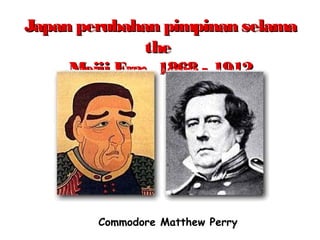
Commodore Matthew Perry
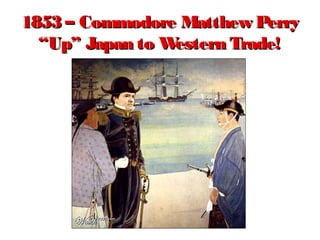
1853 – Commodore Matthew Perry1853 – Commodore Matthew Perry
“Up” Japan to Western Trade!“Up” Japan to Western Trade!
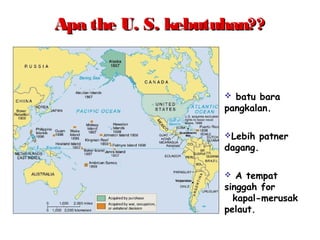
Apa the U. S. kebutuhan??Apa the U. S. kebutuhan??
 batu bara
pangkalan.
Lebih patner
dagang.
 A tempat
singgah for
kapal-merusak
pelaut.
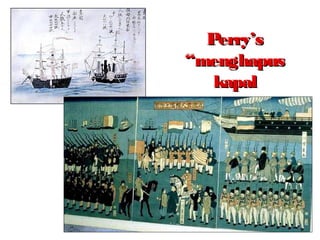
Perry’sPerry’s
“menghapus“menghapus
kapalkapal
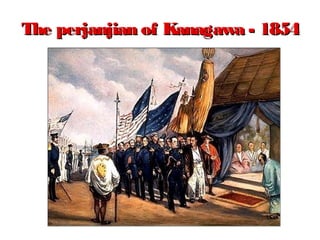
The perjanjian of Kanagawa - 1854The perjanjian of Kanagawa - 1854
Japan Learns a Lesson!Japan Learns a Lesson!
In 1862, just before the start of the
Meiji period, Tokugawa sent officials and
scholars to China to study the situation
there. A Japanese recorded in his diary
from Shanghai…
The Chinese have become servants to the
foreigners. Sovereignty may belong to
China but in fact it's no more than a
colony of Great Britain and France.
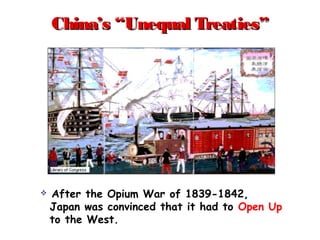
China’s “Unequal Treaties”China’s “Unequal Treaties”
 After the Opium War of 1839-1842,
Japan was convinced that it had to Open Up
to the West.
TheThe Shi-shiShi-shi (“Men of High(“Men of High
Purpose”)Purpose”) Highly idealisticHighly idealistic samuraisamurai who felt that thewho felt that the
arrival of Westerners was an attack on thearrival of Westerners was an attack on the
traditional values of Japan.traditional values of Japan.
 They believed that:They believed that:
 Japan was sacred ground.Japan was sacred ground.
 The emperor, now a figurehead inThe emperor, now a figurehead in
Kyoto, was a God.Kyoto, was a God.
 Were furious at the Shogun for signing treatiesWere furious at the Shogun for signing treaties
with the West without the Emperor’s consent.with the West without the Emperor’s consent.
 Their sloganTheir slogan  Revere the Emperor, ExpelRevere the Emperor, Expel
the Barbarians!the Barbarians!
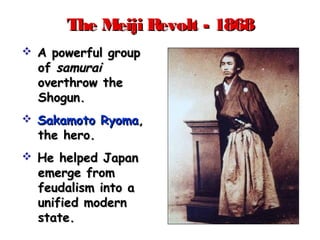
The Meiji Revolt - 1868The Meiji Revolt - 1868
 A powerful groupA powerful group
ofof samuraisamurai
overthrow theoverthrow the
Shogun.Shogun.
 Sakamoto RyomaSakamoto Ryoma,,
the hero.the hero.
 He helped JapanHe helped Japan
emerge fromemerge from
feudalism into afeudalism into a
unified modernunified modern
state.state.
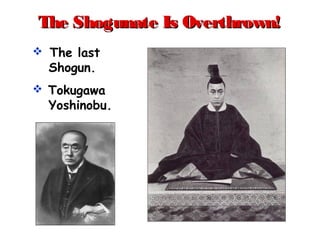
The Shogunate Is Overthrown!The Shogunate Is Overthrown!
 The last
Shogun.
 Tokugawa
Yoshinobu.
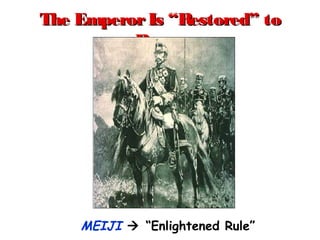
The EmperorIs “Restored” toThe EmperorIs “Restored” to
PowerPower
MEIJI  “Enlightened Rule”
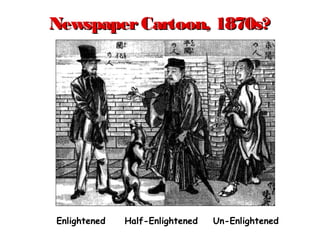
NewspaperCartoon, 1870s?NewspaperCartoon, 1870s?
Enlightened Half-Enlightened Un-Enlightened
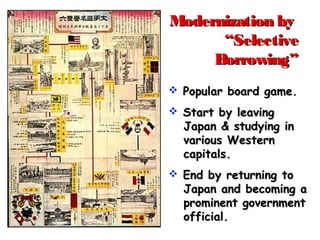
Modernization byModernization by
“Selective“Selective
Borrowing”Borrowing”
 Popular board game.Popular board game.
 Start by leavingStart by leaving
Japan & studying inJapan & studying in
various Westernvarious Western
capitals.capitals.
 End by returning toEnd by returning to
Japan and becoming aJapan and becoming a
prominent governmentprominent government
official.official.
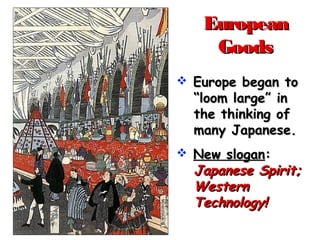
EuropeanEuropean
GoodsGoods
 Europe began toEurope began to
“loom large” in“loom large” in
the thinking ofthe thinking of
many Japanese.many Japanese.
 New sloganNew slogan::
Japanese Spirit;Japanese Spirit;
WesternWestern
Technology!Technology!
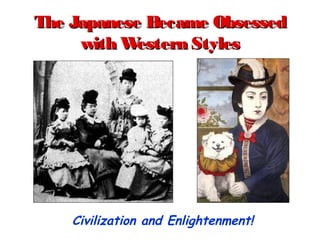
The Japanese Became ObsessedThe Japanese Became Obsessed
with Western Styleswith Western Styles
Civilization and Enlightenment!
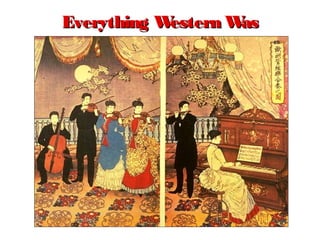
Everything Western WasEverything Western Was
Fashionable!Fashionable!
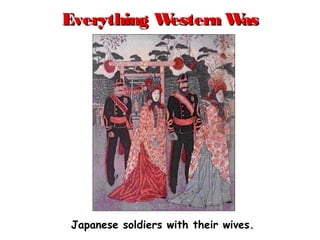
Everything Western WasEverything Western Was
Fashionable!Fashionable!
Japanese soldiers with their wives.
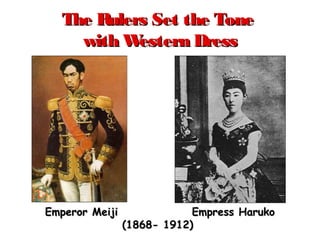
The Rulers Set the ToneThe Rulers Set the Tone
with Western Dresswith Western Dress
Emperor Meiji Empress HarukoEmperor Meiji Empress Haruko
(1868- 1912)(1868- 1912)
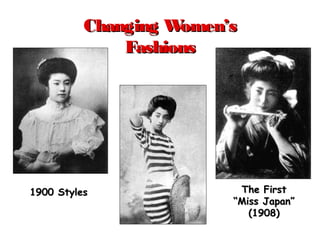
Changing Women’sChanging Women’s
FashionsFashions
1900 Styles1900 Styles The FirstThe First
“Miss Japan”“Miss Japan”
(1908)(1908)
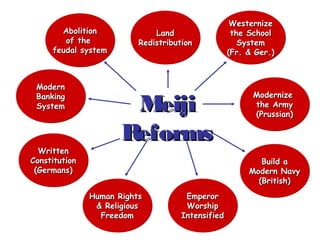
MeijiMeiji
ReformsReforms
AbolitionAbolition
of theof the
feudal systemfeudal system
AbolitionAbolition
of theof the
feudal systemfeudal system
LandLand
RedistributionRedistribution
LandLand
RedistributionRedistribution
Human RightsHuman Rights
& Religious& Religious
FreedomFreedom
Human RightsHuman Rights
& Religious& Religious
FreedomFreedom
Build aBuild a
Modern NavyModern Navy
(British)(British)
Build aBuild a
Modern NavyModern Navy
(British)(British)
WesternizeWesternize
the Schoolthe School
SystemSystem
(Fr. & Ger.)(Fr. & Ger.)
WesternizeWesternize
the Schoolthe School
SystemSystem
(Fr. & Ger.)(Fr. & Ger.)
ModernizeModernize
the Armythe Army
(Prussian)(Prussian)
ModernizeModernize
the Armythe Army
(Prussian)(Prussian)
EmperorEmperor
WorshipWorship
IntensifiedIntensified
EmperorEmperor
WorshipWorship
IntensifiedIntensified
WrittenWritten
ConstitutionConstitution
(Germans)(Germans)
WrittenWritten
ConstitutionConstitution
(Germans)(Germans)
ModernModern
BankingBanking
SystemSystem
ModernModern
BankingBanking
SystemSystem
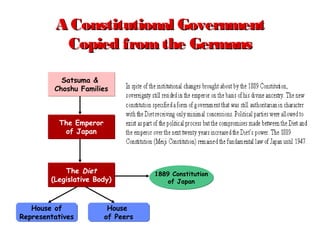
A Constitutional GovernmentA Constitutional Government
Copied fromthe GermansCopied fromthe Germans
Satsuma &
Choshu Families
Satsuma &
Choshu Families
The Emperor
of Japan
The Emperor
of Japan
The Diet
(Legislative Body)
The Diet
(Legislative Body)
House of
Representatives
House of
Representatives
House
of Peers
House
of Peers
1889 Constitution
of Japan
1889 Constitution
of Japan
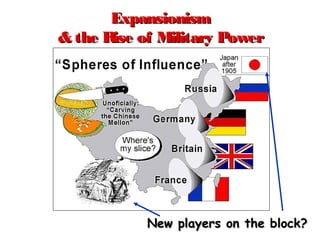
ExpansionismExpansionism
& the Rise of Military Power& the Rise of Military Power
New players on the block?New players on the block?
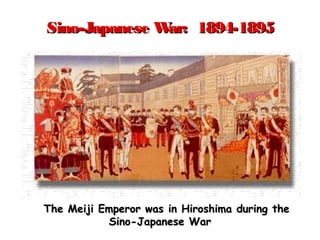
Sino-Japanese War: 1894-1895Sino-Japanese War: 1894-1895
The Meiji Emperor was in Hiroshima during theThe Meiji Emperor was in Hiroshima during the
Sino-Japanese WarSino-Japanese War
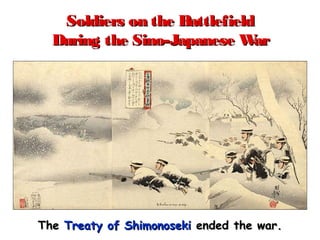
Soldiers on the BattlefieldSoldiers on the Battlefield
During the Sino-Japanese WarDuring the Sino-Japanese War
TheThe Treaty of ShimonosekiTreaty of Shimonoseki ended the war.ended the war.
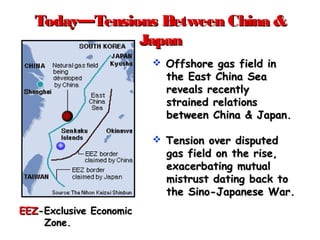
Today—Tensions Between China &Today—Tensions Between China &
JapanJapan
EEZEEZ-Exclusive Economic-Exclusive Economic
Zone.Zone.
 Offshore gas field inOffshore gas field in
the East China Seathe East China Sea
reveals recentlyreveals recently
strained relationsstrained relations
between China & Japan.between China & Japan.
 Tension over disputedTension over disputed
gas field on the rise,gas field on the rise,
exacerbating mutualexacerbating mutual
mistrust dating back tomistrust dating back to
the Sino-Japanese War.the Sino-Japanese War.
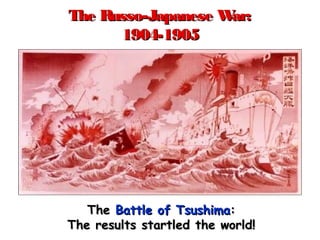
The Russo-Japanese War:The Russo-Japanese War:
1904-19051904-1905
TheThe Battle of TsushimaBattle of Tsushima::
The results startled the world!The results startled the world!
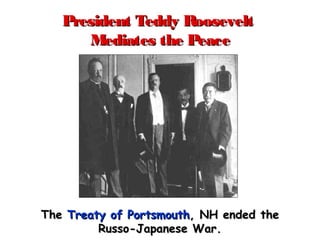
President Teddy RooseveltPresident Teddy Roosevelt
Mediates the PeaceMediates the Peace
TheThe Treaty of PortsmouthTreaty of Portsmouth, NH ended the, NH ended the
Russo-Japanese War.Russo-Japanese War.
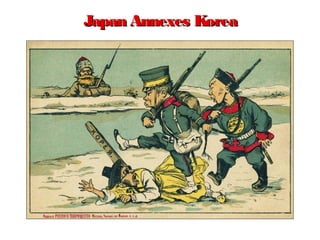
Japan Annexes KoreaJapan Annexes Korea
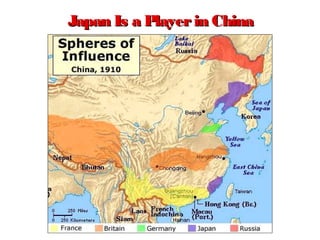
Japan Is a Playerin ChinaJapan Is a Playerin China
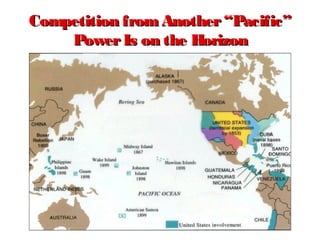
Competition from Another“Pacific”Competition from Another“Pacific”
PowerIs on the HorizonPowerIs on the Horizon
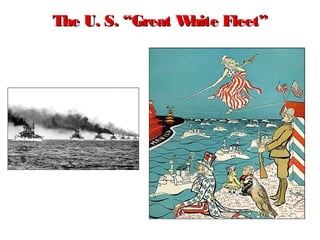
The U. S. “Great White Fleet”The U. S. “Great White Fleet”
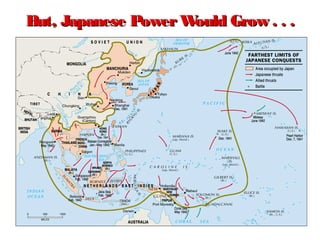
But, Japanese PowerWould Grow . . .But, Japanese PowerWould Grow . . .

Imperialist japan

  • 2.
    Japan perubahan pimpinanselamaJapan perubahan pimpinan selama thethe Meiji Era: 1868 - 1912Meiji Era: 1868 - 1912 Commodore Matthew Perry
  • 3.
    1853 – CommodoreMatthew Perry1853 – Commodore Matthew Perry “Up” Japan to Western Trade!“Up” Japan to Western Trade!
  • 4.
    Apa the U.S. kebutuhan??Apa the U. S. kebutuhan??  batu bara pangkalan. Lebih patner dagang.  A tempat singgah for kapal-merusak pelaut.
  • 5.
  • 6.
    The perjanjian ofKanagawa - 1854The perjanjian of Kanagawa - 1854
  • 7.
    Japan Learns aLesson!Japan Learns a Lesson! In 1862, just before the start of the Meiji period, Tokugawa sent officials and scholars to China to study the situation there. A Japanese recorded in his diary from Shanghai… The Chinese have become servants to the foreigners. Sovereignty may belong to China but in fact it's no more than a colony of Great Britain and France.
  • 8.
    China’s “Unequal Treaties”China’s“Unequal Treaties”  After the Opium War of 1839-1842, Japan was convinced that it had to Open Up to the West.
  • 9.
    TheThe Shi-shiShi-shi (“Menof High(“Men of High Purpose”)Purpose”) Highly idealisticHighly idealistic samuraisamurai who felt that thewho felt that the arrival of Westerners was an attack on thearrival of Westerners was an attack on the traditional values of Japan.traditional values of Japan.  They believed that:They believed that:  Japan was sacred ground.Japan was sacred ground.  The emperor, now a figurehead inThe emperor, now a figurehead in Kyoto, was a God.Kyoto, was a God.  Were furious at the Shogun for signing treatiesWere furious at the Shogun for signing treaties with the West without the Emperor’s consent.with the West without the Emperor’s consent.  Their sloganTheir slogan  Revere the Emperor, ExpelRevere the Emperor, Expel the Barbarians!the Barbarians!
  • 10.
    The Meiji Revolt- 1868The Meiji Revolt - 1868  A powerful groupA powerful group ofof samuraisamurai overthrow theoverthrow the Shogun.Shogun.  Sakamoto RyomaSakamoto Ryoma,, the hero.the hero.  He helped JapanHe helped Japan emerge fromemerge from feudalism into afeudalism into a unified modernunified modern state.state.
  • 11.
    The Shogunate IsOverthrown!The Shogunate Is Overthrown!  The last Shogun.  Tokugawa Yoshinobu.
  • 12.
    The EmperorIs “Restored”toThe EmperorIs “Restored” to PowerPower MEIJI  “Enlightened Rule”
  • 13.
  • 14.
    Modernization byModernization by “Selective“Selective Borrowing”Borrowing” Popular board game.Popular board game.  Start by leavingStart by leaving Japan & studying inJapan & studying in various Westernvarious Western capitals.capitals.  End by returning toEnd by returning to Japan and becoming aJapan and becoming a prominent governmentprominent government official.official.
  • 15.
    EuropeanEuropean GoodsGoods  Europe begantoEurope began to “loom large” in“loom large” in the thinking ofthe thinking of many Japanese.many Japanese.  New sloganNew slogan:: Japanese Spirit;Japanese Spirit; WesternWestern Technology!Technology!
  • 16.
    The Japanese BecameObsessedThe Japanese Became Obsessed with Western Styleswith Western Styles Civilization and Enlightenment!
  • 17.
    Everything Western WasEverythingWestern Was Fashionable!Fashionable!
  • 18.
    Everything Western WasEverythingWestern Was Fashionable!Fashionable! Japanese soldiers with their wives.
  • 19.
    The Rulers Setthe ToneThe Rulers Set the Tone with Western Dresswith Western Dress Emperor Meiji Empress HarukoEmperor Meiji Empress Haruko (1868- 1912)(1868- 1912)
  • 20.
    Changing Women’sChanging Women’s FashionsFashions 1900Styles1900 Styles The FirstThe First “Miss Japan”“Miss Japan” (1908)(1908)
  • 21.
    MeijiMeiji ReformsReforms AbolitionAbolition of theof the feudalsystemfeudal system AbolitionAbolition of theof the feudal systemfeudal system LandLand RedistributionRedistribution LandLand RedistributionRedistribution Human RightsHuman Rights & Religious& Religious FreedomFreedom Human RightsHuman Rights & Religious& Religious FreedomFreedom Build aBuild a Modern NavyModern Navy (British)(British) Build aBuild a Modern NavyModern Navy (British)(British) WesternizeWesternize the Schoolthe School SystemSystem (Fr. & Ger.)(Fr. & Ger.) WesternizeWesternize the Schoolthe School SystemSystem (Fr. & Ger.)(Fr. & Ger.) ModernizeModernize the Armythe Army (Prussian)(Prussian) ModernizeModernize the Armythe Army (Prussian)(Prussian) EmperorEmperor WorshipWorship IntensifiedIntensified EmperorEmperor WorshipWorship IntensifiedIntensified WrittenWritten ConstitutionConstitution (Germans)(Germans) WrittenWritten ConstitutionConstitution (Germans)(Germans) ModernModern BankingBanking SystemSystem ModernModern BankingBanking SystemSystem
  • 22.
    A Constitutional GovernmentAConstitutional Government Copied fromthe GermansCopied fromthe Germans Satsuma & Choshu Families Satsuma & Choshu Families The Emperor of Japan The Emperor of Japan The Diet (Legislative Body) The Diet (Legislative Body) House of Representatives House of Representatives House of Peers House of Peers 1889 Constitution of Japan 1889 Constitution of Japan
  • 23.
    ExpansionismExpansionism & the Riseof Military Power& the Rise of Military Power New players on the block?New players on the block?
  • 24.
    Sino-Japanese War: 1894-1895Sino-JapaneseWar: 1894-1895 The Meiji Emperor was in Hiroshima during theThe Meiji Emperor was in Hiroshima during the Sino-Japanese WarSino-Japanese War
  • 25.
    Soldiers on theBattlefieldSoldiers on the Battlefield During the Sino-Japanese WarDuring the Sino-Japanese War TheThe Treaty of ShimonosekiTreaty of Shimonoseki ended the war.ended the war.
  • 26.
    Today—Tensions Between China&Today—Tensions Between China & JapanJapan EEZEEZ-Exclusive Economic-Exclusive Economic Zone.Zone.  Offshore gas field inOffshore gas field in the East China Seathe East China Sea reveals recentlyreveals recently strained relationsstrained relations between China & Japan.between China & Japan.  Tension over disputedTension over disputed gas field on the rise,gas field on the rise, exacerbating mutualexacerbating mutual mistrust dating back tomistrust dating back to the Sino-Japanese War.the Sino-Japanese War.
  • 27.
    The Russo-Japanese War:TheRusso-Japanese War: 1904-19051904-1905 TheThe Battle of TsushimaBattle of Tsushima:: The results startled the world!The results startled the world!
  • 28.
    President Teddy RooseveltPresidentTeddy Roosevelt Mediates the PeaceMediates the Peace TheThe Treaty of PortsmouthTreaty of Portsmouth, NH ended the, NH ended the Russo-Japanese War.Russo-Japanese War.
  • 29.
  • 30.
    Japan Is aPlayerin ChinaJapan Is a Playerin China
  • 31.
    Competition from Another“Pacific”Competitionfrom Another“Pacific” PowerIs on the HorizonPowerIs on the Horizon
  • 32.
    The U. S.“Great White Fleet”The U. S. “Great White Fleet”
  • 33.
    But, Japanese PowerWouldGrow . . .But, Japanese PowerWould Grow . . .