PSG COLLEGE OF
TECHNOLOGY
FOUNDRY - PROCESS INVOLVED, APPLICATIONS,
WORTHINESS AND ALTERNATIVES
23E104 – BASICS OF MECHANICAL
ENGINEERING
PRESENTED BY
Anish Kumar P S - 24E606
Aathish K – 24E618
Mithun R - 24E629
Shakthi Deepak - 24E643
TOPICS COVERED
--> What is foundry?
--> Basic equipments and tools used.
--> Process and practice overview - Mold
preparation, Casting of product
--> Applications in real life
--> Advantages over other processes
--> Demerits – Defects and its solutions,
Modern alternatives
--> Conclusion
WHAT IS FOUNDRY?
FOUNDRY
A specialized facility that makes metal castings is referred
to as a foundry. Metals are shaped by being melted it into
a liquid, poured into a mold, and then having the mold
material removed once the metal has set and cooled into
desired shapes. It is basically to transform raw metals into
finished products by shaping them through casting. The
two most frequently treated metals are cast iron
and aluminum.
Processes:
1)Pattern making
2)Mold preparation
3)Melting and
Pouring
4)Cooling and
Solidification
5)Shakeout and
Cleaning
6)Inspection and
Finishing
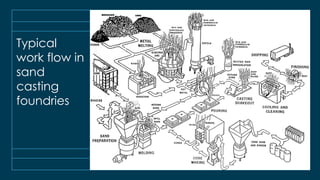
Typical
work flow in
sand
casting
foundries
BASIC EQUIPMENTS AND TOOLS
1. SHOVEL
2. HAND RIDDLE
3. RAMMERS
4. STRIKE OFF BAR
5. VENT WIRE
6. TROWELS
7. SLICKS
8. LIFTERS/ CLEANERS
9. DRAW SPIKE
BASIC EQUIPMENTS AND TOOLS
10. DRAW SCREW
AND RAPPING
PLATE
11. MALLET
12. SWAB
13. CLAMP
COTTER AND
WEDGE
14. GAGGER
15. BELLOW
16. MOULDING
BOXES OR FLASKS
17. LADLES
PROCESS AND PRACTICE OVERVIEW
FOUNDRY PROCESS
The typical casting process includes the following steps:
creating a pattern, molding or mold making, melting, pouring,
ejecting, cleaning, finishing and inspecting.
Melting:
The melting process is usually carried out in a furnace. The
furnace is charged with scrap, alloy elements such as
ferroalloys, and raw materials. Metal is "charged" into a melting
boiler, which is then heated over the melting point of the
metal. The molten metal is tapped into a steel pouring ladle
through a spout in the boiler once it has achieved a certain
pouring temperature. The surface of the molten metal is
skimmed to remove any slag or impurities.
Degassing:
A technique that is necessary to minimize the amount of
hydrogen in molten metal is called degassing. In metal
castings, gases can develop in one of two ways:
Physically trapped throughout the casting process.
through a chemical reaction within the casting.
If the concentration of hydrogen in the melt is excessive, the
final casting will have numerous pores or holes.
As the metal cools and solidifies, the hydrogen will escape the
molten solution, leaving minute air bubbles. By bubbling
insoluble gas (dry) through the melt by agitation or purging,
hydrogen can be removed from the melt effectively as shown
in the diagram below.
Mold Making:
A mold can be understood by taking an example of an ice
tray. The patterns are placed, sand or clay is packed around it
to create a shape, and the pattern is finally removed to make
a shape in the mold. This process is called mold or mold
making.
Molds are expertly crafted with a pattern (a wooden or metal
replica of the thing to be cast), so that the final casting shape
matches the poured mold. Even though silica sand is the most
popular mold material, there are a variety of other materials
that can be utilized, depending on the casting metal and
procedure. Molds can be as little as a few millimetres or as
large as several feet. Single pieces or solid patterns can be
used to create simple designs.
Pouring:
In a foundry, molds are filled with molten metal by pouring into
the mold either by gravity, a vacuum, or pressurized gas. Many
modern foundries pour molten metal using robots or automatic
pouring machines. Historically, molds were manually filled with
ladles. The molten metal poured is now allowed to cool inside
the mold until it solidifies.
Shakeout and Degating:
The solidified metal component is taken out of the mold. If the
mold is made of sand, this can be done by shaking or turning it.
With the sand still fastened to gates and metal runners through
which the molten metal travels. The shakeout process releases
the casting from the sand.
The process of removing the gates, runners, heads, and risers
from the casting is called degating. A sledgehammer or
specially made knockout machinery can be used to break the
sprue, runners, and gates free from the casting. The gating
system needed to make castings in a mold produces scrap
metal that can be reused as molten metal in the casting
process.
Finishing:
Sand or other moulding particles may still adhere to the casting
after degating. Shooting granular particles against the surface
mechanically removes the adhering sand.
To achieve the desired dimensional accuracy, physical shape,
and surface finish, the component undergoes processes like
grinding, machining, and sanding. This makes the final process
of casting. After this, before shipping cast products to
customers, the foundry provides additional services like
painting and assembly. Castings are painted to stop corrosion
and enhance aesthetics.
The processes are carried out by robotic machines which
increases productivity. They also reduce the possibility of
human error and improve the consistency.
TYPES OF MOLDING
Sand Molds: Made with sand bonded by
clay or chemical binders. Commonly used
for expendable molds.
Metal Molds: Made of steel or cast iron.
Used for repetitive casting in permanent
mold processes.
Graphite Molds: Made from graphite. Ideal
for non-ferrous metals due to thermal
conductivity and lubricating properties.
Based on Material Used
Based on Molding techniques
Green Sand Molds
Green sand molds are made using sand, water, and clay. The term
"green" refers to the fact that the sand mold is not baked or cured,
and it retains moisture.
Dry Sand Molds
Dry sand molds are made by baking the sand mould in an oven to
remove moisture. This process enhances the strength and rigidity of
the mold.
Skin-Dried Molds
Skin-dried molds are a hybrid between green and dry sand molds.
The surface of the green sand mould is dried and hardened by
exposure to heat or chemical coatings, while the interior remains
moist
CO2 Molds
CO2 molds are created by mixing sand with sodium silicate and
then hardening the mold by passing carbon dioxide gas through it.
The reaction between the CO2 and sodium silicate causes the
sand to harden.
Centrifugal Moulds
Centrifugal casting, molten metal is poured into a rotating mould.
The centrifugal force distributes the metal evenly within the mould
cavity, creating cylindrical castings
Lost Foam Moulds
Lost foam casting involves creating a foam pattern of the desired
shape, which is then coated with refractory material and buried in
sand. Molten metal is poured into the mould, vaporizing the foam
and taking its place.
Based on mould design
Open Moulds:
Open moulds are designed for simple shapes and are
characterized by having the top of the mould open to the
environment. This allows for easy pouring of the molten metal.
Closed Moulds:
Closed moulds are used for more complex designs and include
cavities and gating systems to guide the flow of molten metal.
These moulds are fully enclosed, providing better control over the
casting process.
APPLICATIONS IN REAL LIFE
PRODUCING
METAL
COMPONENTS
FOR INDUSTRIAL
NEEDS SUCH AS
PUMPS, VALVES,
COMPRESSORS,
AND ENGINES.
PROVIDING COMPONENTS FOR
ENGINE BLOCKS, TRANSMISSION
PARTS, AND OTHER ESSENTIAL
AUTOMOTIVE PARTS.
PRODUCING
METAL TOOLS AND
HARDWARE SUCH
AS WRENCHES,
HAMMERS, AND
PLIERS.
PRODUCING POWER
TRANSMISSION SYSTEMS
SUCH AS TURBINES,
GENERATORS, AND
ELECTRIC MOTORS IS ALSO
DONE THROUGH CASTING
IN A FOUNDRY.
PRODUCING WEAPONS,
AMMUNITION, AND OTHER
MILITARY EQUIPMENT.
WORTHINESS OF FOUNDRY
ADVANTAGES OVER OTHER PROCESSES
• Cost-Effective for Large Production
• Versatility in Material
• Produces less material waste
• Produces components with excellent
mechanical properties due to the
controlled solidification process.
• Capable of producing extremely large
and heavy components.
• Ability to Create Complex Shapes
• Suitable for both small-scale, customized
production and large-scale, mass
production.
DEMERITS –
DEFECTS AND ITS
SOLUTIONS
Casting defects are imperfections or
irregularities that compromise the quality
specifications of a component. While some
of the defects may be tolerated or
neglected, some casting surface defects
result in weak casting, odd shapes, and
poor functionality. Therefore, they must be
removed or prevented to ensure better
functioning of the end product.
There are various types of casting defects,
but they are generally grouped into four
categories, namely:
Metallurgical defects
Defects due to heat
Mold material defects
Casting shape defects
Metallurgical Defects (Metal material)
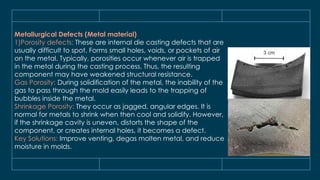
1)Porosity defects: These are internal die casting defects that are
usually difficult to spot. Forms small holes, voids, or pockets of air
on the metal. Typically, porosities occur whenever air is trapped
in the metal during the casting process. Thus, the resulting
component may have weakened structural resistance.
Gas Porosity: During solidification of the metal, the inability of the
gas to pass through the mold easily leads to the trapping of
bubbles inside the metal.
Shrinkage Porosity: They occur as jagged, angular edges. It is
normal for metals to shrink when then cool and solidify. However,
if the shrinkage cavity is uneven, distorts the shape of the
component, or creates internal holes, it becomes a defect.
Key Solutions: Improve venting, degas molten metal, and reduce
moisture in molds.
2)Sinks: A sink is a press-down impact on the casting surface
that does not precisely copy the mold design. Sinks appear
on the casting surface when there is a sub-surface cavity
present. These depressions occur along thick-walled areas
on the metal surface.
3)Slag Inclusions: A slag inclusion firmly attaches to the
casting, reducing the mechanical characteristics of the final
product. It usually occurs when non-metallic materials cause
irregular crusts on the casting surface. The casting defect is a
ribbon-like entrainment or pocket with sharp edges and
irregular shapes.
Key Solutions: Optimized structural design for the mold, Die
maintenance and improved Gateway.
4)Dross: Dross refers to a metal loss that occurs during
nonferrous metal casting operations. As metal melts, it
oxidizes to form layers of impurities and scum that floats to
the surface of the metal. The impurities occur due to the
mixing of the oxide of the base metal and other metals on
the surface.
5)Soldering: Soldering is a common casting defect during
the casting process. It occurs when molten metal attaches
itself to the surface of the die cavity and stays there after
removing the casting. Consequently, some areas of the
casting parts are either missing material or excess material.
You can identify soldering by visual inspection.
Key Solutions: Decrease the melting time, improve die
quality
Defects Due to Heat
1)Hot Tears: Hot tears are some of the significant casting
abnormalities that occur due to heat. This defect occurs
during the solidification of the metal casting. At this stage,
thermally induced tensile strains and stresses develop in
the metal. The hot tear occurs as the metal contracts
when solidifying.
2)Cold Shut: Cold shut defects are cracks that have round
edges. They occur when metal flows into the mold from
more than one point. However, the metal is too cold and
cannot merge properly to form a perfect piece. Thus, a
cold shut occurs as cracks with rounded edges through
the middle of the workpiece, create a weak spot on the
casting.
Key Solutions: Optimize pouring temperature and gating
system design.
Mold Material Casting Defects
1)Fusion: Fusion is another sand casting defect that occurs
when sand grains fuse with the flowing liquid metal. This
results in a thin layer of hard, glassy crust firmly attached
to the casting. The main cause of this defect is the low
refractoriness of sand.
2)Swells: Metallostatic forces often cause the mold wall to
move back, causing a swell in the dimensions of the
workpiece. This means that the casting will enlarge
beyond the desired volume, showing as slight, smooth
bulges. As a result, its feeding and machining
requirements will increase and it may lead to metal
wastage.
Key solutions: Enhance the refractoriness of molding
materials. Design molds to withstand molten metal
pressure to prevent the mold wall from moving backward.
3)Metal Penetration: This occurs in situations when the
molten metal penetrates openings or gaps in the molding
sand. The main reason for this is that the grain size of the
molding sand is too coarse, preventing the proper flowing
of the liquid metal. Consequently, you will get a rough
and irregular casting surface, lowering its aesthetics. 4)
4)Drops: These defects happen when the casting is still in
molten form. They are caused when pieces of loose
molding sand or lumps drop from the surface of the cope
into the mold cavity. As a result, an abnormal and
irregularly shaped projection occurs on the casting’s
surface. Drops can also make the metal surface look dirty
and unsuitable for use.
Key solutions: Improved ramming, Using high quality sand
Casting Shape Defects
1)Mismatches: Mismatches are casting defects that
occur due to the misalignment of the lower and upper
parts of the mold. It could occur when the cope and
drag of the mold are not properly lined up before
pouring the metal.
2)Flash: Flashes are any excess or unwanted material
that occurs as thin, irregular-shaped occurrences on
the parting line of a die-casting part. Typically, it is a
thin sheet of metal forming on the parting faces and
turning into dross after re-melting. Since flashes often
have larger sizes, they can be seen by visual
inspection.
Key solutions: Proper box pins, regular box, pins
maintanence.
MODERN ALTERNATIVES
1. Additive Manufacturing (3D Printing)
Description: Uses layer-by-layer fabrication to create metal parts
directly from digital models.
Advantages: High precision, reduced waste, and elimination of
molds or patterns.
Applications: Prototyping, aerospace components, and intricate
designs.
2. Investment Casting (Lost-Wax Casting)
Description: A wax pattern is coated with refractory material to
form a mold, which is then heated to remove wax before
pouring metal.
Advantages: Superior surface finish and dimensional accuracy
for intricate designs.
Applications: Jewelry, turbine blades, and medical implants.
3. Die Casting
Description: Molten metal is injected into steel
molds under high pressure.
Advantages: High production rate, excellent
surface finish, and tight tolerances.
Applications: Automotive, electronics, and
consumer goods.
4. Continuous Casting
Description: A process where molten metal
solidifies in a continuous mold to produce long
products like billets and slabs.
Advantages: High efficiency, consistent quality,
and reduced waste.
Applications: Steel and non-ferrous metal
industries.
5. Powder Metallurgy
Description: Metal powders are compressed and
sintered to form solid parts.
Advantages: Minimal waste, high material
utilization, and ability to form complex shapes.
Applications: Gears, bearings, and structural
components.
6. Squeeze Casting
Description: Combines casting and forging by
applying pressure during solidification.
Advantages: Strong, high-density parts with
minimal porosity.
Applications: Automotive and heavy machinery
parts.
CONCLUSION
Foundry remains a vital manufacturing process, offering unmatched versatility in producing complex
shapes and large metal components. Through advancements in technology and process
improvements, modern foundries address defects and enhance production efficiency.
Foundries play a crucial role in numerous applications, from automotive to aerospace,
demonstrating their indispensable value in real-world manufacturing.
By understanding its processes, benefits, and limitations, industries can leverage the best aspects of
foundry work while embracing innovative alternatives.
"Foundry is not just a process—it's the backbone of innovation in metal manufacturing."
THANK YOU
BIBLIOGRAPHY
H T T P S : / / T E S T B O O K . C O M / M E C H A N I C A L - E N G I N E E R I N G / F O U N D R Y - D E F I N I T I O N - A N D - P R O C E S S
H T T P S : / / Y A N T H R I S T . C O M / T O P - 1 8 - F O U N D R Y - T O O L S - E Q U I P M E N T /
H T T P S : / / W W W . R A P I D D I R E C T . C O M / B L O G / 1 7 - T Y P E S - O F - C A S T I N G - D E F E C T S /

Foundry presentation : Presentation on moulding processes

  • 1.
    PSG COLLEGE OF TECHNOLOGY FOUNDRY- PROCESS INVOLVED, APPLICATIONS, WORTHINESS AND ALTERNATIVES 23E104 – BASICS OF MECHANICAL ENGINEERING
  • 2.
    PRESENTED BY Anish KumarP S - 24E606 Aathish K – 24E618 Mithun R - 24E629 Shakthi Deepak - 24E643
  • 3.
    TOPICS COVERED --> Whatis foundry? --> Basic equipments and tools used. --> Process and practice overview - Mold preparation, Casting of product --> Applications in real life --> Advantages over other processes --> Demerits – Defects and its solutions, Modern alternatives --> Conclusion
  • 4.
  • 5.
    FOUNDRY A specialized facilitythat makes metal castings is referred to as a foundry. Metals are shaped by being melted it into a liquid, poured into a mold, and then having the mold material removed once the metal has set and cooled into desired shapes. It is basically to transform raw metals into finished products by shaping them through casting. The two most frequently treated metals are cast iron and aluminum.
  • 6.
    Processes: 1)Pattern making 2)Mold preparation 3)Meltingand Pouring 4)Cooling and Solidification 5)Shakeout and Cleaning 6)Inspection and Finishing
  • 8.
  • 9.
  • 10.
    BASIC EQUIPMENTS ANDTOOLS 1. SHOVEL 2. HAND RIDDLE 3. RAMMERS 4. STRIKE OFF BAR 5. VENT WIRE 6. TROWELS 7. SLICKS 8. LIFTERS/ CLEANERS 9. DRAW SPIKE
  • 11.
    BASIC EQUIPMENTS ANDTOOLS 10. DRAW SCREW AND RAPPING PLATE 11. MALLET 12. SWAB 13. CLAMP COTTER AND WEDGE 14. GAGGER 15. BELLOW 16. MOULDING BOXES OR FLASKS 17. LADLES
  • 12.
  • 13.
    FOUNDRY PROCESS The typicalcasting process includes the following steps: creating a pattern, molding or mold making, melting, pouring, ejecting, cleaning, finishing and inspecting. Melting: The melting process is usually carried out in a furnace. The furnace is charged with scrap, alloy elements such as ferroalloys, and raw materials. Metal is "charged" into a melting boiler, which is then heated over the melting point of the metal. The molten metal is tapped into a steel pouring ladle through a spout in the boiler once it has achieved a certain pouring temperature. The surface of the molten metal is skimmed to remove any slag or impurities.
  • 14.
    Degassing: A technique thatis necessary to minimize the amount of hydrogen in molten metal is called degassing. In metal castings, gases can develop in one of two ways: Physically trapped throughout the casting process. through a chemical reaction within the casting. If the concentration of hydrogen in the melt is excessive, the final casting will have numerous pores or holes. As the metal cools and solidifies, the hydrogen will escape the molten solution, leaving minute air bubbles. By bubbling insoluble gas (dry) through the melt by agitation or purging, hydrogen can be removed from the melt effectively as shown in the diagram below.
  • 15.
    Mold Making: A moldcan be understood by taking an example of an ice tray. The patterns are placed, sand or clay is packed around it to create a shape, and the pattern is finally removed to make a shape in the mold. This process is called mold or mold making. Molds are expertly crafted with a pattern (a wooden or metal replica of the thing to be cast), so that the final casting shape matches the poured mold. Even though silica sand is the most popular mold material, there are a variety of other materials that can be utilized, depending on the casting metal and procedure. Molds can be as little as a few millimetres or as large as several feet. Single pieces or solid patterns can be used to create simple designs.
  • 16.
    Pouring: In a foundry,molds are filled with molten metal by pouring into the mold either by gravity, a vacuum, or pressurized gas. Many modern foundries pour molten metal using robots or automatic pouring machines. Historically, molds were manually filled with ladles. The molten metal poured is now allowed to cool inside the mold until it solidifies.
  • 17.
    Shakeout and Degating: Thesolidified metal component is taken out of the mold. If the mold is made of sand, this can be done by shaking or turning it. With the sand still fastened to gates and metal runners through which the molten metal travels. The shakeout process releases the casting from the sand. The process of removing the gates, runners, heads, and risers from the casting is called degating. A sledgehammer or specially made knockout machinery can be used to break the sprue, runners, and gates free from the casting. The gating system needed to make castings in a mold produces scrap metal that can be reused as molten metal in the casting process.
  • 18.
    Finishing: Sand or othermoulding particles may still adhere to the casting after degating. Shooting granular particles against the surface mechanically removes the adhering sand. To achieve the desired dimensional accuracy, physical shape, and surface finish, the component undergoes processes like grinding, machining, and sanding. This makes the final process of casting. After this, before shipping cast products to customers, the foundry provides additional services like painting and assembly. Castings are painted to stop corrosion and enhance aesthetics. The processes are carried out by robotic machines which increases productivity. They also reduce the possibility of human error and improve the consistency.
  • 19.
  • 20.
    Sand Molds: Madewith sand bonded by clay or chemical binders. Commonly used for expendable molds. Metal Molds: Made of steel or cast iron. Used for repetitive casting in permanent mold processes. Graphite Molds: Made from graphite. Ideal for non-ferrous metals due to thermal conductivity and lubricating properties. Based on Material Used
  • 21.
    Based on Moldingtechniques Green Sand Molds Green sand molds are made using sand, water, and clay. The term "green" refers to the fact that the sand mold is not baked or cured, and it retains moisture. Dry Sand Molds Dry sand molds are made by baking the sand mould in an oven to remove moisture. This process enhances the strength and rigidity of the mold. Skin-Dried Molds Skin-dried molds are a hybrid between green and dry sand molds. The surface of the green sand mould is dried and hardened by exposure to heat or chemical coatings, while the interior remains moist
  • 22.
    CO2 Molds CO2 moldsare created by mixing sand with sodium silicate and then hardening the mold by passing carbon dioxide gas through it. The reaction between the CO2 and sodium silicate causes the sand to harden. Centrifugal Moulds Centrifugal casting, molten metal is poured into a rotating mould. The centrifugal force distributes the metal evenly within the mould cavity, creating cylindrical castings Lost Foam Moulds Lost foam casting involves creating a foam pattern of the desired shape, which is then coated with refractory material and buried in sand. Molten metal is poured into the mould, vaporizing the foam and taking its place.
  • 23.
    Based on moulddesign Open Moulds: Open moulds are designed for simple shapes and are characterized by having the top of the mould open to the environment. This allows for easy pouring of the molten metal. Closed Moulds: Closed moulds are used for more complex designs and include cavities and gating systems to guide the flow of molten metal. These moulds are fully enclosed, providing better control over the casting process.
  • 24.
  • 25.
    PRODUCING METAL COMPONENTS FOR INDUSTRIAL NEEDS SUCHAS PUMPS, VALVES, COMPRESSORS, AND ENGINES.
  • 26.
    PROVIDING COMPONENTS FOR ENGINEBLOCKS, TRANSMISSION PARTS, AND OTHER ESSENTIAL AUTOMOTIVE PARTS.
  • 27.
    PRODUCING METAL TOOLS AND HARDWARESUCH AS WRENCHES, HAMMERS, AND PLIERS.
  • 28.
    PRODUCING POWER TRANSMISSION SYSTEMS SUCHAS TURBINES, GENERATORS, AND ELECTRIC MOTORS IS ALSO DONE THROUGH CASTING IN A FOUNDRY.
  • 29.
    PRODUCING WEAPONS, AMMUNITION, ANDOTHER MILITARY EQUIPMENT.
  • 30.
  • 31.
    ADVANTAGES OVER OTHERPROCESSES • Cost-Effective for Large Production • Versatility in Material • Produces less material waste • Produces components with excellent mechanical properties due to the controlled solidification process. • Capable of producing extremely large and heavy components. • Ability to Create Complex Shapes • Suitable for both small-scale, customized production and large-scale, mass production.
  • 32.
    DEMERITS – DEFECTS ANDITS SOLUTIONS Casting defects are imperfections or irregularities that compromise the quality specifications of a component. While some of the defects may be tolerated or neglected, some casting surface defects result in weak casting, odd shapes, and poor functionality. Therefore, they must be removed or prevented to ensure better functioning of the end product. There are various types of casting defects, but they are generally grouped into four categories, namely: Metallurgical defects Defects due to heat Mold material defects Casting shape defects
  • 33.
    Metallurgical Defects (Metalmaterial) 1)Porosity defects: These are internal die casting defects that are usually difficult to spot. Forms small holes, voids, or pockets of air on the metal. Typically, porosities occur whenever air is trapped in the metal during the casting process. Thus, the resulting component may have weakened structural resistance. Gas Porosity: During solidification of the metal, the inability of the gas to pass through the mold easily leads to the trapping of bubbles inside the metal. Shrinkage Porosity: They occur as jagged, angular edges. It is normal for metals to shrink when then cool and solidify. However, if the shrinkage cavity is uneven, distorts the shape of the component, or creates internal holes, it becomes a defect. Key Solutions: Improve venting, degas molten metal, and reduce moisture in molds.
  • 34.
    2)Sinks: A sinkis a press-down impact on the casting surface that does not precisely copy the mold design. Sinks appear on the casting surface when there is a sub-surface cavity present. These depressions occur along thick-walled areas on the metal surface. 3)Slag Inclusions: A slag inclusion firmly attaches to the casting, reducing the mechanical characteristics of the final product. It usually occurs when non-metallic materials cause irregular crusts on the casting surface. The casting defect is a ribbon-like entrainment or pocket with sharp edges and irregular shapes. Key Solutions: Optimized structural design for the mold, Die maintenance and improved Gateway.
  • 35.
    4)Dross: Dross refersto a metal loss that occurs during nonferrous metal casting operations. As metal melts, it oxidizes to form layers of impurities and scum that floats to the surface of the metal. The impurities occur due to the mixing of the oxide of the base metal and other metals on the surface. 5)Soldering: Soldering is a common casting defect during the casting process. It occurs when molten metal attaches itself to the surface of the die cavity and stays there after removing the casting. Consequently, some areas of the casting parts are either missing material or excess material. You can identify soldering by visual inspection. Key Solutions: Decrease the melting time, improve die quality
  • 36.
    Defects Due toHeat 1)Hot Tears: Hot tears are some of the significant casting abnormalities that occur due to heat. This defect occurs during the solidification of the metal casting. At this stage, thermally induced tensile strains and stresses develop in the metal. The hot tear occurs as the metal contracts when solidifying. 2)Cold Shut: Cold shut defects are cracks that have round edges. They occur when metal flows into the mold from more than one point. However, the metal is too cold and cannot merge properly to form a perfect piece. Thus, a cold shut occurs as cracks with rounded edges through the middle of the workpiece, create a weak spot on the casting. Key Solutions: Optimize pouring temperature and gating system design.
  • 37.
    Mold Material CastingDefects 1)Fusion: Fusion is another sand casting defect that occurs when sand grains fuse with the flowing liquid metal. This results in a thin layer of hard, glassy crust firmly attached to the casting. The main cause of this defect is the low refractoriness of sand. 2)Swells: Metallostatic forces often cause the mold wall to move back, causing a swell in the dimensions of the workpiece. This means that the casting will enlarge beyond the desired volume, showing as slight, smooth bulges. As a result, its feeding and machining requirements will increase and it may lead to metal wastage. Key solutions: Enhance the refractoriness of molding materials. Design molds to withstand molten metal pressure to prevent the mold wall from moving backward.
  • 38.
    3)Metal Penetration: Thisoccurs in situations when the molten metal penetrates openings or gaps in the molding sand. The main reason for this is that the grain size of the molding sand is too coarse, preventing the proper flowing of the liquid metal. Consequently, you will get a rough and irregular casting surface, lowering its aesthetics. 4) 4)Drops: These defects happen when the casting is still in molten form. They are caused when pieces of loose molding sand or lumps drop from the surface of the cope into the mold cavity. As a result, an abnormal and irregularly shaped projection occurs on the casting’s surface. Drops can also make the metal surface look dirty and unsuitable for use. Key solutions: Improved ramming, Using high quality sand
  • 39.
    Casting Shape Defects 1)Mismatches:Mismatches are casting defects that occur due to the misalignment of the lower and upper parts of the mold. It could occur when the cope and drag of the mold are not properly lined up before pouring the metal. 2)Flash: Flashes are any excess or unwanted material that occurs as thin, irregular-shaped occurrences on the parting line of a die-casting part. Typically, it is a thin sheet of metal forming on the parting faces and turning into dross after re-melting. Since flashes often have larger sizes, they can be seen by visual inspection. Key solutions: Proper box pins, regular box, pins maintanence.
  • 40.
    MODERN ALTERNATIVES 1. AdditiveManufacturing (3D Printing) Description: Uses layer-by-layer fabrication to create metal parts directly from digital models. Advantages: High precision, reduced waste, and elimination of molds or patterns. Applications: Prototyping, aerospace components, and intricate designs. 2. Investment Casting (Lost-Wax Casting) Description: A wax pattern is coated with refractory material to form a mold, which is then heated to remove wax before pouring metal. Advantages: Superior surface finish and dimensional accuracy for intricate designs. Applications: Jewelry, turbine blades, and medical implants.
  • 41.
    3. Die Casting Description:Molten metal is injected into steel molds under high pressure. Advantages: High production rate, excellent surface finish, and tight tolerances. Applications: Automotive, electronics, and consumer goods. 4. Continuous Casting Description: A process where molten metal solidifies in a continuous mold to produce long products like billets and slabs. Advantages: High efficiency, consistent quality, and reduced waste. Applications: Steel and non-ferrous metal industries.
  • 42.
    5. Powder Metallurgy Description:Metal powders are compressed and sintered to form solid parts. Advantages: Minimal waste, high material utilization, and ability to form complex shapes. Applications: Gears, bearings, and structural components. 6. Squeeze Casting Description: Combines casting and forging by applying pressure during solidification. Advantages: Strong, high-density parts with minimal porosity. Applications: Automotive and heavy machinery parts.
  • 43.
    CONCLUSION Foundry remains avital manufacturing process, offering unmatched versatility in producing complex shapes and large metal components. Through advancements in technology and process improvements, modern foundries address defects and enhance production efficiency. Foundries play a crucial role in numerous applications, from automotive to aerospace, demonstrating their indispensable value in real-world manufacturing. By understanding its processes, benefits, and limitations, industries can leverage the best aspects of foundry work while embracing innovative alternatives. "Foundry is not just a process—it's the backbone of innovation in metal manufacturing."
  • 44.
    THANK YOU BIBLIOGRAPHY H TT P S : / / T E S T B O O K . C O M / M E C H A N I C A L - E N G I N E E R I N G / F O U N D R Y - D E F I N I T I O N - A N D - P R O C E S S H T T P S : / / Y A N T H R I S T . C O M / T O P - 1 8 - F O U N D R Y - T O O L S - E Q U I P M E N T / H T T P S : / / W W W . R A P I D D I R E C T . C O M / B L O G / 1 7 - T Y P E S - O F - C A S T I N G - D E F E C T S /