Presentation on NATALITY,ITS
RELATED TERMS AND MEASUREMENT
OF FERTILITY
Presented By
Aminul Islam
ID:14115570
Department of Population Science
and Human Resource Development,
University of Rajshahi
E-mail:amin_pshrd@yahoo.com
CONTENTS
 Natality
 Related Terms Of Natality
 Measures of Fertility
 Crude Birth Rate (CBR)
 General Fertility Rate (GFR)
 Age Specific Fertility Rate (ASFR)
 Total Fertility Rate (TFR)
 Gross Reproduction Rate (GRR)
 Net Reproduction Rate (NRR)
 Conclusion
Natality
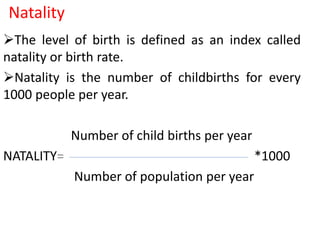
The level of birth is defined as an index called
natality or birth rate.
Natality is the number of childbirths for every
1000 people per year.
Number of child births per year
NATALITY= *1000
Number of population per year
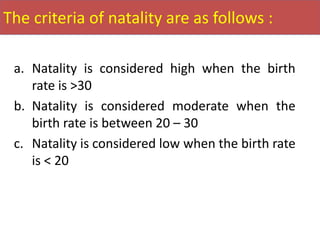
The criteria of natality are as follows :
a. Natality is considered high when the birth
rate is >30
b. Natality is considered moderate when the
birth rate is between 20 – 30
c. Natality is considered low when the birth rate
is < 20
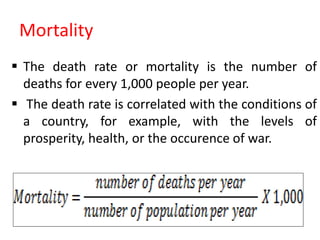
Mortality
 The death rate or mortality is the number of
deaths for every 1,000 people per year.
 The death rate is correlated with the conditions of
a country, for example, with the levels of
prosperity, health, or the occurence of war.
The criteria of the mortality are as follows :
a. Mortality is considered high if the death eate is >
18
b. Mortality is considered moderate if the death
rate is between 14 – 18
c. Mortality is considered low if the death rate is <
14
Fertility
• Number of live births per woman in the
population.
• Represents the actual birth performance.
CONTROLLED FERTILITY
FERTILITY
NATURAL FERTILITY
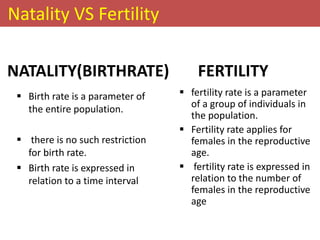
Natality VS Fertility
NATALITY(BIRTHRATE)
 Birth rate is a parameter of
the entire population.
 there is no such restriction
for birth rate.
 Birth rate is expressed in
relation to a time interval
FERTILITY
 fertility rate is a parameter
of a group of individuals in
the population.
 Fertility rate applies for
females in the reproductive
age.
 fertility rate is expressed in
relation to the number of
females in the reproductive
age
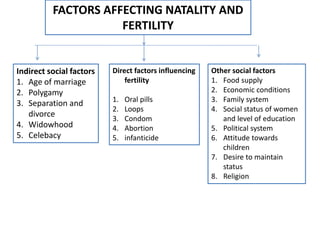
FACTORS AFFECTING NATALITY AND
FERTILITY
Indirect social factors
1. Age of marriage
2. Polygamy
3. Separation and
divorce
4. Widowhood
5. Celebacy
Direct factors influencing
fertility
1. Oral pills
2. Loops
3. Condom
4. Abortion
5. infanticide
Other social factors
1. Food supply
2. Economic conditions
3. Family system
4. Social status of women
and level of education
5. Political system
6. Attitude towards
children
7. Desire to maintain
status
8. Religion
TERMS RELATED TO FERTILITY
FECUNDITY:
Ability or capacity to reproduce
Potential birth
STERILITY:
The inability to reproduce
FECUNDABILITY:
Probability of conception among women
living regularly sexual union without practicing
a method of birth control.
CONT….
PARITY:
Number of children born alive to a
women.
Zero-parity women are women who
have never had a child.
GRAVIDITY:
the number of times a female has
been pregnant
CONT…
CHILDREN EVER BORN
Children ever born to a particular woman is
a measure of her life time fertility experience up to
moment at which the data are collecte
CEB =
Ranges of CEB:
Least Developed:5000 and above
Developing:3400
More Developed:1800
CEB for women over age 49 is called Completed
Fertility Rate
HOW FECUNDITY LIMITS
FERTILITRY???
BIRTH AND DEATH
LIVE BIRTH
Live birth is the complete expulsion or extraction
With the following signs,
breathes
beating of the heart
pulsation of the umbilical cord
definite movement of voluntary muscles
DEATH:
Death is the permanent disappearance of all
evidence of life at any time after live birth has taken
place
MID-YEAR POPULATION
If we assume that births, deaths, and movements
in and out of the population are evenly
distributed throughout the year, the number of
people alive at the middle of the year (July 1)
would equal the number of PYL.
This population alive at the middle of the year is
called MYP.
Calculating Mid-Year Population
•Mid-year population
= (P1 + P2) / 2
= [P1 + (P1 – D)] / 2
= P1 - ½ D
= P1 – ½ (P2 – P1)
• where:
• P1 = population on 1st January
• P2 = population on 1st January next year
• D = Deaths in a year
Quantify the birth performance of a population
over a period of time.
Used to compare the fertility levels of a number of
population, during a particular time interval
Exhibit a time trend in fertility in a population in
the study of differential fertility by various socio-
economic, racial and ethnic groups.
MEASURES OF FERTILITY
Uses:
Crude Birth Rate (CBR)
 Ratio of the total number of registered live births among residents in
an area during a calendar year to the total mid-year estimated
population of the same area, also multiplied by 1,000.
CBR =
B
P
x K
B = total number of live birth registered during the calendar year
P = total mid-year estimated population or the total population of the
middle of the year i.e. as on 1st July
K = a constant usually taken as 1,000
Advantages and limitation of CBR
Advantages
 Simplest and commonest measure on fertility
 Easily calculated
Limitations
 The entire population is in the denominator, whereas all
members of the population do not contribute equally to births
 In spite of its limitation, it is widely used due to the availability
of data
Trend of CBR in Bangladesh
2015 19.46
2014 19.80
2013 20.14
2012 20.50
2011 20.88
2010 21.30
2009 21.76
2008 22.28
2007 22.86
General Fertility Rate (GFR)
Defined as the number of births per year per
thousand mid-year woman of the child
bearing ages.
W 15-49 = total number of women of child bearing
age 15-49 at the mid point of the year in a given
geographical area.
GFR =
B
W 15-49
× 1000
Advantages:
 It includes the female population in
their reproductive ages who are
supposed to be exposed to the risk of
giving birth.
 Generally used in population
projection using component projection
method.
It is the number of births per year per women in a
given age group in a given year and geographical
area.
nBx = No. of Births to the women of ages x to x + n
yrs in a given yr and area.
nWx = No. of women aged x and x + n years at mid-
year in a given year and area
n is usually taken as 5 years.
Age Specific Fertility Rate (ASFR)
ASFR(nfx) =
nBx
nWx
Total Fertility Rate (TFR)
 Sum of age specific fertility rates of women over their
reproductive span i.e. all ages of child-bearing period from 15
to 49 years of age as observed in a given year.
TFR = ∑
Bi
Pi
x 1,000
i = 49
i = 15
B = total number of live birth registered during the year to mothers of age i
where I is an interval of one year
P = mid-year female population in the same age group
Total Fertility Rate (TFR)
 Usual practice, subscript i represents 5 year intervals such as
15-19, 20-24,…. And 45-49 years
TFR = 5 ∑
Bi
Pi
x 1,000
i = 7
i = 1
B = number of live birth registered during the year to mothers of age I where I is
an interval of 5-years
P = mid-year female population in the same age group.
TFR of women with
No education – 3.6
< 5 years of education – 2.5
12+ years of education – 1.8
Trend of TFR in Bangladesh
Gross Reproduction Rate (GRR)
 A special case of TFR
 Only distinction: the numerator of GRR is based on female
births instead of total births
 TFR measures the total number of children a cohort of women
will have
 GRR measures the number of daughters it will have
 GRR shows the average number of female children born to
women living through the child bearing ages (i.e. 15 to 49
years), assuming no mortality
Gross Reproduction Rate (GRR)
 Suppose GRR is 3. if a female child is born at that time, and
survives through her child-bearing period then she will give
birth to 3 female children in her turn, on the average
GRR = ∑
Bx
f
Px
f
x 1,000
w1
w2
Bx
f = number of female infants born to mothers of age x
Px
f = number of women of age x in the mid-year population
w1 and w2 = the lower and upper limits of the child bearing period
K = 1,000
Net Reproduction Rate (NRR)
 NRR is a measure of the number of daughters that a cohort of
new born girl babies will bear during their life time assuming a
fixed schedule of fertility rates and a fixed set of mortality
rates
 NRR is a measure of the extent to which a cohort of newly
born girls will replace themselves under given schedule of age
specific female of fertility and mortality
Net Reproduction Rate (NRR)
NRR = Bx
f
Px
f
x 1,000
fx = age specific female birth rate (daughters only) at age x
 NRR rate 1 means exact replacement
 NRR above unity indicates that the population is more than
replacing itself
 NRR below unity indicates that the population is not replacing itself
NRR is always lower than GRR because it takes into account that
some women die before completing their childbearing years.
REPRODUCTION OF POPULATION WHEN
NRR=3
Trend of NRR in Bangladesh
2015 1.03
2010 1.12
2005 1.29
2000 1.46
1995 1.67
1990 1.96
1985 2.25
1980 2.42
1975 2.23
CONCLUSION
Birth,death and migration are the
variables of demography.They have significant
effect on population change of acountry.Moreover
measures of fertility are used for various purposes
including quantify actual birth performance of
people and compare fertility rate with another
country.
THE END
THANKS FOR PATIENCE
HEARING

Presentation on natality by amin

  • 1.
    Presentation on NATALITY,ITS RELATEDTERMS AND MEASUREMENT OF FERTILITY Presented By Aminul Islam ID:14115570 Department of Population Science and Human Resource Development, University of Rajshahi E-mail:amin_pshrd@yahoo.com
  • 2.
    CONTENTS  Natality  RelatedTerms Of Natality  Measures of Fertility  Crude Birth Rate (CBR)  General Fertility Rate (GFR)  Age Specific Fertility Rate (ASFR)  Total Fertility Rate (TFR)  Gross Reproduction Rate (GRR)  Net Reproduction Rate (NRR)  Conclusion
  • 3.
    Natality The level ofbirth is defined as an index called natality or birth rate. Natality is the number of childbirths for every 1000 people per year. Number of child births per year NATALITY= *1000 Number of population per year
  • 4.
    The criteria ofnatality are as follows : a. Natality is considered high when the birth rate is >30 b. Natality is considered moderate when the birth rate is between 20 – 30 c. Natality is considered low when the birth rate is < 20
  • 5.
    Mortality  The deathrate or mortality is the number of deaths for every 1,000 people per year.  The death rate is correlated with the conditions of a country, for example, with the levels of prosperity, health, or the occurence of war.
  • 6.
    The criteria ofthe mortality are as follows : a. Mortality is considered high if the death eate is > 18 b. Mortality is considered moderate if the death rate is between 14 – 18 c. Mortality is considered low if the death rate is < 14
  • 8.
    Fertility • Number oflive births per woman in the population. • Represents the actual birth performance. CONTROLLED FERTILITY FERTILITY NATURAL FERTILITY
  • 9.
    Natality VS Fertility NATALITY(BIRTHRATE) Birth rate is a parameter of the entire population.  there is no such restriction for birth rate.  Birth rate is expressed in relation to a time interval FERTILITY  fertility rate is a parameter of a group of individuals in the population.  Fertility rate applies for females in the reproductive age.  fertility rate is expressed in relation to the number of females in the reproductive age
  • 10.
    FACTORS AFFECTING NATALITYAND FERTILITY Indirect social factors 1. Age of marriage 2. Polygamy 3. Separation and divorce 4. Widowhood 5. Celebacy Direct factors influencing fertility 1. Oral pills 2. Loops 3. Condom 4. Abortion 5. infanticide Other social factors 1. Food supply 2. Economic conditions 3. Family system 4. Social status of women and level of education 5. Political system 6. Attitude towards children 7. Desire to maintain status 8. Religion
  • 11.
    TERMS RELATED TOFERTILITY FECUNDITY: Ability or capacity to reproduce Potential birth STERILITY: The inability to reproduce FECUNDABILITY: Probability of conception among women living regularly sexual union without practicing a method of birth control.
  • 12.
    CONT…. PARITY: Number of childrenborn alive to a women. Zero-parity women are women who have never had a child. GRAVIDITY: the number of times a female has been pregnant
  • 13.
    CONT… CHILDREN EVER BORN Childrenever born to a particular woman is a measure of her life time fertility experience up to moment at which the data are collecte CEB = Ranges of CEB: Least Developed:5000 and above Developing:3400 More Developed:1800 CEB for women over age 49 is called Completed Fertility Rate
  • 14.
  • 15.
    BIRTH AND DEATH LIVEBIRTH Live birth is the complete expulsion or extraction With the following signs, breathes beating of the heart pulsation of the umbilical cord definite movement of voluntary muscles DEATH: Death is the permanent disappearance of all evidence of life at any time after live birth has taken place
  • 16.
    MID-YEAR POPULATION If weassume that births, deaths, and movements in and out of the population are evenly distributed throughout the year, the number of people alive at the middle of the year (July 1) would equal the number of PYL. This population alive at the middle of the year is called MYP.
  • 17.
    Calculating Mid-Year Population •Mid-yearpopulation = (P1 + P2) / 2 = [P1 + (P1 – D)] / 2 = P1 - ½ D = P1 – ½ (P2 – P1) • where: • P1 = population on 1st January • P2 = population on 1st January next year • D = Deaths in a year
  • 18.
    Quantify the birthperformance of a population over a period of time. Used to compare the fertility levels of a number of population, during a particular time interval Exhibit a time trend in fertility in a population in the study of differential fertility by various socio- economic, racial and ethnic groups. MEASURES OF FERTILITY Uses:
  • 19.
    Crude Birth Rate(CBR)  Ratio of the total number of registered live births among residents in an area during a calendar year to the total mid-year estimated population of the same area, also multiplied by 1,000. CBR = B P x K B = total number of live birth registered during the calendar year P = total mid-year estimated population or the total population of the middle of the year i.e. as on 1st July K = a constant usually taken as 1,000
  • 20.
    Advantages and limitationof CBR Advantages  Simplest and commonest measure on fertility  Easily calculated Limitations  The entire population is in the denominator, whereas all members of the population do not contribute equally to births  In spite of its limitation, it is widely used due to the availability of data
  • 21.
    Trend of CBRin Bangladesh 2015 19.46 2014 19.80 2013 20.14 2012 20.50 2011 20.88 2010 21.30 2009 21.76 2008 22.28 2007 22.86
  • 22.
    General Fertility Rate(GFR) Defined as the number of births per year per thousand mid-year woman of the child bearing ages. W 15-49 = total number of women of child bearing age 15-49 at the mid point of the year in a given geographical area. GFR = B W 15-49 × 1000
  • 23.
    Advantages:  It includesthe female population in their reproductive ages who are supposed to be exposed to the risk of giving birth.  Generally used in population projection using component projection method.
  • 24.
    It is thenumber of births per year per women in a given age group in a given year and geographical area. nBx = No. of Births to the women of ages x to x + n yrs in a given yr and area. nWx = No. of women aged x and x + n years at mid- year in a given year and area n is usually taken as 5 years. Age Specific Fertility Rate (ASFR) ASFR(nfx) = nBx nWx
  • 27.
    Total Fertility Rate(TFR)  Sum of age specific fertility rates of women over their reproductive span i.e. all ages of child-bearing period from 15 to 49 years of age as observed in a given year. TFR = ∑ Bi Pi x 1,000 i = 49 i = 15 B = total number of live birth registered during the year to mothers of age i where I is an interval of one year P = mid-year female population in the same age group
  • 28.
    Total Fertility Rate(TFR)  Usual practice, subscript i represents 5 year intervals such as 15-19, 20-24,…. And 45-49 years TFR = 5 ∑ Bi Pi x 1,000 i = 7 i = 1 B = number of live birth registered during the year to mothers of age I where I is an interval of 5-years P = mid-year female population in the same age group. TFR of women with No education – 3.6 < 5 years of education – 2.5 12+ years of education – 1.8
  • 29.
    Trend of TFRin Bangladesh
  • 31.
    Gross Reproduction Rate(GRR)  A special case of TFR  Only distinction: the numerator of GRR is based on female births instead of total births  TFR measures the total number of children a cohort of women will have  GRR measures the number of daughters it will have  GRR shows the average number of female children born to women living through the child bearing ages (i.e. 15 to 49 years), assuming no mortality
  • 32.
    Gross Reproduction Rate(GRR)  Suppose GRR is 3. if a female child is born at that time, and survives through her child-bearing period then she will give birth to 3 female children in her turn, on the average GRR = ∑ Bx f Px f x 1,000 w1 w2 Bx f = number of female infants born to mothers of age x Px f = number of women of age x in the mid-year population w1 and w2 = the lower and upper limits of the child bearing period K = 1,000
  • 33.
    Net Reproduction Rate(NRR)  NRR is a measure of the number of daughters that a cohort of new born girl babies will bear during their life time assuming a fixed schedule of fertility rates and a fixed set of mortality rates  NRR is a measure of the extent to which a cohort of newly born girls will replace themselves under given schedule of age specific female of fertility and mortality
  • 34.
    Net Reproduction Rate(NRR) NRR = Bx f Px f x 1,000 fx = age specific female birth rate (daughters only) at age x  NRR rate 1 means exact replacement  NRR above unity indicates that the population is more than replacing itself  NRR below unity indicates that the population is not replacing itself NRR is always lower than GRR because it takes into account that some women die before completing their childbearing years.
  • 35.
  • 36.
    Trend of NRRin Bangladesh 2015 1.03 2010 1.12 2005 1.29 2000 1.46 1995 1.67 1990 1.96 1985 2.25 1980 2.42 1975 2.23
  • 37.
    CONCLUSION Birth,death and migrationare the variables of demography.They have significant effect on population change of acountry.Moreover measures of fertility are used for various purposes including quantify actual birth performance of people and compare fertility rate with another country.
  • 38.
    THE END THANKS FORPATIENCE HEARING