Presented By: Prashansa Tayal
M.Sc Biotechnology [3rd Sem]
Chaudhary Charan Singh University,
Meerut, U.P
. India.
Supervisor : MS. Gyanika Shukla Mam [Phd Scholar]
Dept. Of Genetics And Plant Breeding/ Dept. Of
Biotechnology.
Chaudhary Charan Singh University, Meerut U.P., India .
• Fermenters
• Process Techniques
• Basic Structures
• Types of Fermenters
• Fermenters are the closed vessels, with all required supportive accessories to provide aseptic and strict
controlled environment to perform biochemical reactions, mediated by microbial cells.
• Under appropriate cukture conditions, microbial cells produce their metabolites, or produce commercially
valuabkle products through bioconversion.
• Fermenters or bioreactors are fitted mainly with temperature ,pH, aeration controlling systems, and various
sensors to monitor the process.
• The term fermenter and bioreactors are used interchangeably, but there is some difference in these terms.
• Fermenters are used to culture only microbial cells, but in reactors all type of cells, i.e., microbial, plant,
mammalian and animal cells are use to culture and perform their biochemical reactions.
• Technically fermentation is the process, in which the conversion takes place from sugar to acids, gas to
alcohol but fermenters are used to mediate biochemical reactions by microbial cells.
Overview of Fermenters/ Bioreactor Process
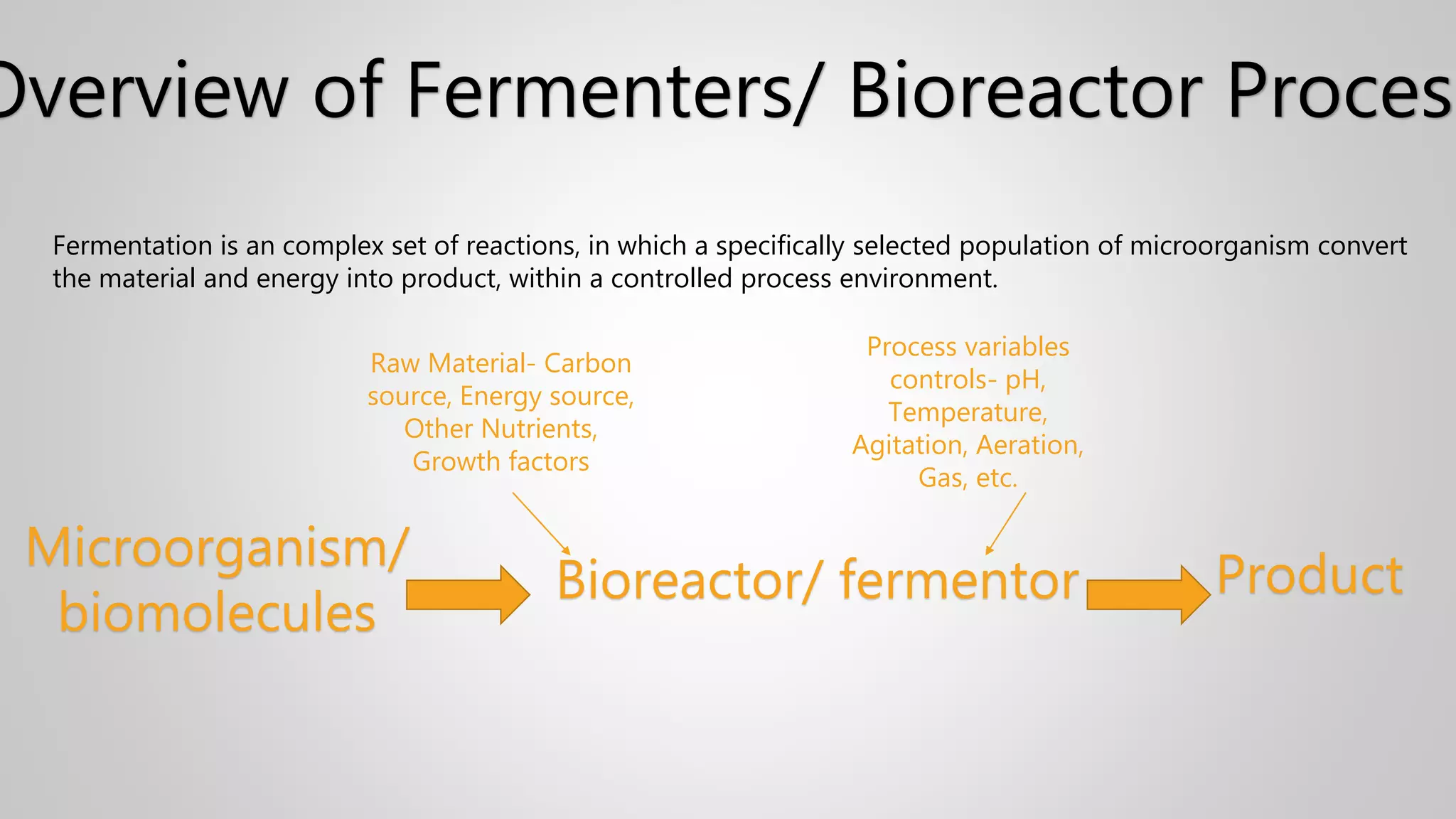
Fermentation is an complex set of reactions, in which a specifically selected population of microorganism convert
the material and energy into product, within a controlled process environment.
Microorganism/
biomolecules
Bioreactor/ fermentor Product
Raw Material- Carbon
source, Energy source,
Other Nutrients,
Growth factors
Process variables
controls- pH,
Temperature,
Agitation, Aeration,
Gas, etc.
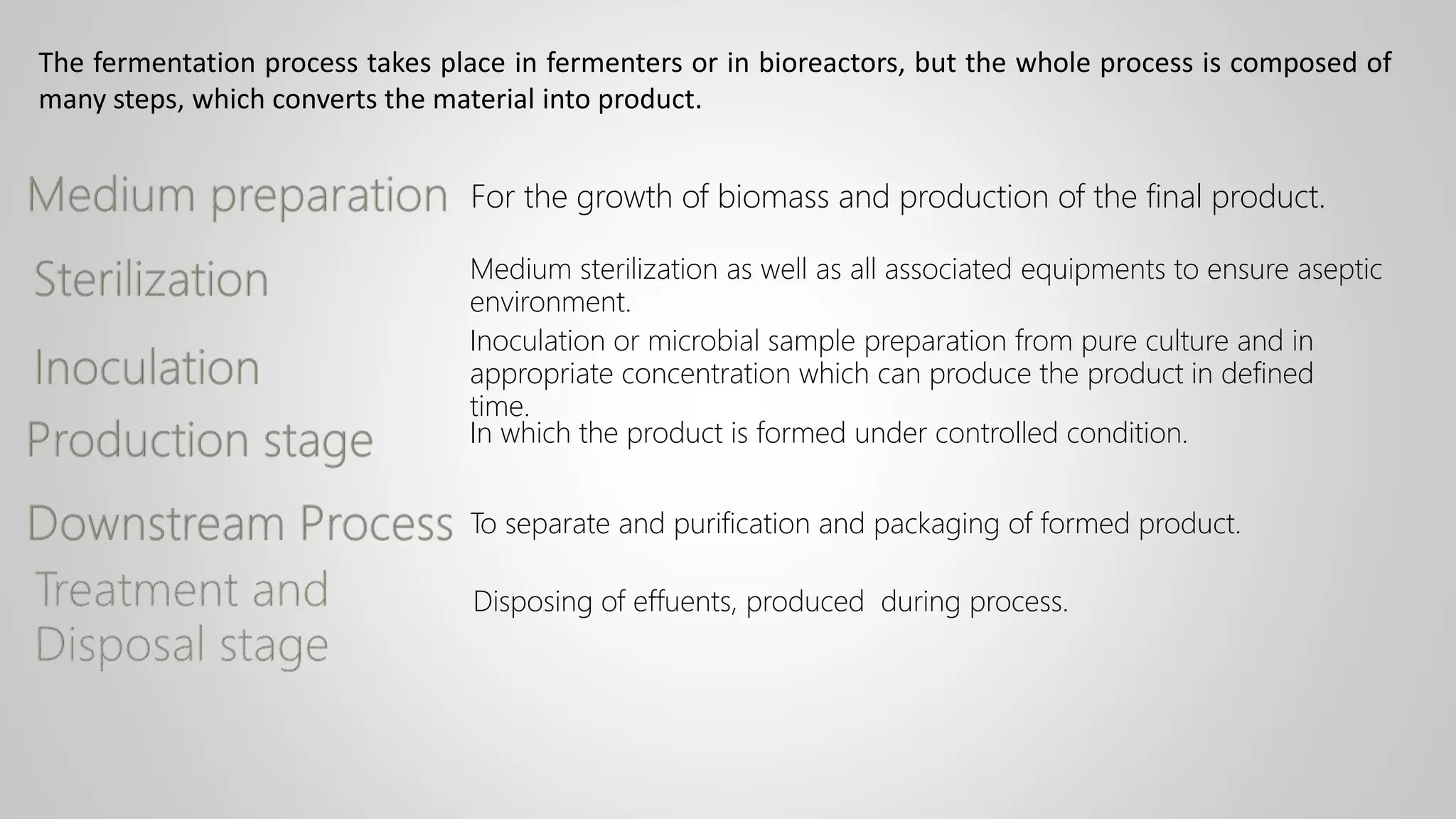
The fermentation process takes place in fermenters or in bioreactors, but the whole process is composed of
many steps, which converts the material into product.
For the growth of biomass and production of the final product.
Medium sterilization as well as all associated equipments to ensure aseptic
environment.
Inoculation or microbial sample preparation from pure culture and in
appropriate concentration which can produce the product in defined
time.
In which the product is formed under controlled condition.
To separate and purification and packaging of formed product.
Disposing of effuents, produced during process.
Inoculum Development
Inoculum is the microbial seed culture, that use to perform the desired bioconversion reaction for the formation of
products.
• The inoculum should be healthy and pure.
• The inoculum should be in suitable morphologic from [vegetative forms].
• The inoculum must be free from any contamination.
• The inoculum must have appropriate metabolic capacity to form product.
Microbial
strain
Cells mix with
culture media
Cells become
in Rapid
dividing Form
{log phase of
growth}
Stored at
20⁰C And
check For
purity
Appropriat
e Dilution
to prepare
Inoculum
And ready
to Transfer
to
fermenter
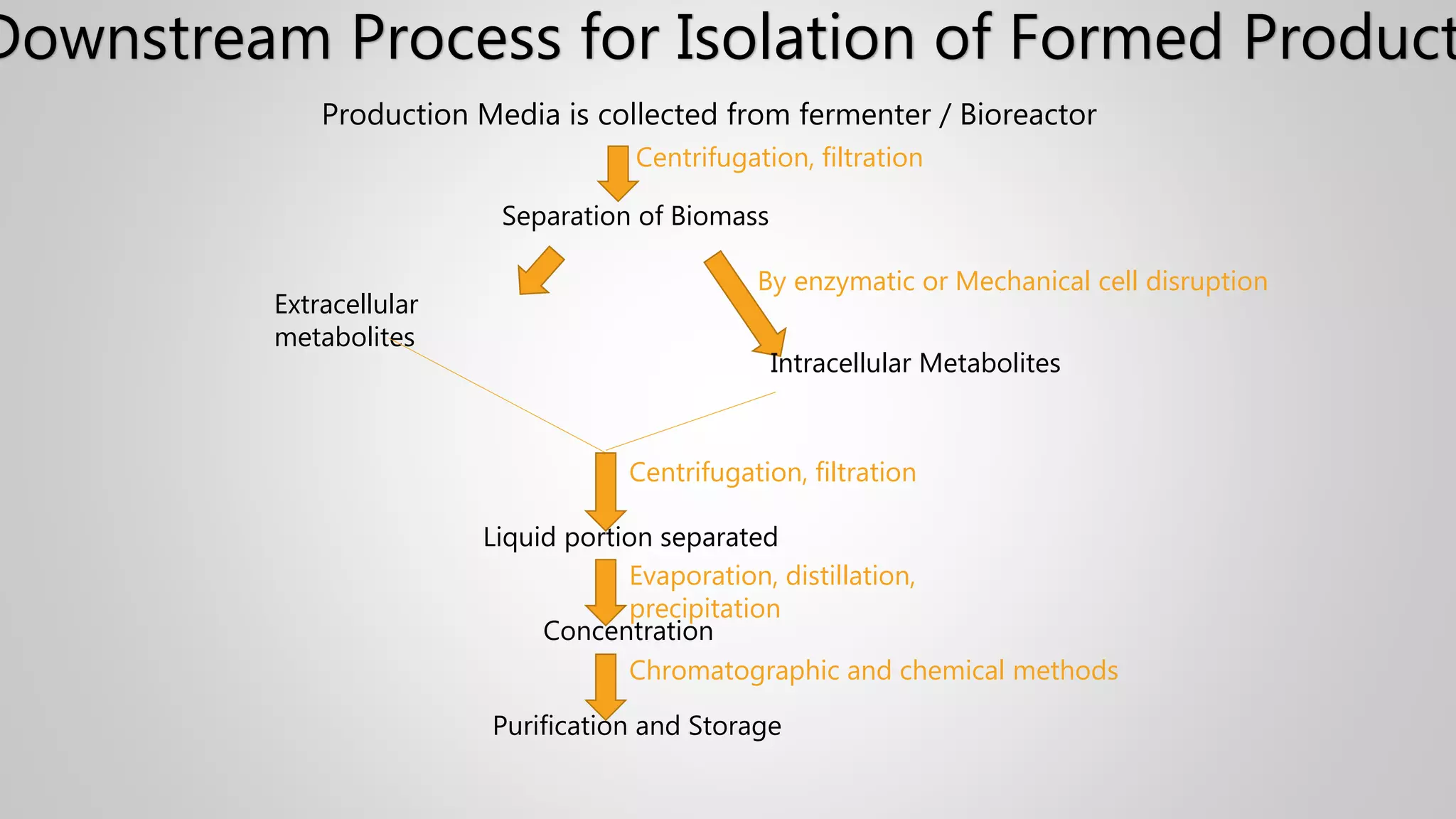
Downstream Process for Isolation of Formed Product
Production Media is collected from fermenter / Bioreactor
Centrifugation, filtration
Separation of Biomass
Extracellular
metabolites
By enzymatic or Mechanical cell disruption
Intracellular Metabolites
Centrifugation, filtration
Liquid portion separated
Evaporation, distillation,
precipitation
Concentration
Chromatographic and chemical methods
Purification and Storage
TYPES OF FERMENTERS
[BIOREACTORS]
SUBMERGED FERMENTERS
• In this type of fermenters, the cells are freely suspended in the culture medium, to grow and formation of
product.
• The agitation in media provides movements for the mixing of air / gases, allow better contact between cultured
cell and substrate.
SUPPORTED GROWTH FERMENTERS
• These are also called surface culture fermenter system. In this type of fermenters, vegetative microbial cells are
cultured on a support or surface, inside the culture media. The cells are not freely suspended in media.
• The main advantage of this type is, better aeration, high product yield and easier product isolation or easy
downstream process.
Mechanically Stirred Fermenters
Any Questions?

Fermentation Technology

  • 1.
    Presented By: PrashansaTayal M.Sc Biotechnology [3rd Sem] Chaudhary Charan Singh University, Meerut, U.P . India. Supervisor : MS. Gyanika Shukla Mam [Phd Scholar] Dept. Of Genetics And Plant Breeding/ Dept. Of Biotechnology. Chaudhary Charan Singh University, Meerut U.P., India .
  • 2.
    • Fermenters • ProcessTechniques • Basic Structures • Types of Fermenters
  • 3.
    • Fermenters arethe closed vessels, with all required supportive accessories to provide aseptic and strict controlled environment to perform biochemical reactions, mediated by microbial cells. • Under appropriate cukture conditions, microbial cells produce their metabolites, or produce commercially valuabkle products through bioconversion. • Fermenters or bioreactors are fitted mainly with temperature ,pH, aeration controlling systems, and various sensors to monitor the process. • The term fermenter and bioreactors are used interchangeably, but there is some difference in these terms. • Fermenters are used to culture only microbial cells, but in reactors all type of cells, i.e., microbial, plant, mammalian and animal cells are use to culture and perform their biochemical reactions. • Technically fermentation is the process, in which the conversion takes place from sugar to acids, gas to alcohol but fermenters are used to mediate biochemical reactions by microbial cells.
  • 4.
    Overview of Fermenters/Bioreactor Process Fermentation is an complex set of reactions, in which a specifically selected population of microorganism convert the material and energy into product, within a controlled process environment. Microorganism/ biomolecules Bioreactor/ fermentor Product Raw Material- Carbon source, Energy source, Other Nutrients, Growth factors Process variables controls- pH, Temperature, Agitation, Aeration, Gas, etc.
  • 5.
    The fermentation processtakes place in fermenters or in bioreactors, but the whole process is composed of many steps, which converts the material into product. For the growth of biomass and production of the final product. Medium sterilization as well as all associated equipments to ensure aseptic environment. Inoculation or microbial sample preparation from pure culture and in appropriate concentration which can produce the product in defined time. In which the product is formed under controlled condition. To separate and purification and packaging of formed product. Disposing of effuents, produced during process.
  • 6.
    Inoculum Development Inoculum isthe microbial seed culture, that use to perform the desired bioconversion reaction for the formation of products. • The inoculum should be healthy and pure. • The inoculum should be in suitable morphologic from [vegetative forms]. • The inoculum must be free from any contamination. • The inoculum must have appropriate metabolic capacity to form product. Microbial strain Cells mix with culture media Cells become in Rapid dividing Form {log phase of growth} Stored at 20⁰C And check For purity Appropriat e Dilution to prepare Inoculum And ready to Transfer to fermenter
  • 7.
    Downstream Process forIsolation of Formed Product Production Media is collected from fermenter / Bioreactor Centrifugation, filtration Separation of Biomass Extracellular metabolites By enzymatic or Mechanical cell disruption Intracellular Metabolites Centrifugation, filtration Liquid portion separated Evaporation, distillation, precipitation Concentration Chromatographic and chemical methods Purification and Storage
  • 9.
  • 10.
    SUBMERGED FERMENTERS • Inthis type of fermenters, the cells are freely suspended in the culture medium, to grow and formation of product. • The agitation in media provides movements for the mixing of air / gases, allow better contact between cultured cell and substrate. SUPPORTED GROWTH FERMENTERS • These are also called surface culture fermenter system. In this type of fermenters, vegetative microbial cells are cultured on a support or surface, inside the culture media. The cells are not freely suspended in media. • The main advantage of this type is, better aeration, high product yield and easier product isolation or easy downstream process.
  • 11.
  • 16.