HAWASSA UNIVERSITY
12/19/2018 2
MSc : clinical laboratory ( special truck diagnosis and
public health microbiology)
Course : microbial genetics
Lecturer : Moges Desta (PhD)
by : Abdikhaliq Hussein Ali
Learning Objectives
At the end of this module, participants will be able to:
Discuss the importance of the overview of Saccharomyces cerevisiae
Describe general features and genetic makeup of Saccharomyces
cerevisiae
Applications of Saccharomyces cerevisiae
Outline
 Introduction of Saccharomyces cerevisiae
 Genetic makeup of Saccharomyces cerevisiae
 Application of Saccharomyces cerevisiae
 Summery
Introduction to Saccharomyces cerevisiae
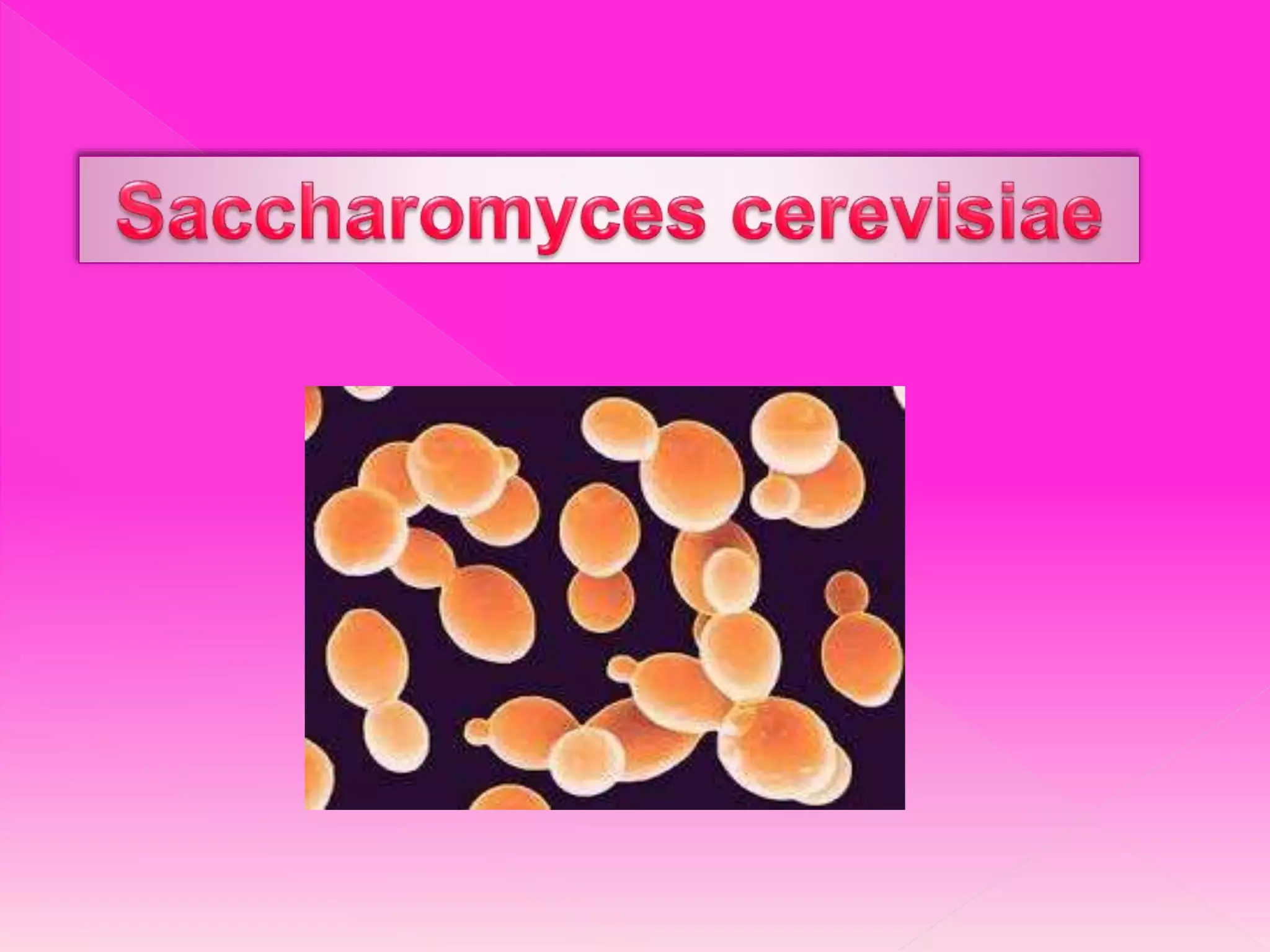
• Saccharomyces cerevisiae is (commonly known as baker’s
yeast) is a single-celled eukaryote. More specifically, it is a
globular-shaped, yellow-green yeast belonging to the Fungi
kingdom
• Other names of Saccharomyces cerevisiae :
• Brewer's yeast
• Ale yeast
• Top-fermenting yeast
• Baker's yeast
 First species domesticated by humans
 Called baker’s yeast (or brewer’s yeast)
 Ferments glucose to ethanol and carbon dioxide
Introduction
• S. cerevisiae has developed as a model organism for
studies of biochemistry, genetics, molecular and
cell biology because it scores favorably on a number
of these criteria:
rapid growth rate
easy to modify genetically
features typical of eukaryotes
relatively simple (unicellular)
relatively small genome
taxonomical Classification
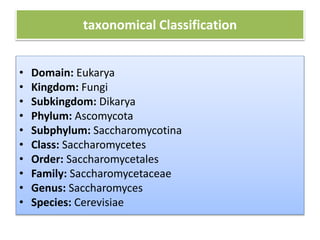
• Domain: Eukarya
• Kingdom: Fungi
• Subkingdom: Dikarya
• Phylum: Ascomycota
• Subphylum: Saccharomycotina
• Class: Saccharomycetes
• Order: Saccharomycetales
• Family: Saccharomycetaceae
• Genus: Saccharomyces
• Species: Cerevisiae
General characteristics of Saccharomyces cerevisiae
• S. cerevisiae lives primarily on fruits, flowers and
other sugar containing substrates
• Free-living organism: yeast copes with a wide range of
environmental conditions:
 S. cerevisiae proliferate from 12°C to 40°C
Growth is possible from pH 2.8-8.0
Almost complete drying is tolerated (dry yeast)
 S. cerevisiae can still grow and ferment at sugar
concentrations of 3M (high osmotic pressure)
Yeast can tolerate up to 20% alcohol
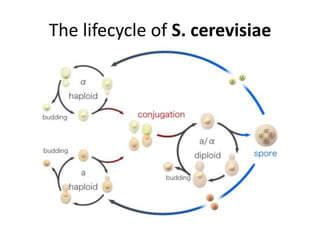
S. cerevisiae have both a stable haploid and diploid state
Genetic makeup of S. cerevisiae
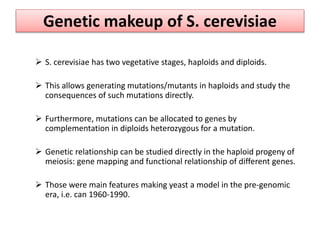
 S. cerevisiae has two vegetative stages, haploids and diploids.
 This allows generating mutations/mutants in haploids and study the
consequences of such mutations directly.
 Furthermore, mutations can be allocated to genes by
complementation in diploids heterozygous for a mutation.
 Genetic relationship can be studied directly in the haploid progeny of
meiosis: gene mapping and functional relationship of different genes.
 Those were main features making yeast a model in the pre-genomic
era, i.e. can 1960-1990.
The lifecycle of S. cerevisiae
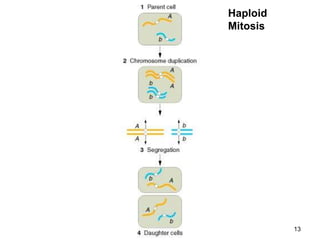
Haploid
Mitosis
13
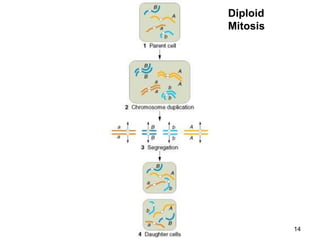
Diploid
Mitosis
14
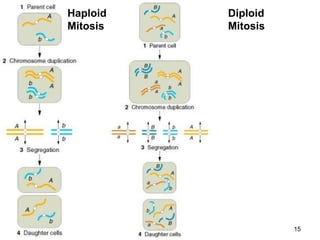
Diploid
Mitosis
Haploid
Mitosis
15
Pathogenicity
• Saccharoyces cerevisiae is not normally
considered to be a pathogen. In healthy people,
disease resulting from S. cerevisiae colonizing in a
particular area are very rare, but have been
reported.
• 1% of all vaginal yeast infections occur due to S.
cerevisiae in the vagina
• immunosuppressed individuals, followed by
those who have taken S. cerevisiae as an
probiotic for diarrhea
Traditional applications
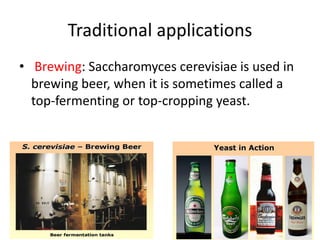
• Brewing: Saccharomyces cerevisiae is used in
brewing beer, when it is sometimes called a
top-fermenting or top-cropping yeast.
applications
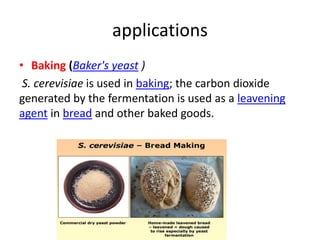
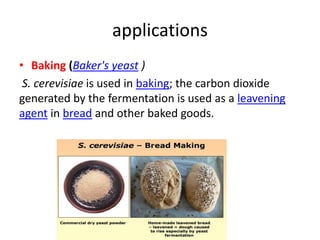
• Baking (Baker's yeast )
S. cerevisiae is used in baking; the carbon dioxide
generated by the fermentation is used as a leavening
agent in bread and other baked goods.
applications
• Baking (Baker's yeast )
S. cerevisiae is used in baking; the carbon dioxide
generated by the fermentation is used as a leavening
agent in bread and other baked goods.
modern applications
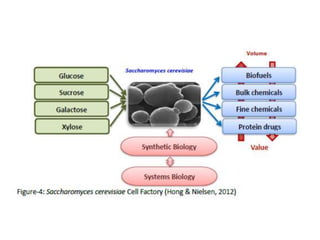
• The yeast Saccharomyces cerevisiae is a key
cell factory already used for the production of
a wide range of industrial products.
Metabolic Engineering in Saccharomyces cerevisiae
Biopharmaceuticals
Agricultural and Biocontrol Applications
Environmental Applications
Biocatalysis and Fine Chemicals
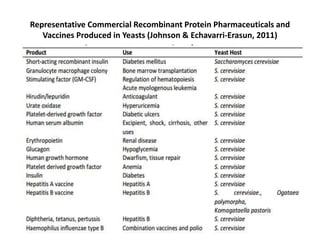
Representative Commercial Recombinant Protein Pharmaceuticals and
Vaccines Produced in Yeasts (Johnson & Echavarri-Erasun, 2011)
summery
Saccharomyces cerevisiae is (commonly
known as baker’s yeast) is a single-celled
eukaryote. More specifically, it is a globular-
shaped, yellow-green yeast belonging to the
Fungi kingdom
First species domesticated by humans
Called baker’s yeast (or brewer’s yeast)
Ferments glucose to ethanol and carbon
dioxide
summery
• S. cerevisiae lives primarily on fruits, flowers
and other sugar containing substrates
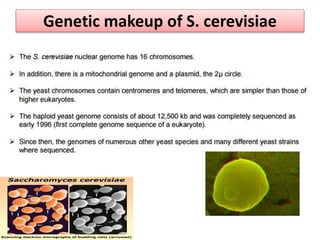
The S. cerevisiae nuclear genome has 16
chromosomes.
In addition, there is a mitochondrial genome
and a plasmid, the 2μ circle.
The yeast chromosomes contain centromeres
and telomeres, which are simpler than those
of higher eukaryotes.
summery
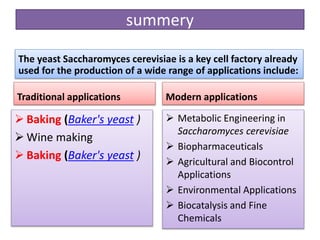
Traditional applications
 Baking (Baker's yeast )
 Wine making
 Baking (Baker's yeast )
Modern applications
 Metabolic Engineering in
Saccharomyces cerevisiae
 Biopharmaceuticals
 Agricultural and Biocontrol
Applications
 Environmental Applications
 Biocatalysis and Fine
Chemicals
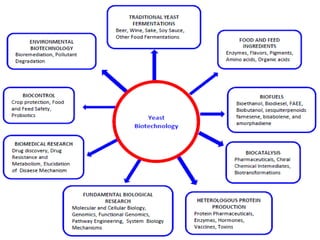
The yeast Saccharomyces cerevisiae is a key cell factory already
used for the production of a wide range of applications include:
References
• Ageitos, J.M., Vallejo, J.A., Veiga-Crespo, P., Villa, T.G., 2011. Oily yeasts as
oleaginous cell factories. Appl. Microbiol. Biotechnol., 90(4):1219-1227.
• Buijs, N.A., Siewers, N., Nielsen, J., 2013. Advanced biofuel production by the yeast
Saccharomyces cerevisiae, Current Opinion in Chemical Biology, 17: 480-488.
• Mustafa Türker, Pakmaya . April ,2014 Yeast Biotechnology: Diversity and
Applications publication at https://www.researchgate.net/publication/285598626
• Straathof, A.J.J., Panke, S. and Schmid, A.; The production of fine chemicals by
biotransformations, Current Opinion in Biotechnology 2002, 13:548–556.
• Wikipedia
https://en.wikipedia.org/wiki/Saccharomyces_cerevisiae#In_commercial_applicati
ons
Saccharomyces cerevisiae

Saccharomyces cerevisiae

  • 2.
    HAWASSA UNIVERSITY 12/19/2018 2 MSc: clinical laboratory ( special truck diagnosis and public health microbiology) Course : microbial genetics Lecturer : Moges Desta (PhD) by : Abdikhaliq Hussein Ali
  • 3.
    Learning Objectives At theend of this module, participants will be able to: Discuss the importance of the overview of Saccharomyces cerevisiae Describe general features and genetic makeup of Saccharomyces cerevisiae Applications of Saccharomyces cerevisiae
  • 4.
    Outline  Introduction ofSaccharomyces cerevisiae  Genetic makeup of Saccharomyces cerevisiae  Application of Saccharomyces cerevisiae  Summery
  • 5.
    Introduction to Saccharomycescerevisiae • Saccharomyces cerevisiae is (commonly known as baker’s yeast) is a single-celled eukaryote. More specifically, it is a globular-shaped, yellow-green yeast belonging to the Fungi kingdom • Other names of Saccharomyces cerevisiae : • Brewer's yeast • Ale yeast • Top-fermenting yeast • Baker's yeast  First species domesticated by humans  Called baker’s yeast (or brewer’s yeast)  Ferments glucose to ethanol and carbon dioxide
  • 6.
    Introduction • S. cerevisiaehas developed as a model organism for studies of biochemistry, genetics, molecular and cell biology because it scores favorably on a number of these criteria: rapid growth rate easy to modify genetically features typical of eukaryotes relatively simple (unicellular) relatively small genome
  • 7.
    taxonomical Classification • Domain:Eukarya • Kingdom: Fungi • Subkingdom: Dikarya • Phylum: Ascomycota • Subphylum: Saccharomycotina • Class: Saccharomycetes • Order: Saccharomycetales • Family: Saccharomycetaceae • Genus: Saccharomyces • Species: Cerevisiae
  • 8.
    General characteristics ofSaccharomyces cerevisiae • S. cerevisiae lives primarily on fruits, flowers and other sugar containing substrates • Free-living organism: yeast copes with a wide range of environmental conditions:  S. cerevisiae proliferate from 12°C to 40°C Growth is possible from pH 2.8-8.0 Almost complete drying is tolerated (dry yeast)  S. cerevisiae can still grow and ferment at sugar concentrations of 3M (high osmotic pressure) Yeast can tolerate up to 20% alcohol S. cerevisiae have both a stable haploid and diploid state
  • 10.
    Genetic makeup ofS. cerevisiae
  • 11.
    Genetic makeup ofS. cerevisiae  S. cerevisiae has two vegetative stages, haploids and diploids.  This allows generating mutations/mutants in haploids and study the consequences of such mutations directly.  Furthermore, mutations can be allocated to genes by complementation in diploids heterozygous for a mutation.  Genetic relationship can be studied directly in the haploid progeny of meiosis: gene mapping and functional relationship of different genes.  Those were main features making yeast a model in the pre-genomic era, i.e. can 1960-1990.
  • 12.
    The lifecycle ofS. cerevisiae
  • 13.
  • 14.
  • 15.
  • 16.
    Pathogenicity • Saccharoyces cerevisiaeis not normally considered to be a pathogen. In healthy people, disease resulting from S. cerevisiae colonizing in a particular area are very rare, but have been reported. • 1% of all vaginal yeast infections occur due to S. cerevisiae in the vagina • immunosuppressed individuals, followed by those who have taken S. cerevisiae as an probiotic for diarrhea
  • 18.
    Traditional applications • Brewing:Saccharomyces cerevisiae is used in brewing beer, when it is sometimes called a top-fermenting or top-cropping yeast.
  • 19.
    applications • Baking (Baker'syeast ) S. cerevisiae is used in baking; the carbon dioxide generated by the fermentation is used as a leavening agent in bread and other baked goods.
  • 20.
    applications • Baking (Baker'syeast ) S. cerevisiae is used in baking; the carbon dioxide generated by the fermentation is used as a leavening agent in bread and other baked goods.
  • 21.
    modern applications • Theyeast Saccharomyces cerevisiae is a key cell factory already used for the production of a wide range of industrial products. Metabolic Engineering in Saccharomyces cerevisiae Biopharmaceuticals Agricultural and Biocontrol Applications Environmental Applications Biocatalysis and Fine Chemicals
  • 22.
    Representative Commercial RecombinantProtein Pharmaceuticals and Vaccines Produced in Yeasts (Johnson & Echavarri-Erasun, 2011)
  • 25.
    summery Saccharomyces cerevisiae is(commonly known as baker’s yeast) is a single-celled eukaryote. More specifically, it is a globular- shaped, yellow-green yeast belonging to the Fungi kingdom First species domesticated by humans Called baker’s yeast (or brewer’s yeast) Ferments glucose to ethanol and carbon dioxide
  • 26.
    summery • S. cerevisiaelives primarily on fruits, flowers and other sugar containing substrates The S. cerevisiae nuclear genome has 16 chromosomes. In addition, there is a mitochondrial genome and a plasmid, the 2μ circle. The yeast chromosomes contain centromeres and telomeres, which are simpler than those of higher eukaryotes.
  • 27.
    summery Traditional applications  Baking(Baker's yeast )  Wine making  Baking (Baker's yeast ) Modern applications  Metabolic Engineering in Saccharomyces cerevisiae  Biopharmaceuticals  Agricultural and Biocontrol Applications  Environmental Applications  Biocatalysis and Fine Chemicals The yeast Saccharomyces cerevisiae is a key cell factory already used for the production of a wide range of applications include:
  • 28.
    References • Ageitos, J.M.,Vallejo, J.A., Veiga-Crespo, P., Villa, T.G., 2011. Oily yeasts as oleaginous cell factories. Appl. Microbiol. Biotechnol., 90(4):1219-1227. • Buijs, N.A., Siewers, N., Nielsen, J., 2013. Advanced biofuel production by the yeast Saccharomyces cerevisiae, Current Opinion in Chemical Biology, 17: 480-488. • Mustafa Türker, Pakmaya . April ,2014 Yeast Biotechnology: Diversity and Applications publication at https://www.researchgate.net/publication/285598626 • Straathof, A.J.J., Panke, S. and Schmid, A.; The production of fine chemicals by biotransformations, Current Opinion in Biotechnology 2002, 13:548–556. • Wikipedia https://en.wikipedia.org/wiki/Saccharomyces_cerevisiae#In_commercial_applicati ons