
• Deyaa Ahmed Shaaban
• Omar Adel
• Omar Hisham
• Ahmed Roushdy Saleh
Before we know what
Femtocell is, we must
know Why we
searched for it …..!!!
The growing number of cellular network users raises issues about
coverage extension in some areas such as indoor or underground
locations.
Why is there a need for such small cells?
The most efficient way to increase network capacity in a cellular
network is to shrink the cell size– ok, there are other ways, including
getting new spectrum, sectorization, adaptive algorithms for
scheduling but all are semi-disruptive and cannot compete with a
smaller cell size. However, in an archetypal mobile network, the cost to
deploy a network with many small cells in data hungry areas is
prohibitive. Femto cells piggyback on broadband connections and are
relatively inexpensive and can effectively form a distributed high
capacity network. On a much simpler usage case, femto cells can
provide coverage where ordinary cells cannot, in highly populated areas
where propagation issues are a concern.
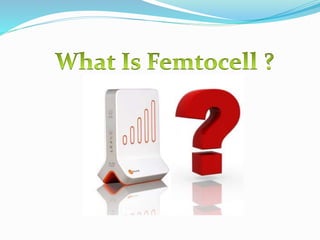
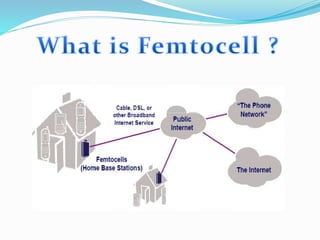
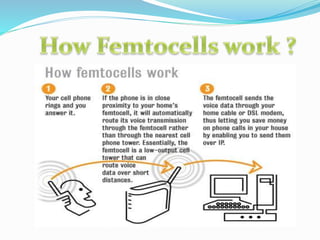
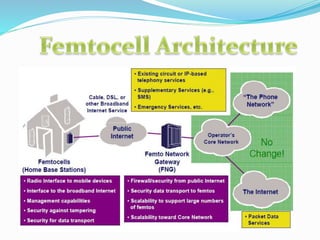
Femtocell is a low-power wireless base station for cellular access
indoor in areas with limited or no cellular provider. The access point
operates in a licensed spectrum and is designed to route mobile
phone traffic through a home or corporate IP network. A femtocell is
connected to a broadband (cable modem or Digital Subscriber Line)
and provides complete voice and data service to standard mobile
devices such as cell phones with al limited number and within
a limited range.
It supports 2 to 5 mobiles.
Unique Characteristics of Femtocells
• Designed for the home environment
– Might get deployed in small-office/home-office or business
situations, but this is not the primary design target
• Operate in licensed spectrum
– E.g., WiFi-based fixed mobile convergence solutions are not
femtocells
– Therefore, femtocells must be operated or associated with a
spectrum license holder
• Designed to connect to the operator’s network via an
untrusted broadband IP-based network, typically
public
– E.g., Cable, DSL, or other home broadband service
– Does not preclude usage over private IP networks or even
non-IP networks, but that is not the design target
Capabilities and Services
High level goal: The end user has access to all
capabilities of his/her mobile device.
• Voice calling (outbound and inbound)
• Additional services such as 3-way calling, call hold, caller-ID,
etc.
• Messaging (such as Text and picture messages or other multimedia
messaging services)
• Data services (such as mobile broadband access)
• Broadcast services
• Location services (and location-based services, navigation
applications, etc.)
• Emergency services (such as E911)
Potential End User Benefits
• Improved coverage in their home
• Possibly just providing coverage where there is
none!
• Enhanced availability of services
• Possible incentives from carriers (e.g., reduced
rates or flat-rate services in the “home zone”)
• Ability to use mobile device as primary “phone”
• Availability of richer cellular services while at
home
• Improved battery life while at home
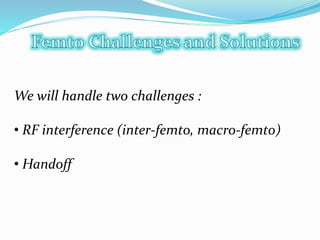
We will handle two challenges :
• RF interference (inter-femto, macro-femto)
• Handoff
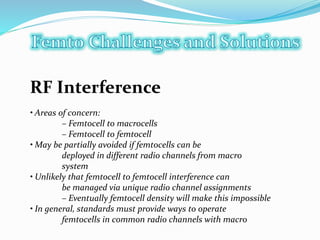
RF Interference
• Areas of concern:
– Femtocell to macrocells
– Femtocell to femtocell
• May be partially avoided if femtocells can be
deployed in different radio channels from macro
system
• Unlikely that femtocell to femtocell interference can
be managed via unique radio channel assignments
– Eventually femtocell density will make this impossible
• In general, standards must provide ways to operate
femtocells in common radio channels with macro
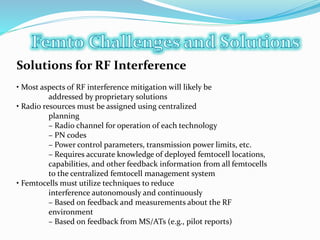
Solutions for RF Interference
• Most aspects of RF interference mitigation will likely be
addressed by proprietary solutions
• Radio resources must be assigned using centralized
planning
– Radio channel for operation of each technology
– PN codes
– Power control parameters, transmission power limits, etc.
– Requires accurate knowledge of deployed femtocell locations,
capabilities, and other feedback information from all femtocells
to the centralized femtocell management system
• Femtocells must utilize techniques to reduce
interference autonomously and continuously
– Based on feedback and measurements about the RF
environment
– Based on feedback from MS/ATs (e.g., pilot reports)
Handoff
• Types of handoff:
– Handout from femtocell to macro system
– Handin from macro system to femtocell
– Inter-femtocell handoff between femtocells
• Inter-femtocell handoff is generally not required for home-based
femtocells (at least for early deployments)
– May be required as the technology involves to be used in enterprises
(e.g., picocells)
• Packet data service handoff follows normal packet data mobility
procedures (e.g., Mobile IP)
Solutions for Handoff
• Handout from femtocell to macro system is fairly
straightforward:
– MS reports macro system pilots to the femtocell
– Femtocell triggers handoff to macro system via standard
ANSI-41 IS handoff signaling to target MSC
• For legacy circuit architecture, A1p triggers controller to initiate
ANSI-41 IS handoff
• For SIP/IMS architecture, SIP signaling triggers CSRV to
initiate ANSI-41 IS handoff
– When target MSC responds with handoff parameters, the
information is passed back to the femtocell
– Femtocell sends handoff direction message to mobile
directing it to the macro system directly
– Call continues
Radio health issues research
A very large amount of research has been undertaken into discovering any links between
low level radio frequency radiation and health issues. If any major links had been found,
then it should be a safe assumption that legislation would have been altered and the use
of low power radio changed.
Much of the research that has been undertaken has been statistical in nature. Research
would look at users of radio equipment and those who have a much lower level of usage,
or no usage at all. The results have to be interpreted in a statistical nature, because
some people who are not exposed to radiation will fall ill anyway. Therefore it is
necessary to look at the illnesses that occur in the two groups of people. Even with large
samples, it appears that most research projects have found little or no evidence of major
health risks and therefore the health organisations have been willing to allow the
current levels of radiation in and around the home.
Although no direct links to cancer have been found, it is a
recognised fact that radio frequency radiation does heat up local
tissue - in the same way as a microwave oven works, although the
power levels for microwave ovens are much higher. As a result a
phenomenon known as "hot ear" can occur when a cell phone held
close to the ear is used for an extended period of time. It is therefore
recommended that cellphones are not used for extended periods of
the day. However, it is current thinking that in view of the 1/d^2 law
where power reduces as the square of the distance, means that
femtocells should not pose any form of risk.
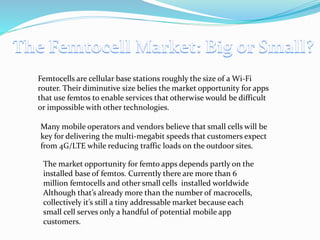
Femtocells are cellular base stations roughly the size of a Wi-Fi
router. Their diminutive size belies the market opportunity for apps
that use femtos to enable services that otherwise would be difficult
or impossible with other technologies.
Many mobile operators and vendors believe that small cells will be
key for delivering the multi-megabit speeds that customers expect
from 4G/LTE while reducing traffic loads on the outdoor sites.
The market opportunity for femto apps depends partly on the
installed base of femtos. Currently there are more than 6
million femtocells and other small cells installed worldwide
Although that’s already more than the number of macrocells,
collectively it’s still a tiny addressable market because each
small cell serves only a handful of potential mobile app
customers.
That will change as small cell deployments continue to mushroom,
according to analyst predictions. In the meantime, finding the market
opportunities for app development means focusing on what specific
operators are doing.
“I’d say maybe half a dozen to a dozen commercial apps today,”
Germano says. “We’re at the early stage of the market where what
we’ll see is a little more mobile operator involvement in new small-
cell-based applications. Some of these applications will be unique to
specific operators or for specific enterprise customers.”
• http://www.airvana.com/technology/femtocell-network-
architecture/#Intro
• http://www.radio-
electronics.com/info/cellulartelecomms/femtocells/femto-cells-health-
issues.php
• http://en.wikipedia.org/wiki/Femtocell

Femto_cells

  • 2.
    • Deyaa AhmedShaaban • Omar Adel • Omar Hisham • Ahmed Roushdy Saleh
  • 4.
    Before we knowwhat Femtocell is, we must know Why we searched for it …..!!!
  • 5.
    The growing numberof cellular network users raises issues about coverage extension in some areas such as indoor or underground locations. Why is there a need for such small cells? The most efficient way to increase network capacity in a cellular network is to shrink the cell size– ok, there are other ways, including getting new spectrum, sectorization, adaptive algorithms for scheduling but all are semi-disruptive and cannot compete with a smaller cell size. However, in an archetypal mobile network, the cost to deploy a network with many small cells in data hungry areas is prohibitive. Femto cells piggyback on broadband connections and are relatively inexpensive and can effectively form a distributed high capacity network. On a much simpler usage case, femto cells can provide coverage where ordinary cells cannot, in highly populated areas where propagation issues are a concern.
  • 7.
    Femtocell is alow-power wireless base station for cellular access indoor in areas with limited or no cellular provider. The access point operates in a licensed spectrum and is designed to route mobile phone traffic through a home or corporate IP network. A femtocell is connected to a broadband (cable modem or Digital Subscriber Line) and provides complete voice and data service to standard mobile devices such as cell phones with al limited number and within a limited range. It supports 2 to 5 mobiles.
  • 9.
    Unique Characteristics ofFemtocells • Designed for the home environment – Might get deployed in small-office/home-office or business situations, but this is not the primary design target • Operate in licensed spectrum – E.g., WiFi-based fixed mobile convergence solutions are not femtocells – Therefore, femtocells must be operated or associated with a spectrum license holder • Designed to connect to the operator’s network via an untrusted broadband IP-based network, typically public – E.g., Cable, DSL, or other home broadband service – Does not preclude usage over private IP networks or even non-IP networks, but that is not the design target
  • 10.
    Capabilities and Services Highlevel goal: The end user has access to all capabilities of his/her mobile device. • Voice calling (outbound and inbound) • Additional services such as 3-way calling, call hold, caller-ID, etc. • Messaging (such as Text and picture messages or other multimedia messaging services) • Data services (such as mobile broadband access) • Broadcast services • Location services (and location-based services, navigation applications, etc.) • Emergency services (such as E911)
  • 11.
    Potential End UserBenefits • Improved coverage in their home • Possibly just providing coverage where there is none! • Enhanced availability of services • Possible incentives from carriers (e.g., reduced rates or flat-rate services in the “home zone”) • Ability to use mobile device as primary “phone” • Availability of richer cellular services while at home • Improved battery life while at home
  • 15.
    We will handletwo challenges : • RF interference (inter-femto, macro-femto) • Handoff
  • 16.
    RF Interference • Areasof concern: – Femtocell to macrocells – Femtocell to femtocell • May be partially avoided if femtocells can be deployed in different radio channels from macro system • Unlikely that femtocell to femtocell interference can be managed via unique radio channel assignments – Eventually femtocell density will make this impossible • In general, standards must provide ways to operate femtocells in common radio channels with macro
  • 17.
    Solutions for RFInterference • Most aspects of RF interference mitigation will likely be addressed by proprietary solutions • Radio resources must be assigned using centralized planning – Radio channel for operation of each technology – PN codes – Power control parameters, transmission power limits, etc. – Requires accurate knowledge of deployed femtocell locations, capabilities, and other feedback information from all femtocells to the centralized femtocell management system • Femtocells must utilize techniques to reduce interference autonomously and continuously – Based on feedback and measurements about the RF environment – Based on feedback from MS/ATs (e.g., pilot reports)
  • 18.
    Handoff • Types ofhandoff: – Handout from femtocell to macro system – Handin from macro system to femtocell – Inter-femtocell handoff between femtocells • Inter-femtocell handoff is generally not required for home-based femtocells (at least for early deployments) – May be required as the technology involves to be used in enterprises (e.g., picocells) • Packet data service handoff follows normal packet data mobility procedures (e.g., Mobile IP)
  • 19.
    Solutions for Handoff •Handout from femtocell to macro system is fairly straightforward: – MS reports macro system pilots to the femtocell – Femtocell triggers handoff to macro system via standard ANSI-41 IS handoff signaling to target MSC • For legacy circuit architecture, A1p triggers controller to initiate ANSI-41 IS handoff • For SIP/IMS architecture, SIP signaling triggers CSRV to initiate ANSI-41 IS handoff – When target MSC responds with handoff parameters, the information is passed back to the femtocell – Femtocell sends handoff direction message to mobile directing it to the macro system directly – Call continues
  • 20.
    Radio health issuesresearch A very large amount of research has been undertaken into discovering any links between low level radio frequency radiation and health issues. If any major links had been found, then it should be a safe assumption that legislation would have been altered and the use of low power radio changed. Much of the research that has been undertaken has been statistical in nature. Research would look at users of radio equipment and those who have a much lower level of usage, or no usage at all. The results have to be interpreted in a statistical nature, because some people who are not exposed to radiation will fall ill anyway. Therefore it is necessary to look at the illnesses that occur in the two groups of people. Even with large samples, it appears that most research projects have found little or no evidence of major health risks and therefore the health organisations have been willing to allow the current levels of radiation in and around the home.
  • 21.
    Although no directlinks to cancer have been found, it is a recognised fact that radio frequency radiation does heat up local tissue - in the same way as a microwave oven works, although the power levels for microwave ovens are much higher. As a result a phenomenon known as "hot ear" can occur when a cell phone held close to the ear is used for an extended period of time. It is therefore recommended that cellphones are not used for extended periods of the day. However, it is current thinking that in view of the 1/d^2 law where power reduces as the square of the distance, means that femtocells should not pose any form of risk.
  • 23.
    Femtocells are cellularbase stations roughly the size of a Wi-Fi router. Their diminutive size belies the market opportunity for apps that use femtos to enable services that otherwise would be difficult or impossible with other technologies. Many mobile operators and vendors believe that small cells will be key for delivering the multi-megabit speeds that customers expect from 4G/LTE while reducing traffic loads on the outdoor sites. The market opportunity for femto apps depends partly on the installed base of femtos. Currently there are more than 6 million femtocells and other small cells installed worldwide Although that’s already more than the number of macrocells, collectively it’s still a tiny addressable market because each small cell serves only a handful of potential mobile app customers.
  • 24.
    That will changeas small cell deployments continue to mushroom, according to analyst predictions. In the meantime, finding the market opportunities for app development means focusing on what specific operators are doing. “I’d say maybe half a dozen to a dozen commercial apps today,” Germano says. “We’re at the early stage of the market where what we’ll see is a little more mobile operator involvement in new small- cell-based applications. Some of these applications will be unique to specific operators or for specific enterprise customers.”
  • 28.