1

Mohan J N
MTech Student ( Networks and Internet Engineering )
Department of Electronics and Communication Engineering
Sri Jayachamarajendra College of Engineering
Mysuru ,India
mohanjn1709@gmail.com
Abstract—Mobile internet has become a basic necessity.
But due to interference in form of building and other entities the
reception of signals is interrupted in many areas. An optimal
solution for these is the small cells. These Small cells unlike the
Macro cells Base Stations can be placed even inside homes
providing better coverage and signal strength we called it as
Femto BSR.In this paper we are proposing to overcome the main
disadvantage of Femto BSR that is signal unavailability when
power down at end user point. Femto is a device which consumes
low power, low cost base station deployed by end user
point.Signal availability in BTS is 24*7 but in Femto which
depends on external power availability at user end. When power
loss at user end will turn off Femto device, this causes signal
unavailability to UEs (Mobiles). To overcome this we can
introduce inbuilt battery backup to Femto device.
Index Terms—Femto cells ,wireless network, Battery backup ,
Base Transceiver Station(BTS) , Signal Availability
I. INTRODUCTION
Base transceiver station (BTS) which proved wireless
communication between UE (Mobile) and network.BTS is
also called as Base station (BS) in 2G or Node B in 3G. Base
Station Control (BSC) act as concentrator. In this paper we are
not going to concentrate about GSM Architecture.
Figure 1 GSMNetworkArchitecture
Thyagaraja Murthy A
Associate Professor
Department of Electronics and Communication Engineering
Sri Jayachamarajendra College of Engineering
Mysuru ,India
trmsjce@gmail.com
II. WHY FEMTO CAME INTO PICTURE
The Base station having a number of radio frequency
channel called as Cells, so each cell covers limited area of
coverage generally 30 km region and limited number of UEs.
Due to interference in form of building and other entities the
reception of signals is interrupted in many areas. Base station
which is located near UEs have greater signal strength, but for
Base station which is located at extreme point of the coverage
area UEs have weak signal strength.UE consumes more
battery power when the signal is weak.
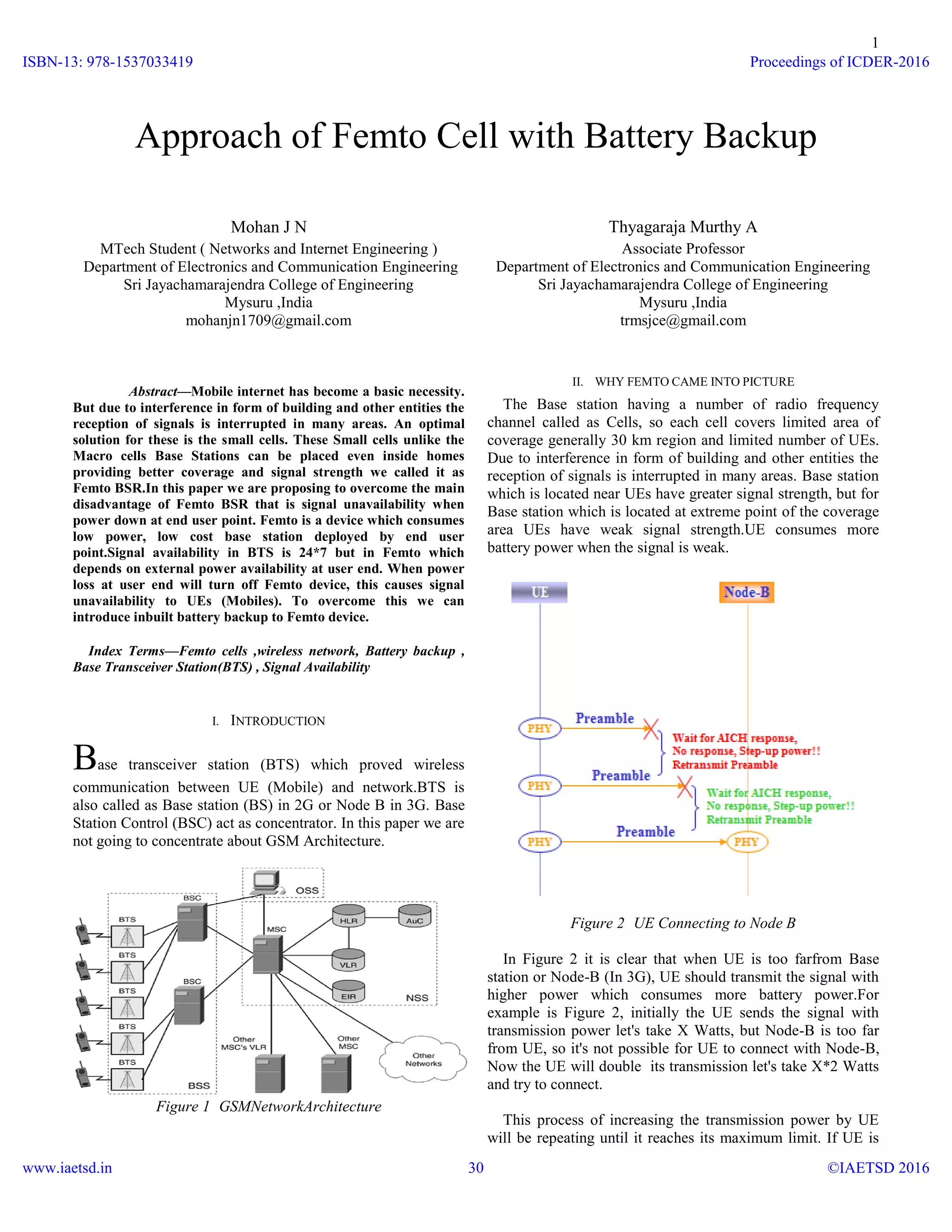
Figure 2 UE Connecting to Node B
In Figure 2 it is clear that when UE is too farfrom Base
station or Node-B (In 3G), UE should transmit the signal with
higher power which consumes more battery power.For
example is Figure 2, initially the UE sends the signal with
transmission power let's take X Watts, but Node-B is too far
from UE, so it's not possible for UE to connect with Node-B,
Now the UE will double its transmission let's take X*2 Watts
and try to connect.
This process of increasing the transmission power by UE
will be repeating until it reaches its maximum limit. If UE is
Approach of Femto Cell with Battery Backup
ISBN-13: 978-1537033419
www.iaetsd.in
Proceedings of ICDER-2016
©IAETSD 201630
2
still not able to connect Node-B, than it is clear that Node-B is
out of coverage area.
This problem is solved by Femto, Femtocells are low-power
wireless access points that operate in licensed spectrum to
establish a connection to standard UE to a mobile operator’s
network using residential DSL or cable broadband
connections.
The Femto Access Point (FAP) functions as the BTS and
the RNC. It is located at the End User’s Premises. So small,
infect that can be located in a customer’s Premises as shown in
Figure 3.The Femtocell unit generates a personal UE signal in
the home and communicates to the operator’s network using
standard broadband DSL on Cable service and it supports two
to five UE in a residential setting and area of coverage is
10metes. This will allow enhance coverage area and capacity
for each user within their residence.
III. ABOUT FEMTO
Third-generation cellular technology suffers from
insufficient indoor-signal penetration, leading to reduced
coverage in the environment where consumers spend two-
thirds of their period. Lowly coverage diminishes the
eminence of voice and video applications, and slows down
high-speed data services.
Figure3 Femto Architecture
To keep consumers gratified, 3G carriers have
improved capacity by building additional micro cell sites. This
strategy is pleasant much fewer striking. Site purchasing costs
are exorbitant and continue to mount as space on viable towers
and buildings fills up, landlord’s exact high rents and
regulators impose onerous permit requirements. Public
resistance to the building of extensive base stations is
increasingly common. Acquiring a site is only half the battle :
Erudite base station kit necessity then be purchased, installed
,insured ,operated and maintained.
Wellit's unblemished more customers want to use
mobile phones in the home, even when there’s a fixed line
available. Friends and family commonly dials a mobile UE
number first, and it’s where messages and contact lists are
stored. However, it is often the case that provides complete or
even sufficient mobile residential coverage is a significant
challenge for operators. From a competition perception, Femto
cells are essential because mobile operators need to seize
residential minutes from fixed suppliers, and reply to emergent
VoIP and Wi-Fi assistances.
Improving user experience in the home is also
necessary for decreasing churn and acquiring market share and
new revenues. However, high deployment costs ensure that 3G
networks infrequently outspread outside the regulatory
minimum.
Using Femto cells solves these problems with a
device that services power and backhaul via the consumer’s
present properties. It also enables capacity equivalent to a full
3G network area at very small transfer powers, dramatically
growing battery life of existing phones, without needing to
introduce Wi-Fi enabled handsets.
IV. ADVANTAGES OF FEMTO
 A Femtocell is used for compensating weak cellular
coverage inside the premises .
 Femtocell can also give lower call charges while the
caller calling from home, using the Femtocell as it
directly attaches to the core network over the internet.
 Some vendors are also planning to incorporate all the
3 types – Wi-Fi, DSL and cellular into the same box
to achieve maximum functionality.
 Voice calls/data calls over the Femtocells are
encrypts and the UE automatically switches over to
the Femtocells when they comes in their varieties –
eg. in home, where they are installed.
 Femtocell units can handle up to three or four
simultaneous calls, from the equivalent operators,
depends on the model. They can operate with normal
cellphones, without any enhancements.
 Femtocell entities can help's associated cellular
services like 3G by offering a better speed and data
rate when inside office block, where the coverage and
data rate is usually lesser than outside.
 Generally, the cell towers are back-hauled by
expending lines with bandwidth nearby 2 Mbps (in
some residences) and hence when newer services like
3G are introduced, these lines could not be enough
and hence may require a upgrade. But with
Femtocells, since the subscribers internet connection
are using, there could not be an problem with current
infrastructure if Femtocells are adopted in a large
scale.
 Femtocells can not simply spread the cellular macro
network but can also become the primary network if
enough Femtocells are implemented in an region. So,
all future demotions etc. can be done by the
Femtocells itself, reducing the number of macro base
stations needs to shield an area – however this is a
long shot, based on the current situation and the
problems described below.
Femto has this many advantages, but there is one
main drawback in femto system compared to Base transceiver
station is signal availability.
ISBN-13: 978-1537033419
www.iaetsd.in
Proceedings of ICDER-2016
©IAETSD 201631
3
It means Base transceiver station available 24*7 to
UEs,in Femto which depends on external power availability at
user end.
V. APPROACH
To overcome signal unavailable to UEs when power
loss at femto side. We can design inbuilt battery to femto,
which makes femto available 24*7.
A. Ideal specification
Femto device required : 24V/0.5A=12 Watts
Ideal Battery
Battery unit : Ah/mAh
Battery power : V * Ah rating
Eg: 24V * 7Ah Battery gives power of 168 WattsFemto needs
12 Watts.
Battery backup is 168 / 12=14 hours.
By this approach we can make Femto 24*7 available to UEs.

VI. CONCLUSION
Femtocells have the potential to provide high-quality
network access to indoor users at low price, while
instantaneously decreasing the burden on the whole system.
This article has identified the key benefits of femtocells, the
technical and professional contests, and research
opportunities.
From a technical standpoint, providers look
experiments in provided that a low-cost answer while
providing inbuilt battery backup to femto. It makes femto
device more compatible and 24*7 signal available to end UEs.
VII. ACKNOWLEDGEMENT
I am extremely thankful to my guide Mr. Thyagaraja
Murthy A, Associate Professor, Dept. of ECE, SJCE, Mysuru
for their valuable guidance, constant assistance, provision,
fortitude and useful suggestions for the completion of this
work.
REFERENCES
[1] Jeffrey G. Andrews, “Femtocells: Past, Present and
Future”, IEEE journal on selected areas in communications,
Vol. 30, No. 3,pp 275-286, April 2012
[2] Cisco, “Cisco visual networking index: Global mobile data
traffic forecast update,
20102015,” Whitepaper, Vol. 31, No. 3,pp 217-216 Feb. 2011.
[3] D. Kilper, G. Atkinson, S. Korotky, S. Goyal, P. Vetter, D.
Suvakovic, and O. Blume, “Power trends in communication
networks,” IEEE Journal on Selected Topics in Quantum
Electronics, vol. 17, no. 2, pp. 275 –284, Apr. 2011.
[4] V. Chandrasekhar, J. G. Andrews, and A. Gatherer,
“Femtocell networks: a survey,” IEEE Communication
Magazine, vol. 46, no. 9, pp. 59–67, September 2008.
[5] E. Drucker, “Development and application of a cellular
repeater,” Proc. IEEE Vehicular Technology Conference, pp.
321 –325, Jun. 1988.
[6] Lavina Balraj and R. Kavitha, "Deployment of Femtocell
and Antenna in commercial building in cost effective way",
Proc. IEEE, The International Conference on Computational
and Network Technologies,pp.218-281, July 4-6,2013
[7] R Tang, “Indoor Propagation in Cellular/PCS System
Design”, Wireless Communications and Systems, IEEE 1999
Emerging Technologies Symposium, pp 8.1 – 8.4, 1999.
[8] Syed Faraz Hasan, Nazmul Haq Siddique and Shyam
Chakraborty, “Femtocell versus WiFi – A Survey and
Comparison of Architecture and Performance”, IEEE journal
on Wireless Communication, pp 916 – 920, February 2009
[9] J Ott and D Kutscher, “Exploiting Regular Hot-Spots for
Drive-thru Internet”, Proceedings of KiVS 2005.
[10] S. Chakraborty, T Frankkila, J Peisa, P Synnergren, “IMS
Multimedia Telephony over Cellular Systems”, Wiley, 2007.
[11] D Lopez-Perez, A Valcarce, G Roche, E Liu and J Zhang,
“Access Methods to WiMAX Femtocells: A downlink system-
level case study”, IEEE ICCS 2008, pp 1657 – 1662, 2008
[12] Madhwal E and R Mahapatra, “Performance analysis of
femtocell network in macrocell environment”, IEEE
conference on Electronics, Communication and
Instrumentation, Kolkata, pp 1-4, January 2014
[13] Farhad Meshkati, et., Al, “Mobility and Capacity Offload
for 3G UMTS Femtocells”, Proc. IEEE Global
Telecommunications Conference, Nov 30 -Dec 4 2009
[14] Alan Barbeiri., et Al, “LTE Femto cells: system design
and performance analysis”, IEEE journal on selected areas of
communication, Vol 30, no. 3, April 2012
[15] M. Taranetz, M. Rupp, “Performance of femtocell access
point deployments in user hot-spot scenarios”, IEEE
Conference on Telecommunication Networks and
Applications Conference, pp 1-5, November 2012
ISBN-13: 978-1537033419
www.iaetsd.in
Proceedings of ICDER-2016
©IAETSD 201632

iaetsd Approach of femto cell with battery backup

  • 1.
    1  Mohan J N MTechStudent ( Networks and Internet Engineering ) Department of Electronics and Communication Engineering Sri Jayachamarajendra College of Engineering Mysuru ,India mohanjn1709@gmail.com Abstract—Mobile internet has become a basic necessity. But due to interference in form of building and other entities the reception of signals is interrupted in many areas. An optimal solution for these is the small cells. These Small cells unlike the Macro cells Base Stations can be placed even inside homes providing better coverage and signal strength we called it as Femto BSR.In this paper we are proposing to overcome the main disadvantage of Femto BSR that is signal unavailability when power down at end user point. Femto is a device which consumes low power, low cost base station deployed by end user point.Signal availability in BTS is 24*7 but in Femto which depends on external power availability at user end. When power loss at user end will turn off Femto device, this causes signal unavailability to UEs (Mobiles). To overcome this we can introduce inbuilt battery backup to Femto device. Index Terms—Femto cells ,wireless network, Battery backup , Base Transceiver Station(BTS) , Signal Availability I. INTRODUCTION Base transceiver station (BTS) which proved wireless communication between UE (Mobile) and network.BTS is also called as Base station (BS) in 2G or Node B in 3G. Base Station Control (BSC) act as concentrator. In this paper we are not going to concentrate about GSM Architecture. Figure 1 GSMNetworkArchitecture Thyagaraja Murthy A Associate Professor Department of Electronics and Communication Engineering Sri Jayachamarajendra College of Engineering Mysuru ,India trmsjce@gmail.com II. WHY FEMTO CAME INTO PICTURE The Base station having a number of radio frequency channel called as Cells, so each cell covers limited area of coverage generally 30 km region and limited number of UEs. Due to interference in form of building and other entities the reception of signals is interrupted in many areas. Base station which is located near UEs have greater signal strength, but for Base station which is located at extreme point of the coverage area UEs have weak signal strength.UE consumes more battery power when the signal is weak. Figure 2 UE Connecting to Node B In Figure 2 it is clear that when UE is too farfrom Base station or Node-B (In 3G), UE should transmit the signal with higher power which consumes more battery power.For example is Figure 2, initially the UE sends the signal with transmission power let's take X Watts, but Node-B is too far from UE, so it's not possible for UE to connect with Node-B, Now the UE will double its transmission let's take X*2 Watts and try to connect. This process of increasing the transmission power by UE will be repeating until it reaches its maximum limit. If UE is Approach of Femto Cell with Battery Backup ISBN-13: 978-1537033419 www.iaetsd.in Proceedings of ICDER-2016 ©IAETSD 201630
  • 2.
    2 still not ableto connect Node-B, than it is clear that Node-B is out of coverage area. This problem is solved by Femto, Femtocells are low-power wireless access points that operate in licensed spectrum to establish a connection to standard UE to a mobile operator’s network using residential DSL or cable broadband connections. The Femto Access Point (FAP) functions as the BTS and the RNC. It is located at the End User’s Premises. So small, infect that can be located in a customer’s Premises as shown in Figure 3.The Femtocell unit generates a personal UE signal in the home and communicates to the operator’s network using standard broadband DSL on Cable service and it supports two to five UE in a residential setting and area of coverage is 10metes. This will allow enhance coverage area and capacity for each user within their residence. III. ABOUT FEMTO Third-generation cellular technology suffers from insufficient indoor-signal penetration, leading to reduced coverage in the environment where consumers spend two- thirds of their period. Lowly coverage diminishes the eminence of voice and video applications, and slows down high-speed data services. Figure3 Femto Architecture To keep consumers gratified, 3G carriers have improved capacity by building additional micro cell sites. This strategy is pleasant much fewer striking. Site purchasing costs are exorbitant and continue to mount as space on viable towers and buildings fills up, landlord’s exact high rents and regulators impose onerous permit requirements. Public resistance to the building of extensive base stations is increasingly common. Acquiring a site is only half the battle : Erudite base station kit necessity then be purchased, installed ,insured ,operated and maintained. Wellit's unblemished more customers want to use mobile phones in the home, even when there’s a fixed line available. Friends and family commonly dials a mobile UE number first, and it’s where messages and contact lists are stored. However, it is often the case that provides complete or even sufficient mobile residential coverage is a significant challenge for operators. From a competition perception, Femto cells are essential because mobile operators need to seize residential minutes from fixed suppliers, and reply to emergent VoIP and Wi-Fi assistances. Improving user experience in the home is also necessary for decreasing churn and acquiring market share and new revenues. However, high deployment costs ensure that 3G networks infrequently outspread outside the regulatory minimum. Using Femto cells solves these problems with a device that services power and backhaul via the consumer’s present properties. It also enables capacity equivalent to a full 3G network area at very small transfer powers, dramatically growing battery life of existing phones, without needing to introduce Wi-Fi enabled handsets. IV. ADVANTAGES OF FEMTO  A Femtocell is used for compensating weak cellular coverage inside the premises .  Femtocell can also give lower call charges while the caller calling from home, using the Femtocell as it directly attaches to the core network over the internet.  Some vendors are also planning to incorporate all the 3 types – Wi-Fi, DSL and cellular into the same box to achieve maximum functionality.  Voice calls/data calls over the Femtocells are encrypts and the UE automatically switches over to the Femtocells when they comes in their varieties – eg. in home, where they are installed.  Femtocell units can handle up to three or four simultaneous calls, from the equivalent operators, depends on the model. They can operate with normal cellphones, without any enhancements.  Femtocell entities can help's associated cellular services like 3G by offering a better speed and data rate when inside office block, where the coverage and data rate is usually lesser than outside.  Generally, the cell towers are back-hauled by expending lines with bandwidth nearby 2 Mbps (in some residences) and hence when newer services like 3G are introduced, these lines could not be enough and hence may require a upgrade. But with Femtocells, since the subscribers internet connection are using, there could not be an problem with current infrastructure if Femtocells are adopted in a large scale.  Femtocells can not simply spread the cellular macro network but can also become the primary network if enough Femtocells are implemented in an region. So, all future demotions etc. can be done by the Femtocells itself, reducing the number of macro base stations needs to shield an area – however this is a long shot, based on the current situation and the problems described below. Femto has this many advantages, but there is one main drawback in femto system compared to Base transceiver station is signal availability. ISBN-13: 978-1537033419 www.iaetsd.in Proceedings of ICDER-2016 ©IAETSD 201631
  • 3.
    3 It means Basetransceiver station available 24*7 to UEs,in Femto which depends on external power availability at user end. V. APPROACH To overcome signal unavailable to UEs when power loss at femto side. We can design inbuilt battery to femto, which makes femto available 24*7. A. Ideal specification Femto device required : 24V/0.5A=12 Watts Ideal Battery Battery unit : Ah/mAh Battery power : V * Ah rating Eg: 24V * 7Ah Battery gives power of 168 WattsFemto needs 12 Watts. Battery backup is 168 / 12=14 hours. By this approach we can make Femto 24*7 available to UEs. VI. CONCLUSION Femtocells have the potential to provide high-quality network access to indoor users at low price, while instantaneously decreasing the burden on the whole system. This article has identified the key benefits of femtocells, the technical and professional contests, and research opportunities. From a technical standpoint, providers look experiments in provided that a low-cost answer while providing inbuilt battery backup to femto. It makes femto device more compatible and 24*7 signal available to end UEs. VII. ACKNOWLEDGEMENT I am extremely thankful to my guide Mr. Thyagaraja Murthy A, Associate Professor, Dept. of ECE, SJCE, Mysuru for their valuable guidance, constant assistance, provision, fortitude and useful suggestions for the completion of this work. REFERENCES [1] Jeffrey G. Andrews, “Femtocells: Past, Present and Future”, IEEE journal on selected areas in communications, Vol. 30, No. 3,pp 275-286, April 2012 [2] Cisco, “Cisco visual networking index: Global mobile data traffic forecast update, 20102015,” Whitepaper, Vol. 31, No. 3,pp 217-216 Feb. 2011. [3] D. Kilper, G. Atkinson, S. Korotky, S. Goyal, P. Vetter, D. Suvakovic, and O. Blume, “Power trends in communication networks,” IEEE Journal on Selected Topics in Quantum Electronics, vol. 17, no. 2, pp. 275 –284, Apr. 2011. [4] V. Chandrasekhar, J. G. Andrews, and A. Gatherer, “Femtocell networks: a survey,” IEEE Communication Magazine, vol. 46, no. 9, pp. 59–67, September 2008. [5] E. Drucker, “Development and application of a cellular repeater,” Proc. IEEE Vehicular Technology Conference, pp. 321 –325, Jun. 1988. [6] Lavina Balraj and R. Kavitha, "Deployment of Femtocell and Antenna in commercial building in cost effective way", Proc. IEEE, The International Conference on Computational and Network Technologies,pp.218-281, July 4-6,2013 [7] R Tang, “Indoor Propagation in Cellular/PCS System Design”, Wireless Communications and Systems, IEEE 1999 Emerging Technologies Symposium, pp 8.1 – 8.4, 1999. [8] Syed Faraz Hasan, Nazmul Haq Siddique and Shyam Chakraborty, “Femtocell versus WiFi – A Survey and Comparison of Architecture and Performance”, IEEE journal on Wireless Communication, pp 916 – 920, February 2009 [9] J Ott and D Kutscher, “Exploiting Regular Hot-Spots for Drive-thru Internet”, Proceedings of KiVS 2005. [10] S. Chakraborty, T Frankkila, J Peisa, P Synnergren, “IMS Multimedia Telephony over Cellular Systems”, Wiley, 2007. [11] D Lopez-Perez, A Valcarce, G Roche, E Liu and J Zhang, “Access Methods to WiMAX Femtocells: A downlink system- level case study”, IEEE ICCS 2008, pp 1657 – 1662, 2008 [12] Madhwal E and R Mahapatra, “Performance analysis of femtocell network in macrocell environment”, IEEE conference on Electronics, Communication and Instrumentation, Kolkata, pp 1-4, January 2014 [13] Farhad Meshkati, et., Al, “Mobility and Capacity Offload for 3G UMTS Femtocells”, Proc. IEEE Global Telecommunications Conference, Nov 30 -Dec 4 2009 [14] Alan Barbeiri., et Al, “LTE Femto cells: system design and performance analysis”, IEEE journal on selected areas of communication, Vol 30, no. 3, April 2012 [15] M. Taranetz, M. Rupp, “Performance of femtocell access point deployments in user hot-spot scenarios”, IEEE Conference on Telecommunication Networks and Applications Conference, pp 1-5, November 2012 ISBN-13: 978-1537033419 www.iaetsd.in Proceedings of ICDER-2016 ©IAETSD 201632