BY;
DEEPIKA C.S.
E C E
MODEL ENGINEERING COLLEGE
1
FEMTOCELLS
Overview
 Introduction
 What is Femtocell
 Operation
 Architecture
 Characteristics
 Requirements
 Advantages and Disadvantages
 Challenges
 Comparison
 Future scope
 Conclusion
2
INTRODUCTION
 Cellular phones face issues of poor signal
strength and call quality when used indoors.
 In the metric system, Femto (f) is the prefix for a
factor of 10 ^ -15.
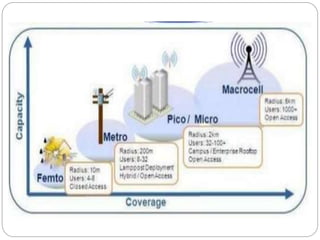
 Femtocell are reduced scale cellular access
points typically for indoor use.
 Cellular gateway is simply connected via
broadband
3
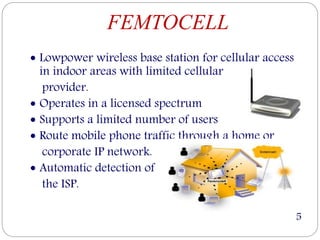
FEMTOCELL
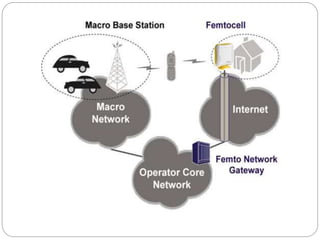
 Lowpower wireless base station for cellular access
in indoor areas with limited cellular
provider.
 Operates in a licensed spectrum
 Supports a limited number of users
 Route mobile phone traffic through a home or
corporate IP network.
 Automatic detection of
the ISP.
5
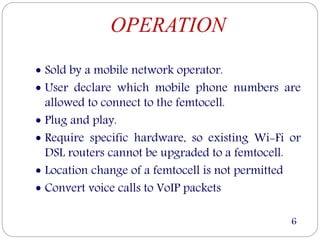
OPERATION
 Sold by a mobile network operator.
 User declare which mobile phone numbers are
allowed to connect to the femtocell.
 Plug and play.
 Require specific hardware, so existing Wi-Fi or
DSL routers cannot be upgraded to a femtocell.
 Location change of a femtocell is not permitted
 Convert voice calls to VoIP packets
6
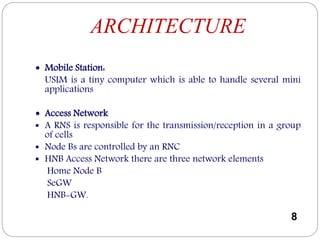
ARCHITECTURE
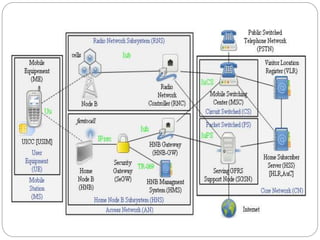
 Mobile Station:
USIM is a tiny computer which is able to handle several mini
applications
 Access Network
 A RNS is responsible for the transmission/reception in a group
of cells
 Node Bs are controlled by an RNC
 HNB Access Network there are three network elements
Home Node B
SeGW
HNB-GW.
8
 Core Network
 MSC is a telephone exchange that makes the
connection between mobile users within the network.
 SGSN performs the same functions as the MSC for
voice traffic.
 HLR is a central database that contains details of each
mobile phone subscriber that is authorized to use the
GSM core network.
 VLR is a database of the subscribers who have
roamed.
10
CHARACTERISTICS
• Secure and self-managing
• Locked to a single mobile phone network
• Low power but high quality
• Open or restricted access
• Standalone or integrated femtocells
11
REQUIREMENTS
 The key elements of the femtocell is:
 Installation
 Organization
 Configuration
should be completely trouble free and without
any intervention from the home owner.
12
 Self-organization requirements
Three main areas
 Femtocell self configuration
 Femtocell self optimisation
 Femtocell self healing:
 Configuration at start-up
 Stage 1
Femtocell will attempt to gain access to the core
network via the gateway - utilise the femtocell ID
- a unique identifier.
13
 Stage 2
To configure the radio interface parameters.
o RF channel information (frequencies for uplink
and downlink).
o Scrambling codes.
o Service area code and information.
o Neighbour list.
o Physical cell ID.
o RF parameters including pilot, maximum RF
power, etc..
14
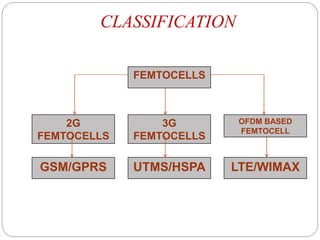
CLASSIFICATION
FEMTOCELLS
2G
FEMTOCELLS
3G
FEMTOCELLS
OFDM BASED
FEMTOCELL
LTE/WIMAXUTMS/HSPAGSM/GPRS
 2G FEMTOCELLS
 Based on Global System for Mobile
Communication
 Low cost
 Good quality voice service
Challenge of GSM
 Power control is not flexible enough to cope with
the evolving interference issues
 Does not provide high data rates
16
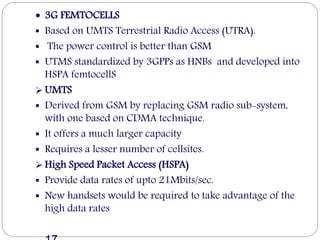
 3G FEMTOCELLS
 Based on UMTS Terrestrial Radio Access (UTRA).
 The power control is better than GSM
 UTMS standardized by 3GPPs as HNBs and developed into
HSPA femtocellS
 UMTS
 Derived from GSM by replacing GSM radio sub-system,
with one based on CDMA technique.
 It offers a much larger capacity
 Requires a lesser number of cellsites.
 High Speed Packet Access (HSPA)
 Provide data rates of upto 21Mbits/sec.
 New handsets would be required to take advantage of the
high data rates
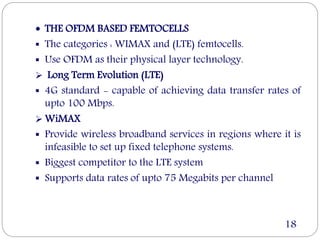
 THE OFDM BASED FEMTOCELLS
 The categories : WIMAX and (LTE) femtocells.
 Use OFDM as their physical layer technology.
 Long Term Evolution (LTE)
 4G standard - capable of achieving data transfer rates of
upto 100 Mbps.
 WiMAX
 Provide wireless broadband services in regions where it is
infeasible to set up fixed telephone systems.
 Biggest competitor to the LTE system
 Supports data rates of upto 75 Megabits per channel
18
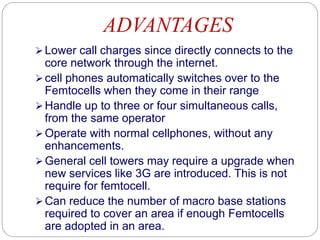
ADVANTAGES
Lower call charges since directly connects to the
core network through the internet.
cell phones automatically switches over to the
Femtocells when they come in their range
Handle up to three or four simultaneous calls,
from the same operator
Operate with normal cellphones, without any
enhancements.
General cell towers may require a upgrade when
new services like 3G are introduced. This is not
require for femtocell.
Can reduce the number of macro base stations
required to cover an area if enough Femtocells
are adopted in an area.
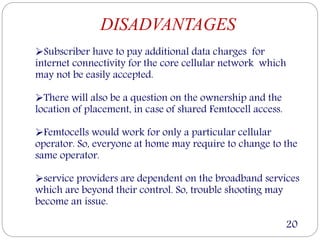
DISADVANTAGES
Subscriber have to pay additional data charges for
internet connectivity for the core cellular network which
may not be easily accepted.
There will also be a question on the ownership and the
location of placement, in case of shared Femtocell access.
Femtocells would work for only a particular cellular
operator. So, everyone at home may require to change to the
same operator.
service providers are dependent on the broadband services
which are beyond their control. So, trouble shooting may
become an issue.
20
CHALLENGES
 INTERFERNCE
The home base stations are randomly located inside
the same area covered by the larger cellular network
and they may use of the same spectral frequencies.
When a signal is transmitted, the various transmitters
within the same frequency band might not be able to
differentiate which one of the transmitter it listening
to.
Types of interference
 Co-tier interference.
 Cross- tier interference.
21
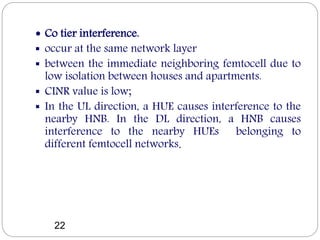
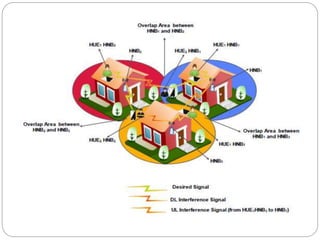
 Co tier interference.
 occur at the same network layer
 between the immediate neighboring femtocell due to
low isolation between houses and apartments.
 CINR value is low;
 In the UL direction, a HUE causes interference to the
nearby HNB. In the DL direction, a HNB causes
interference to the nearby HUEs belonging to
different femtocell networks.
22
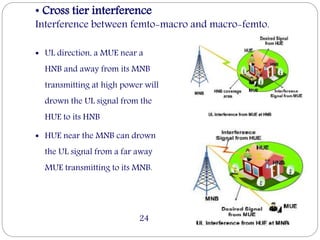
• Cross tier interference
Interference between femto-macro and macro-femto.
 UL direction, a MUE near a
HNB and away from its MNB
transmitting at high power will
drown the UL signal from the
HUE to its HNB
 HUE near the MNB can drown
the UL signal from a far away
MUE transmitting to its MNB.
24
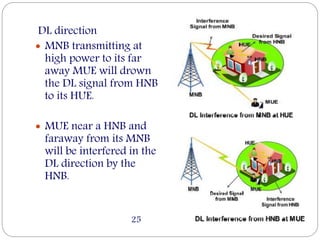
DL direction
 MNB transmitting at
high power to its far
away MUE will drown
the DL signal from HNB
to its HUE.
 MUE near a HNB and
faraway from its MNB
will be interfered in the
DL direction by the
HNB.
25
Interference cancellation methods
Successive interference cancellation (SIC)
Parallel interference Cancellation(PIC)
The PIC detects all the users interference at the same time
The SIC detects its interference one after the other
 Other challenges
 Self-organisation
 Mobility management and handovers
 Security
 Timing and synchronization
26
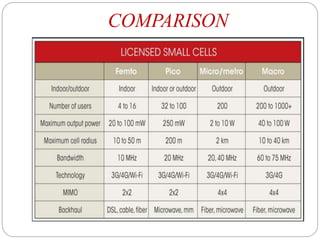
COMPARISON
FUTURE SCOPE
 Research is being done on femto cells that work
on 4G network for business enterprises that can
handle more calls simultaneously.
 Since a femto cell hub is primarily used in home
and utilizing internet bridge it makes sense to
eventually see it with other home appliances as
well.
28
CONCLUSION
 Unsatisfactory coverage and the increasing number of
application are two driving forces for femtocell
development
 Femtocell have the potential to provide high quality
network access to indoor users at low cost
-- Improve Coverage
-- Provide huge capacity gain
 Femtocells are considered to be the solution to meet
the future needs for high data rates and capacity in
wireless cellular networks.
29
FEMTOCELL

FEMTOCELL

  • 1.
    BY; DEEPIKA C.S. E CE MODEL ENGINEERING COLLEGE 1 FEMTOCELLS
  • 2.
    Overview  Introduction  Whatis Femtocell  Operation  Architecture  Characteristics  Requirements  Advantages and Disadvantages  Challenges  Comparison  Future scope  Conclusion 2
  • 3.
    INTRODUCTION  Cellular phonesface issues of poor signal strength and call quality when used indoors.  In the metric system, Femto (f) is the prefix for a factor of 10 ^ -15.  Femtocell are reduced scale cellular access points typically for indoor use.  Cellular gateway is simply connected via broadband 3
  • 5.
    FEMTOCELL  Lowpower wirelessbase station for cellular access in indoor areas with limited cellular provider.  Operates in a licensed spectrum  Supports a limited number of users  Route mobile phone traffic through a home or corporate IP network.  Automatic detection of the ISP. 5
  • 6.
    OPERATION  Sold bya mobile network operator.  User declare which mobile phone numbers are allowed to connect to the femtocell.  Plug and play.  Require specific hardware, so existing Wi-Fi or DSL routers cannot be upgraded to a femtocell.  Location change of a femtocell is not permitted  Convert voice calls to VoIP packets 6
  • 8.
    ARCHITECTURE  Mobile Station: USIMis a tiny computer which is able to handle several mini applications  Access Network  A RNS is responsible for the transmission/reception in a group of cells  Node Bs are controlled by an RNC  HNB Access Network there are three network elements Home Node B SeGW HNB-GW. 8
  • 10.
     Core Network MSC is a telephone exchange that makes the connection between mobile users within the network.  SGSN performs the same functions as the MSC for voice traffic.  HLR is a central database that contains details of each mobile phone subscriber that is authorized to use the GSM core network.  VLR is a database of the subscribers who have roamed. 10
  • 11.
    CHARACTERISTICS • Secure andself-managing • Locked to a single mobile phone network • Low power but high quality • Open or restricted access • Standalone or integrated femtocells 11
  • 12.
    REQUIREMENTS  The keyelements of the femtocell is:  Installation  Organization  Configuration should be completely trouble free and without any intervention from the home owner. 12
  • 13.
     Self-organization requirements Threemain areas  Femtocell self configuration  Femtocell self optimisation  Femtocell self healing:  Configuration at start-up  Stage 1 Femtocell will attempt to gain access to the core network via the gateway - utilise the femtocell ID - a unique identifier. 13
  • 14.
     Stage 2 Toconfigure the radio interface parameters. o RF channel information (frequencies for uplink and downlink). o Scrambling codes. o Service area code and information. o Neighbour list. o Physical cell ID. o RF parameters including pilot, maximum RF power, etc.. 14
  • 15.
  • 16.
     2G FEMTOCELLS Based on Global System for Mobile Communication  Low cost  Good quality voice service Challenge of GSM  Power control is not flexible enough to cope with the evolving interference issues  Does not provide high data rates 16
  • 17.
     3G FEMTOCELLS Based on UMTS Terrestrial Radio Access (UTRA).  The power control is better than GSM  UTMS standardized by 3GPPs as HNBs and developed into HSPA femtocellS  UMTS  Derived from GSM by replacing GSM radio sub-system, with one based on CDMA technique.  It offers a much larger capacity  Requires a lesser number of cellsites.  High Speed Packet Access (HSPA)  Provide data rates of upto 21Mbits/sec.  New handsets would be required to take advantage of the high data rates
  • 18.
     THE OFDMBASED FEMTOCELLS  The categories : WIMAX and (LTE) femtocells.  Use OFDM as their physical layer technology.  Long Term Evolution (LTE)  4G standard - capable of achieving data transfer rates of upto 100 Mbps.  WiMAX  Provide wireless broadband services in regions where it is infeasible to set up fixed telephone systems.  Biggest competitor to the LTE system  Supports data rates of upto 75 Megabits per channel 18
  • 19.
    ADVANTAGES Lower call chargessince directly connects to the core network through the internet. cell phones automatically switches over to the Femtocells when they come in their range Handle up to three or four simultaneous calls, from the same operator Operate with normal cellphones, without any enhancements. General cell towers may require a upgrade when new services like 3G are introduced. This is not require for femtocell. Can reduce the number of macro base stations required to cover an area if enough Femtocells are adopted in an area.
  • 20.
    DISADVANTAGES Subscriber have topay additional data charges for internet connectivity for the core cellular network which may not be easily accepted. There will also be a question on the ownership and the location of placement, in case of shared Femtocell access. Femtocells would work for only a particular cellular operator. So, everyone at home may require to change to the same operator. service providers are dependent on the broadband services which are beyond their control. So, trouble shooting may become an issue. 20
  • 21.
    CHALLENGES  INTERFERNCE The homebase stations are randomly located inside the same area covered by the larger cellular network and they may use of the same spectral frequencies. When a signal is transmitted, the various transmitters within the same frequency band might not be able to differentiate which one of the transmitter it listening to. Types of interference  Co-tier interference.  Cross- tier interference. 21
  • 22.
     Co tierinterference.  occur at the same network layer  between the immediate neighboring femtocell due to low isolation between houses and apartments.  CINR value is low;  In the UL direction, a HUE causes interference to the nearby HNB. In the DL direction, a HNB causes interference to the nearby HUEs belonging to different femtocell networks. 22
  • 24.
    • Cross tierinterference Interference between femto-macro and macro-femto.  UL direction, a MUE near a HNB and away from its MNB transmitting at high power will drown the UL signal from the HUE to its HNB  HUE near the MNB can drown the UL signal from a far away MUE transmitting to its MNB. 24
  • 25.
    DL direction  MNBtransmitting at high power to its far away MUE will drown the DL signal from HNB to its HUE.  MUE near a HNB and faraway from its MNB will be interfered in the DL direction by the HNB. 25
  • 26.
    Interference cancellation methods Successiveinterference cancellation (SIC) Parallel interference Cancellation(PIC) The PIC detects all the users interference at the same time The SIC detects its interference one after the other  Other challenges  Self-organisation  Mobility management and handovers  Security  Timing and synchronization 26
  • 27.
  • 28.
    FUTURE SCOPE  Researchis being done on femto cells that work on 4G network for business enterprises that can handle more calls simultaneously.  Since a femto cell hub is primarily used in home and utilizing internet bridge it makes sense to eventually see it with other home appliances as well. 28
  • 29.
    CONCLUSION  Unsatisfactory coverageand the increasing number of application are two driving forces for femtocell development  Femtocell have the potential to provide high quality network access to indoor users at low cost -- Improve Coverage -- Provide huge capacity gain  Femtocells are considered to be the solution to meet the future needs for high data rates and capacity in wireless cellular networks. 29