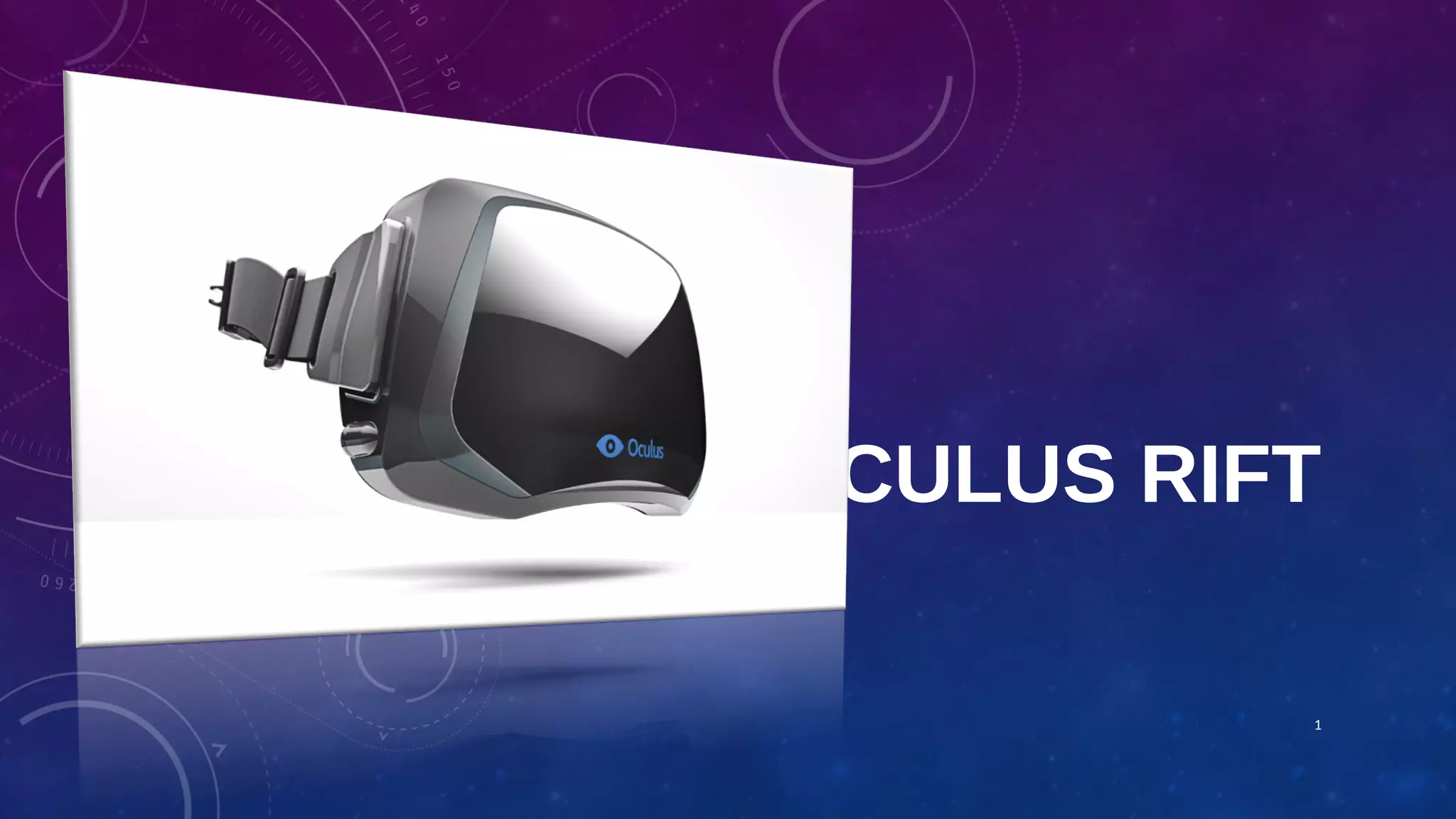
OCULUS RIFT
1
OCULUS RIFT
• The Oculus Rift is an upcoming virtual reality head-mounted
display, being developed by Oculus VR
• Oculus Rift was invented by a virtual reality enthusiast named
Palmer Luckey and later developed with the help of John
Cormack.
2
WHAT IS VIRTUAL REALITY?
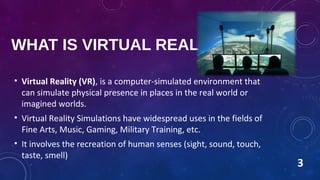
• Virtual Reality (VR), is a computer-simulated environment that
can simulate physical presence in places in the real world or
imagined worlds.
• Virtual Reality Simulations have widespread uses in the fields of
Fine Arts, Music, Gaming, Military Training, etc.
• It involves the recreation of human senses (sight, sound, touch,
taste, smell)
3
EARLY INVENTIONS IN VR FIELD
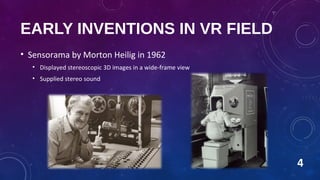
• Sensorama by Morton Heilig in 1962
• Displayed stereoscopic 3D images in a wide-frame view
• Supplied stereo sound
4
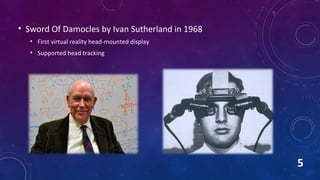
• Sword Of Damocles by Ivan Sutherland in 1968
• First virtual reality head-mounted display
• Supported head tracking
5
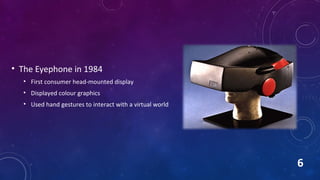
• The Eyephone in 1984
• First consumer head-mounted display
• Displayed colour graphics
• Used hand gestures to interact with a virtual world
6
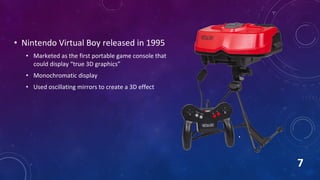
• Nintendo Virtual Boy released in 1995
• Marketed as the first portable game console that
could display “true 3D graphics”
• Monochromatic display
• Used oscillating mirrors to create a 3D effect
7
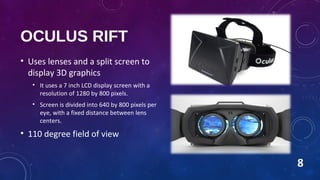
OCULUS RIFT
• Uses lenses and a split screen to
display 3D graphics
• It uses a 7 inch LCD display screen with a
resolution of 1280 by 800 pixels.
• Screen is divided into 640 by 800 pixels per
eye, with a fixed distance between lens
centers.
• 110 degree field of view
8
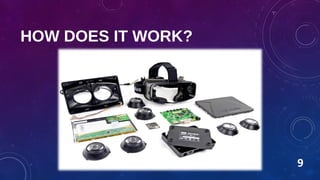
HOW DOES IT WORK?
9
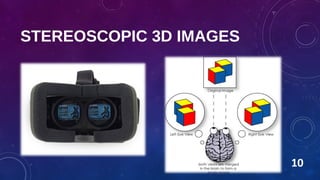
STEREOSCOPIC 3D IMAGES
10
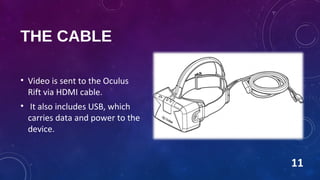
THE CABLE
• Video is sent to the Oculus
Rift via HDMI cable.
• It also includes USB, which
carries data and power to the
device.
11
THE POSITIONAL
TRACKER
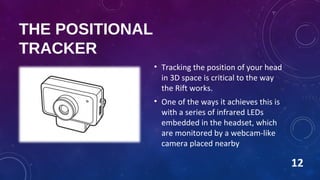
• Tracking the position of your head
in 3D space is critical to the way
the Rift works.
• One of the ways it achieves this is
with a series of infrared LEDs
embedded in the headset, which
are monitored by a webcam-like
camera placed nearby
12
THE HEADSET
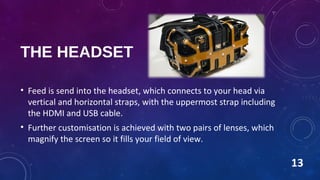
• Feed is send into the headset, which connects to your head via
vertical and horizontal straps, with the uppermost strap including
the HDMI and USB cable.
• Further customisation is achieved with two pairs of lenses, which
magnify the screen so it fills your field of view.
13
THE COMPONENTS
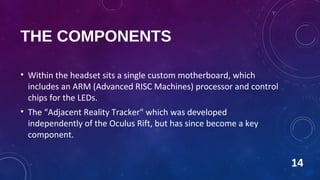
• Within the headset sits a single custom motherboard, which
includes an ARM (Advanced RISC Machines) processor and control
chips for the LEDs.
• The “Adjacent Reality Tracker" which was developed
independently of the Oculus Rift, but has since become a key
component.
14
THE COMPONENTS(CONTD.)
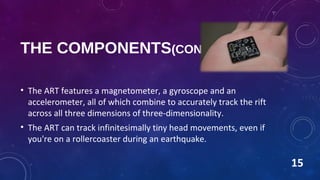
• The ART features a magnetometer, a gyroscope and an
accelerometer, all of which combine to accurately track the rift
across all three dimensions of three-dimensionality.
• The ART can track infinitesimally tiny head movements, even if
you're on a rollercoaster during an earthquake.
15
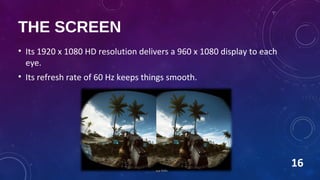
THE SCREEN
• Its 1920 x 1080 HD resolution delivers a 960 x 1080 display to each
eye.
• Its refresh rate of 60 Hz keeps things smooth.
16
THE FEEDBACK LOOP
• A huge amount of data is continually sent back and forth between
the positional tracker, the headset, the computer and its software.
• It results in an incredibly smooth VR experience.
• Adjustments such as brightness and contrast are made via Oculus'
software.
• It also includes the ability to calibrate the Rift, set your height and
enter your interpupillary distance (IPD), i.e., the size of the gap
between your pupils.
17
THE AUDIO
• Oculus Audio SDK allows the use of Head-Related Transfer
Function (HRTF) technology.
• HRTFs simulate the changes to a sound when it reaches your head
from a point in space.
• It does this by referencing data that represents changes that
would happen to a sound coming from that direction.
18
VERSIONS RELEASED
19
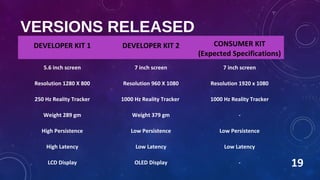
DEVELOPER KIT 1 DEVELOPER KIT 2 CONSUMER KIT
(Expected Specifications)
5.6 inch screen 7 inch screen 7 inch screen
Resolution 1280 X 800 Resolution 960 X 1080 Resolution 1920 x 1080
250 Hz Reality Tracker 1000 Hz Reality Tracker 1000 Hz Reality Tracker
Weight 289 gm Weight 379 gm -
High Persistence Low Persistence Low Persistence
High Latency Low Latency Low Latency
LCD Display OLED Display -
ADOPTION
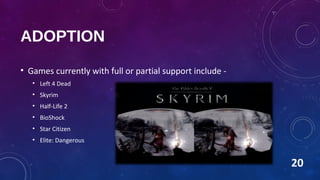
• Games currently with full or partial support include -
• Left 4 Dead
• Skyrim
• Half-Life 2
• BioShock
• Star Citizen
• Elite: Dangerous
20
SHORTCOMINGS
• Users encounter Motion Sickness.
• Current Model not very glass friendly.
• Heavy Weight Design.
• High Cost.
21
CONCLUSION
• Oculus Rift has revolutionized the VR Gaming experience.
• The DK2 has been a critical success among the developers.
• There is much excitement about the release of the first consumer
kit of Oculus Rift for consumers worldwide.
• The invention & development of Oculus Rift has resulted in many
other similar projects such as Sony’s Project Morpheus &
Microsoft’s Windows Holographic.
22
23

Oculus Rift

  • 1.
  • 2.
    OCULUS RIFT • TheOculus Rift is an upcoming virtual reality head-mounted display, being developed by Oculus VR • Oculus Rift was invented by a virtual reality enthusiast named Palmer Luckey and later developed with the help of John Cormack. 2
  • 3.
    WHAT IS VIRTUALREALITY? • Virtual Reality (VR), is a computer-simulated environment that can simulate physical presence in places in the real world or imagined worlds. • Virtual Reality Simulations have widespread uses in the fields of Fine Arts, Music, Gaming, Military Training, etc. • It involves the recreation of human senses (sight, sound, touch, taste, smell) 3
  • 4.
    EARLY INVENTIONS INVR FIELD • Sensorama by Morton Heilig in 1962 • Displayed stereoscopic 3D images in a wide-frame view • Supplied stereo sound 4
  • 5.
    • Sword OfDamocles by Ivan Sutherland in 1968 • First virtual reality head-mounted display • Supported head tracking 5
  • 6.
    • The Eyephonein 1984 • First consumer head-mounted display • Displayed colour graphics • Used hand gestures to interact with a virtual world 6
  • 7.
    • Nintendo VirtualBoy released in 1995 • Marketed as the first portable game console that could display “true 3D graphics” • Monochromatic display • Used oscillating mirrors to create a 3D effect 7
  • 8.
    OCULUS RIFT • Useslenses and a split screen to display 3D graphics • It uses a 7 inch LCD display screen with a resolution of 1280 by 800 pixels. • Screen is divided into 640 by 800 pixels per eye, with a fixed distance between lens centers. • 110 degree field of view 8
  • 9.
    HOW DOES ITWORK? 9
  • 10.
  • 11.
    THE CABLE • Videois sent to the Oculus Rift via HDMI cable. • It also includes USB, which carries data and power to the device. 11
  • 12.
    THE POSITIONAL TRACKER • Trackingthe position of your head in 3D space is critical to the way the Rift works. • One of the ways it achieves this is with a series of infrared LEDs embedded in the headset, which are monitored by a webcam-like camera placed nearby 12
  • 13.
    THE HEADSET • Feedis send into the headset, which connects to your head via vertical and horizontal straps, with the uppermost strap including the HDMI and USB cable. • Further customisation is achieved with two pairs of lenses, which magnify the screen so it fills your field of view. 13
  • 14.
    THE COMPONENTS • Withinthe headset sits a single custom motherboard, which includes an ARM (Advanced RISC Machines) processor and control chips for the LEDs. • The “Adjacent Reality Tracker" which was developed independently of the Oculus Rift, but has since become a key component. 14
  • 15.
    THE COMPONENTS(CONTD.) • TheART features a magnetometer, a gyroscope and an accelerometer, all of which combine to accurately track the rift across all three dimensions of three-dimensionality. • The ART can track infinitesimally tiny head movements, even if you're on a rollercoaster during an earthquake. 15
  • 16.
    THE SCREEN • Its1920 x 1080 HD resolution delivers a 960 x 1080 display to each eye. • Its refresh rate of 60 Hz keeps things smooth. 16
  • 17.
    THE FEEDBACK LOOP •A huge amount of data is continually sent back and forth between the positional tracker, the headset, the computer and its software. • It results in an incredibly smooth VR experience. • Adjustments such as brightness and contrast are made via Oculus' software. • It also includes the ability to calibrate the Rift, set your height and enter your interpupillary distance (IPD), i.e., the size of the gap between your pupils. 17
  • 18.
    THE AUDIO • OculusAudio SDK allows the use of Head-Related Transfer Function (HRTF) technology. • HRTFs simulate the changes to a sound when it reaches your head from a point in space. • It does this by referencing data that represents changes that would happen to a sound coming from that direction. 18
  • 19.
    VERSIONS RELEASED 19 DEVELOPER KIT1 DEVELOPER KIT 2 CONSUMER KIT (Expected Specifications) 5.6 inch screen 7 inch screen 7 inch screen Resolution 1280 X 800 Resolution 960 X 1080 Resolution 1920 x 1080 250 Hz Reality Tracker 1000 Hz Reality Tracker 1000 Hz Reality Tracker Weight 289 gm Weight 379 gm - High Persistence Low Persistence Low Persistence High Latency Low Latency Low Latency LCD Display OLED Display -
  • 20.
    ADOPTION • Games currentlywith full or partial support include - • Left 4 Dead • Skyrim • Half-Life 2 • BioShock • Star Citizen • Elite: Dangerous 20
  • 21.
    SHORTCOMINGS • Users encounterMotion Sickness. • Current Model not very glass friendly. • Heavy Weight Design. • High Cost. 21
  • 22.
    CONCLUSION • Oculus Rifthas revolutionized the VR Gaming experience. • The DK2 has been a critical success among the developers. • There is much excitement about the release of the first consumer kit of Oculus Rift for consumers worldwide. • The invention & development of Oculus Rift has resulted in many other similar projects such as Sony’s Project Morpheus & Microsoft’s Windows Holographic. 22
  • 23.