FEMTOCELL
TECHNOLOGY
Presented by
kvk
INTRODUCTION
• This is often the case in homes and buildings where coverage
decreases considerably as soon as you go indoors
• People are ditching their landlines in favor of mobile phones
• It has become necessary to work on new technology that will facilitate
calling coverage both indoor and outdoor
• Femtocell technology could be the answer
• In addition to facilitating better indoor call coverage, this emerging
technology reduces the drain that advanced mobile services (such as
mobile broadband) are placing on the capacity offered by phone
companies
CONTENTS
• Femtocells
• Femtocell working
• System architecture
• Handover operation
• Design of femtocell
• Advantages
• Disadvantages
• Applications
• Future scope
• Conclusion
CONCEPT OF FEMTOCELL
• A femtocell is a very small base station.
• Femtocells are low-power wireless access points.
• It can be placed in a customer’s residence.
• This will allow improved coverage & capacity.
• The femtocell concept aims to combine fixed line broadband access
with cellular telephony.
• One of the main design challenges of the femtocell is that the
hierarchical architecture and manual cell planning.
CONCEPT OF FEMTOCELL
• Third generation cellular technology suffers from inadequate indoor signal penetration.
• For that reason to improve accessing, we developed cells femtocell.
• Femtocells poor coverage diminishes the quality of voice and video applications, and slow
down high speed data services.
• Femtocells are important because mobile operators need to seize residential minutes from
fixed provider,& respond to emerging Wi-Fi offerings
• Femtocells solves problems like when a device that employs power and backhaul via user’s
existing resources.
• It also enables capacity equivalent full 3G network sector at indoor environment
NEED FOR FEMTOCELL
FEMTOCELL WORKING
FEMTOCELL WORKING
• Femtocells from part of the mobile operation’s network, although they are located at home or
in the business.
• Femtocells operate at very low radiation power levels i.e. 50 mw
• Femtocells typically range of 200 meters.
• A femtocell is installed at home and connected to mains power and a standard broadband IP
connection through to the mobile operator’s core network.
• Generally femtocells provided by voice calls , text messages and data services.
Femtocell working
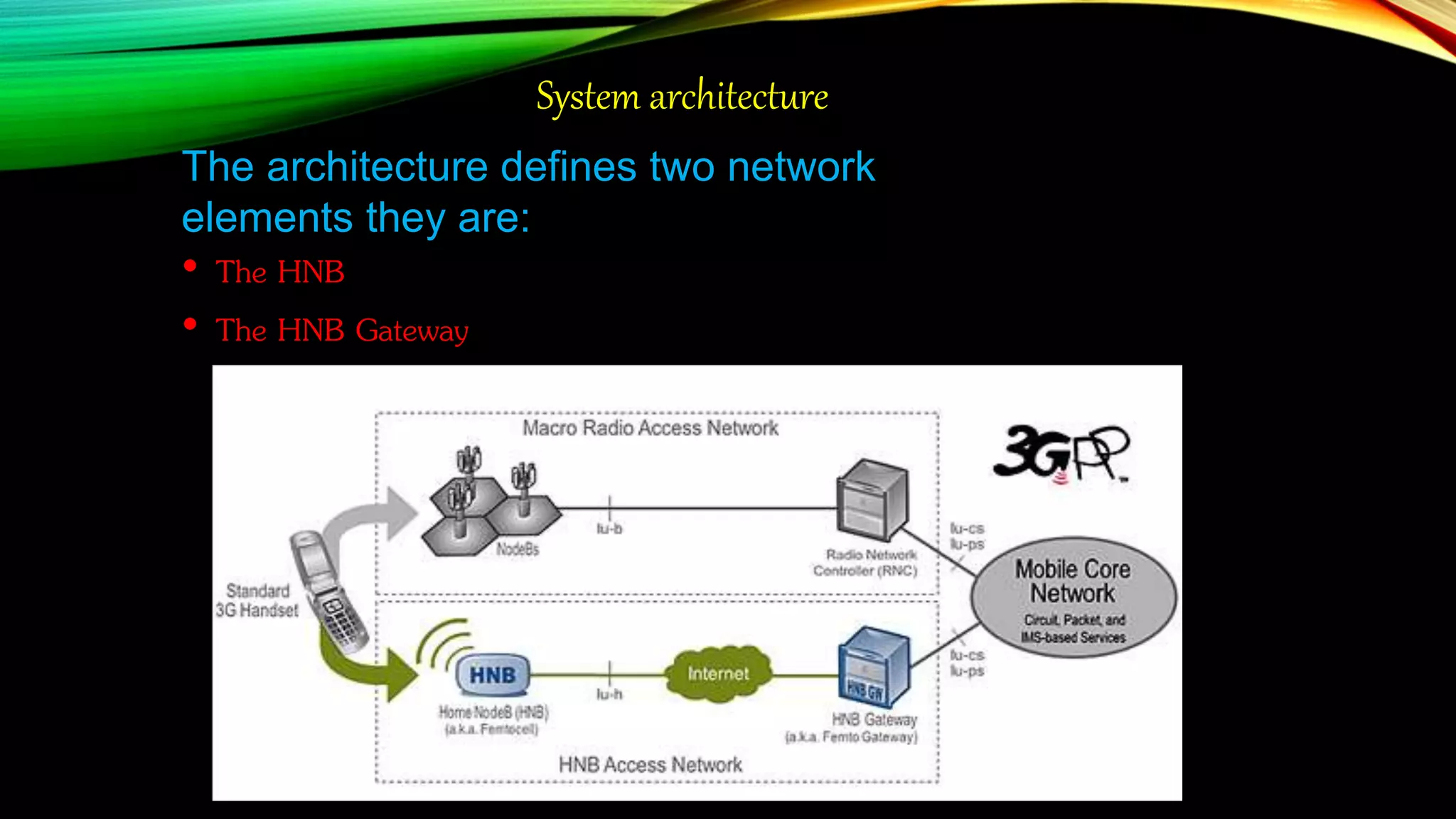
System architecture
The architecture defines two network
elements they are:
• The HNB
• The HNB Gateway
HOME NODEB(HNB)
• Connected to an existing residential broadband service.
• HNB provides radio coverage for standard 3G handsets within a home.
HNB GATEWAY (HNB-GW):
• Installed within an operator’s network.
• The HNB Gateway aggregates traffic from a large no of HNBs back into an
existing core service network through the standard Iu-cs and Iu-ps interfaces.
Iu-h interface:
• The Iu-h interface is in between the HNB and HNB Gateway.
SYSTEM ARCHITECTURE
HANDOVER OPERATION
Handover in mobile phone systems:
• A mobile phone switches between different call sites during a phone call.
Femtocell Handover:
• Femtocell do not implement soft handover
• All calls are switching instantly from femtocell & external outdoor cellular network.
• This is known as hard Handover.
• The 2G & 3G systems co-exist, it automatically select 3G where good reception.
Optimizing Handover into a Femtocell:
• There are 3 approaches
• Adding femtocells to the neighbor lists
• Adding some smarts into mobile phone
• Making the femtocell as clever as possible
DESIGN OF FEMTOCELL
The following key features are in the implementation of femtocell
• Low-impact
• Low RF power
• Capacity
• Low-cost
• Energy offset
• Easy end user installation
• Backhaul via broadband
• Interference
• Handovers
• Security
• Worldwide cellular network standards support
• Support for 3G existing devices
• Operator controlled
• New services and applications
• Service assurance
ADVANTAGES
• Better coverage and capacity
• Improved macro reliability
• Cost benefit
• Reduced subscriber turnover
• Capacity benefits of femtocell
• Lower transmit power
• Higher SINR
DISADVANTAGES
• Difficult to install
• Requires broadband connection
• It does not provide good coverage in outdoors
APPLICATIONS
DSL Modem
• No additional external connections are needed
• The modem will already have power& data connectivity
• Many mobile operators have started offering DSL broadband
Cable modem
• More households in USA receive their broadband internet service from their cable
TV supplier than from the phone company.
• The modem can be separate from the TV Set-top box or a combined unit.
Home LAN
• A wired local network is basically a group of devices connected to one another using
network cables.
FUTURE SCOPE
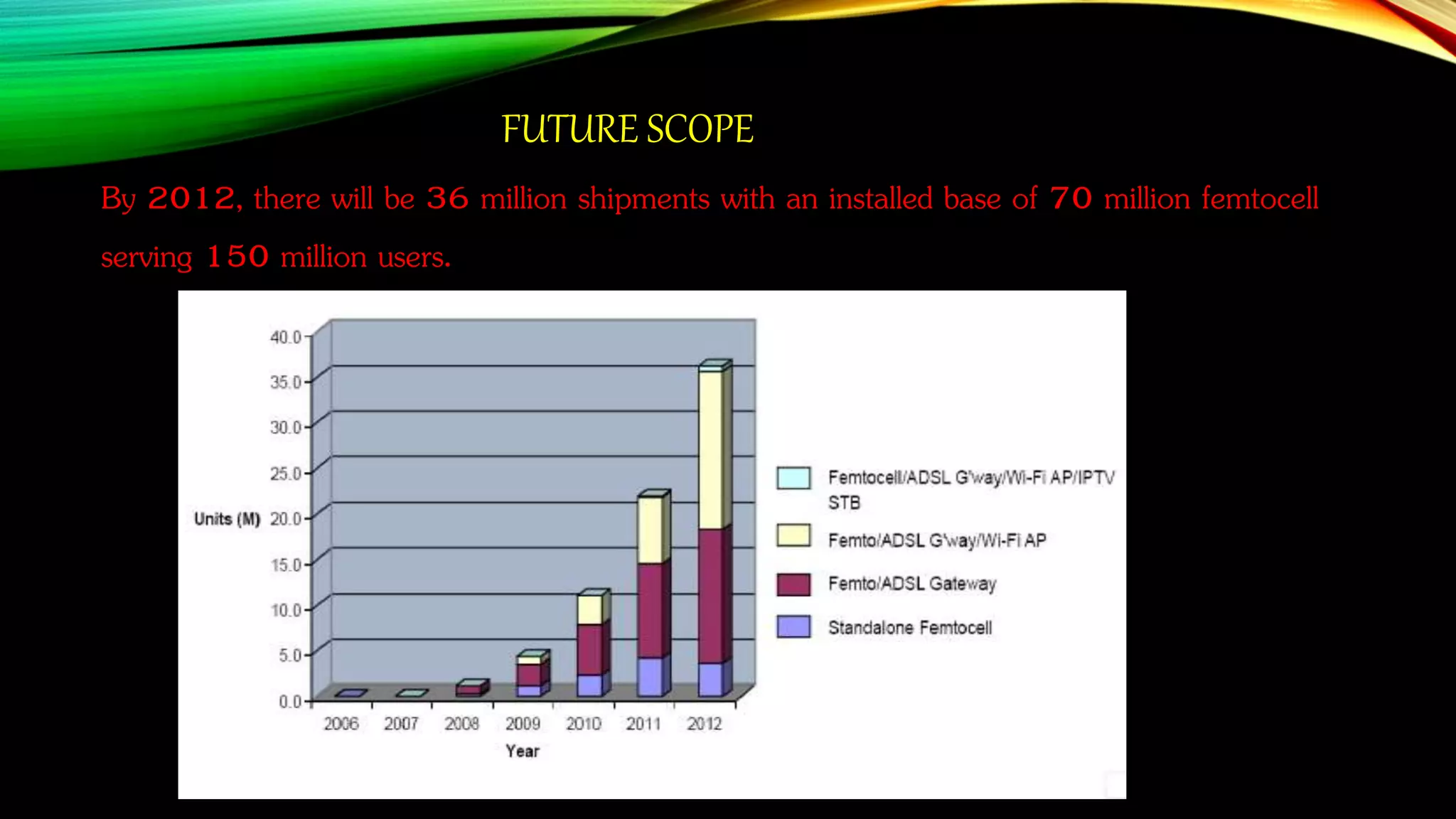
By 2012, there will be 36 million shipments with an installed base of 70 million femtocell
serving 150 million users.
CONCLUSION
• Femtocells are on a road to nowhere
• Unsatisfactory coverage and the increasing number of high-data rate application are two
driving forces for femtocell development
• Femtocells have the potential to provide high quality network access to indoor users at
low cost
• Improve coverage
THANK YOU

FemtoCell

  • 1.
  • 2.
    INTRODUCTION • This isoften the case in homes and buildings where coverage decreases considerably as soon as you go indoors • People are ditching their landlines in favor of mobile phones • It has become necessary to work on new technology that will facilitate calling coverage both indoor and outdoor • Femtocell technology could be the answer • In addition to facilitating better indoor call coverage, this emerging technology reduces the drain that advanced mobile services (such as mobile broadband) are placing on the capacity offered by phone companies
  • 3.
    CONTENTS • Femtocells • Femtocellworking • System architecture • Handover operation • Design of femtocell • Advantages • Disadvantages • Applications • Future scope • Conclusion
  • 4.
    CONCEPT OF FEMTOCELL •A femtocell is a very small base station. • Femtocells are low-power wireless access points.
  • 5.
    • It canbe placed in a customer’s residence. • This will allow improved coverage & capacity. • The femtocell concept aims to combine fixed line broadband access with cellular telephony. • One of the main design challenges of the femtocell is that the hierarchical architecture and manual cell planning. CONCEPT OF FEMTOCELL
  • 6.
    • Third generationcellular technology suffers from inadequate indoor signal penetration. • For that reason to improve accessing, we developed cells femtocell. • Femtocells poor coverage diminishes the quality of voice and video applications, and slow down high speed data services. • Femtocells are important because mobile operators need to seize residential minutes from fixed provider,& respond to emerging Wi-Fi offerings • Femtocells solves problems like when a device that employs power and backhaul via user’s existing resources. • It also enables capacity equivalent full 3G network sector at indoor environment NEED FOR FEMTOCELL
  • 7.
  • 8.
    FEMTOCELL WORKING • Femtocellsfrom part of the mobile operation’s network, although they are located at home or in the business. • Femtocells operate at very low radiation power levels i.e. 50 mw • Femtocells typically range of 200 meters. • A femtocell is installed at home and connected to mains power and a standard broadband IP connection through to the mobile operator’s core network. • Generally femtocells provided by voice calls , text messages and data services.
  • 9.
  • 10.
    System architecture The architecturedefines two network elements they are: • The HNB • The HNB Gateway
  • 11.
    HOME NODEB(HNB) • Connectedto an existing residential broadband service. • HNB provides radio coverage for standard 3G handsets within a home. HNB GATEWAY (HNB-GW): • Installed within an operator’s network. • The HNB Gateway aggregates traffic from a large no of HNBs back into an existing core service network through the standard Iu-cs and Iu-ps interfaces. Iu-h interface: • The Iu-h interface is in between the HNB and HNB Gateway. SYSTEM ARCHITECTURE
  • 12.
    HANDOVER OPERATION Handover inmobile phone systems: • A mobile phone switches between different call sites during a phone call. Femtocell Handover: • Femtocell do not implement soft handover • All calls are switching instantly from femtocell & external outdoor cellular network. • This is known as hard Handover. • The 2G & 3G systems co-exist, it automatically select 3G where good reception. Optimizing Handover into a Femtocell: • There are 3 approaches • Adding femtocells to the neighbor lists • Adding some smarts into mobile phone • Making the femtocell as clever as possible
  • 13.
    DESIGN OF FEMTOCELL Thefollowing key features are in the implementation of femtocell • Low-impact • Low RF power • Capacity • Low-cost • Energy offset • Easy end user installation • Backhaul via broadband • Interference • Handovers • Security
  • 14.
    • Worldwide cellularnetwork standards support • Support for 3G existing devices • Operator controlled • New services and applications • Service assurance
  • 15.
    ADVANTAGES • Better coverageand capacity • Improved macro reliability • Cost benefit • Reduced subscriber turnover • Capacity benefits of femtocell • Lower transmit power • Higher SINR
  • 16.
    DISADVANTAGES • Difficult toinstall • Requires broadband connection • It does not provide good coverage in outdoors
  • 17.
    APPLICATIONS DSL Modem • Noadditional external connections are needed • The modem will already have power& data connectivity • Many mobile operators have started offering DSL broadband
  • 18.
    Cable modem • Morehouseholds in USA receive their broadband internet service from their cable TV supplier than from the phone company. • The modem can be separate from the TV Set-top box or a combined unit.
  • 19.
    Home LAN • Awired local network is basically a group of devices connected to one another using network cables.
  • 20.
    FUTURE SCOPE By 2012,there will be 36 million shipments with an installed base of 70 million femtocell serving 150 million users.
  • 21.
    CONCLUSION • Femtocells areon a road to nowhere • Unsatisfactory coverage and the increasing number of high-data rate application are two driving forces for femtocell development • Femtocells have the potential to provide high quality network access to indoor users at low cost • Improve coverage
  • 22.