A DETAILED STUDY ON FEMTOCELL
Presented by :
NAME - NIKHIL KUMAR SINGH
ENROLMENT NO - 10304016031
CLASS ROLL NO - 16/IC/031
BRANCH - INSTRUMENTATION & CONTROL ENGINEERING
1
Introduction
 A femtocell is a small cellular base station designed for use in residential or small business
environments
 It connects to the service provider’s network via broadband (such as DSL or cable) and
typically supports 2 to 5 mobile phones in a residential setting
 Afemtocell allows service providers to extend service coverage inside of your home -
especially where access would otherwise be limited or unavailable - without the need for
expensive cellular towers
 It also decreases backhaul costs since it routes your mobile phone traffic through the IP
network
 Afemtocell is sometimes referred to as a “home base station”, “access point base station”,
“3G access point”, “small cellular base station” and “personal 2G-3G base station”
2
History On Femtocell
 The first interest in femtocells started around 2002 when a group of engineers at Motorola
were investigating possible new applications and methodologies that could be used with
mobile communications.
 A couple of years later in 2004, the idea was beginning to gain some momentum and a
variety of companies were looking into the idea.
 With the idea gaining momentum, and many more companies investigating femto cell
technology, the Femto Forum was set up in July 2007. Its aim was to promote the wide-
scale adoption of femtocells. With mounting industry pressure to be able to deploy femto
cell technology, the Femto Forum also played a coordinating role in ensuring that the
standards were agreed and released as fast as possible.
3
Why Femtocell ?
• Technical motivation
•
•
•
Reduced separation distance between transmitter and receiver
Interference is isolated by building structure
Limited number of users
• Business motivation
•
•
Half of voice calls and a majority of data traffic originate indoor
Operators expand network capacity and coverage without much investments on
infrastructure.
Subscribers get better radio service at low price•
4
PHYSICAL APPEARENCE
5
PROBLEM:
• Low signal strength
 Poor voice quality
 Slow data rates
 Authentication issues
 Expensive deployment
6
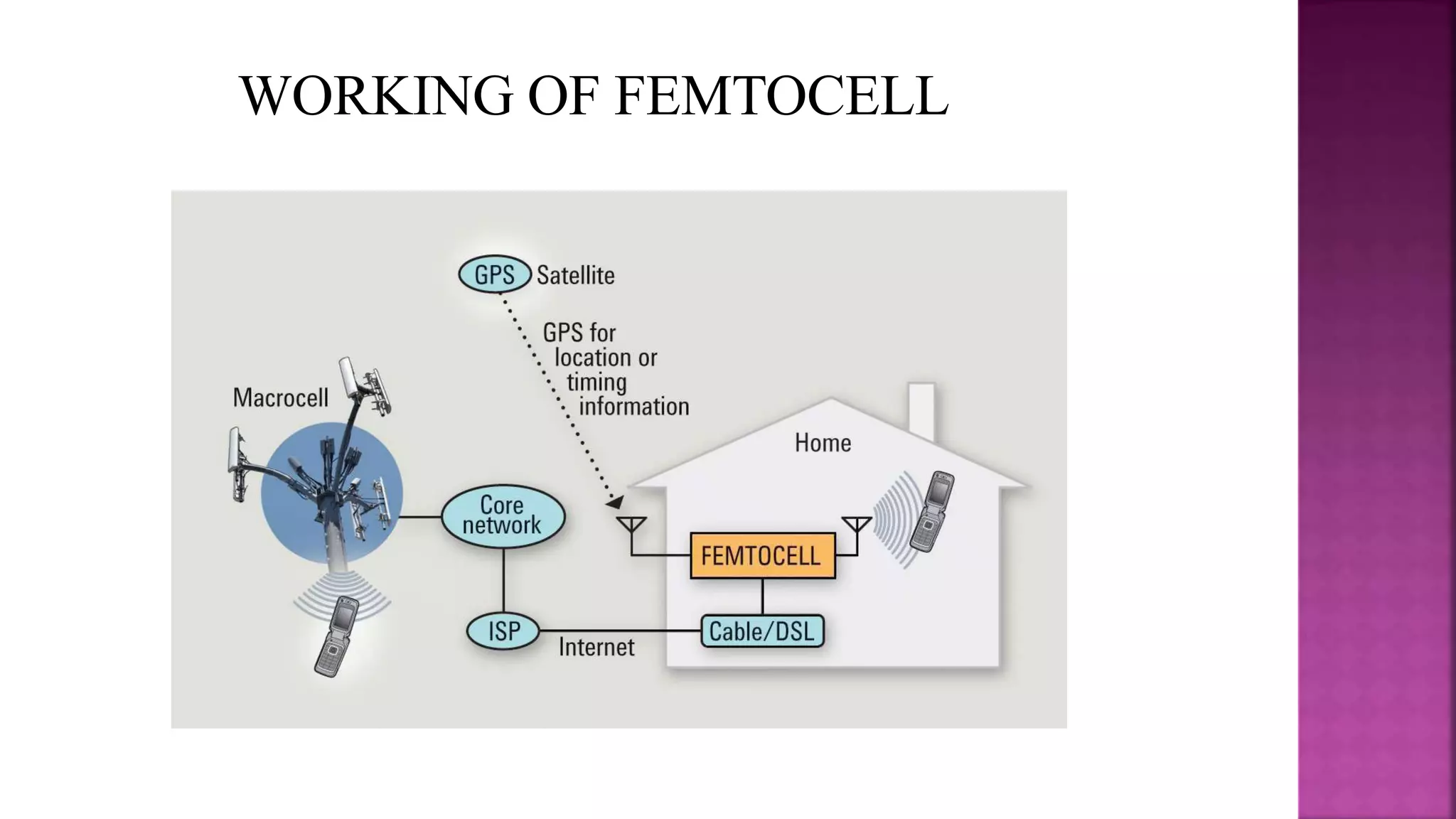
WORKING OF FEMTOCELL
s llHow doe femtoce works ?
7
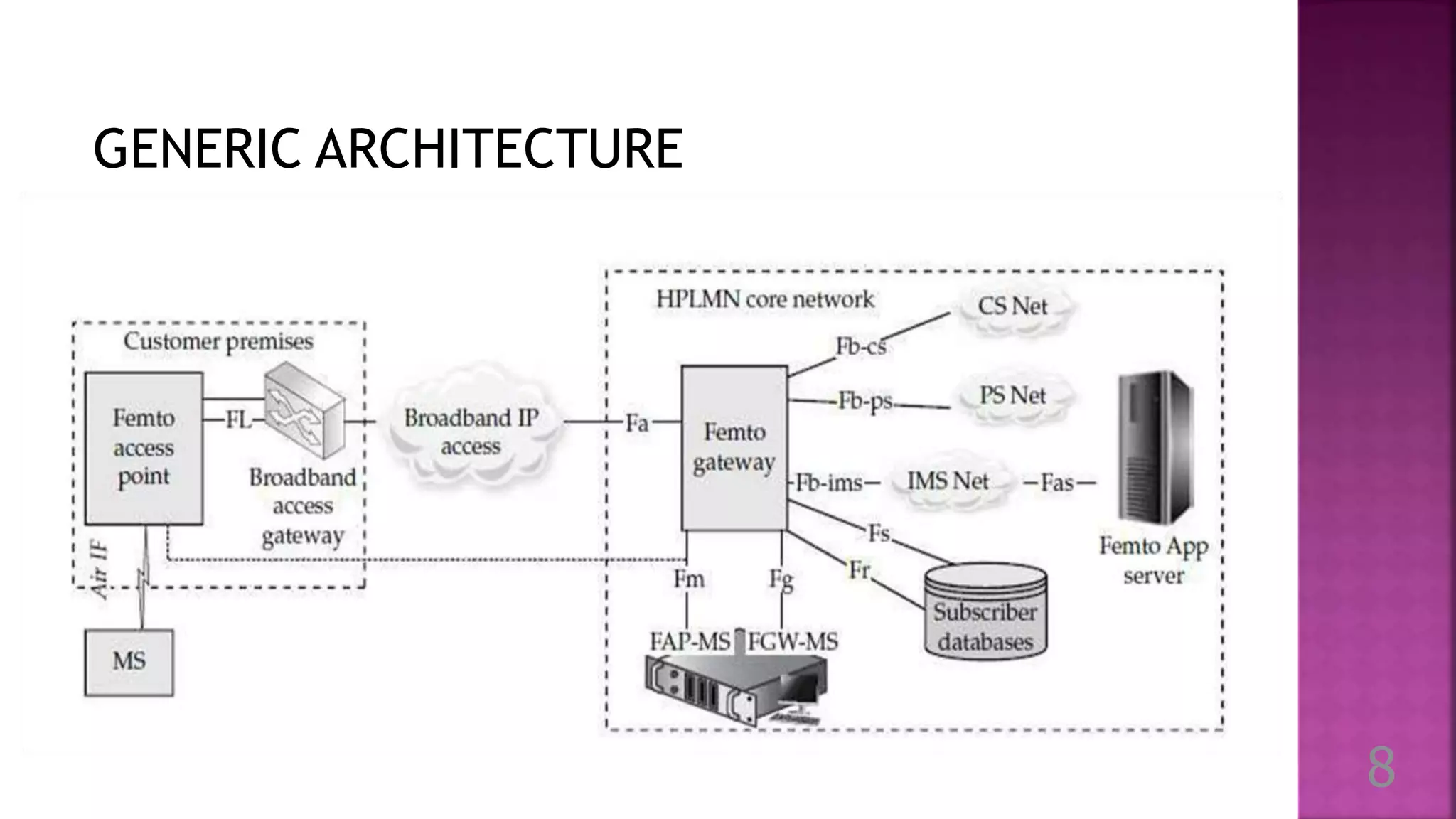
GENERIC ARCHITECTURE
8
nDefinitio & Differentiation Of Femtocell
9
Femtocell Picocell Wifi
Site Rental customer operator customer
Installation customer operator customer
Electricity Bill customer operator customer
Radio Planning no (local) yes (prior & global) no
Backhaul Connection via customer dedicated via customer
Macrocell Interaction not (yet) yes not applicable
Transmission Power < 23dBm 23-30dBm 20dBm
Access Rights mainly closed public closed
Handover possible yes vertical
Photo
 Home security
 Multimedia
 Video door bell
 Gaming
 Shopping
 Child monitor
SERVICE and APPLICATION
10
 Enhanced services
 Increased revenue
 Offload data traffic
 Increased area spectral efficiency
 Improved customer satisfaction
Network Providers
11
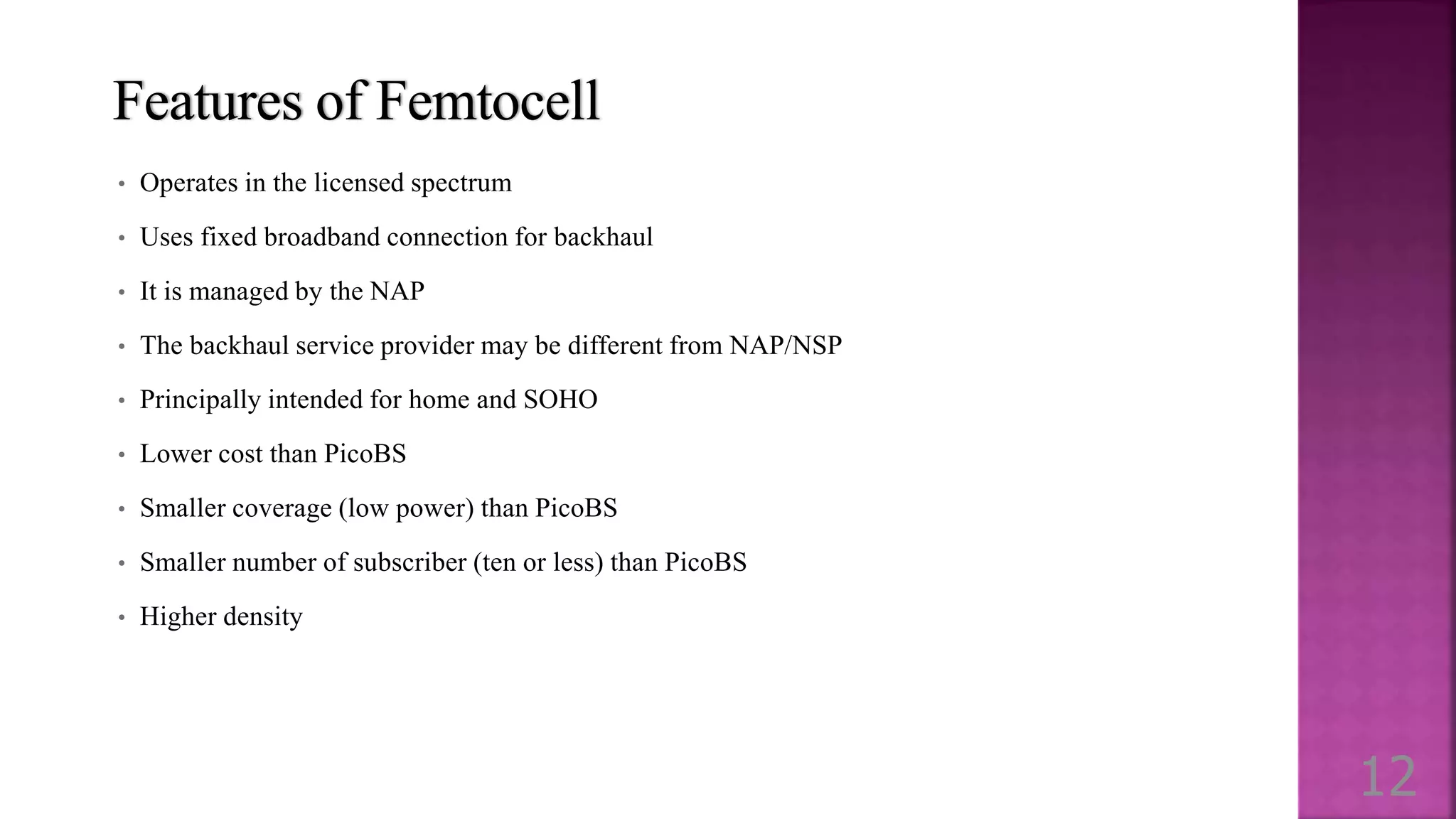
Features of Femtocell
• Operates in the licensed spectrum
• Uses fixed broadband connection for backhaul
• It is managed by the NAP
• The backhaul service provider may be different from NAP/NSP
• Principally intended for home and SOHO
• Lower cost than PicoBS
• Smaller coverage (low power) than PicoBS
• Smaller number of subscriber (ten or less) than PicoBS
• Higher density
12
Users Benefits
- Reduced “in home” call charges.
- Improved indoor coverage (Base station in your bedroom).
- Continued use of current handset.
- Reduced battery drain.
- Fast/Higher performance 3G services.
13
Operators’benefits
- Improves coverage.
- Reduces backhaul traffic.
- Provides capacity enhancements.
- Reduces churn.
- Easy Radio Coverage for rural areas.
- Where there is ADSL you can have mobility.
- Stimulates 3G usage.
- Addresses the fixed mobile convergence market with a highly attractive and efficient
solution.
14
Advantages Of Femtocell
1. Low Device Cost:
 efficient, low-cost power amplifiers, highly sensitive receivers, flexible channel bandwidth, reliable RF filters;
low cost and low power implementation; etc.
2. System Interference Management:
 minimize interference to macro (and vice versa); minimize interference to adjacent femtos; coping with
unplanned rollouts; coverage estimation, interference cancellation; etc.
3. Femtocell Capacity Maximization:
 link and access management (handover, admission control, resource management, load balancing and flow
control); dynamic bandwidth allocation and sharing; etc.
4. Backhaul Issues:
 wired or wireless backhaul, reducing signaling load, QoS provisioning and traffic priorization, joint access and
backhaul design; etc.
5. Viable SystemArchitecture:
 control & data planes, access control, authentication, local breakout, efficient forwarding, seamless mobility,
zero-config, etc.
15
Conclusion
• Femtocell extends the high-data rate service coverage of UMTS to indoor environment
•
•
Higher spectral efficiency due to short range and well isolation
With massive deployment, a solution for ubiquitous mobile broadband access
• Arange of case studies verify CSG femtocell operation
•
•
Interference locally distributed
Flexible spectrum scheme is efficient to reduce uplink outage rate
• Mobile teletrauma use case:
With a certain level of femtocell penetration ratio, the service can be delivered with sufficient low
outage rate
• At least an order of magnitude reduction in service outage rates when femtocells are utilized,
compared with macrocell only case
• Downlink direction study is also interesting and beneficial to complete the use case study.
In the long term, the research direction is LTE femtocell.
16
THANK YOU
17

a detailed study on femtocell,

  • 1.
    A DETAILED STUDYON FEMTOCELL Presented by : NAME - NIKHIL KUMAR SINGH ENROLMENT NO - 10304016031 CLASS ROLL NO - 16/IC/031 BRANCH - INSTRUMENTATION & CONTROL ENGINEERING 1
  • 2.
    Introduction  A femtocellis a small cellular base station designed for use in residential or small business environments  It connects to the service provider’s network via broadband (such as DSL or cable) and typically supports 2 to 5 mobile phones in a residential setting  Afemtocell allows service providers to extend service coverage inside of your home - especially where access would otherwise be limited or unavailable - without the need for expensive cellular towers  It also decreases backhaul costs since it routes your mobile phone traffic through the IP network  Afemtocell is sometimes referred to as a “home base station”, “access point base station”, “3G access point”, “small cellular base station” and “personal 2G-3G base station” 2
  • 3.
    History On Femtocell The first interest in femtocells started around 2002 when a group of engineers at Motorola were investigating possible new applications and methodologies that could be used with mobile communications.  A couple of years later in 2004, the idea was beginning to gain some momentum and a variety of companies were looking into the idea.  With the idea gaining momentum, and many more companies investigating femto cell technology, the Femto Forum was set up in July 2007. Its aim was to promote the wide- scale adoption of femtocells. With mounting industry pressure to be able to deploy femto cell technology, the Femto Forum also played a coordinating role in ensuring that the standards were agreed and released as fast as possible. 3
  • 4.
    Why Femtocell ? •Technical motivation • • • Reduced separation distance between transmitter and receiver Interference is isolated by building structure Limited number of users • Business motivation • • Half of voice calls and a majority of data traffic originate indoor Operators expand network capacity and coverage without much investments on infrastructure. Subscribers get better radio service at low price• 4
  • 5.
  • 6.
    PROBLEM: • Low signalstrength  Poor voice quality  Slow data rates  Authentication issues  Expensive deployment 6
  • 7.
  • 8.
    s llHow doefemtoce works ? 7
  • 9.
  • 10.
    nDefinitio & DifferentiationOf Femtocell 9 Femtocell Picocell Wifi Site Rental customer operator customer Installation customer operator customer Electricity Bill customer operator customer Radio Planning no (local) yes (prior & global) no Backhaul Connection via customer dedicated via customer Macrocell Interaction not (yet) yes not applicable Transmission Power < 23dBm 23-30dBm 20dBm Access Rights mainly closed public closed Handover possible yes vertical Photo
  • 11.
     Home security Multimedia  Video door bell  Gaming  Shopping  Child monitor SERVICE and APPLICATION 10
  • 12.
     Enhanced services Increased revenue  Offload data traffic  Increased area spectral efficiency  Improved customer satisfaction Network Providers 11
  • 13.
    Features of Femtocell •Operates in the licensed spectrum • Uses fixed broadband connection for backhaul • It is managed by the NAP • The backhaul service provider may be different from NAP/NSP • Principally intended for home and SOHO • Lower cost than PicoBS • Smaller coverage (low power) than PicoBS • Smaller number of subscriber (ten or less) than PicoBS • Higher density 12
  • 14.
    Users Benefits - Reduced“in home” call charges. - Improved indoor coverage (Base station in your bedroom). - Continued use of current handset. - Reduced battery drain. - Fast/Higher performance 3G services. 13
  • 15.
    Operators’benefits - Improves coverage. -Reduces backhaul traffic. - Provides capacity enhancements. - Reduces churn. - Easy Radio Coverage for rural areas. - Where there is ADSL you can have mobility. - Stimulates 3G usage. - Addresses the fixed mobile convergence market with a highly attractive and efficient solution. 14
  • 16.
    Advantages Of Femtocell 1.Low Device Cost:  efficient, low-cost power amplifiers, highly sensitive receivers, flexible channel bandwidth, reliable RF filters; low cost and low power implementation; etc. 2. System Interference Management:  minimize interference to macro (and vice versa); minimize interference to adjacent femtos; coping with unplanned rollouts; coverage estimation, interference cancellation; etc. 3. Femtocell Capacity Maximization:  link and access management (handover, admission control, resource management, load balancing and flow control); dynamic bandwidth allocation and sharing; etc. 4. Backhaul Issues:  wired or wireless backhaul, reducing signaling load, QoS provisioning and traffic priorization, joint access and backhaul design; etc. 5. Viable SystemArchitecture:  control & data planes, access control, authentication, local breakout, efficient forwarding, seamless mobility, zero-config, etc. 15
  • 17.
    Conclusion • Femtocell extendsthe high-data rate service coverage of UMTS to indoor environment • • Higher spectral efficiency due to short range and well isolation With massive deployment, a solution for ubiquitous mobile broadband access • Arange of case studies verify CSG femtocell operation • • Interference locally distributed Flexible spectrum scheme is efficient to reduce uplink outage rate • Mobile teletrauma use case: With a certain level of femtocell penetration ratio, the service can be delivered with sufficient low outage rate • At least an order of magnitude reduction in service outage rates when femtocells are utilized, compared with macrocell only case • Downlink direction study is also interesting and beneficial to complete the use case study. In the long term, the research direction is LTE femtocell. 16
  • 18.