Febrile Non-
Hemolytic
Transfusion
Reaction
Alo, Valenzuela, Villa
Introduction
Febrile non-hemolytic transfusion reaction (FNHTR) is an acute complication of
transfusion presenting with at least a 1C increase in body temperature that can be
accompanied by chills, nausea or vomiting, tachycardia, increase in blood pressure,
and tachypnea. Occasionally, shaking chills is the only initial presenting symptom,
followed by an increase in body temperature up to 30 minutes after discontinuing
the transfusion. An asymptomatic rise in body temperature in a hypothermic patient
to normal body temperature should not be considered a FNHTR.
Brief History
01
â—Ź Mid 20th
century
â—Ź Was first identified and defined as a distinct clinical
condition.
â—Ź Some patients reported fever, chills, and rigors
during or after blood transfusions, even when there
was no sign of hemolysis.
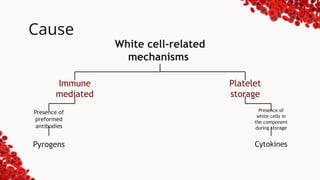
Cause
White cell-related
mechanisms
Immune
mediated
Platelet
storage
Presence of
preformed
antibodies
Presence of
white cells in
the component
during storage
Pyrogens Cytokines
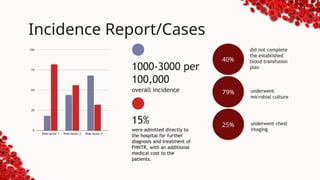
Incidence Report/Cases
15%
were admitted directly to
the hospital for further
diagnosis and treatment of
FHNTR, with an additional
medical cost to the
patients.
1000-3000 per
100,000
overall incidence
did not complete
the established
blood transfusion
plan
underwent
microbial culture
underwent chest
imaging
40%
79%
25%
Prevalence
•Typically estimated to range between 0.5% and 5% of
transfusions.
•1 in 100 units transfused.
•Multiply -transfused patients and multiparous women make
up the largest populations
Signs/Symptoms
•Fever
•Chills
•Headache
•Nausea/vomiting
•Tachycardia
•Tachypnea
•increase blood pressure
• Fever of at least 39 °C, OR a rise in
temperature of at least 2 °C from pre-
transfusion values AND/OR other symptoms
or signs, including chills (rigors), painful
muscles (myalgia), or nausea that are severe
enough that the transfusion is stopped.
Indication
Laboratory Testing/Procedure
1. Clinical Assessment: Clinically assess the patient for
symptoms such as fever, chills, rigors, and headache.
2. Exclusion of Acute Hemolytic Reaction: Perform a direct
antiglobulin test (DAT), also known as the Coombs test, to
exclude an acute hemolytic reaction.
3. Further Testing: A full blood count and repeat ABO grouping
may be indicated.
• Treatment may include the use of antipyretics like
paracetamol. For rigors, treat with meperidine. And for
future transfusion, prestorage leukoreduction of PRBC and
platelets is sometimes performed to reduce the risk of
recurrence.
Management and Treatment
• STOP the transfusion immediately and follow other steps for
managing suspected transfusion reactions.
Principle and Applications 5th Ed.
Research Progress on Febrile non-hemolytic transfusion Reaction: A Narrative review. (2022, December).
National Library of Medicine. Retrieved May 1, 2024, from
https://www.ncbi.nlm.nih.gov/pmc/articles/PMC9843350/
Acad P
. (2020) Educational Case: Febrile Nonhemolytic TransfusionReaction. Retrieved May 1, 2024, from
https://www.ncbi.nlm.nih.gov/pmc/articles/PMC7364804/
Harmening D. (2019) Modern Blood Banking & Transfusion Practices 7th Edition. (pp. 383-384). F.A Davis
Febrile Nonhemolytic Transfusion Reactions: Definition, Manifestation, and Prevalence Retrieved May
1,2024 from
https://www.labce.com/spg1870614_febrile_nonhemolytic_transfusion_reactions_definit.aspx
References

febrile non-hemolyctic transfusion reaction

  • 1.
  • 2.
    Introduction Febrile non-hemolytic transfusionreaction (FNHTR) is an acute complication of transfusion presenting with at least a 1C increase in body temperature that can be accompanied by chills, nausea or vomiting, tachycardia, increase in blood pressure, and tachypnea. Occasionally, shaking chills is the only initial presenting symptom, followed by an increase in body temperature up to 30 minutes after discontinuing the transfusion. An asymptomatic rise in body temperature in a hypothermic patient to normal body temperature should not be considered a FNHTR.
  • 3.
  • 4.
    â—Ź Mid 20th century â—ŹWas first identified and defined as a distinct clinical condition. â—Ź Some patients reported fever, chills, and rigors during or after blood transfusions, even when there was no sign of hemolysis.
  • 5.
  • 6.
    Incidence Report/Cases 15% were admitteddirectly to the hospital for further diagnosis and treatment of FHNTR, with an additional medical cost to the patients. 1000-3000 per 100,000 overall incidence did not complete the established blood transfusion plan underwent microbial culture underwent chest imaging 40% 79% 25%
  • 7.
    Prevalence •Typically estimated torange between 0.5% and 5% of transfusions. •1 in 100 units transfused. •Multiply -transfused patients and multiparous women make up the largest populations
  • 8.
  • 9.
    • Fever ofat least 39 °C, OR a rise in temperature of at least 2 °C from pre- transfusion values AND/OR other symptoms or signs, including chills (rigors), painful muscles (myalgia), or nausea that are severe enough that the transfusion is stopped. Indication
  • 10.
    Laboratory Testing/Procedure 1. ClinicalAssessment: Clinically assess the patient for symptoms such as fever, chills, rigors, and headache. 2. Exclusion of Acute Hemolytic Reaction: Perform a direct antiglobulin test (DAT), also known as the Coombs test, to exclude an acute hemolytic reaction. 3. Further Testing: A full blood count and repeat ABO grouping may be indicated.
  • 11.
    • Treatment mayinclude the use of antipyretics like paracetamol. For rigors, treat with meperidine. And for future transfusion, prestorage leukoreduction of PRBC and platelets is sometimes performed to reduce the risk of recurrence. Management and Treatment • STOP the transfusion immediately and follow other steps for managing suspected transfusion reactions.
  • 12.
    Principle and Applications5th Ed. Research Progress on Febrile non-hemolytic transfusion Reaction: A Narrative review. (2022, December). National Library of Medicine. Retrieved May 1, 2024, from https://www.ncbi.nlm.nih.gov/pmc/articles/PMC9843350/ Acad P . (2020) Educational Case: Febrile Nonhemolytic TransfusionReaction. Retrieved May 1, 2024, from https://www.ncbi.nlm.nih.gov/pmc/articles/PMC7364804/ Harmening D. (2019) Modern Blood Banking & Transfusion Practices 7th Edition. (pp. 383-384). F.A Davis Febrile Nonhemolytic Transfusion Reactions: Definition, Manifestation, and Prevalence Retrieved May 1,2024 from https://www.labce.com/spg1870614_febrile_nonhemolytic_transfusion_reactions_definit.aspx References