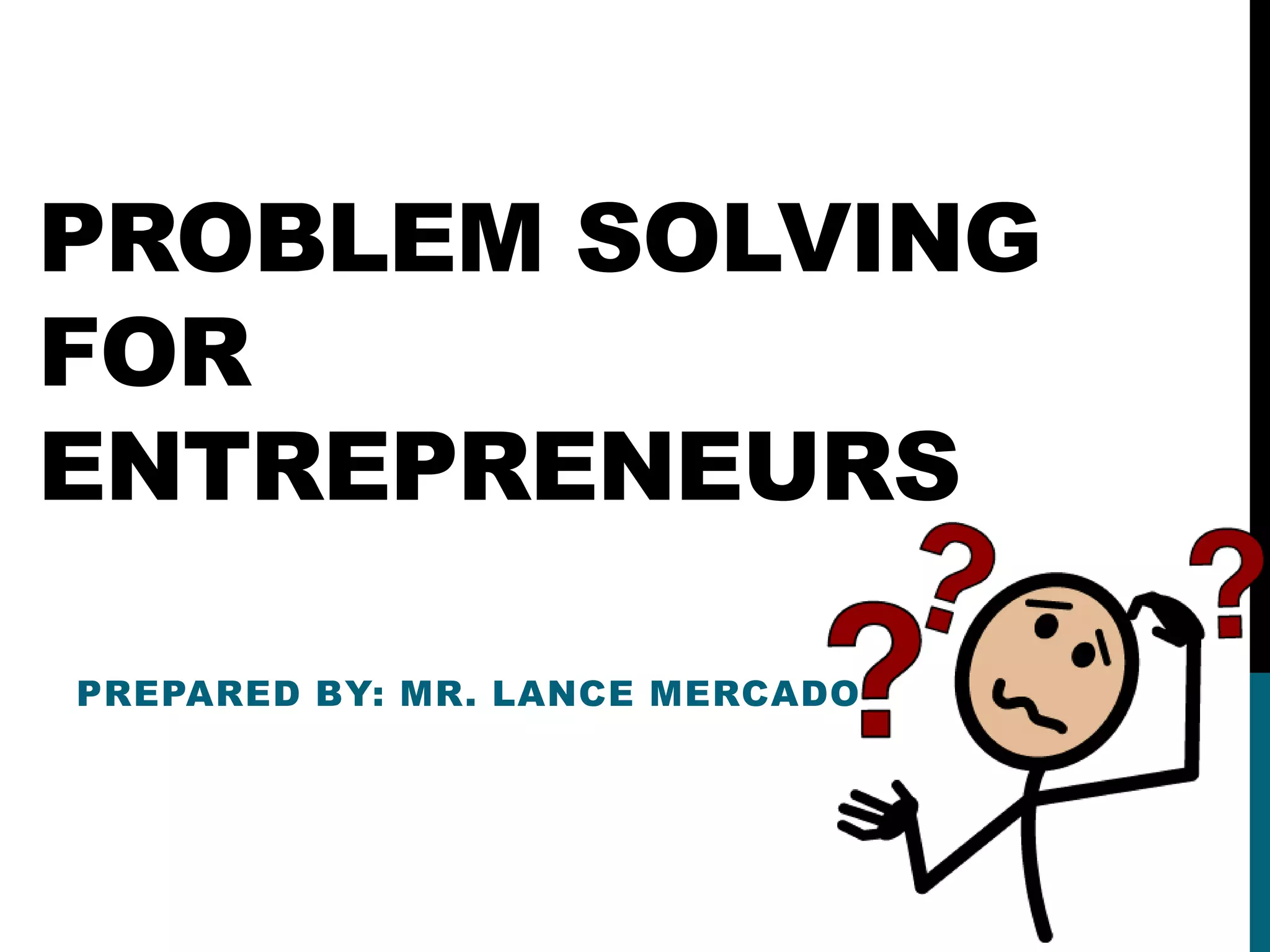
PROBLEM SOLVING
FOR
ENTREPRENEURS
PREPARED BY: MR. LANCE MERCADO
READ..
(RESEARCH YOUR IDEAS)
Gloria and Delia spent time on the Internet and in
the local library researching ideas for their new
business. As a result, they had come up with
sereral ideas. Now they had to decide what to do
with these ideas. As they discussed their options,
Gloria said, “You know, Delia, we can talk about
these ideas, but we really need a system that we
can use for solving problems. We want to be sure
that we make the very best decisions for our
business.” “Yes,” Delia responded, “You are right.
I remember reading about a problem-solving model
in one of the books we found at the library. Let’s go
back and find it and see if we can adapt it for our
use!”
WORK AS A TEAM...
1. How important do you think it is to
use a system for solving problems
and making decisions?
USE THE PROBLEM –
SOLVING MODEL
- As an Entrepreneur, you will be faced with
making decisions and solving problems
every day. Whether or not to become an
entrepreneur is a big decision. Many
entrepreneur make decisions casually or
base them on intuition. As a result, their
decisions are based on faulty assumptions
or illogical thinking. The best entrepreneurs
use formal problem – solving models to
gather information and evaluate different
options.
USE THE PROBLEM –
SOLVING MODEL
- A formal problem – solving model helps
people solve problems in a logical manner.
The model consists of six steps:
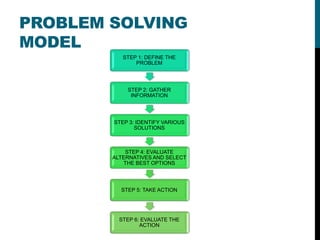
PROBLEM SOLVING
MODEL
STEP 1: DEFINE THE
PROBLEM
STEP 2: GATHER
INFORMATION
STEP 3: IDENTIFY VARIOUS
SOLUTIONS
STEP 4: EVALUATE
ALTERNATIVES AND SELECT
THE BEST OPTIONS
STEP 5: TAKE ACTION
STEP 6: EVALUATE THE
ACTION
STEP 1: DEFINE THE
PROBLEM
-Before you can solve a problem, you need to
diagnose it. Write down what the problem is and
why it is a problem. Try to quantify it too.
For example: You may be trying to decide whether
to start your own business or accept a job offer,
your income would be $30,000 a year. If you reject
the job offer, you would lose that income.
Quantifying the problem helps you figure out how
much it is worth to you to solve it.
Dan Parker knows what his problem is: Should he
start a website design company? He took many
computer courses throughout high school, and he
is now attending college. He has worked in the
food industry throughout high school and college
to earn money to help pay for his college
expenses. Dan enjoys working at restaurants and
has gained valuable customer service and
management experience. In addition, he also
volunteers his web design skills on projects for his
university and local community programs. He will
be graduating in the next few months with a degree
in Computer Science. Dan is considerig starting
his own website design business, but he is not
sure whether that is the right choice for him.
STEP 2: GATHER
INFORMATION
- Once the problem has been defined, you
need to gather information that could help
solve it. Relevant information may be
obtained from many sources, including
company records, industry data, and trade
magazines. It is also a good idea to
interview other people in the industry to
find out what their experiences have been
and to learn how they have solved similar
problems.
In Dan’s case, it would be helpful for him to take a
closer look at himself. He should do a self-
assessment to determine his strenghts and
weakness. He also needs to consider his skills,
experience and interests. Does he have the
characteristics of a successful entrepreneur? He
also needs to examine the advantages and
disadvantages of running a website design
company. He should talk to other professionals in
the business and read trade magazines to gather
information about running a website design
business. Dan needs to thoroughly explore every
aspect of starting and running a website design
company.
STEP 3: IDENTIFY
VARIOUS SOLUTIONS
- Most problems can be solved in various
ways. Identify all possibilities before you
settle on particular solution.
Dan comes up with several possible solutions to
his problem.
1. Work as an employee in a position that utilize
his customer service skills and management
experience.
2. Work as a website designer for another
company to gain more experience and then
start his own business in 3 to 5 years.
3. Pursue his interests in the food industry and
open his own restaurant.
4. Start his own website design company upon
graduation.
STEP 4: EVALUATE
ALTERNATIVES AND
SELECT BEST OPTION
- The decision maker next needs to
evaluate the some cases, it may be
possible to quantify the costs and benefits
of each alternative. In other cases,
quantifying each alternative may not be
possible, and the decision maker may
simply have to rank each alternative.
Dan ranks option 1 to the lowest because of his
strong desire to be his own boss. All of the
information that Dan gathered indicates that he
has a strong chance of succedding as an
entrepreneur. He ranks option 3 next to the lowest.
Dan has considerable experience in the food
industry and enjoys that type of work, but he
decides he would rather pursue his interests in
website design. He ranks option 2 second because
he is already condfident in his level of computer
knowledge and experience. After evaluating all of
his alternatives, Dan decides option 4 is the best
solution.
STEP 5: TAKE ACTION
- Once you have selected the best solution
to the problem, you need to take action to
implement it. Dan begins putting together a
business plan and spreading the word
about his new venture.
STEP 6: EVALUATE
THE ACTION
-The problem-solving process is not
complete until you evaluate your action to
because even a well-thought-out solution
may not work.
After being in business for six months, Dan
evaluates whether he is achieving his
financial and non financial goals. It seems
that Dan made the right decision because
his business is profitable and he is
enjoying his work. He has been able to
fulfill his dream of working for himself while
providing a valuable service to others. Dan
will continue to use problem-solving-model
to make the most effective decisions for
him and his new business.
PROBLEM SOLVING
SKILLS
The more often you use the problem-solving
model, the better skilled at decision making you
will become. It will become a valuable tool to you
throughout your career. There are a few other
things you can do to improve your problem solving
skills.
1. Communicate
2. Brainstorm
3. Learn from Mistakes
SOLVE THE PROBLEM!
You own a successful shop that buys,
sells, and services bicyles. In January,
the owner of the building you now
lease tells you that she has found a
buyer for the property and plans to
sell it in six months, meaning you may
have to move your business. Using
the 6 step problem-solving, develop a
plan for how to proceed.

Problem Solving for Entrepreneurs

  • 1.
  • 2.
    READ.. (RESEARCH YOUR IDEAS) Gloriaand Delia spent time on the Internet and in the local library researching ideas for their new business. As a result, they had come up with sereral ideas. Now they had to decide what to do with these ideas. As they discussed their options, Gloria said, “You know, Delia, we can talk about these ideas, but we really need a system that we can use for solving problems. We want to be sure that we make the very best decisions for our business.” “Yes,” Delia responded, “You are right. I remember reading about a problem-solving model in one of the books we found at the library. Let’s go back and find it and see if we can adapt it for our use!”
  • 3.
    WORK AS ATEAM... 1. How important do you think it is to use a system for solving problems and making decisions?
  • 4.
    USE THE PROBLEM– SOLVING MODEL - As an Entrepreneur, you will be faced with making decisions and solving problems every day. Whether or not to become an entrepreneur is a big decision. Many entrepreneur make decisions casually or base them on intuition. As a result, their decisions are based on faulty assumptions or illogical thinking. The best entrepreneurs use formal problem – solving models to gather information and evaluate different options.
  • 5.
    USE THE PROBLEM– SOLVING MODEL - A formal problem – solving model helps people solve problems in a logical manner. The model consists of six steps:
  • 6.
    PROBLEM SOLVING MODEL STEP 1:DEFINE THE PROBLEM STEP 2: GATHER INFORMATION STEP 3: IDENTIFY VARIOUS SOLUTIONS STEP 4: EVALUATE ALTERNATIVES AND SELECT THE BEST OPTIONS STEP 5: TAKE ACTION STEP 6: EVALUATE THE ACTION
  • 7.
    STEP 1: DEFINETHE PROBLEM -Before you can solve a problem, you need to diagnose it. Write down what the problem is and why it is a problem. Try to quantify it too. For example: You may be trying to decide whether to start your own business or accept a job offer, your income would be $30,000 a year. If you reject the job offer, you would lose that income. Quantifying the problem helps you figure out how much it is worth to you to solve it.
  • 8.
    Dan Parker knowswhat his problem is: Should he start a website design company? He took many computer courses throughout high school, and he is now attending college. He has worked in the food industry throughout high school and college to earn money to help pay for his college expenses. Dan enjoys working at restaurants and has gained valuable customer service and management experience. In addition, he also volunteers his web design skills on projects for his university and local community programs. He will be graduating in the next few months with a degree in Computer Science. Dan is considerig starting his own website design business, but he is not sure whether that is the right choice for him.
  • 9.
    STEP 2: GATHER INFORMATION -Once the problem has been defined, you need to gather information that could help solve it. Relevant information may be obtained from many sources, including company records, industry data, and trade magazines. It is also a good idea to interview other people in the industry to find out what their experiences have been and to learn how they have solved similar problems.
  • 10.
    In Dan’s case,it would be helpful for him to take a closer look at himself. He should do a self- assessment to determine his strenghts and weakness. He also needs to consider his skills, experience and interests. Does he have the characteristics of a successful entrepreneur? He also needs to examine the advantages and disadvantages of running a website design company. He should talk to other professionals in the business and read trade magazines to gather information about running a website design business. Dan needs to thoroughly explore every aspect of starting and running a website design company.
  • 11.
    STEP 3: IDENTIFY VARIOUSSOLUTIONS - Most problems can be solved in various ways. Identify all possibilities before you settle on particular solution.
  • 12.
    Dan comes upwith several possible solutions to his problem. 1. Work as an employee in a position that utilize his customer service skills and management experience. 2. Work as a website designer for another company to gain more experience and then start his own business in 3 to 5 years. 3. Pursue his interests in the food industry and open his own restaurant. 4. Start his own website design company upon graduation.
  • 13.
    STEP 4: EVALUATE ALTERNATIVESAND SELECT BEST OPTION - The decision maker next needs to evaluate the some cases, it may be possible to quantify the costs and benefits of each alternative. In other cases, quantifying each alternative may not be possible, and the decision maker may simply have to rank each alternative.
  • 14.
    Dan ranks option1 to the lowest because of his strong desire to be his own boss. All of the information that Dan gathered indicates that he has a strong chance of succedding as an entrepreneur. He ranks option 3 next to the lowest. Dan has considerable experience in the food industry and enjoys that type of work, but he decides he would rather pursue his interests in website design. He ranks option 2 second because he is already condfident in his level of computer knowledge and experience. After evaluating all of his alternatives, Dan decides option 4 is the best solution.
  • 15.
    STEP 5: TAKEACTION - Once you have selected the best solution to the problem, you need to take action to implement it. Dan begins putting together a business plan and spreading the word about his new venture.
  • 16.
    STEP 6: EVALUATE THEACTION -The problem-solving process is not complete until you evaluate your action to because even a well-thought-out solution may not work.
  • 17.
    After being inbusiness for six months, Dan evaluates whether he is achieving his financial and non financial goals. It seems that Dan made the right decision because his business is profitable and he is enjoying his work. He has been able to fulfill his dream of working for himself while providing a valuable service to others. Dan will continue to use problem-solving-model to make the most effective decisions for him and his new business.
  • 18.
    PROBLEM SOLVING SKILLS The moreoften you use the problem-solving model, the better skilled at decision making you will become. It will become a valuable tool to you throughout your career. There are a few other things you can do to improve your problem solving skills. 1. Communicate 2. Brainstorm 3. Learn from Mistakes
  • 19.
    SOLVE THE PROBLEM! Youown a successful shop that buys, sells, and services bicyles. In January, the owner of the building you now lease tells you that she has found a buyer for the property and plans to sell it in six months, meaning you may have to move your business. Using the 6 step problem-solving, develop a plan for how to proceed.