FCE 552: Engineering Survey IV      Dept. of Civil Engineering


   Fundamentals of Remote Sensing

 1.          Concept of Remote Sensing
 2.          Characteristics of E-M Radiation
 3.          Classification of E-M Radiation
 4.          Types of Remote Sensing

B. Sc.(Civil Engineering)                University of Nairobi
FCE 552: Engineering Survey IV   Dept. of Civil Engineering


           1. Concept of Remote Sensing


B. Sc.(Civil Engineering)             University of Nairobi
FCE 552: Engineering Survey IV          Dept. of Civil Engineering


               Concept of Remote Sensing (1)

      Definition
    Remote sensing is the art, science and
    technology of acquiring information about the
    Earth's surface without actually being in contact
    with it. This is done by sensing and recording
    reflected or emitted energy and processing,
    analyzing, and applying that information.

B. Sc.(Civil Engineering)                    University of Nairobi
FCE 552: Engineering Survey IV         Dept. of Civil Engineering


               Concept of Remote Sensing (2)


B. Sc.(Civil Engineering)                   University of Nairobi
FCE 552: Engineering Survey IV              Dept. of Civil Engineering


                       Flow of Remote Sensing


B. Sc.(Civil Engineering)                        University of Nairobi
FCE 552: Engineering Survey IV            Dept. of Civil Engineering


                   Remote Sensing Process (1)


B. Sc.(Civil Engineering)                      University of Nairobi
FCE 552: Engineering Survey IV                 Dept. of Civil Engineering


                  Remote Sensing Process (2)
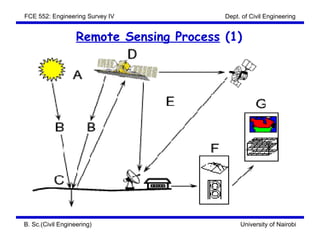
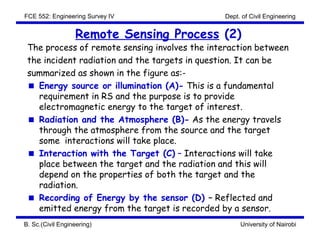
 The process of remote sensing involves the interaction between
 the incident radiation and the targets in question. It can be
 summarized as shown in the figure as:-
    Energy source or illumination (A)- This is a fundamental
    requirement in RS and the purpose is to provide
    electromagnetic energy to the target of interest.
    Radiation and the Atmosphere (B)- As the energy travels
    through the atmosphere from the source and the target
    some interactions will take place.
    Interaction with the Target (C) – Interactions will take
    place between the target and the radiation and this will
    depend on the properties of both the target and the
    radiation.
    Recording of Energy by the sensor (D) – Reflected and
    emitted energy from the target is recorded by a sensor.
B. Sc.(Civil Engineering)                           University of Nairobi
FCE 552: Engineering Survey IV                     Dept. of Civil Engineering


                   Remote Sensing Process (3)
     Transmission, Reception and Processing (E)-the energy
     recorded by the sensor has to be transmitted, often in
     electronic form, to a receiving and processing station where
     the data are processed into an image (hardcopy and/or
     digital).
     Interpretation and Analysis (F) - the processed image is
     interpreted, visually and/or digitally or electronically, to
     extract information about the target which was illuminated.
     Application (G) - the final element of the remote sensing
     process is achieved when we apply the information we have
     been able to extract from the imagery about the target in
     order to better understand it, reveal some new information,
     or assist in solving a particular problem

B. Sc.(Civil Engineering)                               University of Nairobi
FCE 552: Engineering Survey IV    Dept. of Civil Engineering


2.        Characteristics of Electromagnetic
          Radiation


B. Sc.(Civil Engineering)              University of Nairobi
FCE 552: Engineering Survey IV             Dept. of Civil Engineering


                    Electromagnetic Radiation


B. Sc.(Civil Engineering)                       University of Nairobi
FCE 552: Engineering Survey IV   Dept. of Civil Engineering


 Information from Electromagnetic Radiation


B. Sc.(Civil Engineering)             University of Nairobi
FCE 552: Engineering Survey IV       Dept. of Civil Engineering


 3.          Classification of Electromagnetic
             Radiation


B. Sc.(Civil Engineering)                 University of Nairobi
FCE 552: Engineering Survey IV   Dept. of Civil Engineering


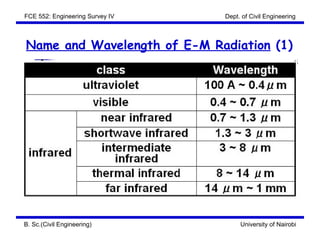
Name and Wavelength of E-M Radiation (1)


B. Sc.(Civil Engineering)             University of Nairobi
FCE 552: Engineering Survey IV   Dept. of Civil Engineering


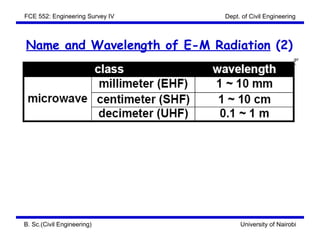
Name and Wavelength of E-M Radiation (2)


B. Sc.(Civil Engineering)             University of Nairobi
FCE 552: Engineering Survey IV    Dept. of Civil Engineering


Principal Atmospheric Windows used in Remote Sensing


   B. Sc.(Civil Engineering)              University of Nairobi
FCE 552: Engineering Survey IV          Dept. of Civil Engineering


                Bands used in Remote Sensing


B. Sc.(Civil Engineering)                    University of Nairobi
FCE 552: Engineering Survey IV   Dept. of Civil Engineering


    What do we measure in Remote Sensing?


B. Sc.(Civil Engineering)             University of Nairobi
FCE 552: Engineering Survey IV          Dept. of Civil Engineering


           4.          Types of Remote Sensing


B. Sc.(Civil Engineering)                    University of Nairobi
FCE 552: Engineering Survey IV            Dept. of Civil Engineering


                     Types of Remote Sensing


B. Sc.(Civil Engineering)                      University of Nairobi

Fce 552 part5

  • 1.
    FCE 552: EngineeringSurvey IV Dept. of Civil Engineering Fundamentals of Remote Sensing 1. Concept of Remote Sensing 2. Characteristics of E-M Radiation 3. Classification of E-M Radiation 4. Types of Remote Sensing B. Sc.(Civil Engineering) University of Nairobi
  • 2.
    FCE 552: EngineeringSurvey IV Dept. of Civil Engineering 1. Concept of Remote Sensing B. Sc.(Civil Engineering) University of Nairobi
  • 3.
    FCE 552: EngineeringSurvey IV Dept. of Civil Engineering Concept of Remote Sensing (1) Definition Remote sensing is the art, science and technology of acquiring information about the Earth's surface without actually being in contact with it. This is done by sensing and recording reflected or emitted energy and processing, analyzing, and applying that information. B. Sc.(Civil Engineering) University of Nairobi
  • 4.
    FCE 552: EngineeringSurvey IV Dept. of Civil Engineering Concept of Remote Sensing (2) B. Sc.(Civil Engineering) University of Nairobi
  • 5.
    FCE 552: EngineeringSurvey IV Dept. of Civil Engineering Flow of Remote Sensing B. Sc.(Civil Engineering) University of Nairobi
  • 6.
    FCE 552: EngineeringSurvey IV Dept. of Civil Engineering Remote Sensing Process (1) B. Sc.(Civil Engineering) University of Nairobi
  • 7.
    FCE 552: EngineeringSurvey IV Dept. of Civil Engineering Remote Sensing Process (2) The process of remote sensing involves the interaction between the incident radiation and the targets in question. It can be summarized as shown in the figure as:- Energy source or illumination (A)- This is a fundamental requirement in RS and the purpose is to provide electromagnetic energy to the target of interest. Radiation and the Atmosphere (B)- As the energy travels through the atmosphere from the source and the target some interactions will take place. Interaction with the Target (C) – Interactions will take place between the target and the radiation and this will depend on the properties of both the target and the radiation. Recording of Energy by the sensor (D) – Reflected and emitted energy from the target is recorded by a sensor. B. Sc.(Civil Engineering) University of Nairobi
  • 8.
    FCE 552: EngineeringSurvey IV Dept. of Civil Engineering Remote Sensing Process (3) Transmission, Reception and Processing (E)-the energy recorded by the sensor has to be transmitted, often in electronic form, to a receiving and processing station where the data are processed into an image (hardcopy and/or digital). Interpretation and Analysis (F) - the processed image is interpreted, visually and/or digitally or electronically, to extract information about the target which was illuminated. Application (G) - the final element of the remote sensing process is achieved when we apply the information we have been able to extract from the imagery about the target in order to better understand it, reveal some new information, or assist in solving a particular problem B. Sc.(Civil Engineering) University of Nairobi
  • 9.
    FCE 552: EngineeringSurvey IV Dept. of Civil Engineering 2. Characteristics of Electromagnetic Radiation B. Sc.(Civil Engineering) University of Nairobi
  • 10.
    FCE 552: EngineeringSurvey IV Dept. of Civil Engineering Electromagnetic Radiation B. Sc.(Civil Engineering) University of Nairobi
  • 11.
    FCE 552: EngineeringSurvey IV Dept. of Civil Engineering Information from Electromagnetic Radiation B. Sc.(Civil Engineering) University of Nairobi
  • 12.
    FCE 552: EngineeringSurvey IV Dept. of Civil Engineering 3. Classification of Electromagnetic Radiation B. Sc.(Civil Engineering) University of Nairobi
  • 13.
    FCE 552: EngineeringSurvey IV Dept. of Civil Engineering Name and Wavelength of E-M Radiation (1) B. Sc.(Civil Engineering) University of Nairobi
  • 14.
    FCE 552: EngineeringSurvey IV Dept. of Civil Engineering Name and Wavelength of E-M Radiation (2) B. Sc.(Civil Engineering) University of Nairobi
  • 15.
    FCE 552: EngineeringSurvey IV Dept. of Civil Engineering Principal Atmospheric Windows used in Remote Sensing B. Sc.(Civil Engineering) University of Nairobi
  • 16.
    FCE 552: EngineeringSurvey IV Dept. of Civil Engineering Bands used in Remote Sensing B. Sc.(Civil Engineering) University of Nairobi
  • 17.
    FCE 552: EngineeringSurvey IV Dept. of Civil Engineering What do we measure in Remote Sensing? B. Sc.(Civil Engineering) University of Nairobi
  • 18.
    FCE 552: EngineeringSurvey IV Dept. of Civil Engineering 4. Types of Remote Sensing B. Sc.(Civil Engineering) University of Nairobi
  • 19.
    FCE 552: EngineeringSurvey IV Dept. of Civil Engineering Types of Remote Sensing B. Sc.(Civil Engineering) University of Nairobi