FCE 552: Engineering Survey IV      Dept. of Geospatial & Space Technology


                       Image Interpretation

  1.          Concept of image interpretation

  2.          Procedures of Interpretation

  3.          Interpretation Elements

  4.          Interpretation Keys

  5.          Applications of Image Interpretation

B. Sc. (Civil Engineering)                             University of Nairobi
FCE 552: Engineering Survey IV   Dept. of Geospatial & Space Technology


  Concept of Image Interpretation


Engineering Surveying IV                            University of Nairobi
FCE 552: Engineering Survey IV   Dept. of Geospatial & Space Technology


            The Remote Sensing Process


Engineering Surveying IV                            University of Nairobi
FCE 552: Engineering Survey IV   Dept. of Geospatial & Space Technology


     Objective of Image Interpretation

To extract qualitative and quantitative information
from imagery about the shape, location, structure,
characteristics, quality, condition, relationship of and
between objects using human knowledge.


B. Sc. (Civil Engineering)                          University of Nairobi
FCE 552: Engineering Survey IV   Dept. of Geospatial & Space Technology


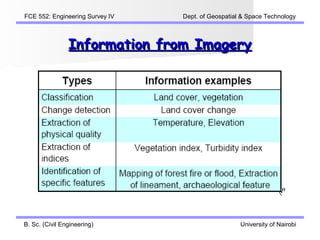
                Information from Imagery


B. Sc. (Civil Engineering)                          University of Nairobi
FCE 552: Engineering Survey IV   Dept. of Geospatial & Space Technology


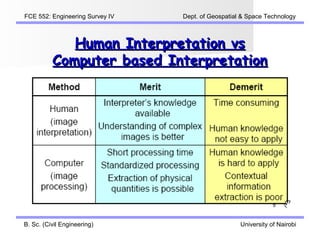
             Human Interpretation vs
          Computer based Interpretation


B. Sc. (Civil Engineering)                          University of Nairobi
FCE 552: Engineering Survey IV   Dept. of Geospatial & Space Technology


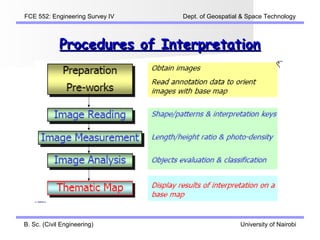
        Procedures of Interpretation


B. Sc. (Civil Engineering)                          University of Nairobi
FCE 552: Engineering Survey IV   Dept. of Geospatial & Space Technology


             Procedures of Interpretation


B. Sc. (Civil Engineering)                          University of Nairobi
FCE 552: Engineering Survey IV              Dept. of Geospatial & Space Technology


                    Image Classification (1)
 Image Classification involves assigning all pixels in the image to
 particular classes or themes (e.g., water, coniferous forest, deciduous
 forest, maize, wheat, etc.). The resulting classified image is comprised
 of a mosaic of pixels, each of which belong to a particular theme, and is
 essentially a thematic "map" of the original image.


B. Sc. (Civil Engineering)                                     University of Nairobi
FCE 552: Engineering Survey IV       Dept. of Geospatial & Space Technology


                    Image Classification (2)
Information Classes and Spectral Classes:
   Information classes are those categories of interest that the
   analyst is actually trying to identify in the imagery, such as
   different kinds of crops, different forest types or tree
   species, different geologic units or rock types, etc.
   Spectral classes are groups of pixels that are uniform (or
   near-similar) with respect to their brightness values in the
   different spectral channels of the data.
   The objective is to match the spectral classes in the data to
   the information classes of interest. Rarely is there a simple
   one-to one match between these two types of classes.

B. Sc. (Civil Engineering)                              University of Nairobi
FCE 552: Engineering Survey IV   Dept. of Geospatial & Space Technology


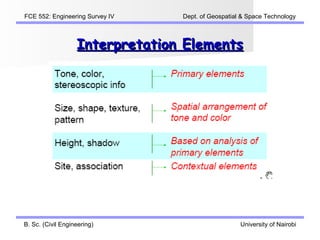
               Interpretation Elements


B. Sc. (Civil Engineering)                          University of Nairobi
FCE 552: Engineering Survey IV   Dept. of Geospatial & Space Technology


                   Interpretation Elements


B. Sc. (Civil Engineering)                          University of Nairobi
FCE 552: Engineering Survey IV   Dept. of Geospatial & Space Technology


                     Interpretation Keys


B. Sc. (Civil Engineering)                          University of Nairobi
FCE 552: Engineering Survey IV   Dept. of Geospatial & Space Technology


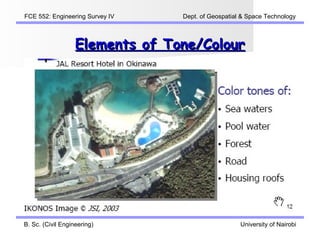
                   Elements of Tone/Colour


B. Sc. (Civil Engineering)                          University of Nairobi
FCE 552: Engineering Survey IV   Dept. of Geospatial & Space Technology


                 Elements of Size & Shape


B. Sc. (Civil Engineering)                          University of Nairobi
FCE 552: Engineering Survey IV      Dept. of Geospatial & Space Technology


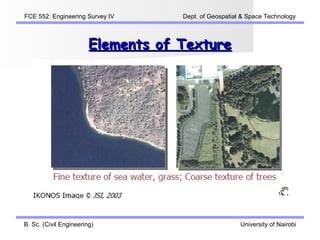
                        Elements of Texture


B. Sc. (Civil Engineering)                             University of Nairobi
FCE 552: Engineering Survey IV      Dept. of Geospatial & Space Technology


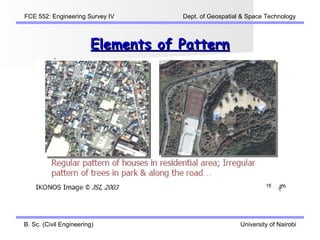
                        Elements of Pattern


B. Sc. (Civil Engineering)                             University of Nairobi
FCE 552: Engineering Survey IV   Dept. of Geospatial & Space Technology


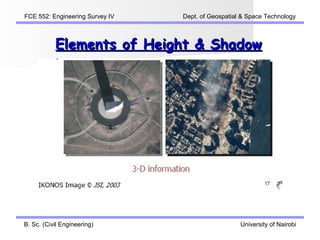
           Elements of Height & Shadow


B. Sc. (Civil Engineering)                          University of Nairobi
FCE 552: Engineering Survey IV   Dept. of Geospatial & Space Technology


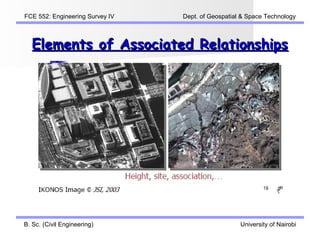
  Elements of Associated Relationships


B. Sc. (Civil Engineering)                          University of Nairobi
FCE 552: Engineering Survey IV   Dept. of Geospatial & Space Technology


           Interpretation Keys for Trees


B. Sc. (Civil Engineering)                          University of Nairobi
FCE 552: Engineering Survey IV   Dept. of Geospatial & Space Technology


Applications of Image Interpretation


 B. Sc. (Civil Engineering)                          University of Nairobi
FCE 552: Engineering Survey IV   Dept. of Geospatial & Space Technology


          Interpretation of Aster Image


B. Sc. (Civil Engineering)                          University of Nairobi
FCE 552: Engineering Survey IV           Dept. of Geospatial & Space Technology


                             Colour Composition


B. Sc. (Civil Engineering)                                  University of Nairobi
FCE 552: Engineering Survey IV   Dept. of Geospatial & Space Technology


    Image Interpretation – Land Covers


B. Sc. (Civil Engineering)                          University of Nairobi
FCE 552: Engineering Survey IV   Dept. of Geospatial & Space Technology


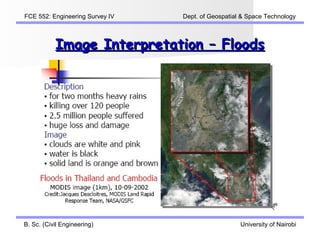
           Image Interpretation – Floods


B. Sc. (Civil Engineering)                          University of Nairobi
FCE 552: Engineering Survey IV   Dept. of Geospatial & Space Technology


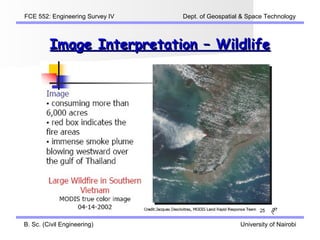
         Image Interpretation – Wildlife


B. Sc. (Civil Engineering)                          University of Nairobi
FCE 552: Engineering Survey IV   Dept. of Geospatial & Space Technology


          Image Interpretation – Volcano


B. Sc. (Civil Engineering)                          University of Nairobi
FCE 552: Engineering Survey IV   Dept. of Geospatial & Space Technology


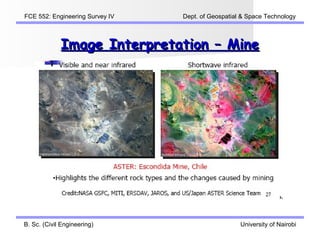
             Image Interpretation – Mine


B. Sc. (Civil Engineering)                          University of Nairobi
FCE 552: Engineering Survey IV   Dept. of Geospatial & Space Technology


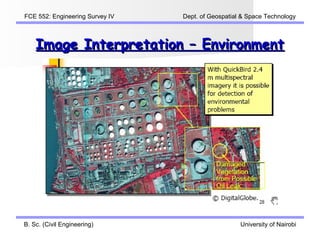
    Image Interpretation – Environment


B. Sc. (Civil Engineering)                          University of Nairobi
FCE 552: Engineering Survey IV   Dept. of Geospatial & Space Technology


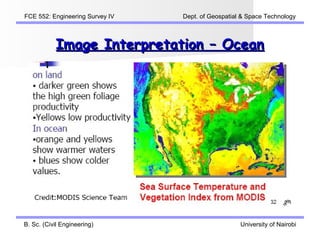
           Image Interpretation – Ocean


B. Sc. (Civil Engineering)                          University of Nairobi

Fce 552 part6-3

  • 1.
    FCE 552: EngineeringSurvey IV Dept. of Geospatial & Space Technology Image Interpretation 1. Concept of image interpretation 2. Procedures of Interpretation 3. Interpretation Elements 4. Interpretation Keys 5. Applications of Image Interpretation B. Sc. (Civil Engineering) University of Nairobi
  • 2.
    FCE 552: EngineeringSurvey IV Dept. of Geospatial & Space Technology Concept of Image Interpretation Engineering Surveying IV University of Nairobi
  • 3.
    FCE 552: EngineeringSurvey IV Dept. of Geospatial & Space Technology The Remote Sensing Process Engineering Surveying IV University of Nairobi
  • 4.
    FCE 552: EngineeringSurvey IV Dept. of Geospatial & Space Technology Objective of Image Interpretation To extract qualitative and quantitative information from imagery about the shape, location, structure, characteristics, quality, condition, relationship of and between objects using human knowledge. B. Sc. (Civil Engineering) University of Nairobi
  • 5.
    FCE 552: EngineeringSurvey IV Dept. of Geospatial & Space Technology Information from Imagery B. Sc. (Civil Engineering) University of Nairobi
  • 6.
    FCE 552: EngineeringSurvey IV Dept. of Geospatial & Space Technology Human Interpretation vs Computer based Interpretation B. Sc. (Civil Engineering) University of Nairobi
  • 7.
    FCE 552: EngineeringSurvey IV Dept. of Geospatial & Space Technology Procedures of Interpretation B. Sc. (Civil Engineering) University of Nairobi
  • 8.
    FCE 552: EngineeringSurvey IV Dept. of Geospatial & Space Technology Procedures of Interpretation B. Sc. (Civil Engineering) University of Nairobi
  • 9.
    FCE 552: EngineeringSurvey IV Dept. of Geospatial & Space Technology Image Classification (1) Image Classification involves assigning all pixels in the image to particular classes or themes (e.g., water, coniferous forest, deciduous forest, maize, wheat, etc.). The resulting classified image is comprised of a mosaic of pixels, each of which belong to a particular theme, and is essentially a thematic "map" of the original image. B. Sc. (Civil Engineering) University of Nairobi
  • 10.
    FCE 552: EngineeringSurvey IV Dept. of Geospatial & Space Technology Image Classification (2) Information Classes and Spectral Classes: Information classes are those categories of interest that the analyst is actually trying to identify in the imagery, such as different kinds of crops, different forest types or tree species, different geologic units or rock types, etc. Spectral classes are groups of pixels that are uniform (or near-similar) with respect to their brightness values in the different spectral channels of the data. The objective is to match the spectral classes in the data to the information classes of interest. Rarely is there a simple one-to one match between these two types of classes. B. Sc. (Civil Engineering) University of Nairobi
  • 11.
    FCE 552: EngineeringSurvey IV Dept. of Geospatial & Space Technology Interpretation Elements B. Sc. (Civil Engineering) University of Nairobi
  • 12.
    FCE 552: EngineeringSurvey IV Dept. of Geospatial & Space Technology Interpretation Elements B. Sc. (Civil Engineering) University of Nairobi
  • 13.
    FCE 552: EngineeringSurvey IV Dept. of Geospatial & Space Technology Interpretation Keys B. Sc. (Civil Engineering) University of Nairobi
  • 14.
    FCE 552: EngineeringSurvey IV Dept. of Geospatial & Space Technology Elements of Tone/Colour B. Sc. (Civil Engineering) University of Nairobi
  • 15.
    FCE 552: EngineeringSurvey IV Dept. of Geospatial & Space Technology Elements of Size & Shape B. Sc. (Civil Engineering) University of Nairobi
  • 16.
    FCE 552: EngineeringSurvey IV Dept. of Geospatial & Space Technology Elements of Texture B. Sc. (Civil Engineering) University of Nairobi
  • 17.
    FCE 552: EngineeringSurvey IV Dept. of Geospatial & Space Technology Elements of Pattern B. Sc. (Civil Engineering) University of Nairobi
  • 18.
    FCE 552: EngineeringSurvey IV Dept. of Geospatial & Space Technology Elements of Height & Shadow B. Sc. (Civil Engineering) University of Nairobi
  • 19.
    FCE 552: EngineeringSurvey IV Dept. of Geospatial & Space Technology Elements of Associated Relationships B. Sc. (Civil Engineering) University of Nairobi
  • 20.
    FCE 552: EngineeringSurvey IV Dept. of Geospatial & Space Technology Interpretation Keys for Trees B. Sc. (Civil Engineering) University of Nairobi
  • 21.
    FCE 552: EngineeringSurvey IV Dept. of Geospatial & Space Technology Applications of Image Interpretation B. Sc. (Civil Engineering) University of Nairobi
  • 22.
    FCE 552: EngineeringSurvey IV Dept. of Geospatial & Space Technology Interpretation of Aster Image B. Sc. (Civil Engineering) University of Nairobi
  • 23.
    FCE 552: EngineeringSurvey IV Dept. of Geospatial & Space Technology Colour Composition B. Sc. (Civil Engineering) University of Nairobi
  • 24.
    FCE 552: EngineeringSurvey IV Dept. of Geospatial & Space Technology Image Interpretation – Land Covers B. Sc. (Civil Engineering) University of Nairobi
  • 25.
    FCE 552: EngineeringSurvey IV Dept. of Geospatial & Space Technology Image Interpretation – Floods B. Sc. (Civil Engineering) University of Nairobi
  • 26.
    FCE 552: EngineeringSurvey IV Dept. of Geospatial & Space Technology Image Interpretation – Wildlife B. Sc. (Civil Engineering) University of Nairobi
  • 27.
    FCE 552: EngineeringSurvey IV Dept. of Geospatial & Space Technology Image Interpretation – Volcano B. Sc. (Civil Engineering) University of Nairobi
  • 28.
    FCE 552: EngineeringSurvey IV Dept. of Geospatial & Space Technology Image Interpretation – Mine B. Sc. (Civil Engineering) University of Nairobi
  • 29.
    FCE 552: EngineeringSurvey IV Dept. of Geospatial & Space Technology Image Interpretation – Environment B. Sc. (Civil Engineering) University of Nairobi
  • 30.
    FCE 552: EngineeringSurvey IV Dept. of Geospatial & Space Technology Image Interpretation – Ocean B. Sc. (Civil Engineering) University of Nairobi