FATTY ESTERS
Prepared by :
Nurul Afifah Binti Mohd Yusoff
2013275464
EH110 4A
Faculty of Chemical Engineering
CONTENTS
 Definition of fatty esters
 Production processes of fatty esters and its
derivative.
 Flow chart of fatty ester production
 Uses and application of fatty ester
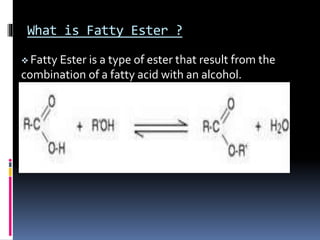
What is Fatty Ester ?
 Fatty Ester is a type of ester that result from the
combination of a fatty acid with an alcohol.
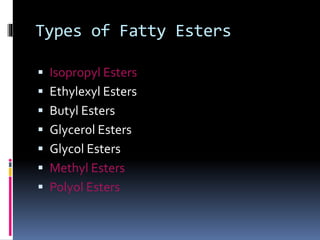
Types of Fatty Esters
 Isopropyl Esters
 Ethylexyl Esters
 Butyl Esters
 Glycerol Esters
 Glycol Esters
 Methyl Esters
 Polyol Esters
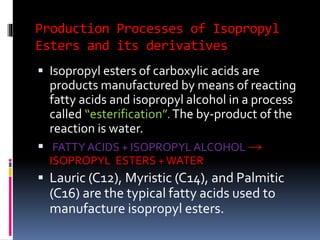
Production Processes of Isopropyl
Esters and its derivatives
 Isopropyl esters of carboxylic acids are
products manufactured by means of reacting
fatty acids and isopropyl alcohol in a process
called “esterification”.The by‐product of the
reaction is water.
 FATTY ACIDS + ISOPROPYL ALCOHOL →
ISOPROPYL ESTERS +WATER
 Lauric (C12), Myristic (C14), and Palmitic
(C16) are the typical fatty acids used to
manufacture isopropyl esters.
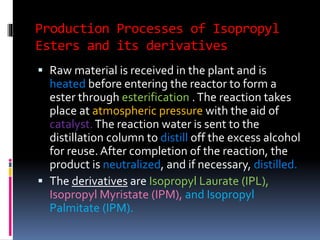
Production Processes of Isopropyl
Esters and its derivatives
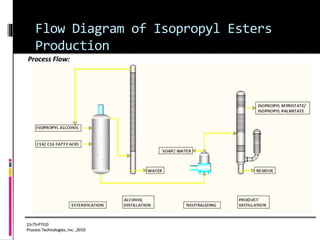
 Raw material is received in the plant and is
heated before entering the reactor to form a
ester through esterification .The reaction takes
place at atmospheric pressure with the aid of
catalyst.The reaction water is sent to the
distillation column to distill off the excess alcohol
for reuse. After completion of the reaction, the
product is neutralized, and if necessary, distilled.
 The derivatives are Isopropyl Laurate (IPL),
Isopropyl Myristate (IPM), and Isopropyl
Palmitate (IPM).
Flow Diagram of Isopropyl Esters
Production
Uses and application of isopropyl
esters
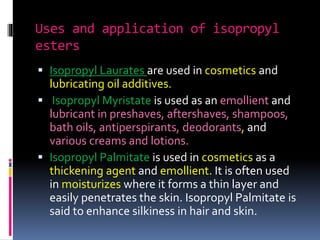
 Isopropyl Laurates are used in cosmetics and
lubricating oil additives.
 Isopropyl Myristate is used as an emollient and
lubricant in preshaves, aftershaves, shampoos,
bath oils, antiperspirants, deodorants, and
various creams and lotions.
 Isopropyl Palmitate is used in cosmetics as a
thickening agent and emollient. It is often used
in moisturizes where it forms a thin layer and
easily penetrates the skin. Isopropyl Palmitate is
said to enhance silkiness in hair and skin.
Production Processes of Methyl
Esters and its derivatives
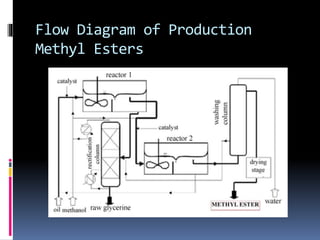
 Methyl esters were produced by
transesterification of palm oil with methanol in
the presence of a catalyst (KOH).The rate of
transesterification in a batch reactor increased
with temperature up to 60°C. (Higher
temperatures did not reduce the time to reach
maximal conversion. The mixture enters into the
second reactor to recover the excess of
methanol and enters into the washing column
together with water. Next, methyl esters goes to
drying stage to be dried. After that, we got
methyl esters.
Flow Diagram of Production
Methyl Esters
Uses and application of
metyhl esters
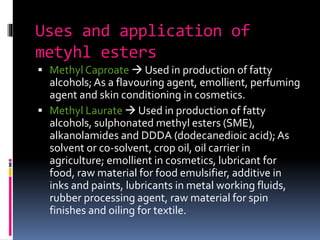
 Methyl Caproate  Used in production of fatty
alcohols;As a flavouring agent, emollient, perfuming
agent and skin conditioning in cosmetics.
 Methyl Laurate  Used in production of fatty
alcohols, sulphonated methyl esters (SME),
alkanolamides and DDDA (dodecanedioic acid);As
solvent or co-solvent, crop oil, oil carrier in
agriculture; emollient in cosmetics, lubricant for
food, raw material for food emulsifier, additive in
inks and paints, lubricants in metal working fluids,
rubber processing agent, raw material for spin
finishes and oiling for textile.
Uses and application of
metyhl esters
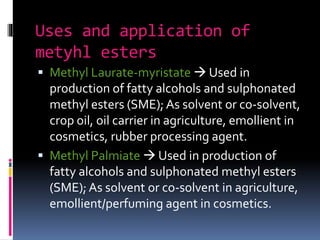
 Methyl Laurate-myristate  Used in
production of fatty alcohols and sulphonated
methyl esters (SME); As solvent or co-solvent,
crop oil, oil carrier in agriculture, emollient in
cosmetics, rubber processing agent.
 Methyl Palmiate  Used in production of
fatty alcohols and sulphonated methyl esters
(SME); As solvent or co-solvent in agriculture,
emollient/perfuming agent in cosmetics.
Production Processes of Polyol
Esters and its derivatives
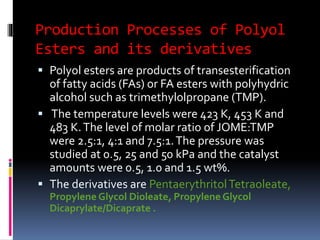
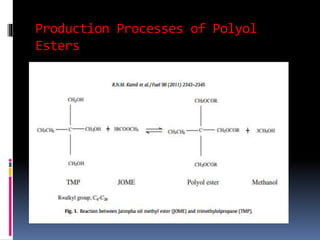
 Polyol esters are products of transesterification
of fatty acids (FAs) or FA esters with polyhydric
alcohol such as trimethylolpropane (TMP).
 The temperature levels were 423 K, 453 K and
483 K.The level of molar ratio of JOME:TMP
were 2.5:1, 4:1 and 7.5:1.The pressure was
studied at 0.5, 25 and 50 kPa and the catalyst
amounts were 0.5, 1.0 and 1.5 wt%.
 The derivatives are PentaerythritolTetraoleate,
Propylene Glycol Dioleate, Propylene Glycol
Dicaprylate/Dicaprate .
Production Processes of Polyol
Esters
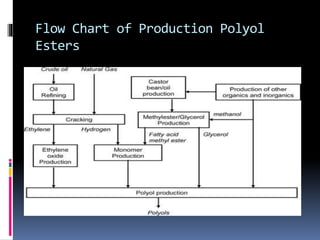
Flow Chart of Production Polyol
Esters
Uses and application of
Polyol esters
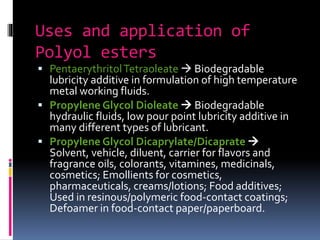
 PentaerythritolTetraoleate  Biodegradable
lubricity additive in formulation of high temperature
metal working fluids.
 Propylene Glycol Dioleate  Biodegradable
hydraulic fluids, low pour point lubricity additive in
many different types of lubricant.
 Propylene Glycol Dicaprylate/Dicaprate 
Solvent, vehicle, diluent, carrier for flavors and
fragrance oils, colorants, vitamines, medicinals,
cosmetics; Emollients for cosmetics,
pharmaceuticals, creams/lotions; Food additives;
Used in resinous/polymeric food-contact coatings;
Defoamer in food-contact paper/paperboard.
REFERENCES
 http://www.klkoleo.com/brand/palmester%C
2%AE-fatty-esters
 http://ptiph.com/PDF/ipl_ipp_ipm.pdf
 http://www.klkoleo.com/brand/palmere%C2
%AE-methyl-esters
 http://journeytoforever.org/biofuel_library/tr
ansesterification%20paper.pdf
 file:///C:/Users/User/Downloads/Jatropha%20
Oil%20Polyol%20Esters%20(Published,%202
011,Fuel).pdf

Fatty Esters

  • 1.
    FATTY ESTERS Prepared by: Nurul Afifah Binti Mohd Yusoff 2013275464 EH110 4A Faculty of Chemical Engineering
  • 2.
    CONTENTS  Definition offatty esters  Production processes of fatty esters and its derivative.  Flow chart of fatty ester production  Uses and application of fatty ester
  • 3.
    What is FattyEster ?  Fatty Ester is a type of ester that result from the combination of a fatty acid with an alcohol.
  • 4.
    Types of FattyEsters  Isopropyl Esters  Ethylexyl Esters  Butyl Esters  Glycerol Esters  Glycol Esters  Methyl Esters  Polyol Esters
  • 6.
    Production Processes ofIsopropyl Esters and its derivatives  Isopropyl esters of carboxylic acids are products manufactured by means of reacting fatty acids and isopropyl alcohol in a process called “esterification”.The by‐product of the reaction is water.  FATTY ACIDS + ISOPROPYL ALCOHOL → ISOPROPYL ESTERS +WATER  Lauric (C12), Myristic (C14), and Palmitic (C16) are the typical fatty acids used to manufacture isopropyl esters.
  • 7.
    Production Processes ofIsopropyl Esters and its derivatives  Raw material is received in the plant and is heated before entering the reactor to form a ester through esterification .The reaction takes place at atmospheric pressure with the aid of catalyst.The reaction water is sent to the distillation column to distill off the excess alcohol for reuse. After completion of the reaction, the product is neutralized, and if necessary, distilled.  The derivatives are Isopropyl Laurate (IPL), Isopropyl Myristate (IPM), and Isopropyl Palmitate (IPM).
  • 8.
    Flow Diagram ofIsopropyl Esters Production
  • 9.
    Uses and applicationof isopropyl esters  Isopropyl Laurates are used in cosmetics and lubricating oil additives.  Isopropyl Myristate is used as an emollient and lubricant in preshaves, aftershaves, shampoos, bath oils, antiperspirants, deodorants, and various creams and lotions.  Isopropyl Palmitate is used in cosmetics as a thickening agent and emollient. It is often used in moisturizes where it forms a thin layer and easily penetrates the skin. Isopropyl Palmitate is said to enhance silkiness in hair and skin.
  • 11.
    Production Processes ofMethyl Esters and its derivatives  Methyl esters were produced by transesterification of palm oil with methanol in the presence of a catalyst (KOH).The rate of transesterification in a batch reactor increased with temperature up to 60°C. (Higher temperatures did not reduce the time to reach maximal conversion. The mixture enters into the second reactor to recover the excess of methanol and enters into the washing column together with water. Next, methyl esters goes to drying stage to be dried. After that, we got methyl esters.
  • 12.
    Flow Diagram ofProduction Methyl Esters
  • 13.
    Uses and applicationof metyhl esters  Methyl Caproate  Used in production of fatty alcohols;As a flavouring agent, emollient, perfuming agent and skin conditioning in cosmetics.  Methyl Laurate  Used in production of fatty alcohols, sulphonated methyl esters (SME), alkanolamides and DDDA (dodecanedioic acid);As solvent or co-solvent, crop oil, oil carrier in agriculture; emollient in cosmetics, lubricant for food, raw material for food emulsifier, additive in inks and paints, lubricants in metal working fluids, rubber processing agent, raw material for spin finishes and oiling for textile.
  • 14.
    Uses and applicationof metyhl esters  Methyl Laurate-myristate  Used in production of fatty alcohols and sulphonated methyl esters (SME); As solvent or co-solvent, crop oil, oil carrier in agriculture, emollient in cosmetics, rubber processing agent.  Methyl Palmiate  Used in production of fatty alcohols and sulphonated methyl esters (SME); As solvent or co-solvent in agriculture, emollient/perfuming agent in cosmetics.
  • 16.
    Production Processes ofPolyol Esters and its derivatives  Polyol esters are products of transesterification of fatty acids (FAs) or FA esters with polyhydric alcohol such as trimethylolpropane (TMP).  The temperature levels were 423 K, 453 K and 483 K.The level of molar ratio of JOME:TMP were 2.5:1, 4:1 and 7.5:1.The pressure was studied at 0.5, 25 and 50 kPa and the catalyst amounts were 0.5, 1.0 and 1.5 wt%.  The derivatives are PentaerythritolTetraoleate, Propylene Glycol Dioleate, Propylene Glycol Dicaprylate/Dicaprate .
  • 17.
  • 18.
    Flow Chart ofProduction Polyol Esters
  • 19.
    Uses and applicationof Polyol esters  PentaerythritolTetraoleate  Biodegradable lubricity additive in formulation of high temperature metal working fluids.  Propylene Glycol Dioleate  Biodegradable hydraulic fluids, low pour point lubricity additive in many different types of lubricant.  Propylene Glycol Dicaprylate/Dicaprate  Solvent, vehicle, diluent, carrier for flavors and fragrance oils, colorants, vitamines, medicinals, cosmetics; Emollients for cosmetics, pharmaceuticals, creams/lotions; Food additives; Used in resinous/polymeric food-contact coatings; Defoamer in food-contact paper/paperboard.
  • 20.
    REFERENCES  http://www.klkoleo.com/brand/palmester%C 2%AE-fatty-esters  http://ptiph.com/PDF/ipl_ipp_ipm.pdf http://www.klkoleo.com/brand/palmere%C2 %AE-methyl-esters  http://journeytoforever.org/biofuel_library/tr ansesterification%20paper.pdf  file:///C:/Users/User/Downloads/Jatropha%20 Oil%20Polyol%20Esters%20(Published,%202 011,Fuel).pdf