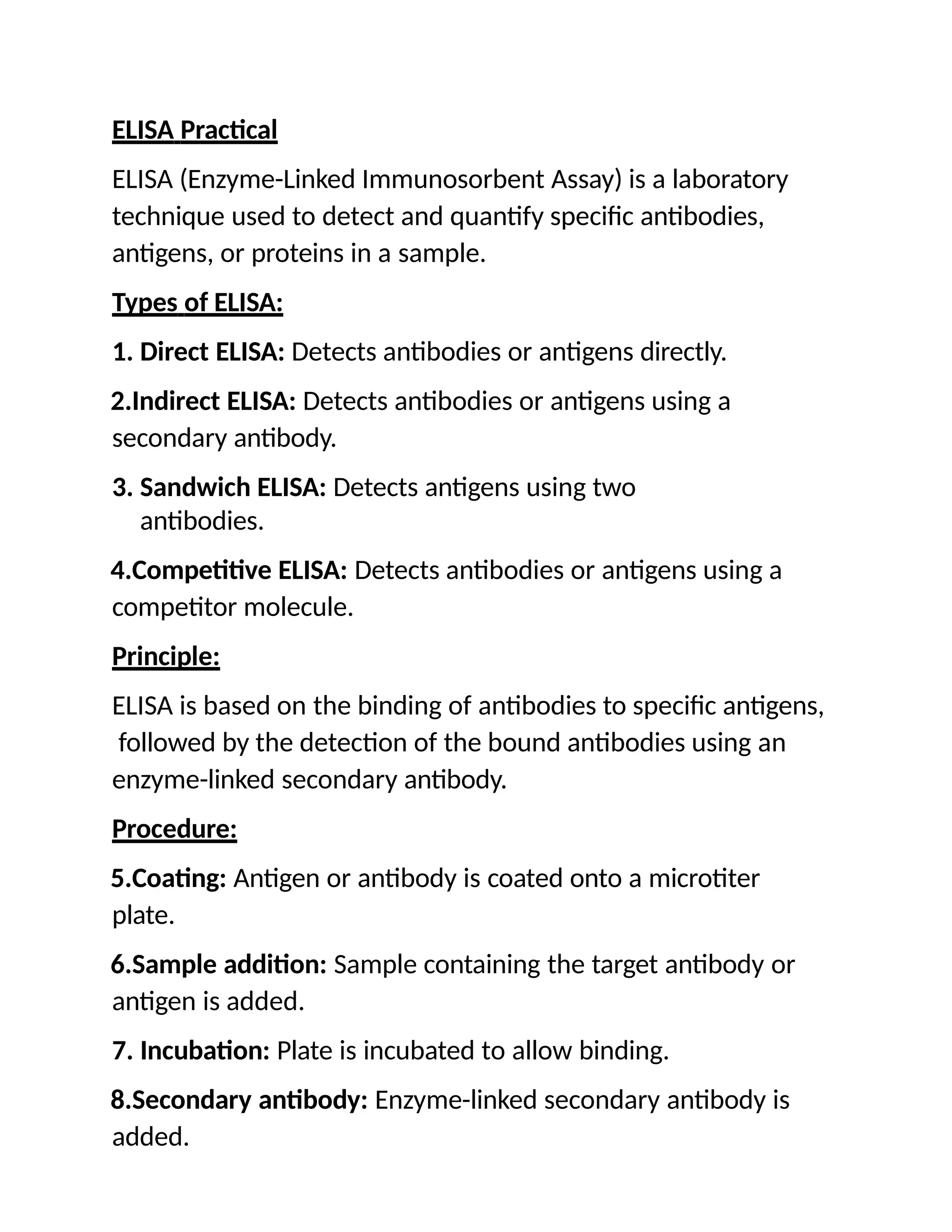
ELISA Practical
ELISA (Enzyme-Linked Immunosorbent Assay) is a laboratory
technique used to detect and quantify specific antibodies,
antigens, or proteins in a sample.
Types of ELISA:
1. Direct ELISA: Detects antibodies or antigens directly.
2.Indirect ELISA: Detects antibodies or antigens using a
secondary antibody.
3. Sandwich ELISA: Detects antigens using two
antibodies.
4.Competitive ELISA: Detects antibodies or antigens using a
competitor molecule.
Principle:
ELISA is based on the binding of antibodies to specific antigens,
followed by the detection of the bound antibodies using an
enzyme-linked secondary antibody.
Procedure:
5.Coating: Antigen or antibody is coated onto a microtiter
plate.
6.Sample addition: Sample containing the target antibody or
antigen is added.
7. Incubation: Plate is incubated to allow binding.
8.Secondary antibody: Enzyme-linked secondary antibody is
added.
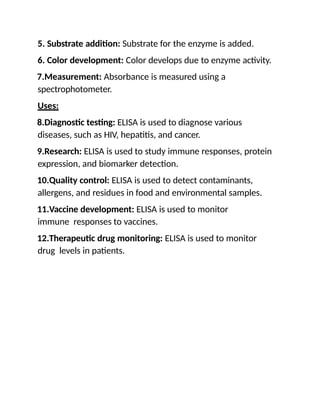
5. Substrate addition: Substrate for the enzyme is added.
6. Color development: Color develops due to enzyme activity.
7.Measurement: Absorbance is measured using a
spectrophotometer.
Uses:
8.Diagnostic testing: ELISA is used to diagnose various
diseases, such as HIV, hepatitis, and cancer.
9.Research: ELISA is used to study immune responses, protein
expression, and biomarker detection.
10.Quality control: ELISA is used to detect contaminants,
allergens, and residues in food and environmental samples.
11.Vaccine development: ELISA is used to monitor
immune responses to vaccines.
12.Therapeutic drug monitoring: ELISA is used to monitor
drug levels in patients.

ELISA Practical.pptx techniques in biochemistry

  • 1.
    ELISA Practical ELISA (Enzyme-LinkedImmunosorbent Assay) is a laboratory technique used to detect and quantify specific antibodies, antigens, or proteins in a sample. Types of ELISA: 1. Direct ELISA: Detects antibodies or antigens directly. 2.Indirect ELISA: Detects antibodies or antigens using a secondary antibody. 3. Sandwich ELISA: Detects antigens using two antibodies. 4.Competitive ELISA: Detects antibodies or antigens using a competitor molecule. Principle: ELISA is based on the binding of antibodies to specific antigens, followed by the detection of the bound antibodies using an enzyme-linked secondary antibody. Procedure: 5.Coating: Antigen or antibody is coated onto a microtiter plate. 6.Sample addition: Sample containing the target antibody or antigen is added. 7. Incubation: Plate is incubated to allow binding. 8.Secondary antibody: Enzyme-linked secondary antibody is added.
  • 2.
    5. Substrate addition:Substrate for the enzyme is added. 6. Color development: Color develops due to enzyme activity. 7.Measurement: Absorbance is measured using a spectrophotometer. Uses: 8.Diagnostic testing: ELISA is used to diagnose various diseases, such as HIV, hepatitis, and cancer. 9.Research: ELISA is used to study immune responses, protein expression, and biomarker detection. 10.Quality control: ELISA is used to detect contaminants, allergens, and residues in food and environmental samples. 11.Vaccine development: ELISA is used to monitor immune responses to vaccines. 12.Therapeutic drug monitoring: ELISA is used to monitor drug levels in patients.