Fattyacid synthesis
Dr.M.Sabarinathan M.Sc.,PhD
Department of Biochemistry
Introduction
 Fatty acids are synthesized mainly by a de novo
synthetic pathway operating in the cytoplasm.
 The major fatty acid synthesized de novo is
palmitic acid, the 16C saturated fatty acid.
 The process occurs in liver, adipose tissue, kidney,
brain, and mammary glands.
Steps
 The fatty acid synthesis may be learnt in 3
stages
 I. Production of acetyl CoA and NADPH
 II. Conversion of acetyl CoA to malonyl
CoA
 III. Reactions of fatty acid synthase
complex.
I. Production
of acetyl CoA
and NADPH
 Acetyl CoA and NADPH are the prerequisites for
fatty acid synthesis.
 Acetyl CoA is the source of carbon atoms while
NADPH provides the reducing equivalents and ATP
supplies energy for fatty acid formation.
 It is produced in the mitochondria by the oxidation
of pyruvate and fatty acids, degradation of carbon
skeleton of certain amino acids, and from ketone
bodies.
 Mitochondria are not permeable to acetyl CoA
Transport of
Acetyl CoA
to
Cytoplasm
II. Formation
of malonyl
CoA
 Acetyl CoA is carboxylated to malonyl CoA by the
enzyme acetyl CoA carboxylase
 This is an ATP-dependent reaction and requires
biotin for CO2 fixation.
Fatty Acid
Synthase
(FAS)
Complex
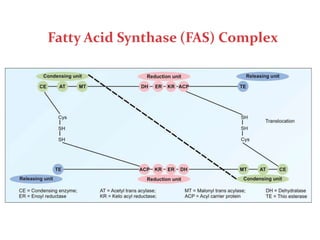
 This system exists as a multi-enzyme complex.
 The enzymes form a dimer with identical
subunits.
 Each subunit of the complex is organized into 3
domains with 7 enzymes
 Advantages of Multi-enzyme Complex
 a. Intermediates of the reaction can easily
interact with the active sites of the enzymes.
 b. One gene codes all the enzymes; so all the
enzymes are in equimolecular concentrations.
 c. So the efficiency of the process is enhanced.
Fatty Acid Synthase (FAS) Complex
III. Reactions
of fattyacid
synthase
complex
 1. The acetyl unit is then transferred from ACP to
cysteine residue of the enzyme.
 It is catalysed by the enzyme, acetyl CoA-ACP
transacylase.
 2. The enzyme malonyl CoA-ACP transacylase
transfers malonate from malonyl CoA to bind to
ACP.
 3. The acetyl unit attached to cysteine is transferred
to malonyl group.
 This reaction is catalyzed by β-ketoacyl ACP
synthase.
III. Reactions
of fattyacid
synthase
complex
 4. β -Ketoacyl ACP reductase reduces
 ketoacyl group to hydroxyacyl group. The
 reducing equivalents are supplied by NADPH.
 5. β -Hydroxyacyl ACP undergoes dehydration.
 A molecule of water is eliminated and a double
 bond is introduced.
 6. A second NADPH-dependent reduction,
catalysed by enoyl-ACP reductase occurs to produce
acyl-ACP.
 The four-carbon unit attached to ACP is butyryl
group.
III. Reactions
of fattyacid
synthase
complex
 7. The carbon chain attached to ACP is transferred
to cysteine residue and the reactions 2-6 are
repeated 6 more times.
 Each time, the fatty acid chain is lengthened by a
two-carbon unit
 8. The enzyme palmitoyl thioesterase separates
palmitate from fatty acid synthase.
 This completes the synthesis of palmitate.
Regulation
 Fatty acid production is controlled by
 enzymes, metabolites, end products, hormones
 and dietary manipulations.
 Acetyl CoA carboxylase : This enzyme
 controls a committed step in fatty acid synthesis.
 Hormonal influence : insulin promotes fatty acid
 synthesis while glucagon inhibits.
Dietary
regulation
 Consumption of high carbohydrate or fat-free diet
increases the synthesis of acetyl CoA carboxylase
and fatty acid synthase, which promote fatty acid
formation.
 On the other hand, fasting or high fat diet
decreases fatty acid production by reducing the
synthesis of these two enzymes.
Availability
of NADPH
 The reducing equivalents for fatty acid synthesis
are provided by NADPH which come either from
citrate (acetyl CoA) transport or hexose
monophosphate shunt.
 About 50-60% of required NADPH is obtained
from HMP shunt, which significantly influences
fatty acid synthesis.
Fatty Acids Synthesis-1.pptx

Fatty Acids Synthesis-1.pptx

  • 1.
  • 2.
    Introduction  Fatty acidsare synthesized mainly by a de novo synthetic pathway operating in the cytoplasm.  The major fatty acid synthesized de novo is palmitic acid, the 16C saturated fatty acid.  The process occurs in liver, adipose tissue, kidney, brain, and mammary glands.
  • 3.
    Steps  The fattyacid synthesis may be learnt in 3 stages  I. Production of acetyl CoA and NADPH  II. Conversion of acetyl CoA to malonyl CoA  III. Reactions of fatty acid synthase complex.
  • 4.
    I. Production of acetylCoA and NADPH  Acetyl CoA and NADPH are the prerequisites for fatty acid synthesis.  Acetyl CoA is the source of carbon atoms while NADPH provides the reducing equivalents and ATP supplies energy for fatty acid formation.  It is produced in the mitochondria by the oxidation of pyruvate and fatty acids, degradation of carbon skeleton of certain amino acids, and from ketone bodies.  Mitochondria are not permeable to acetyl CoA
  • 5.
  • 6.
    II. Formation of malonyl CoA Acetyl CoA is carboxylated to malonyl CoA by the enzyme acetyl CoA carboxylase  This is an ATP-dependent reaction and requires biotin for CO2 fixation.
  • 7.
    Fatty Acid Synthase (FAS) Complex  Thissystem exists as a multi-enzyme complex.  The enzymes form a dimer with identical subunits.  Each subunit of the complex is organized into 3 domains with 7 enzymes  Advantages of Multi-enzyme Complex  a. Intermediates of the reaction can easily interact with the active sites of the enzymes.  b. One gene codes all the enzymes; so all the enzymes are in equimolecular concentrations.  c. So the efficiency of the process is enhanced.
  • 8.
    Fatty Acid Synthase(FAS) Complex
  • 9.
    III. Reactions of fattyacid synthase complex 1. The acetyl unit is then transferred from ACP to cysteine residue of the enzyme.  It is catalysed by the enzyme, acetyl CoA-ACP transacylase.  2. The enzyme malonyl CoA-ACP transacylase transfers malonate from malonyl CoA to bind to ACP.  3. The acetyl unit attached to cysteine is transferred to malonyl group.  This reaction is catalyzed by β-ketoacyl ACP synthase.
  • 10.
    III. Reactions of fattyacid synthase complex 4. β -Ketoacyl ACP reductase reduces  ketoacyl group to hydroxyacyl group. The  reducing equivalents are supplied by NADPH.  5. β -Hydroxyacyl ACP undergoes dehydration.  A molecule of water is eliminated and a double  bond is introduced.  6. A second NADPH-dependent reduction, catalysed by enoyl-ACP reductase occurs to produce acyl-ACP.  The four-carbon unit attached to ACP is butyryl group.
  • 11.
    III. Reactions of fattyacid synthase complex 7. The carbon chain attached to ACP is transferred to cysteine residue and the reactions 2-6 are repeated 6 more times.  Each time, the fatty acid chain is lengthened by a two-carbon unit  8. The enzyme palmitoyl thioesterase separates palmitate from fatty acid synthase.  This completes the synthesis of palmitate.
  • 13.
    Regulation  Fatty acidproduction is controlled by  enzymes, metabolites, end products, hormones  and dietary manipulations.  Acetyl CoA carboxylase : This enzyme  controls a committed step in fatty acid synthesis.  Hormonal influence : insulin promotes fatty acid  synthesis while glucagon inhibits.
  • 14.
    Dietary regulation  Consumption ofhigh carbohydrate or fat-free diet increases the synthesis of acetyl CoA carboxylase and fatty acid synthase, which promote fatty acid formation.  On the other hand, fasting or high fat diet decreases fatty acid production by reducing the synthesis of these two enzymes.
  • 15.
    Availability of NADPH  Thereducing equivalents for fatty acid synthesis are provided by NADPH which come either from citrate (acetyl CoA) transport or hexose monophosphate shunt.  About 50-60% of required NADPH is obtained from HMP shunt, which significantly influences fatty acid synthesis.