Fasteners.ppt
Threaded Fastener Issues:
Types
Materials/Grades
Tightening Torque
Nuts and Bolts
Fasteners.ppt
Threaded Fasteners
Did you know that?
the Boeing 747 uses about 2.5 million fasteners
• 70,000 titanium costing $150,000
• 400,000 other fasteners costing about $250,000
• 30,000 squeeze rivets, 50cents each installed
In certain applications (such as an engine
head), you should tighten the bolt as much as
possible, if it does not fail by twisting during
tightening, there is a very good possibility that
the bolt will never fail
Fasteners.ppt
Why are fasteners used?
Advantages
Removable
Easy to install
Wide variety of standard parts
Disadvantages
loosening
failure
cost
Fasteners.ppt
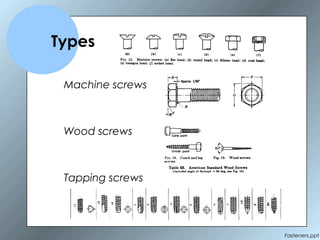
Types
Machine screws
Wood screws
Tapping screws
Fasteners.ppt
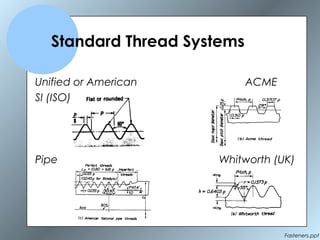
Standard Thread Systems
Unified or American ACME
SI (ISO)
Pipe Whitworth (UK)
Fasteners.ppt
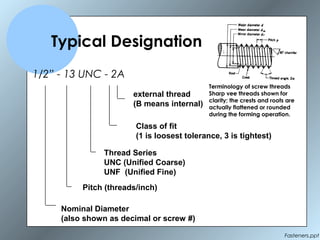
Typical Designation
1/2” - 13 UNC - 2A
external thread
(B means internal)
Class of fit
(1 is loosest tolerance, 3 is tightest)
Thread Series
UNC (Unified Coarse)
UNF (Unified Fine)
Pitch (threads/inch)
Nominal Diameter
(also shown as decimal or screw #)
Terminology of screw threads
Sharp vee threads shown for
clarity; the crests and roots are
actually flattened or rounded
during the forming operation.
Fasteners.ppt
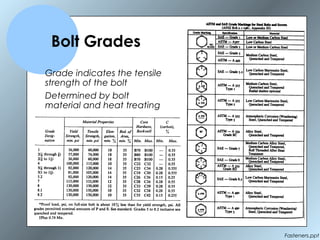
Bolt Grades
Grade indicates the tensile
strength of the bolt
Determined by bolt
material and heat treating
Fasteners.ppt
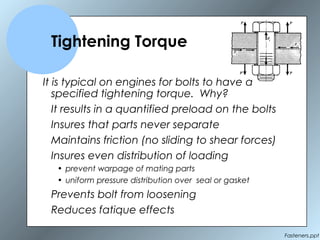
Tightening Torque
It is typical on engines for bolts to have a
specified tightening torque. Why?
It results in a quantified preload on the bolts
Insures that parts never separate
Maintains friction (no sliding to shear forces)
Insures even distribution of loading
• prevent warpage of mating parts
• uniform pressure distribution over seal or gasket
Prevents bolt from loosening
Reduces fatique effects
Fasteners.ppt
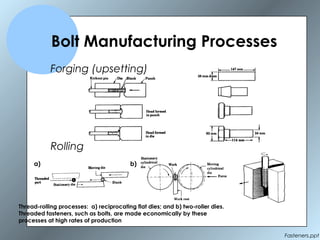
Bolt Manufacturing Processes
Forging (upsetting)
Rolling
Thread-rolling processes: a) reciprocating flat dies; and b) two-roller dies.
Threaded fasteners, such as bolts, are made economically by these
processes at high rates of production
a) b)
Fasteners.ppt -
Manufacturing Processes -
continued
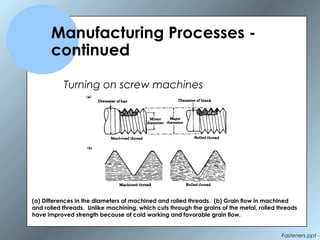
Turning on screw machines
(a) Differences in the diameters of machined and rolled threads. (b) Grain flow in machined
and rolled threads. Unlike machining, which cuts through the grains of the metal, rolled threads
have improved strength because of cold working and favorable grain flow.
Fasteners.ppt -
References
Kalpakjian, S. Manufacturing Engineering
and Technology, 2nd Edition, Addison
Wesley, 1992.
Spotts, M.F., Design of Machine Elements.
Prentice-Hall, Inc., 1985.
Shigley, Joseph and Mitchell, Larry,
Mechanical Engineering Design. McGraw-
HillBook Company, 1983.

Fasteners (1)

  • 1.
  • 2.
    Fasteners.ppt Threaded Fasteners Did youknow that? the Boeing 747 uses about 2.5 million fasteners • 70,000 titanium costing $150,000 • 400,000 other fasteners costing about $250,000 • 30,000 squeeze rivets, 50cents each installed In certain applications (such as an engine head), you should tighten the bolt as much as possible, if it does not fail by twisting during tightening, there is a very good possibility that the bolt will never fail
  • 3.
    Fasteners.ppt Why are fastenersused? Advantages Removable Easy to install Wide variety of standard parts Disadvantages loosening failure cost
  • 4.
  • 5.
    Fasteners.ppt Standard Thread Systems Unifiedor American ACME SI (ISO) Pipe Whitworth (UK)
  • 6.
    Fasteners.ppt Typical Designation 1/2” -13 UNC - 2A external thread (B means internal) Class of fit (1 is loosest tolerance, 3 is tightest) Thread Series UNC (Unified Coarse) UNF (Unified Fine) Pitch (threads/inch) Nominal Diameter (also shown as decimal or screw #) Terminology of screw threads Sharp vee threads shown for clarity; the crests and roots are actually flattened or rounded during the forming operation.
  • 7.
    Fasteners.ppt Bolt Grades Grade indicatesthe tensile strength of the bolt Determined by bolt material and heat treating
  • 8.
    Fasteners.ppt Tightening Torque It istypical on engines for bolts to have a specified tightening torque. Why? It results in a quantified preload on the bolts Insures that parts never separate Maintains friction (no sliding to shear forces) Insures even distribution of loading • prevent warpage of mating parts • uniform pressure distribution over seal or gasket Prevents bolt from loosening Reduces fatique effects
  • 9.
    Fasteners.ppt Bolt Manufacturing Processes Forging(upsetting) Rolling Thread-rolling processes: a) reciprocating flat dies; and b) two-roller dies. Threaded fasteners, such as bolts, are made economically by these processes at high rates of production a) b)
  • 10.
    Fasteners.ppt - Manufacturing Processes- continued Turning on screw machines (a) Differences in the diameters of machined and rolled threads. (b) Grain flow in machined and rolled threads. Unlike machining, which cuts through the grains of the metal, rolled threads have improved strength because of cold working and favorable grain flow.
  • 11.
    Fasteners.ppt - References Kalpakjian, S.Manufacturing Engineering and Technology, 2nd Edition, Addison Wesley, 1992. Spotts, M.F., Design of Machine Elements. Prentice-Hall, Inc., 1985. Shigley, Joseph and Mitchell, Larry, Mechanical Engineering Design. McGraw- HillBook Company, 1983.