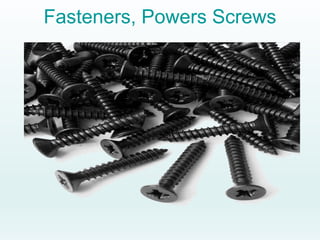
Fasteners, Powers Screws
• Helical thread screw was an important invention.
• Power Screw, transmit angular motion to liner
motion
• Transmit large or produce large axial force
• It is always desired to reduce number of screws
Threaded Fasteners
Introduction
• Fasteners are the thousands of bolts, nuts, screws, clips
and adhesives that hold a vehicle together
• Must be able to identify and use fasteners properly
• Each fastener is engineered for a specific application
• Always replace a fastener with exactly the same type
that was removed from the original equipment
manufacture (OEM) assembly
Bolts
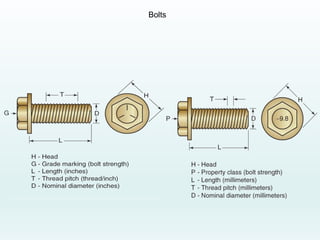
• Bolt is a shaft with a head on one end and threads on the other
• Cap screw is a high-strength bolt
• Bolts and cap screws are named after the body part they hold
– Fender bolt, hood hinge bolt, etc.
• Also named after the shape and head drive configuration
• Bolt head is used to tighten the bolt
• Socket wrench fits over the bolt head
• Some metric/SAE sockets are very close in size
• Improper wrench or socket size could strip or round off the both you
are working on
– This could damage your tools or even cause an injury if the tool
slips off
Bolts
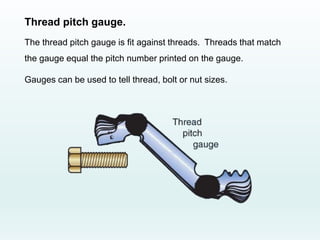
Thread pitch gauge.
The thread pitch gauge is fit against threads. Threads that match
the gauge equal the pitch number printed on the gauge.
Gauges can be used to tell thread, bolt or nut sizes.
Bolt Strengths or Grades
• Bolt strength is the amount of tightening force that should be applied
• Bolts are made from different materials
– Have degrees of hardness for different situations
• Bolt grade markings are lines or numbers on top of the head to
identify hardness and strength
• Hardness or strength of metric bolts is indicated by a property class
indicator on bolt head
• Bolt strength markings are given as lines, more lines means more
strength
• Metric bolt strength markings are numeric
– Higher number means more strength
• Tensile strength is the amount of pressure bolt can withstand before
breaking when pulled apart
• The harder the bolt, the greater tensile strength
Nuts (continued)
• Wing nuts have two arms for turning by
hand
– Used when a part must be removed
frequently for service or maintenance, such as
for air cleaners
• Acorn nuts are closed on one end for
appearance, to keep water/debris off the
threads
• Body nut has a washer formed onto the
nut to distribute the clamping force of the
thin body panel or trim piece to prevent
warpage
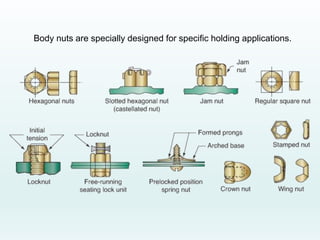
Body nuts are specially designed for specific holding applications.
Washers
• Washers prevent damage to surface of parts and provide better
holding power
• Flat washers prevent smaller bolt heads from pulling through sheet
metal and plastic
• Wave washers add a spring action to keep parts from rattling and
loosening
• Body or fender washers have large outside diameter for the size
hole in them
– Have better holding power on thin metal and plastic parts
• Copper or brass washers prevent fluid leakage
Washers
• Spacer washers allow for the adjustment of parts
• Fiber washers prevent vibration or leakage but cannot be
tightened to a great extent
• Finishing washers have a curved shape for appearance
• Split lock washers are used under nuts to prevent
loosening by vibration
• Shakeproof or teeth lock washers have teeth or bent
lugs that grip both the work and the nut
Screws
• Screws hold nonstructural parts on a vehicle
• Machine screws are threaded their full length and are
relatively weak
• Set screws have an internal drive head for an Allen
wrench and hold parts onto shafts
• Sheet metal screws and self-tapping screws have
pointed or tapered tips
• Trim screws have a washer attached
• Headlight aiming screws have a plastic adapter
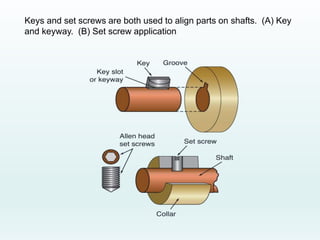
Keys and set screws are both used to align parts on shafts. (A) Key
and keyway. (B) Set screw application
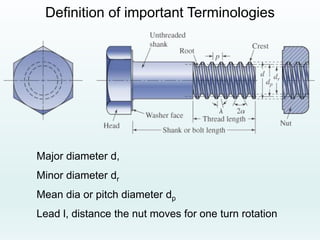
Definition of important Terminologies
Major diameter d,
Minor diameter dr
Mean dia or pitch diameter dp
Lead l, distance the nut moves for one turn rotation
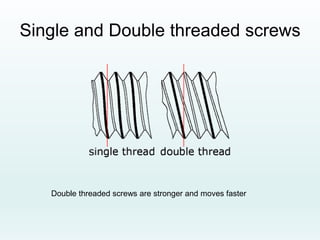
Single and Double threaded screws
Double threaded screws are stronger and moves faster
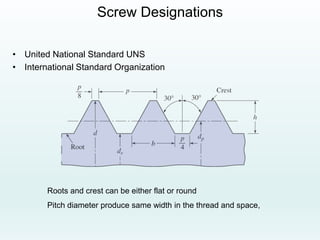
Screw Designations
• United National Standard UNS
• International Standard Organization
Roots and crest can be either flat or round
Pitch diameter produce same width in the thread and space,
Coarse thread Designated by UNC
• Fine Thread UNF, is more resistance to loosening,
because of its small helix angle.
• They are used when Vibration is present
• Class of screw, defines its fit, Class 1 fits have widest
tolerances, Class 2 is the most commonly used
• Class three for very precision application
• Example:1in-12 UNRF-2A-LH, A for Ext. Thread and B for
Internal, R root radius
• Metric M10x1.5 10 diameter mm major diameter,1.5 pitch
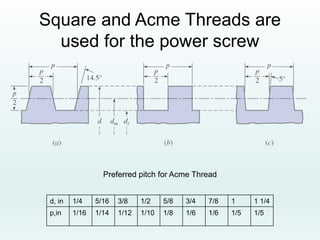
Square and Acme Threads are
used for the power screw
Preferred pitch for Acme Thread
d, in 1/4 5/16 3/8 1/2 5/8 3/4 7/8 1 1 1/4
p,in 1/16 1/14 1/12 1/10 1/8 1/6 1/6 1/5 1/5
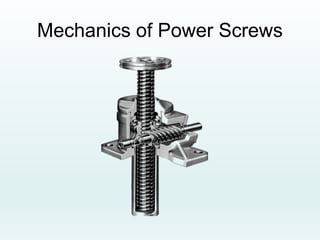
Mechanics of Power Screws
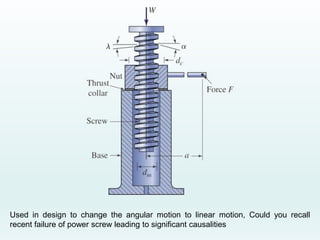
Used in design to change the angular motion to linear motion, Could you recall
recent failure of power screw leading to significant causalities
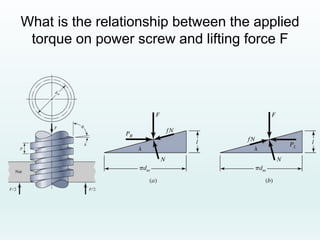
What is the relationship between the applied
torque on power screw and lifting force F
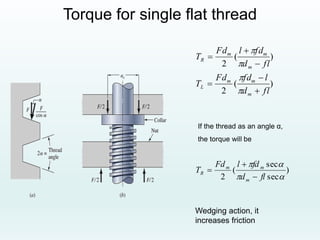
Torque for single flat thread
)
sec
sec
(
2 



fl
d
fd
l
Fd
T
m
m
m
R



)
(
2
)
(
2
fl
d
l
fd
Fd
T
fl
d
fd
l
Fd
T
m
m
m
L
m
m
m
R










If the thread as an angle α,
the torque will be
Wedging action, it
increases friction
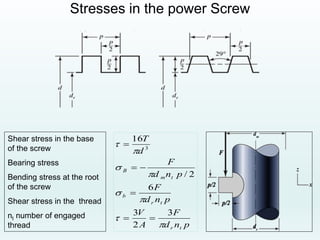
Stresses in the power Screw
p
n
d
F
A
V
p
n
d
F
p
n
d
F
d
T
t
r
t
r
b
t
m
B








3
2
3
6
2
/
16
3






Shear stress in the base
of the screw
Bearing stress
Bending stress at the root
of the screw
Shear stress in the thread
nt number of engaged
thread
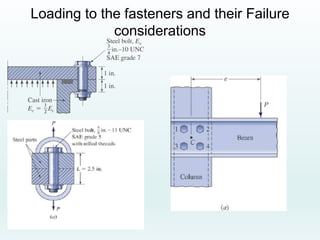
Loading to the fasteners and their Failure
considerations
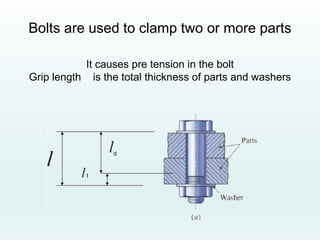
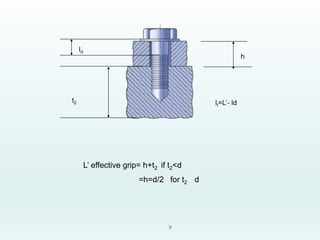
Bolts are used to clamp two or more parts
It causes pre tension in the bolt
Grip length is the total thickness of parts and washers
L’ effective grip= h+t2 if t2<d
=h=d/2 for t2 d

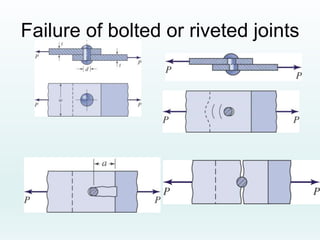
Failure of bolted or riveted joints
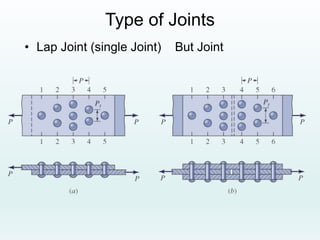
Type of Joints
• Lap Joint (single Joint) But Joint

1 a. Threaded fasteners and powers screws introduction

  • 1.
  • 2.
    • Helical threadscrew was an important invention. • Power Screw, transmit angular motion to liner motion • Transmit large or produce large axial force • It is always desired to reduce number of screws Threaded Fasteners
  • 3.
    Introduction • Fasteners arethe thousands of bolts, nuts, screws, clips and adhesives that hold a vehicle together • Must be able to identify and use fasteners properly • Each fastener is engineered for a specific application • Always replace a fastener with exactly the same type that was removed from the original equipment manufacture (OEM) assembly
  • 4.
    Bolts • Bolt isa shaft with a head on one end and threads on the other • Cap screw is a high-strength bolt • Bolts and cap screws are named after the body part they hold – Fender bolt, hood hinge bolt, etc. • Also named after the shape and head drive configuration • Bolt head is used to tighten the bolt • Socket wrench fits over the bolt head • Some metric/SAE sockets are very close in size • Improper wrench or socket size could strip or round off the both you are working on – This could damage your tools or even cause an injury if the tool slips off
  • 5.
  • 6.
    Thread pitch gauge. Thethread pitch gauge is fit against threads. Threads that match the gauge equal the pitch number printed on the gauge. Gauges can be used to tell thread, bolt or nut sizes.
  • 7.
    Bolt Strengths orGrades • Bolt strength is the amount of tightening force that should be applied • Bolts are made from different materials – Have degrees of hardness for different situations • Bolt grade markings are lines or numbers on top of the head to identify hardness and strength • Hardness or strength of metric bolts is indicated by a property class indicator on bolt head • Bolt strength markings are given as lines, more lines means more strength • Metric bolt strength markings are numeric – Higher number means more strength • Tensile strength is the amount of pressure bolt can withstand before breaking when pulled apart • The harder the bolt, the greater tensile strength
  • 8.
    Nuts (continued) • Wingnuts have two arms for turning by hand – Used when a part must be removed frequently for service or maintenance, such as for air cleaners • Acorn nuts are closed on one end for appearance, to keep water/debris off the threads • Body nut has a washer formed onto the nut to distribute the clamping force of the thin body panel or trim piece to prevent warpage
  • 9.
    Body nuts arespecially designed for specific holding applications.
  • 10.
    Washers • Washers preventdamage to surface of parts and provide better holding power • Flat washers prevent smaller bolt heads from pulling through sheet metal and plastic • Wave washers add a spring action to keep parts from rattling and loosening • Body or fender washers have large outside diameter for the size hole in them – Have better holding power on thin metal and plastic parts • Copper or brass washers prevent fluid leakage
  • 11.
    Washers • Spacer washersallow for the adjustment of parts • Fiber washers prevent vibration or leakage but cannot be tightened to a great extent • Finishing washers have a curved shape for appearance • Split lock washers are used under nuts to prevent loosening by vibration • Shakeproof or teeth lock washers have teeth or bent lugs that grip both the work and the nut
  • 12.
    Screws • Screws holdnonstructural parts on a vehicle • Machine screws are threaded their full length and are relatively weak • Set screws have an internal drive head for an Allen wrench and hold parts onto shafts • Sheet metal screws and self-tapping screws have pointed or tapered tips • Trim screws have a washer attached • Headlight aiming screws have a plastic adapter
  • 13.
    Keys and setscrews are both used to align parts on shafts. (A) Key and keyway. (B) Set screw application
  • 14.
    Definition of importantTerminologies Major diameter d, Minor diameter dr Mean dia or pitch diameter dp Lead l, distance the nut moves for one turn rotation
  • 15.
    Single and Doublethreaded screws Double threaded screws are stronger and moves faster
  • 16.
    Screw Designations • UnitedNational Standard UNS • International Standard Organization Roots and crest can be either flat or round Pitch diameter produce same width in the thread and space,
  • 17.
    Coarse thread Designatedby UNC • Fine Thread UNF, is more resistance to loosening, because of its small helix angle. • They are used when Vibration is present • Class of screw, defines its fit, Class 1 fits have widest tolerances, Class 2 is the most commonly used • Class three for very precision application • Example:1in-12 UNRF-2A-LH, A for Ext. Thread and B for Internal, R root radius • Metric M10x1.5 10 diameter mm major diameter,1.5 pitch
  • 18.
    Square and AcmeThreads are used for the power screw Preferred pitch for Acme Thread d, in 1/4 5/16 3/8 1/2 5/8 3/4 7/8 1 1 1/4 p,in 1/16 1/14 1/12 1/10 1/8 1/6 1/6 1/5 1/5
  • 19.
  • 20.
    Used in designto change the angular motion to linear motion, Could you recall recent failure of power screw leading to significant causalities
  • 21.
    What is therelationship between the applied torque on power screw and lifting force F
  • 22.
    Torque for singleflat thread ) sec sec ( 2     fl d fd l Fd T m m m R    ) ( 2 ) ( 2 fl d l fd Fd T fl d fd l Fd T m m m L m m m R           If the thread as an angle α, the torque will be Wedging action, it increases friction
  • 23.
    Stresses in thepower Screw p n d F A V p n d F p n d F d T t r t r b t m B         3 2 3 6 2 / 16 3       Shear stress in the base of the screw Bearing stress Bending stress at the root of the screw Shear stress in the thread nt number of engaged thread
  • 24.
    Loading to thefasteners and their Failure considerations
  • 25.
    Bolts are usedto clamp two or more parts It causes pre tension in the bolt Grip length is the total thickness of parts and washers
  • 26.
    L’ effective grip=h+t2 if t2<d =h=d/2 for t2 d 
  • 27.
    Failure of boltedor riveted joints
  • 28.
    Type of Joints •Lap Joint (single Joint) But Joint