Spanish Multi-Center Fast-Track Group Protocol and Preliminary Results Dr. Arantxa Muñoz Duyos Hospital Mútua de Terrassa
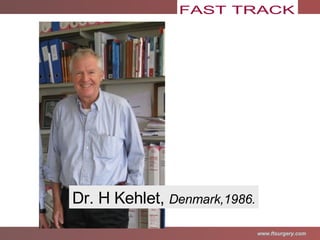
Dr. H Kehlet,  Denmark,1986.
Optimize the peri-operative treatment of the patient with the goal to: reduce the morbility increase recovery after surgery reduce hospital lenght of stay ( los )  reduce hospital cost
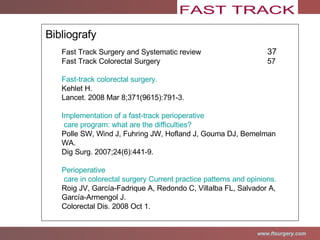
Bibliografy Fast Track Surgery and Systematic review 37 Fast Track Colorectal Surgery 57 Fast-track colorectal surgery. Kehlet H. Lancet. 2008 Mar 8;371(9615):791-3.   Implementation of a fast-track  perioperative  care program: what are the difficulties? Polle SW, Wind J, Fuhring JW, Hofland J, Gouma DJ, Bemelman WA. Dig Surg. 2007;24(6):441-9.  Perioperative  care in colorectal surgery Current practice patterns and opinions. Roig JV, García-Fadrique A, Redondo C, Villalba FL, Salvador A, García-Armengol J. Colorectal Dis. 2008 Oct 1.
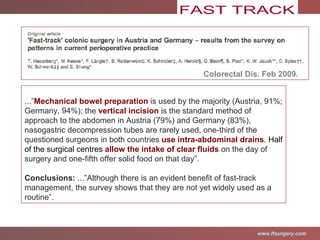
Colorectal Dis. Feb 2009. ...” Mechanical bowel preparation  is used by the majority (Austria, 91%; Germany, 94%); the  vertical incision  is the standard method of approach to the abdomen in Austria (79%) and Germany (83%), nasogastric decompression tubes are rarely used, one-third of the questioned surgeons in both countries  use intra-abdominal drains .  Half of the surgical centres  allow the intake of clear fluids  on the day of surgery and one-fifth offer solid food on that day”. Conclusions:  ...”Although there is an evident benefit of fast-track management, the survey shows that they are not yet widely used as a routine”.
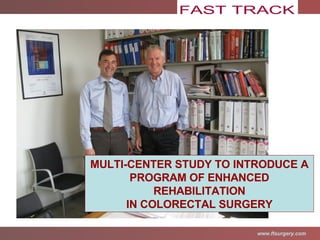
MULTI-CENTER STUDY TO INTRODUCE A PROGRAM OF ENHANCED REHABILITATION IN COLORECTAL SURGERY
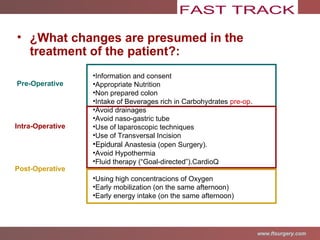
Pre-Operative Intra-Operative Post-Operative ¿What changes are presumed in the treatment of the patient?: Information and consent Appropriate Nutrition Non prepared colon Intake of Beverages rich in Carbohydrates  pre-op . Avoid drainages Avoid naso-gastric tube Use of laparoscopic techniques Use of Transversal Incision Epidural  Anastesia (open Surgery). Avoid Hypothermia Fluid therapy (“Goal-directed”).CardioQ Using high concentracions of Oxygen Early mobilization (on the same afternoon) Early energy intake (on the same afternoon)
Objetives: What are our results for traditional surgery? Where are the difficulties of implementing a program of Fast-Track? Evidence of a multi-center group using the same protocol for the patients themselves. Are the results extrapolated to any other centers? Permanent audit of the multi-center group results. To collaborate with other national or international centers. To offer  the best available information on fast-track to whom it may concern. Spanish Multi-center Fast-Track Group
MULTI-CENTER STUDY FOR  THE INTRODUCTION OF A PROGRAM ON ENHANCED REHABILITATION IN COLORECTAL SURGERY : Inclusion Criteria: Patients older than 18 years, scheduled for surgery intervention for right colon, left and / or rectum due to a malignant or benign cause.  Exclusión Criteria: Emergency surgery. Patients in need of colostomy or ileostomy . Patients  who have not signed informed consent .
MULTI-CENTER STUDY FOR  THE INTRODUCTION OF A PROGRAM ON ENHANCED REHABILITATION IN COLORECTAL SURGERY: Ethical Aspects : Taking into account that each point of “Fast Track” is a form of treatment fully accepted and supported by the best available scientific evidence was not considered appropriate by ethics committees and clinical trials on the approval request . However, patients are individually informed orally and in writing on the early rehabilitation program, expecting them to cooperate./ expecting from them their collaboration .
PRE-OPERATIVE Verbal and written information about the early rehabilitation program and obtain signature for the informed consent . Evaluation of quality of life baseline  : SF-36, EuroQoL. Malnourished patients (>10% weight in < than three months),  hyperproteine supplement twice daily, at least the whole week before surgery.  DAY -1: Non preparation of the colon. Two Enemas Casen ® at 20.00 hr. Normal intake in the morning. Throughout the afternoon, 4 Nutricia Preop ® bricks of 800 ml (100 mg of carbohydrates).  During the afternoon, fluid intake on demand. A drink  rich in carbohydrates at 20.00 hr. Not to use pre-medication. Prophylaxis of pulmonary embolism as usual . Protocol 1 2 3 4
DAY 0: Two hours before surgery, intake of drink rich in carbohydrates (Nutricia Preop ®, 2 bricks, 400ml, 50g CHO).  Two hours before Casen  ®  Enema. Not to use pre-medication. Routine Vital Signs surveillance IN THE OPERATING ROOM Surgeons: Not to use drains. Avoid gastric nasal tube. Attempt Laparoscopic intervention.  Transverse incision in open surgery.  Infiltrate wounds with Bupivacaine 0,25 % (20 ml). Protocol 5 6 7 8
Anaesthesiologists: Epidural analgesia. At T9-T10 Bupivacaine 0,25/0,50% with Sulfentanyl/Fentanyl. Maintenance: Oxygen/air with FiO2>80%. Do not use morphine Analgesia with Paracetamol IV in the operating room, Diclofenac IV, u nless contraindication or alteration of the renal function. Anti-emetics: Ondansetron IV (Zofran) 4 mg. Do not use Dexamethason.( If necessary use Droperidol  0.625 mg or Haloperidol 1 mg).  Thermal blanket. Monitoring:  Routine + esophageal Doppler. Central catheter / arterial catheter if necessary  *Goal directed fluidtherapy Optimization according to ejection volume  (Stroke Volume)  with the esophageal Doppler probe  (Reset volume bolus of coloid 250cc  depending on the drop in the cardiac output measured by the esophageal Doppler). (*)Grocott M et al. Anesth Analg. 2005;100:1093–1106. (*)Bundgaard-Nielsen M et al. Acta Anaesthesiol Scand. 2007;51:331–340 . Protocol 9 10 11 12
DAY 0. Postoperative first hours: High flow oxygen mask for 2 hours. After nasal mask to keep saturation >95%. In the afternoon mobilize the patient to arm chair (min. 2 hrs) From 18.00 hr, liquid diet (800-1000cc) +  2 units rich in protein and calories.  Minimum diuresis (500cc first 24 hrs). Analgesia with 1 gr Paracetamol/ 6 hrs + Epidural catheter. Gluco-saline maintenance. Protocol 13 14
DAY +1: Liquid diet (min. 2 liters) + 3 energy preps. Movilization with armchair 6 hrs. day. Discontinue fluids IV if tolerated. IV access heparinized. Maintain epidural pump (if any).  Paracetamol 1 gr / 6 hrs. Lactulose 1 pack / 12 hrs. Protocol
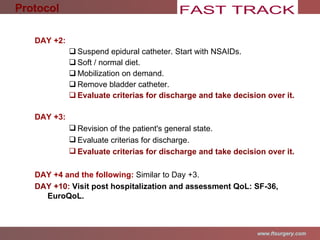
DAY +2: Suspend epidural catheter. Start with NSAIDs . Soft / normal diet. Mobilization on demand. Remove bladder catheter. Evaluate criterias for discharge and take decision over it. DAY +3: Revision of the patient's general state . Evaluate criterias for discharge. Evaluate criterias for discharge and take decision over it.   DAY +4 and the following:  Similar to Day +3. DAY +10:   Visit post hospitalization and assessment QoL: SF-36, EuroQoL. Protocol
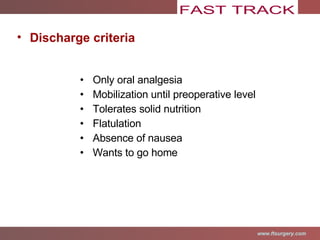
Only oral analgesia Mobilization until preoperative level Tolerates solid nutrition Flatulation Absence of nausea  Wants to go home Discharge criteria
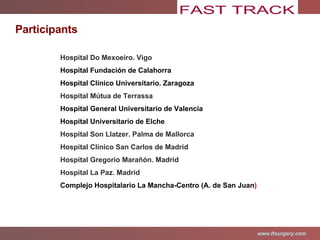
Hospital Do Mexoeiro. Vigo Hospital Fundación de Calahorra  Hospital Clínico Universitario. Zaragoza Hospital Mútua de Terrassa Hospital General Universitario de Valencia Hospital Universitario de Elche Hospital Son Llatzer. Palma de Mallorca Hospital Clínico San Carlos de Madrid Hospital Gregorio Marañón. Madrid Hospital La Paz. Madrid Complejo Hospitalario La Mancha-Centro (A. de San Juan ) Participants


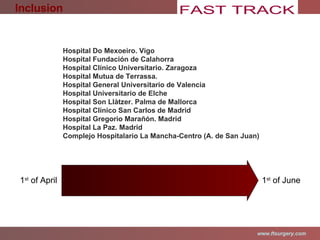
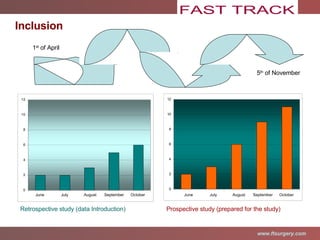
Hospital Do Mexoeiro. Vigo Hospital Fundación de Calahorra Hospital Clínico Universitario. Zaragoza Hospital Mutua de Terrassa. Hospital General Universitario de Valencia Hospital Universitario de Elche Hospital Son Llàtzer. Palma de Mallorca Hospital Clínico San Carlos de Madrid Hospital Gregorio Marañón. Madrid Hospital La Paz. Madrid Complejo Hospitalario La Mancha-Centro (A. de San Juan) 1 st  of April 1 st  of June Inclusion
Retrospective study (data Introduction) Prospective study (prepared for the study) Inclusion June  July  August  September  October June  July  August  September  October 1 st  of April 5 th  of November
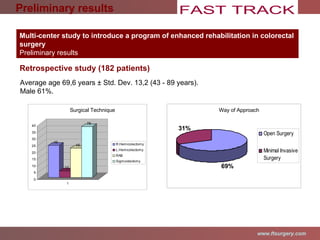
Retrospective study (182 patients) Multi-center study to introduce a program of enhanced rehabilitation in colorectal surgery Preliminary results Average age 69,6 years  ± Std. Dev. 13,2 (43 - 89 years).  Male 61%. 69% 31% Way of Approach Preliminary results Surgical Technique
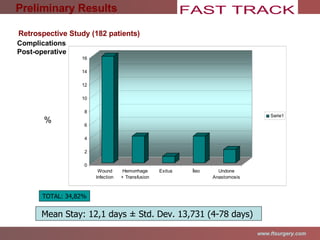
Complications Post-operative TOTAL: 34,82% % Mean Stay: 12,1 days  ± Std. Dev. 13,731 (4-78 days)  Preliminary Results Retrospective Study (182 patients)
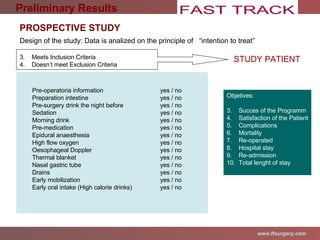
Design of the study: Data is analized on the principle of  “intention to treat” Meets Inclusion Criteria Doesn’t meet Exclusion Criteria STUDY PATIENT Objetives: Succes of the Programm Satisfaction of the Patient Complications Mortality Re-operated Hospital stay Re-admission Total lenght of stay Preliminary Results PROSPECTIVE STUDY Pre-operatoria information  yes / no Preparation intestine yes / no Pre-surgery drink the night before yes / no Sedation yes / no  Morning drink yes / no Pre-medication yes / no Epidural anaesthesia yes / no High flow oxygen yes / no Oesophageal Doppler  yes / no Thermal blanket yes / no Nasal gastric tube yes / no Drains yes / no Early mobilization yes / no Early oral intake (High calorie drinks) yes / no
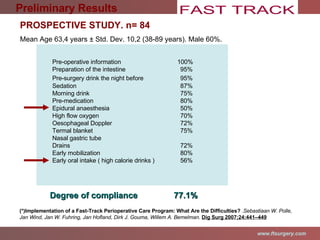
Degree of compliance   77.1%   63% (*)Implementation of a Fast-Track Perioperative Care Program: What Are the Difficulties?  . Sebastiaan W. Polle, Jan Wind, Jan W. Fuhring, Jan Hofland, Dirk J. Gouma, Willem A. Bemelman.   Dig Surg 2007;24:441–449 Mean Age 63,4 years  ± Std. Dev. 10,2 (38-89 years). Male 60%. Preliminary Results PROSPECTIVE STUDY. n= 84  Pre-operative information    100% 87% Preparation of the intestine 95%   100% Pre-surgery drink the night before   95% 83% Sedation 87%  40% Morning drink  75% 30% Pre-medication 80% 70% Epidural anaesthesia 50% 71% High flow oxygen 70% 67% Oesophageal Doppler 72% Termal blanket 75%   100% Nasal gastric tube 72% Drains 72% Early mobilization 80% 40% Early oral intake ( high calorie drinks ) 56% 13%
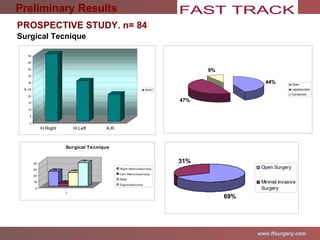
Surgical Tecnique  Preliminary Results PROSPECTIVE STUDY. n= 84  69% 31% Retrospective 69% 31%
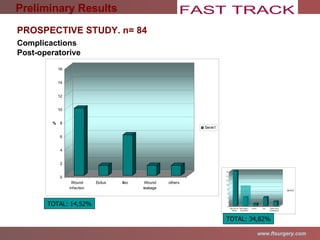
Complicactions Post-operatorive TOTAL: 14,52% Preliminary Results TOTAL: 34,82% PROSPECTIVE STUDY. n= 84
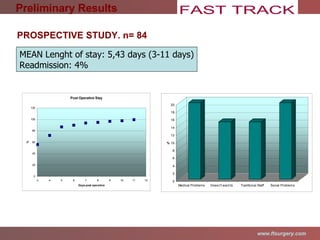
MEAN Lenght of stay: 5,43 days  (3-11 days) Readmission: 4%  Preliminary Results PROSPECTIVE STUDY. n= 84
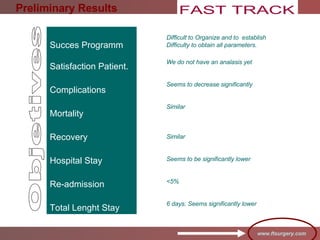
Preliminary Results Succes Programm Satisfaction Patient. Complications Mortality Recovery Hospital Stay Re-admission Total Lenght Stay Difficult to Organize and to  establish Difficulty to obtain all parameters. We do not have an analasis yet Seems to decrease significantly Similar Similar Seems to be significantly lower <5% 6 days. Seems significantly lower Objetives
 

Spanish Multi-Center Fast-Track Group - Protocol and Preliminary Results

  • 1.
    Spanish Multi-Center Fast-TrackGroup Protocol and Preliminary Results Dr. Arantxa Muñoz Duyos Hospital Mútua de Terrassa
  • 2.
    Dr. H Kehlet, Denmark,1986.
  • 3.
    Optimize the peri-operativetreatment of the patient with the goal to: reduce the morbility increase recovery after surgery reduce hospital lenght of stay ( los ) reduce hospital cost
  • 4.
    Bibliografy Fast TrackSurgery and Systematic review 37 Fast Track Colorectal Surgery 57 Fast-track colorectal surgery. Kehlet H. Lancet. 2008 Mar 8;371(9615):791-3. Implementation of a fast-track perioperative care program: what are the difficulties? Polle SW, Wind J, Fuhring JW, Hofland J, Gouma DJ, Bemelman WA. Dig Surg. 2007;24(6):441-9. Perioperative care in colorectal surgery Current practice patterns and opinions. Roig JV, García-Fadrique A, Redondo C, Villalba FL, Salvador A, García-Armengol J. Colorectal Dis. 2008 Oct 1.
  • 5.
    Colorectal Dis. Feb2009. ...” Mechanical bowel preparation is used by the majority (Austria, 91%; Germany, 94%); the vertical incision is the standard method of approach to the abdomen in Austria (79%) and Germany (83%), nasogastric decompression tubes are rarely used, one-third of the questioned surgeons in both countries use intra-abdominal drains . Half of the surgical centres allow the intake of clear fluids on the day of surgery and one-fifth offer solid food on that day”. Conclusions: ...”Although there is an evident benefit of fast-track management, the survey shows that they are not yet widely used as a routine”.
  • 6.
    MULTI-CENTER STUDY TOINTRODUCE A PROGRAM OF ENHANCED REHABILITATION IN COLORECTAL SURGERY
  • 7.
    Pre-Operative Intra-Operative Post-Operative¿What changes are presumed in the treatment of the patient?: Information and consent Appropriate Nutrition Non prepared colon Intake of Beverages rich in Carbohydrates pre-op . Avoid drainages Avoid naso-gastric tube Use of laparoscopic techniques Use of Transversal Incision Epidural Anastesia (open Surgery). Avoid Hypothermia Fluid therapy (“Goal-directed”).CardioQ Using high concentracions of Oxygen Early mobilization (on the same afternoon) Early energy intake (on the same afternoon)
  • 8.
    Objetives: What areour results for traditional surgery? Where are the difficulties of implementing a program of Fast-Track? Evidence of a multi-center group using the same protocol for the patients themselves. Are the results extrapolated to any other centers? Permanent audit of the multi-center group results. To collaborate with other national or international centers. To offer the best available information on fast-track to whom it may concern. Spanish Multi-center Fast-Track Group
  • 9.
    MULTI-CENTER STUDY FOR THE INTRODUCTION OF A PROGRAM ON ENHANCED REHABILITATION IN COLORECTAL SURGERY : Inclusion Criteria: Patients older than 18 years, scheduled for surgery intervention for right colon, left and / or rectum due to a malignant or benign cause. Exclusión Criteria: Emergency surgery. Patients in need of colostomy or ileostomy . Patients who have not signed informed consent .
  • 10.
    MULTI-CENTER STUDY FOR THE INTRODUCTION OF A PROGRAM ON ENHANCED REHABILITATION IN COLORECTAL SURGERY: Ethical Aspects : Taking into account that each point of “Fast Track” is a form of treatment fully accepted and supported by the best available scientific evidence was not considered appropriate by ethics committees and clinical trials on the approval request . However, patients are individually informed orally and in writing on the early rehabilitation program, expecting them to cooperate./ expecting from them their collaboration .
  • 11.
    PRE-OPERATIVE Verbal andwritten information about the early rehabilitation program and obtain signature for the informed consent . Evaluation of quality of life baseline : SF-36, EuroQoL. Malnourished patients (>10% weight in < than three months), hyperproteine supplement twice daily, at least the whole week before surgery. DAY -1: Non preparation of the colon. Two Enemas Casen ® at 20.00 hr. Normal intake in the morning. Throughout the afternoon, 4 Nutricia Preop ® bricks of 800 ml (100 mg of carbohydrates). During the afternoon, fluid intake on demand. A drink rich in carbohydrates at 20.00 hr. Not to use pre-medication. Prophylaxis of pulmonary embolism as usual . Protocol 1 2 3 4
  • 12.
    DAY 0: Twohours before surgery, intake of drink rich in carbohydrates (Nutricia Preop ®, 2 bricks, 400ml, 50g CHO). Two hours before Casen ® Enema. Not to use pre-medication. Routine Vital Signs surveillance IN THE OPERATING ROOM Surgeons: Not to use drains. Avoid gastric nasal tube. Attempt Laparoscopic intervention. Transverse incision in open surgery. Infiltrate wounds with Bupivacaine 0,25 % (20 ml). Protocol 5 6 7 8
  • 13.
    Anaesthesiologists: Epidural analgesia.At T9-T10 Bupivacaine 0,25/0,50% with Sulfentanyl/Fentanyl. Maintenance: Oxygen/air with FiO2>80%. Do not use morphine Analgesia with Paracetamol IV in the operating room, Diclofenac IV, u nless contraindication or alteration of the renal function. Anti-emetics: Ondansetron IV (Zofran) 4 mg. Do not use Dexamethason.( If necessary use Droperidol 0.625 mg or Haloperidol 1 mg). Thermal blanket. Monitoring: Routine + esophageal Doppler. Central catheter / arterial catheter if necessary *Goal directed fluidtherapy Optimization according to ejection volume (Stroke Volume) with the esophageal Doppler probe (Reset volume bolus of coloid 250cc depending on the drop in the cardiac output measured by the esophageal Doppler). (*)Grocott M et al. Anesth Analg. 2005;100:1093–1106. (*)Bundgaard-Nielsen M et al. Acta Anaesthesiol Scand. 2007;51:331–340 . Protocol 9 10 11 12
  • 14.
    DAY 0. Postoperativefirst hours: High flow oxygen mask for 2 hours. After nasal mask to keep saturation >95%. In the afternoon mobilize the patient to arm chair (min. 2 hrs) From 18.00 hr, liquid diet (800-1000cc) + 2 units rich in protein and calories. Minimum diuresis (500cc first 24 hrs). Analgesia with 1 gr Paracetamol/ 6 hrs + Epidural catheter. Gluco-saline maintenance. Protocol 13 14
  • 15.
    DAY +1: Liquiddiet (min. 2 liters) + 3 energy preps. Movilization with armchair 6 hrs. day. Discontinue fluids IV if tolerated. IV access heparinized. Maintain epidural pump (if any). Paracetamol 1 gr / 6 hrs. Lactulose 1 pack / 12 hrs. Protocol
  • 16.
    DAY +2: Suspendepidural catheter. Start with NSAIDs . Soft / normal diet. Mobilization on demand. Remove bladder catheter. Evaluate criterias for discharge and take decision over it. DAY +3: Revision of the patient's general state . Evaluate criterias for discharge. Evaluate criterias for discharge and take decision over it. DAY +4 and the following: Similar to Day +3. DAY +10: Visit post hospitalization and assessment QoL: SF-36, EuroQoL. Protocol
  • 17.
    Only oral analgesiaMobilization until preoperative level Tolerates solid nutrition Flatulation Absence of nausea Wants to go home Discharge criteria
  • 18.
    Hospital Do Mexoeiro.Vigo Hospital Fundación de Calahorra Hospital Clínico Universitario. Zaragoza Hospital Mútua de Terrassa Hospital General Universitario de Valencia Hospital Universitario de Elche Hospital Son Llatzer. Palma de Mallorca Hospital Clínico San Carlos de Madrid Hospital Gregorio Marañón. Madrid Hospital La Paz. Madrid Complejo Hospitalario La Mancha-Centro (A. de San Juan ) Participants
  • 19.
  • 20.
  • 21.
  • 22.
  • 23.
    Hospital Do Mexoeiro.Vigo Hospital Fundación de Calahorra Hospital Clínico Universitario. Zaragoza Hospital Mutua de Terrassa. Hospital General Universitario de Valencia Hospital Universitario de Elche Hospital Son Llàtzer. Palma de Mallorca Hospital Clínico San Carlos de Madrid Hospital Gregorio Marañón. Madrid Hospital La Paz. Madrid Complejo Hospitalario La Mancha-Centro (A. de San Juan) 1 st of April 1 st of June Inclusion
  • 24.
    Retrospective study (dataIntroduction) Prospective study (prepared for the study) Inclusion June July August September October June July August September October 1 st of April 5 th of November
  • 25.
    Retrospective study (182patients) Multi-center study to introduce a program of enhanced rehabilitation in colorectal surgery Preliminary results Average age 69,6 years ± Std. Dev. 13,2 (43 - 89 years). Male 61%. 69% 31% Way of Approach Preliminary results Surgical Technique
  • 26.
    Complications Post-operative TOTAL:34,82% % Mean Stay: 12,1 days ± Std. Dev. 13,731 (4-78 days) Preliminary Results Retrospective Study (182 patients)
  • 27.
    Design of thestudy: Data is analized on the principle of “intention to treat” Meets Inclusion Criteria Doesn’t meet Exclusion Criteria STUDY PATIENT Objetives: Succes of the Programm Satisfaction of the Patient Complications Mortality Re-operated Hospital stay Re-admission Total lenght of stay Preliminary Results PROSPECTIVE STUDY Pre-operatoria information yes / no Preparation intestine yes / no Pre-surgery drink the night before yes / no Sedation yes / no Morning drink yes / no Pre-medication yes / no Epidural anaesthesia yes / no High flow oxygen yes / no Oesophageal Doppler yes / no Thermal blanket yes / no Nasal gastric tube yes / no Drains yes / no Early mobilization yes / no Early oral intake (High calorie drinks) yes / no
  • 28.
    Degree of compliance 77.1% 63% (*)Implementation of a Fast-Track Perioperative Care Program: What Are the Difficulties? . Sebastiaan W. Polle, Jan Wind, Jan W. Fuhring, Jan Hofland, Dirk J. Gouma, Willem A. Bemelman. Dig Surg 2007;24:441–449 Mean Age 63,4 years ± Std. Dev. 10,2 (38-89 years). Male 60%. Preliminary Results PROSPECTIVE STUDY. n= 84 Pre-operative information 100% 87% Preparation of the intestine 95% 100% Pre-surgery drink the night before 95% 83% Sedation 87% 40% Morning drink 75% 30% Pre-medication 80% 70% Epidural anaesthesia 50% 71% High flow oxygen 70% 67% Oesophageal Doppler 72% Termal blanket 75% 100% Nasal gastric tube 72% Drains 72% Early mobilization 80% 40% Early oral intake ( high calorie drinks ) 56% 13%
  • 29.
    Surgical Tecnique Preliminary Results PROSPECTIVE STUDY. n= 84 69% 31% Retrospective 69% 31%
  • 30.
    Complicactions Post-operatorive TOTAL:14,52% Preliminary Results TOTAL: 34,82% PROSPECTIVE STUDY. n= 84
  • 31.
    MEAN Lenght ofstay: 5,43 days (3-11 days) Readmission: 4% Preliminary Results PROSPECTIVE STUDY. n= 84
  • 32.
    Preliminary Results SuccesProgramm Satisfaction Patient. Complications Mortality Recovery Hospital Stay Re-admission Total Lenght Stay Difficult to Organize and to establish Difficulty to obtain all parameters. We do not have an analasis yet Seems to decrease significantly Similar Similar Seems to be significantly lower <5% 6 days. Seems significantly lower Objetives
  • 33.