







DIPSI Guideline on GDM
Dr Sujoy Dasgupta
MBBS (Gold Medalist, Hons)
MS (OBGY- Gold Medalist)
DNB (New Delhi)
MRCOG (London)
Advanced ART Course for Clinicians (NUHS, Singapore)
Consultant: Reproductive Medicine, Genome Fertility Centre, Kolkata
Visiting Consultant, RSV Hospital, Kolkata
Bhagirathi Neotia Women and Child Care centre
Woodlands Multispeciality Hospital, Kolkata
Managing Committee Member, Bengal Obstetric & Gynaecological Society (BOGS)
Secretary, Subfertility and Reproductive Endocrinology Committee, BOGS
Executive Committee Member, Indian Fertility Society (IFS)- West Bengal Chapter
Executive Committee Member, Indian Society for Assisted Reproduction (ISAR)- Bengal
Member, Endocrinology Committee, Federation of Obstetric and Gynaecological Societies of India (FOGSI)
Winner, Prof Geoffrey Chamberlain Award, RCOG World Congress, London, 2019
Diabetes in Pregnancy
1. Pre-existing (Overt DM)
2. Newly Diagnosed in Pregnancy (GDM)
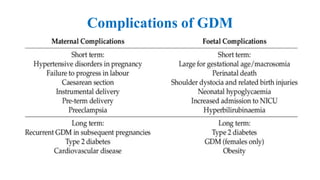
Complications of GDM
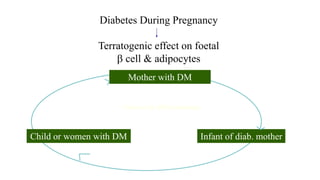
Diabetes During Pregnancy
Terratogenic effect on foetal
 cell & adipocytes
Mother with DM
Infant of diab. mother
Child or women with DM
Vicious cycle DM in pregnancy
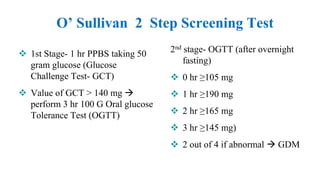
O’ Sullivan 2 Step Screening Test
2nd stage- OGTT (after overnight
fasting)
 0 hr ≥105 mg
 1 hr ≥190 mg
 2 hr ≥165 mg
 3 hr ≥145 mg)
 2 out of 4 if abnormal  GDM
 1st Stage- 1 hr PPBS taking 50
gram glucose (Glucose
Challenge Test- GCT)
 Value of GCT > 140 mg 
perform 3 hr 100 G Oral glucose
Tolerance Test (OGTT)
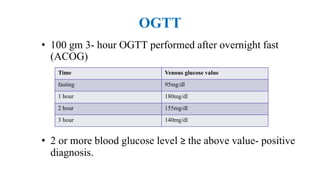
OGTT
• 100 gm 3- hour OGTT performed after overnight fast
(ACOG)
• 2 or more blood glucose level ≥ the above value- positive
diagnosis.
Time Venous glucose value
fasting 95mg/dl
1 hour 180mg/dl
2 hour 155mg/dl
3 hour 140mg/dl
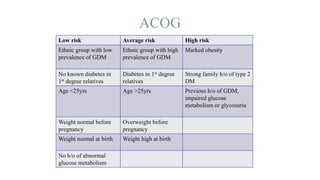
ACOG
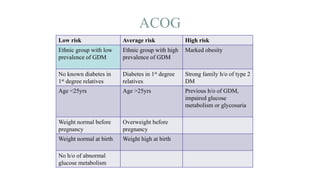
Low risk Average risk High risk
Ethnic group with low
prevalence of GDM
Ethnic group with high
prevalence of GDM
Marked obesity
No known diabetes in
1st degree relatives
Diabetes in 1st degree
relatives
Strong family h/o of type 2
DM
Age <25yrs Age >25yrs Previous h/o of GDM,
impaired glucose
metabolism or glycosuria
Weight normal before
pregnancy
Overweight before
pregnancy
Weight normal at birth Weight high at birth
No h/o of abnormal
glucose metabolism
ACOG
Low risk Average risk High risk
Ethnic group with low
prevalence of GDM
Ethnic group with high
prevalence of GDM
Marked obesity
No known diabetes in
1st degree relatives
Diabetes in 1st degree
relatives
Strong family h/o of type 2
DM
Age <25yrs Age >25yrs Previous h/o of GDM,
impaired glucose
metabolism or glycosuria
Weight normal before
pregnancy
Overweight before
pregnancy
Weight normal at birth Weight high at birth
No h/o of abnormal
glucose metabolism
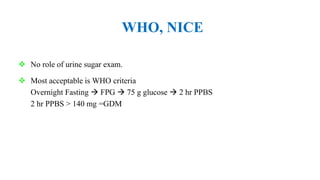
WHO, NICE
 No role of urine sugar exam.
 Most acceptable is WHO criteria
Overnight Fasting  FPG  75 g glucose  2 hr PPBS
2 hr PPBS > 140 mg =GDM
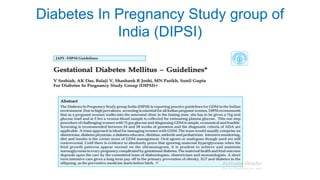
Diabetes In Pregnancy Study group of
India (DIPSI)
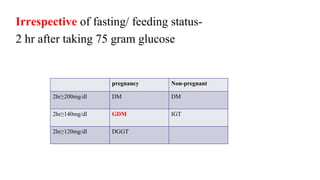
Irrespective of fasting/ feeding status-
2 hr after taking 75 gram glucose
pregnancy Non-pregnant
2hr≥200mg/dl DM DM
2hr≥140mg/dl GDM IGT
2hr≥120mg/dl DGGT
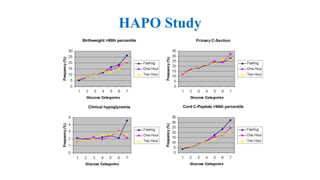
HAPO Study
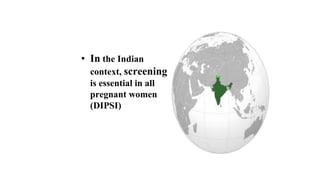
• In the Indian
context, screening
is essential in all
pregnant women
(DIPSI)
When to screen
• Early Pregnancy
• 24-28 wk (if early screen is negative)
Management
Management
• Fasting glucose >120- Insulin/ OHA
• FPG <120- MNT
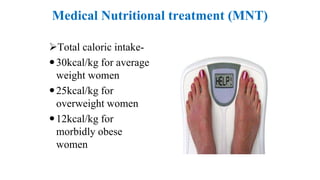
Medical Nutritional treatment (MNT)
Total caloric intake-
30kcal/kg for average
weight women
25kcal/kg for
overweight women
12kcal/kg for
morbidly obese
women
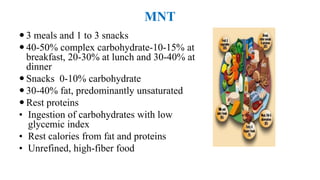
MNT
 3 meals and 1 to 3 snacks
 40-50% complex carbohydrate-10-15% at
breakfast, 20-30% at lunch and 30-40% at
dinner
 Snacks 0-10% carbohydrate
 30-40% fat, predominantly unsaturated
 Rest proteins
• Ingestion of carbohydrates with low
glycemic index
• Rest calories from fat and proteins
• Unrefined, high-fiber food
Exercise
• Resistance exercises
decrease requirement
for insulin
• Strenuous exercises is
discouraged
• Stretching exercises is
encouraged
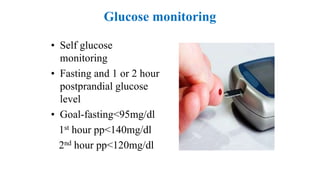
Glucose monitoring
• Self glucose
monitoring
• Fasting and 1 or 2 hour
postprandial glucose
level
• Goal-fasting<95mg/dl
1st hour pp<140mg/dl
2nd hour pp<120mg/dl
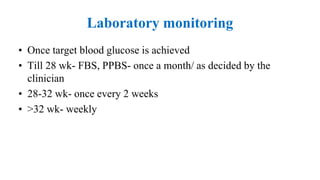
Laboratory monitoring
• Once target blood glucose is achieved
• Till 28 wk- FBS, PPBS- once a month/ as decided by the
clinician
• 28-32 wk- once every 2 weeks
• >32 wk- weekly
If goal is not met by MNT in 2 weeks
• Insulin/ OHA
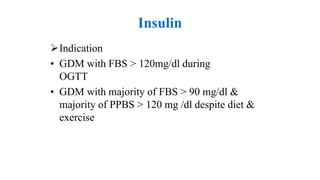
Insulin
Indication
• GDM with FBS > 120mg/dl during
OGTT
• GDM with majority of FBS > 90 mg/dl &
majority of PPBS > 120 mg /dl despite diet &
exercise
Which OHA
• Metformin
• Glibenclamide (Glyburide)
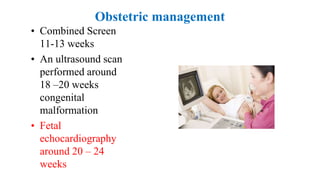
Obstetric management
• Combined Screen
11-13 weeks
• An ultrasound scan
performed around
18 –20 weeks
congenital
malformation
• Fetal
echocardiography
around 20 – 24
weeks
Fetal surveillance
• EFW by USG- 28, 32 36 weeks
• Doppler- From 38 weeks (If uncomplicated)
Delivery
When to induce?
• Low risk GDM- allow to develop
spontaneous labour at term
• At 40wks –induce labour
• High risk GDM-induction at 38wks
Mode of delivery
Vaginal route preferred
Cesarean section-
1. Past obstetric history
2. Other obstetric complications
3. Fetal weight 4.5 kg or more
4. Patient’s will
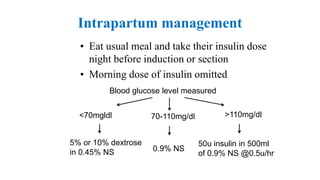
Intrapartum management
• Eat usual meal and take their insulin dose
night before induction or section
• Morning dose of insulin omitted
Blood glucose level measured
<70mgldl 70-110mg/dl >110mg/dl
5% or 10% dextrose
in 0.45% NS 0.9% NS
50u insulin in 500ml
of 0.9% NS @0.5u/hr
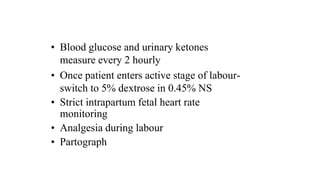
• Blood glucose and urinary ketones
measure every 2 hourly
• Once patient enters active stage of labour-
switch to 5% dextrose in 0.45% NS
• Strict intrapartum fetal heart rate
monitoring
• Analgesia during labour
• Partograph
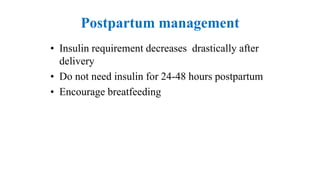
Postpartum management
• Insulin requirement decreases drastically after
delivery
• Do not need insulin for 24-48 hours postpartum
• Encourage breatfeeding
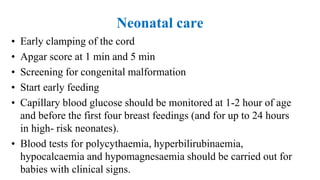
Neonatal care
• Early clamping of the cord
• Apgar score at 1 min and 5 min
• Screening for congenital malformation
• Start early feeding
• Capillary blood glucose should be monitored at 1-2 hour of age
and before the first four breast feedings (and for up to 24 hours
in high- risk neonates).
• Blood tests for polycythaemia, hyperbilirubinaemia,
hypocalcaemia and hypomagnesaemia should be carried out for
babies with clinical signs.
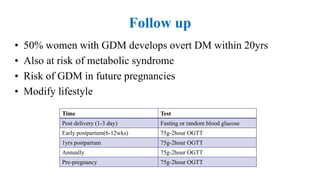
Follow up
• 50% women with GDM develops overt DM within 20yrs
• Also at risk of metabolic syndrome
• Risk of GDM in future pregnancies
• Modify lifestyle
Time Test
Post delivery (1-3 day) Fasting or random blood glucose
Early postpartum(6-12wks) 75g-2hour OGTT
1yrs postpartum 75g-2hour OGTT
Annually 75g-2hour OGTT
Pre-pregnancy 75g-2hour OGTT
What we need
• Awareness- Before, During, After pregnancy
• Pre-conceptional care
• Glycaemic Control
• Obstetric Management
• Monitoring
• Delivery Plan
• Multidisciplinary Team
Thank You
DIPSI Guideline on GDM

DIPSI Guideline on GDM

  • 1.
    DIPSI Guideline onGDM Dr Sujoy Dasgupta MBBS (Gold Medalist, Hons) MS (OBGY- Gold Medalist) DNB (New Delhi) MRCOG (London) Advanced ART Course for Clinicians (NUHS, Singapore) Consultant: Reproductive Medicine, Genome Fertility Centre, Kolkata Visiting Consultant, RSV Hospital, Kolkata Bhagirathi Neotia Women and Child Care centre Woodlands Multispeciality Hospital, Kolkata Managing Committee Member, Bengal Obstetric & Gynaecological Society (BOGS) Secretary, Subfertility and Reproductive Endocrinology Committee, BOGS Executive Committee Member, Indian Fertility Society (IFS)- West Bengal Chapter Executive Committee Member, Indian Society for Assisted Reproduction (ISAR)- Bengal Member, Endocrinology Committee, Federation of Obstetric and Gynaecological Societies of India (FOGSI) Winner, Prof Geoffrey Chamberlain Award, RCOG World Congress, London, 2019
  • 2.
    Diabetes in Pregnancy 1.Pre-existing (Overt DM) 2. Newly Diagnosed in Pregnancy (GDM)
  • 3.
  • 4.
    Diabetes During Pregnancy Terratogeniceffect on foetal  cell & adipocytes Mother with DM Infant of diab. mother Child or women with DM Vicious cycle DM in pregnancy
  • 5.
    O’ Sullivan 2Step Screening Test 2nd stage- OGTT (after overnight fasting)  0 hr ≥105 mg  1 hr ≥190 mg  2 hr ≥165 mg  3 hr ≥145 mg)  2 out of 4 if abnormal  GDM  1st Stage- 1 hr PPBS taking 50 gram glucose (Glucose Challenge Test- GCT)  Value of GCT > 140 mg  perform 3 hr 100 G Oral glucose Tolerance Test (OGTT)
  • 6.
    OGTT • 100 gm3- hour OGTT performed after overnight fast (ACOG) • 2 or more blood glucose level ≥ the above value- positive diagnosis. Time Venous glucose value fasting 95mg/dl 1 hour 180mg/dl 2 hour 155mg/dl 3 hour 140mg/dl
  • 7.
    ACOG Low risk Averagerisk High risk Ethnic group with low prevalence of GDM Ethnic group with high prevalence of GDM Marked obesity No known diabetes in 1st degree relatives Diabetes in 1st degree relatives Strong family h/o of type 2 DM Age <25yrs Age >25yrs Previous h/o of GDM, impaired glucose metabolism or glycosuria Weight normal before pregnancy Overweight before pregnancy Weight normal at birth Weight high at birth No h/o of abnormal glucose metabolism
  • 8.
    ACOG Low risk Averagerisk High risk Ethnic group with low prevalence of GDM Ethnic group with high prevalence of GDM Marked obesity No known diabetes in 1st degree relatives Diabetes in 1st degree relatives Strong family h/o of type 2 DM Age <25yrs Age >25yrs Previous h/o of GDM, impaired glucose metabolism or glycosuria Weight normal before pregnancy Overweight before pregnancy Weight normal at birth Weight high at birth No h/o of abnormal glucose metabolism
  • 9.
    WHO, NICE  Norole of urine sugar exam.  Most acceptable is WHO criteria Overnight Fasting  FPG  75 g glucose  2 hr PPBS 2 hr PPBS > 140 mg =GDM
  • 10.
    Diabetes In PregnancyStudy group of India (DIPSI)
  • 11.
    Irrespective of fasting/feeding status- 2 hr after taking 75 gram glucose pregnancy Non-pregnant 2hr≥200mg/dl DM DM 2hr≥140mg/dl GDM IGT 2hr≥120mg/dl DGGT
  • 12.
  • 13.
    • In theIndian context, screening is essential in all pregnant women (DIPSI)
  • 14.
    When to screen •Early Pregnancy • 24-28 wk (if early screen is negative)
  • 15.
  • 16.
    Management • Fasting glucose>120- Insulin/ OHA • FPG <120- MNT
  • 17.
    Medical Nutritional treatment(MNT) Total caloric intake- 30kcal/kg for average weight women 25kcal/kg for overweight women 12kcal/kg for morbidly obese women
  • 18.
    MNT  3 mealsand 1 to 3 snacks  40-50% complex carbohydrate-10-15% at breakfast, 20-30% at lunch and 30-40% at dinner  Snacks 0-10% carbohydrate  30-40% fat, predominantly unsaturated  Rest proteins • Ingestion of carbohydrates with low glycemic index • Rest calories from fat and proteins • Unrefined, high-fiber food
  • 19.
    Exercise • Resistance exercises decreaserequirement for insulin • Strenuous exercises is discouraged • Stretching exercises is encouraged
  • 20.
    Glucose monitoring • Selfglucose monitoring • Fasting and 1 or 2 hour postprandial glucose level • Goal-fasting<95mg/dl 1st hour pp<140mg/dl 2nd hour pp<120mg/dl
  • 21.
    Laboratory monitoring • Oncetarget blood glucose is achieved • Till 28 wk- FBS, PPBS- once a month/ as decided by the clinician • 28-32 wk- once every 2 weeks • >32 wk- weekly
  • 22.
    If goal isnot met by MNT in 2 weeks • Insulin/ OHA
  • 23.
    Insulin Indication • GDM withFBS > 120mg/dl during OGTT • GDM with majority of FBS > 90 mg/dl & majority of PPBS > 120 mg /dl despite diet & exercise
  • 24.
    Which OHA • Metformin •Glibenclamide (Glyburide)
  • 25.
    Obstetric management • CombinedScreen 11-13 weeks • An ultrasound scan performed around 18 –20 weeks congenital malformation • Fetal echocardiography around 20 – 24 weeks
  • 26.
    Fetal surveillance • EFWby USG- 28, 32 36 weeks • Doppler- From 38 weeks (If uncomplicated)
  • 27.
  • 28.
    When to induce? •Low risk GDM- allow to develop spontaneous labour at term • At 40wks –induce labour • High risk GDM-induction at 38wks
  • 29.
    Mode of delivery Vaginalroute preferred Cesarean section- 1. Past obstetric history 2. Other obstetric complications 3. Fetal weight 4.5 kg or more 4. Patient’s will
  • 30.
    Intrapartum management • Eatusual meal and take their insulin dose night before induction or section • Morning dose of insulin omitted Blood glucose level measured <70mgldl 70-110mg/dl >110mg/dl 5% or 10% dextrose in 0.45% NS 0.9% NS 50u insulin in 500ml of 0.9% NS @0.5u/hr
  • 31.
    • Blood glucoseand urinary ketones measure every 2 hourly • Once patient enters active stage of labour- switch to 5% dextrose in 0.45% NS • Strict intrapartum fetal heart rate monitoring • Analgesia during labour • Partograph
  • 32.
    Postpartum management • Insulinrequirement decreases drastically after delivery • Do not need insulin for 24-48 hours postpartum • Encourage breatfeeding
  • 33.
    Neonatal care • Earlyclamping of the cord • Apgar score at 1 min and 5 min • Screening for congenital malformation • Start early feeding • Capillary blood glucose should be monitored at 1-2 hour of age and before the first four breast feedings (and for up to 24 hours in high- risk neonates). • Blood tests for polycythaemia, hyperbilirubinaemia, hypocalcaemia and hypomagnesaemia should be carried out for babies with clinical signs.
  • 34.
    Follow up • 50%women with GDM develops overt DM within 20yrs • Also at risk of metabolic syndrome • Risk of GDM in future pregnancies • Modify lifestyle Time Test Post delivery (1-3 day) Fasting or random blood glucose Early postpartum(6-12wks) 75g-2hour OGTT 1yrs postpartum 75g-2hour OGTT Annually 75g-2hour OGTT Pre-pregnancy 75g-2hour OGTT
  • 35.
    What we need •Awareness- Before, During, After pregnancy • Pre-conceptional care • Glycaemic Control • Obstetric Management • Monitoring • Delivery Plan • Multidisciplinary Team
  • 36.