Division of Trauma Surgery and Critical Care
JPN Apex Trauma Center
All India Institute of Medical Sciences
TRAUMA CENSUS 2016
ED ATTENDANCE 2016 (n=66,891)
46998, 71%
15677, 23%
3926, 6%
Triage
Green
Yellow
Red
FIVE YEAR ED DATA
Year 2012 2013 2014 2015 2016
Total 53050 55171 55734 64913 66,891
2.6% INCREASE IN ED ATTENDANCE
38964 35316
40928
49677 46998
10950 17066
11729
11612 15677
3136 2789 3077
3624 3926
0
10000
20000
30000
40000
50000
60000
70000
2012 2013 2014 2015 2016
RED
YELLOW
GREEN
EMERGENCY DEPARTMENT
RED AREA DETAILS (N= 3906)
SPECIALITY TOTAL NO ADMITTED
RE-TRIAGED TO
YELLOW
ADMITTED/
TRANSFER OUT/
DISCHARGED
SURGERY 1465 1408 57 18/8/31
NEURO-
SURGERY 1530 1309 221 16/134/71
ORTHO 911 206 705 350/342/13
ED INTERVENTIONS (N=19,078)
Procedure No.
Suturing 18532
ICD Insertion 492
Tracheostomy 1
Cricothyroidotomy 0
SPC (Percutaneous) 17
CT Angiography 36
ADMISSION UNDER TRAUMA SURGERY
(N=1960)
1426, 73%
534, 27%
A
ED
FUC
YEARLY SURGERY ADMISSIONS
YEAR 2012 2013 2014 2015 2016
SURGERY
ADMISSIONS
1299 1625 1789 1879 1960
918
1348 1284 1386 1426
381
275 505 493 534
2012 2013 2014 2015 2016
ED FOLLOW UP
4% increase in annual surgery admissions
DEMOGRAPHIC PROFILE (N=1426)
1217,
85%
209, 15%
M/F
Male
Female
1152,
81%
150, 10%
124,
9%
Adult ( >18yrs)
Adolescent
(12-18)
Pediatric
(<12yrs)
Demographic Profile (n-1426)
Trend over 3 years
Numbers of Admissions(n-1426)
55
189
476
312
170
43 33
6
87
246
491
296
136
79
37 14
106
240
536
265
130
101
39
9
less than 10 11-20 yrs 21-30 yrs 31-40 yrs 41-50 yrs 51-60 yrs 61-70 yrs more than 70
2014
2015
2016
MODE OF INJURY (N-1426)
52.8%
17.4%
13.8%
9.9%
4.4%
1.6%
0
100
200
300
400
500
600
700
800
Distribution
Distribution
719
174 170 193
10 18
835
210 185
97 40 19753 248 197 142 64 22
0
100
200
300
400
500
600
700
800
900
RTA FFH ASSAULT UNINTENTIONAL RAILWAY TRACK
INJURY
SELF INFLICTED
2014
2015
2016
Mode of Injury (n-1426)
Trend over 3 years
Modes of RTI (n- 753, 52.8% )
Mode of RTI No. %
Pedestrian 161 21.3
Bicycle 22 2.9
Motorized 2 wheeler 311 41.3
Motorized 3 wheeler 49 6.5
4 wheeler 88 11.7
Heavy vehicle 43 5.7
Bullock cart 6 0.7
Unknown 73 9.6
Assault Cases (n=197, 13.8% )
39, 20%
108, 55%
50, 25%
Cases
Blunt assault
Low velocity
penetrating
high velocity
Penetrating
Anatomical Distribution of Injuries
(n= 2029)
97 101
409
680
452
182
108
0
100
200
300
400
500
600
700
800
Series 1
Head &
Neck
Maxillof
acial
Chest
Abdome
n &
Pelvis
Extremit
ies
Soft
tissue
Vascular
2016 97 101 409 680 452 182 108
2015 108 129 429 595 495 344 139
2014 119 129 444 492 475 205 136
97 101
409
680
452
182
108
108 129
429
595
495
344
139
119 129
444
492 475
205
136
0
100
200
300
400
500
600
700
800
AxisTitle
Anatomical Distribution of Injuries(n=2029)
Trend over 3 years
Abdominal Trauma (n=680)
(33.5% of all Trauma, n= 2029)
Organ Involved No.
Solid Organ
(Liver or Spleen)
Single
Organ
197
> 1 Organ 97
Hollow Viscus 103
Genitourinary 67
Pancreatico-duodenal 26
Others (Hemoperitoneum,
Retroperitoneal hematoma)
191
Liver Trauma (n= 139)
(20.5% of all abdominal Trauma , n= 680 )
90, 64.7 %
49, 35.2 %
ISOLATED
ASSOCIATED
16
38
24
33
28
0
5
10
15
20
25
30
35
40
GRADE
1
GRADE
2
GRADE
3
GRADE
4
GRADE
5
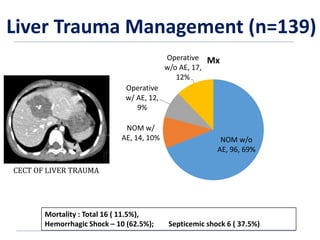
Liver Trauma Management (n=139)
CECT OF LIVER TRAUMA
Mortality : Total 16 ( 11.5%),
Hemorrhagic Shock – 10 (62.5%); Septicemic shock 6 ( 37.5%)
NOM w/o
AE, 96, 69%
NOM w/
AE, 14, 10%
Operative
w/ AE, 12,
9%
Operative
w/o AE, 17,
12%
Mx
Splenic Trauma (n= 116)
(17.1% of Abdominal Trauma, n= 680)
68, 58.6%
48, 41.3%
ISOLATED
ASSOCIATED
17
28
23
34
14
0
5
10
15
20
25
30
35
40
GRADE 1 GRADE 2 GRADE 3 GRADE 4 GRADE 5
Splenic Trauma Management (n=116)
CECT OF SPLENIC INJURY
Non-
Operative
w/o AE, 62,
53%
Non-
operative
with AE, 28,
24%
Splenectom
y, 24, 21%
Splenorrap
hy, 2, 2%
Mortality : Total 2 ( 1.7%),
Hemorrhagic Shock – 1 (50%); Septicemic shock 1 ( 50%)
Failure of NOM - 0
Hollow Viscus Trauma(n=103)
(15.1% of abdominal Trauma , n= 680)
Hollow Viscus Procedure Nos.
Esophagus:
3 (2.9)%)
Cervical Oesophagostomy + FJ
3
Stomach:
15 (15.9%)
Repair
15
Jejunum:
39 (39.4%)
Repair 18
RA + FJ 21
Ileum:
23 (21.2%)
Repair 8
RA 5
Ileostomy 10
Colon And Rectum:
23 (23.4%)
Repair 6
RA 3
End Colostomy 12
Loop Colostomy 2
Pancreatico-duodenal Trauma(n=26)
3.8% of all abdominal Trauma, n= 680
Procedure No.
Spleen preserving Distal Pancreatectomy 5
Distal Pancreatectomy + Splenectomy 5
Repair of laceration 1
NOM 7
Isolated Pancreatic Trauma
(n=18; 69.2%)
Mortality : Total 1 (3.8%),
Hemorrhagic Shock – 0; MODS – 1 ( 100%)
Procedure No.
Drain Placement for Duodenal Hematoma 1
Repair + RD + FJ 3
NOM 2
Pyloric Exclusion + GJ + RD + Repair
(2nd part of Duodenal Injury)
2
Pancreatico-duodenal Trauma(n=26)
Pancreatic Associated with Duodenal Trauma
(8; 30.7%)
Genitourinary trauma (n=67)
(9.8 of Abdominal trauma (n=680)
Management
KIDNEY
(41, 61.9%)
Operative:
• Nephrectomy
• Repair
4
3
NOM
34
URETER
(4, 6.3%)
Repair
DJ Stenting
1
3
Genitourinary trauma(n=67)
Management
BLADDER
(11, 17.4%)
Extraperitoneal NOM WITH PUC 5
Intraperitoneal
Repair with SPC 4
Repair with PUC 2
URETHRA
(5, 7.9%)
SPC 5
TESTES
(1, 1.5%)
Repair 1
PENILE TRAUMA
(3, 4.7%)
Repair
3
VAGINAL TRAUMA
2
Repair 2
Laparoscopic & Endoscopic Procedures
(n=51)
Procedure No.
Diagnostic Laparoscopy 38
Lap Diaphragmatic Repair 4
PEG 4
Lap Cholecystectomy 3
Percutaneous endoscopic Necrosectomy 2
Thoracic Trauma (n=409)
314,
81%
73,
19%
B
With ICD
Without ICD
387, 95%
22, 5%
A
Non-Operative
Operative
Mortality : Total 15 (3.66%),
Hemorrhagic Shock – 4 (27.5%); Septicemic shock 11 ( 66.5%)
Thoracic Injury (n=409)
Operative Cases, n=22; 5.5%
Intra-op picture of Thoracotomy
Major Indications No.
Massive Hemothorax 6
Cardiac Trauma 4
VATS 3
Bronchopleural fistula
3
Subclavian artery injury
2
Lung hernia repair 1
Resuscitative
Thoracotomy
3
Vascular Trauma
Upper Limb, n=66, 68.04%
Peripheral Vascular Trauma (n=97)
7
29
10
14
6
0
5
10
15
20
25
30
35
AXILLARY BRACHIAL RADIAL ULNAR RADIAL+ULNAR
Lower Limb (n=31, 30.92%)
Peripheral Vascular Trauma (n=97)
11
20
0
2
4
6
8
10
12
14
16
18
20
FEMORAL POPLITEAL
Vascular Trauma Management(n=97)
Average
Critical
Ischemic
time
(Hrs)
INTERPOSITION
GRAFT
EEA with
EMBOLECTOM
Y
EMBOLECT
OMY only
Outcome
RSVG Synthetic Limb
salvage
Ampu
tation
AXILLARY (7) 8Hrs 1 - 6 0
6 1
BRACHIAL
(29)
7.5hrs 8 - 18 3 29 0
RADIAL (12) 6Hrs - - 12 0 12 0
ULNAR (18) 6Hrs - - 18 0 18 0
FEMORAL
(11)
9Hrs 2 1 7 1 10 1
POPLITEAL
(20)
6.5Hrs 10 - 4 6 17 3
Vascular Trauma Management(n=97)
EtE Anastomosis : 65 cases, 66.2%
Reverse Saphenous Graft : 21 cases, 22.4%
Embolectomy: 10 cases, 9.4%
PTFE Graft (Femoral artery): 1 case, 1.3%
Primary Amputation: 0
Amputation (after vascular intervention): 5 cases, 5.7%
Central Vascular Injury(n=11)
VESSEL INVOLVED NO. MANAGEMENT
Subclavian Artery 02
04
Inter-position grafting
Non op ( Concomitant
Brachial Plexus Injury -
Viable non-functional
limb)
Inferior Vena Cava 01 Primary Repair
Descending Thoracic Aorta 02 Stent grafting
External Carotid Artery 01 Repair
Common carotid artery 1 REPAIR
Neck trauma (n=29)
9, 31%
13, 45%
2, 7%
5, 17%
A
Blunt
Low velocity
penetrating
High velocity
penetrating
Kite injuries
Neck trauma –Injury distribution (n=29)
7
15
7
0
5
10
15
20
AeroDigestive Vascular Soft tissues
Injuries
3
20
6
0
10
20
30
Zone I Zone II Zone III
Neck Zones
Neck trauma – Management (n=29)
Procedure No.
Primary Tracheal Repair 05
Exploration with Hemostasis 12
Primary Repair of Larynx 02
NOM 10
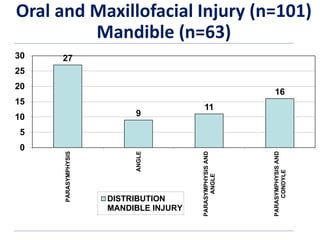
Oral and Maxillofacial Injury (n=101)
Mandible (n=63)
27
9
11
16
0
5
10
15
20
25
30
PARASYMPHYSIS
ANGLE
PARASYMPHYSISAND
ANGLE
PARASYMPHYSISAND
CONDYLE
DISTRIBUTION
MANDIBLE INJURY
Oral and Maxillofacial (n=101)
Others (n=38)
Subdivision of Cases-Mid Face
7
10
9
12
0
2
4
6
8
10
12
14
Lefort1
Lefort2
Lefort3
ZMCwith
panfacial
Soft Tissue Reconstructive Procedures
(n=862)
265, 30.6%
368, 42.4%
129, 15.3%
4, 0.4%
96, 11.1%
STSG DEBRIDEMENT DEBRIDEMENT + STSG FTG FLAP
Laparotomy (n=194)
140
49
5
0
20
40
60
80
100
120
140
160
PRIMARY
CLOSURE
MESH
LAPAROSTOMY
DELAYED PRIMARY CLOSURE
72.1%
27.9%
Operative Procedures(n=1948)
1497, 76%
348, 17%
132, 7%
Distribution
General
Anesthesia
Spinal anesthesia
Local Anesthesia
OPERATIVE PROCEDURES (N= 1948)
Type No.
EMERGENCY 765
PLANNED 1183
Region-wise No.
ABDOMEN 324
THORAX 41
MAXILLO-FACIAL 101
VASCULAR 108
EXTREMITIES 794
HEAD &NECK 55
GENITO URINARY 31
PLASTIC AND SOFT
TISSUE
494
Type of Anesthesia No.
GA 1459
SA 343
LA+BRACHIAL 146
NUMBER OF SURGICAL PROCEDURES
THORAX
THORACOTOMY 26
VATS 3
ABDOMEN
SPLEEN
SPLENECTOMY 29
SPLENORRHAPHY 2
LIVER
PACKING 29
PACK REMOVAL 25
OESOPHAGUS OESOPHAGOSTOMY 3
REPAIR 0
STOMACH
REPAIR 15
PEG 4
DUODENUM REPAIR 5
DUODENOSTOMY+FJ 5
JEJUNUM
REPAIR 18
RA 21
ABDOMEN
ILEUM
REPAIR 8
ILEOSTOMY+REPAIR 10
COLON
COLOSTOMY 14
REPAIR 6
RA 3
PANCREAS RESECTION 10
GALL BLADDER
CHOLECYSTECTOMY 2
CBD REPAIR 0
MESH LAPAROSTOMY 49
PELVIS PACKING AND INTERNAL ILIAC ART. LIGATION 14
GENITOURINARY
KIDNEY
RENORRHAPHY 3
NEPHRECTOMY 4
URETER REPAIR 1
STENTING 3
GENITOURINARY
BLADDER
REPAIR 6
SPC 4
URETHRA URETHROPLASTY 5
LAPROSCOPIC
PROCEDURES
DIAGNOSTIC LAPROSCOPY 38
EXTREMITY
STUMP REVISION/ SECONDARY
SUTURING
151
VASCULAR
CENTRAL VASCULAR REPAIR 7
PERIPHERAL VASCULAR REPAIR 97
FACIAL BONES MANDIBLE
ORIF
WIRING
46
7
NECK TRACHEA
TRACHEAL REPAIR 6
NECK EXPLORATION 20
PLASTIC AND SOFT TISSUE
GRAFT + FLAP SURGERY 394 +
100
DEBRIDEMENT 528
Planned Abdominal Procedures
Procedure Nos.
Abdominoplasty 11
Colostomy Restoration 6
Ileostomy Restoration 1
Urethroplasty 5
Inlay Mesh Hernioplasty
INTERVENTIONAL RADIOLOGY ( n=98)
• Liver Angio-embolization – 26
• Splenic AE – 28
• Pelvic – 4
• Renal Artery – 2
• Maxillary Artery – 3
• PCN – 3
• PTBD – 2
• IVC filter – 2
• Misc. (PEG, Thrombin inj, Other arteries) - 19
ICU AUDIT
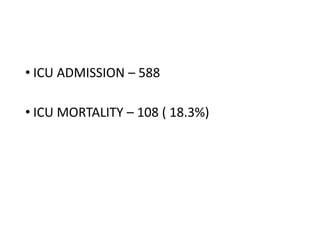
• ICU ADMISSION – 588
• ICU MORTALITY – 108 ( 18.3%)
ADMISSION
( N=588)
MONITORING
( N=91)
VENTILATION
(N=294)
SHOCK
(N=203)
ICU Interventions
191
205
186
56
146
147
0 50 100 150 200 250
ICD
CENTRAL LINE
ARTERIAL LINE
PCT
FOB
DIALYSIS
ICU MORTALITY (N=108)
HAEMORRHAG
IC SHOCK, 36,
33%
SEPTIC SHOCK,
39, 36%
MODS, 14,
13%
HEAD INJURY,
6, 6%
ARDS, 8, 7%
OTHERS, 5, 5%
ANATOMICAL DISTRIBUTION OF
MORTALITY ( N-108)
HEAD AND
NECK, 13,
12%
ABDOMEN AND
PELVIS, 49, 45%
THORAX, 23,
21%
EXTREMITY, 19,
18%
VASCULAR, 2,
2%
SOFT TISSUE,
2, 2%
3 Yearly Mortality Comparison
34
44
3636
43
39
4 5 5
7
16 14
5
7 6
0
5
10
15
20
25
30
35
40
45
50
2014 2015 2016
HEMORRHAGIC
SHOCK
SEPSIS
ARDS
MODS
HEAD INJURY
INJURY SEVERITY SCORE (ISS)
0
5
10
15
20
25
30
35
40
45
50
1 11 21 31 41 51 61 71 81 91 101
Cause of Death in ISS 15 and < 15 (n=16)
2
8
3
1
1
1
0 1 2 3 4 5 6 7 8 9
OTHERS
SS
MODS
ARDS
HS
HI
MULTIPLE CASUALTIES
SI.
NO
MODE OF
INJURY
MECHANISM PLACE DATE VICTIMS
BROUGHT TO
ED
1 RTI Head on collision
between 2 cars
Meerut 03-01-16 6
2 Constructio
n site
Mud collapse Kidwai
Nagar
11-01-16 12
3 RTI Truck overturn Suraj Kund 21-01-16 13
4 RTI Tempo hit by
Truck
Sarita Vihar 22-01-16 7
5 RTI Car hit with DTC
bus
BRT
Corridor
23-02-16 5
6 RTI Bike and
Rikshaw
passengers hit by
car
Kalkaji 27-02-16 6
7 Assault Group Assault Fatehpur
Beri
14-04-16 15
8 Constructio
n site
Collapse of wall Fatehpur
Beri
20-04-16 5
9 RTI Head on collision
between 2 cars
Dwark
Express
25-04-16 12
10 Assault Group Assault Malaviya
Nagar
25-10-16 21
11 RTI Pedestrian hit by
4 wheeler
Noida 25-11-16 5
12 RTI Bus Overturn Sarai Kale
Khan
27-12-16 8
TOTAL MORTALITY
• Total ED admission – 1426
• Total ED mortality – 11
• Total OT mortality - 13
• Total ICU mortality – 108
• Total mortality Rate – 9.25%
Early and Late Mortality(n=132)
0
10
20
30
40
50
60
70
<6hrs 6-24hrs 24-72HRS >72HRS
36
8
21
67
SUMMARY
• Average ED attendance per day is 180
• Around 52 minor procedures done in ED per day.
• Majority of trauma victims are young males( 20-40 years, 59%).
• RTI is the most common mode of injury( 52.8%).
• Two wheeler were involved in 45.65% of RTI cases.
• Majority of thoracic, liver , spleen and renal injuries treated non operatively
• Newer interventions like PEN utilized.
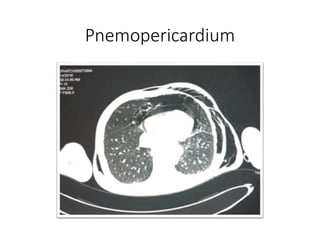
Pnemopericardium
Clothesline Injury
Infected Subclavian Stent with
septicemia
Thrasher Entrapment of hair
Scalp avulsion
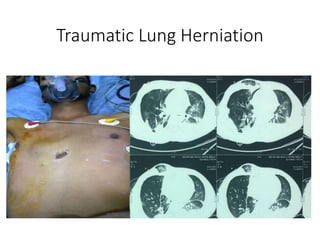
Traumatic Lung Herniation
Precordial Impalement
Traumatic Bronchobiliary Fistula
Shotgun injury Perforating CCA
Thank YouThank You

Trauma surgery audit 2016

  • 1.
    Division of TraumaSurgery and Critical Care JPN Apex Trauma Center All India Institute of Medical Sciences TRAUMA CENSUS 2016
  • 2.
    ED ATTENDANCE 2016(n=66,891) 46998, 71% 15677, 23% 3926, 6% Triage Green Yellow Red
  • 3.
    FIVE YEAR EDDATA Year 2012 2013 2014 2015 2016 Total 53050 55171 55734 64913 66,891 2.6% INCREASE IN ED ATTENDANCE 38964 35316 40928 49677 46998 10950 17066 11729 11612 15677 3136 2789 3077 3624 3926 0 10000 20000 30000 40000 50000 60000 70000 2012 2013 2014 2015 2016 RED YELLOW GREEN
  • 4.
    EMERGENCY DEPARTMENT RED AREADETAILS (N= 3906) SPECIALITY TOTAL NO ADMITTED RE-TRIAGED TO YELLOW ADMITTED/ TRANSFER OUT/ DISCHARGED SURGERY 1465 1408 57 18/8/31 NEURO- SURGERY 1530 1309 221 16/134/71 ORTHO 911 206 705 350/342/13
  • 5.
    ED INTERVENTIONS (N=19,078) ProcedureNo. Suturing 18532 ICD Insertion 492 Tracheostomy 1 Cricothyroidotomy 0 SPC (Percutaneous) 17 CT Angiography 36
  • 6.
    ADMISSION UNDER TRAUMASURGERY (N=1960) 1426, 73% 534, 27% A ED FUC
  • 7.
    YEARLY SURGERY ADMISSIONS YEAR2012 2013 2014 2015 2016 SURGERY ADMISSIONS 1299 1625 1789 1879 1960 918 1348 1284 1386 1426 381 275 505 493 534 2012 2013 2014 2015 2016 ED FOLLOW UP 4% increase in annual surgery admissions
  • 8.
    DEMOGRAPHIC PROFILE (N=1426) 1217, 85% 209,15% M/F Male Female 1152, 81% 150, 10% 124, 9% Adult ( >18yrs) Adolescent (12-18) Pediatric (<12yrs)
  • 9.
    Demographic Profile (n-1426) Trendover 3 years Numbers of Admissions(n-1426) 55 189 476 312 170 43 33 6 87 246 491 296 136 79 37 14 106 240 536 265 130 101 39 9 less than 10 11-20 yrs 21-30 yrs 31-40 yrs 41-50 yrs 51-60 yrs 61-70 yrs more than 70 2014 2015 2016
  • 10.
    MODE OF INJURY(N-1426) 52.8% 17.4% 13.8% 9.9% 4.4% 1.6% 0 100 200 300 400 500 600 700 800 Distribution Distribution
  • 11.
    719 174 170 193 1018 835 210 185 97 40 19753 248 197 142 64 22 0 100 200 300 400 500 600 700 800 900 RTA FFH ASSAULT UNINTENTIONAL RAILWAY TRACK INJURY SELF INFLICTED 2014 2015 2016 Mode of Injury (n-1426) Trend over 3 years
  • 12.
    Modes of RTI(n- 753, 52.8% ) Mode of RTI No. % Pedestrian 161 21.3 Bicycle 22 2.9 Motorized 2 wheeler 311 41.3 Motorized 3 wheeler 49 6.5 4 wheeler 88 11.7 Heavy vehicle 43 5.7 Bullock cart 6 0.7 Unknown 73 9.6
  • 13.
    Assault Cases (n=197,13.8% ) 39, 20% 108, 55% 50, 25% Cases Blunt assault Low velocity penetrating high velocity Penetrating
  • 14.
    Anatomical Distribution ofInjuries (n= 2029) 97 101 409 680 452 182 108 0 100 200 300 400 500 600 700 800 Series 1
  • 15.
    Head & Neck Maxillof acial Chest Abdome n & Pelvis Extremit ies Soft tissue Vascular 201697 101 409 680 452 182 108 2015 108 129 429 595 495 344 139 2014 119 129 444 492 475 205 136 97 101 409 680 452 182 108 108 129 429 595 495 344 139 119 129 444 492 475 205 136 0 100 200 300 400 500 600 700 800 AxisTitle Anatomical Distribution of Injuries(n=2029) Trend over 3 years
  • 16.
    Abdominal Trauma (n=680) (33.5%of all Trauma, n= 2029) Organ Involved No. Solid Organ (Liver or Spleen) Single Organ 197 > 1 Organ 97 Hollow Viscus 103 Genitourinary 67 Pancreatico-duodenal 26 Others (Hemoperitoneum, Retroperitoneal hematoma) 191
  • 17.
    Liver Trauma (n=139) (20.5% of all abdominal Trauma , n= 680 ) 90, 64.7 % 49, 35.2 % ISOLATED ASSOCIATED 16 38 24 33 28 0 5 10 15 20 25 30 35 40 GRADE 1 GRADE 2 GRADE 3 GRADE 4 GRADE 5
  • 18.
    Liver Trauma Management(n=139) CECT OF LIVER TRAUMA Mortality : Total 16 ( 11.5%), Hemorrhagic Shock – 10 (62.5%); Septicemic shock 6 ( 37.5%) NOM w/o AE, 96, 69% NOM w/ AE, 14, 10% Operative w/ AE, 12, 9% Operative w/o AE, 17, 12% Mx
  • 19.
    Splenic Trauma (n=116) (17.1% of Abdominal Trauma, n= 680) 68, 58.6% 48, 41.3% ISOLATED ASSOCIATED 17 28 23 34 14 0 5 10 15 20 25 30 35 40 GRADE 1 GRADE 2 GRADE 3 GRADE 4 GRADE 5
  • 20.
    Splenic Trauma Management(n=116) CECT OF SPLENIC INJURY Non- Operative w/o AE, 62, 53% Non- operative with AE, 28, 24% Splenectom y, 24, 21% Splenorrap hy, 2, 2% Mortality : Total 2 ( 1.7%), Hemorrhagic Shock – 1 (50%); Septicemic shock 1 ( 50%) Failure of NOM - 0
  • 21.
    Hollow Viscus Trauma(n=103) (15.1%of abdominal Trauma , n= 680) Hollow Viscus Procedure Nos. Esophagus: 3 (2.9)%) Cervical Oesophagostomy + FJ 3 Stomach: 15 (15.9%) Repair 15 Jejunum: 39 (39.4%) Repair 18 RA + FJ 21 Ileum: 23 (21.2%) Repair 8 RA 5 Ileostomy 10 Colon And Rectum: 23 (23.4%) Repair 6 RA 3 End Colostomy 12 Loop Colostomy 2
  • 22.
    Pancreatico-duodenal Trauma(n=26) 3.8% ofall abdominal Trauma, n= 680 Procedure No. Spleen preserving Distal Pancreatectomy 5 Distal Pancreatectomy + Splenectomy 5 Repair of laceration 1 NOM 7 Isolated Pancreatic Trauma (n=18; 69.2%) Mortality : Total 1 (3.8%), Hemorrhagic Shock – 0; MODS – 1 ( 100%)
  • 23.
    Procedure No. Drain Placementfor Duodenal Hematoma 1 Repair + RD + FJ 3 NOM 2 Pyloric Exclusion + GJ + RD + Repair (2nd part of Duodenal Injury) 2 Pancreatico-duodenal Trauma(n=26) Pancreatic Associated with Duodenal Trauma (8; 30.7%)
  • 24.
    Genitourinary trauma (n=67) (9.8of Abdominal trauma (n=680) Management KIDNEY (41, 61.9%) Operative: • Nephrectomy • Repair 4 3 NOM 34 URETER (4, 6.3%) Repair DJ Stenting 1 3
  • 25.
    Genitourinary trauma(n=67) Management BLADDER (11, 17.4%) ExtraperitonealNOM WITH PUC 5 Intraperitoneal Repair with SPC 4 Repair with PUC 2 URETHRA (5, 7.9%) SPC 5 TESTES (1, 1.5%) Repair 1 PENILE TRAUMA (3, 4.7%) Repair 3 VAGINAL TRAUMA 2 Repair 2
  • 26.
    Laparoscopic & EndoscopicProcedures (n=51) Procedure No. Diagnostic Laparoscopy 38 Lap Diaphragmatic Repair 4 PEG 4 Lap Cholecystectomy 3 Percutaneous endoscopic Necrosectomy 2
  • 27.
    Thoracic Trauma (n=409) 314, 81% 73, 19% B WithICD Without ICD 387, 95% 22, 5% A Non-Operative Operative Mortality : Total 15 (3.66%), Hemorrhagic Shock – 4 (27.5%); Septicemic shock 11 ( 66.5%)
  • 28.
    Thoracic Injury (n=409) OperativeCases, n=22; 5.5% Intra-op picture of Thoracotomy Major Indications No. Massive Hemothorax 6 Cardiac Trauma 4 VATS 3 Bronchopleural fistula 3 Subclavian artery injury 2 Lung hernia repair 1 Resuscitative Thoracotomy 3
  • 29.
  • 30.
    Upper Limb, n=66,68.04% Peripheral Vascular Trauma (n=97) 7 29 10 14 6 0 5 10 15 20 25 30 35 AXILLARY BRACHIAL RADIAL ULNAR RADIAL+ULNAR
  • 31.
    Lower Limb (n=31,30.92%) Peripheral Vascular Trauma (n=97) 11 20 0 2 4 6 8 10 12 14 16 18 20 FEMORAL POPLITEAL
  • 32.
    Vascular Trauma Management(n=97) Average Critical Ischemic time (Hrs) INTERPOSITION GRAFT EEAwith EMBOLECTOM Y EMBOLECT OMY only Outcome RSVG Synthetic Limb salvage Ampu tation AXILLARY (7) 8Hrs 1 - 6 0 6 1 BRACHIAL (29) 7.5hrs 8 - 18 3 29 0 RADIAL (12) 6Hrs - - 12 0 12 0 ULNAR (18) 6Hrs - - 18 0 18 0 FEMORAL (11) 9Hrs 2 1 7 1 10 1 POPLITEAL (20) 6.5Hrs 10 - 4 6 17 3
  • 33.
    Vascular Trauma Management(n=97) EtEAnastomosis : 65 cases, 66.2% Reverse Saphenous Graft : 21 cases, 22.4% Embolectomy: 10 cases, 9.4% PTFE Graft (Femoral artery): 1 case, 1.3% Primary Amputation: 0 Amputation (after vascular intervention): 5 cases, 5.7%
  • 34.
    Central Vascular Injury(n=11) VESSELINVOLVED NO. MANAGEMENT Subclavian Artery 02 04 Inter-position grafting Non op ( Concomitant Brachial Plexus Injury - Viable non-functional limb) Inferior Vena Cava 01 Primary Repair Descending Thoracic Aorta 02 Stent grafting External Carotid Artery 01 Repair Common carotid artery 1 REPAIR
  • 35.
    Neck trauma (n=29) 9,31% 13, 45% 2, 7% 5, 17% A Blunt Low velocity penetrating High velocity penetrating Kite injuries
  • 36.
    Neck trauma –Injurydistribution (n=29) 7 15 7 0 5 10 15 20 AeroDigestive Vascular Soft tissues Injuries 3 20 6 0 10 20 30 Zone I Zone II Zone III Neck Zones
  • 37.
    Neck trauma –Management (n=29) Procedure No. Primary Tracheal Repair 05 Exploration with Hemostasis 12 Primary Repair of Larynx 02 NOM 10
  • 38.
    Oral and MaxillofacialInjury (n=101) Mandible (n=63) 27 9 11 16 0 5 10 15 20 25 30 PARASYMPHYSIS ANGLE PARASYMPHYSISAND ANGLE PARASYMPHYSISAND CONDYLE DISTRIBUTION MANDIBLE INJURY
  • 39.
    Oral and Maxillofacial(n=101) Others (n=38) Subdivision of Cases-Mid Face 7 10 9 12 0 2 4 6 8 10 12 14 Lefort1 Lefort2 Lefort3 ZMCwith panfacial
  • 40.
    Soft Tissue ReconstructiveProcedures (n=862) 265, 30.6% 368, 42.4% 129, 15.3% 4, 0.4% 96, 11.1% STSG DEBRIDEMENT DEBRIDEMENT + STSG FTG FLAP
  • 41.
  • 42.
    Operative Procedures(n=1948) 1497, 76% 348,17% 132, 7% Distribution General Anesthesia Spinal anesthesia Local Anesthesia
  • 43.
    OPERATIVE PROCEDURES (N=1948) Type No. EMERGENCY 765 PLANNED 1183 Region-wise No. ABDOMEN 324 THORAX 41 MAXILLO-FACIAL 101 VASCULAR 108 EXTREMITIES 794 HEAD &NECK 55 GENITO URINARY 31 PLASTIC AND SOFT TISSUE 494 Type of Anesthesia No. GA 1459 SA 343 LA+BRACHIAL 146
  • 44.
    NUMBER OF SURGICALPROCEDURES THORAX THORACOTOMY 26 VATS 3 ABDOMEN SPLEEN SPLENECTOMY 29 SPLENORRHAPHY 2 LIVER PACKING 29 PACK REMOVAL 25 OESOPHAGUS OESOPHAGOSTOMY 3 REPAIR 0 STOMACH REPAIR 15 PEG 4 DUODENUM REPAIR 5 DUODENOSTOMY+FJ 5 JEJUNUM REPAIR 18 RA 21
  • 45.
    ABDOMEN ILEUM REPAIR 8 ILEOSTOMY+REPAIR 10 COLON COLOSTOMY14 REPAIR 6 RA 3 PANCREAS RESECTION 10 GALL BLADDER CHOLECYSTECTOMY 2 CBD REPAIR 0 MESH LAPAROSTOMY 49 PELVIS PACKING AND INTERNAL ILIAC ART. LIGATION 14 GENITOURINARY KIDNEY RENORRHAPHY 3 NEPHRECTOMY 4 URETER REPAIR 1 STENTING 3
  • 46.
    GENITOURINARY BLADDER REPAIR 6 SPC 4 URETHRAURETHROPLASTY 5 LAPROSCOPIC PROCEDURES DIAGNOSTIC LAPROSCOPY 38 EXTREMITY STUMP REVISION/ SECONDARY SUTURING 151 VASCULAR CENTRAL VASCULAR REPAIR 7 PERIPHERAL VASCULAR REPAIR 97 FACIAL BONES MANDIBLE ORIF WIRING 46 7 NECK TRACHEA TRACHEAL REPAIR 6 NECK EXPLORATION 20 PLASTIC AND SOFT TISSUE GRAFT + FLAP SURGERY 394 + 100 DEBRIDEMENT 528
  • 47.
    Planned Abdominal Procedures ProcedureNos. Abdominoplasty 11 Colostomy Restoration 6 Ileostomy Restoration 1 Urethroplasty 5 Inlay Mesh Hernioplasty
  • 48.
    INTERVENTIONAL RADIOLOGY (n=98) • Liver Angio-embolization – 26 • Splenic AE – 28 • Pelvic – 4 • Renal Artery – 2 • Maxillary Artery – 3 • PCN – 3 • PTBD – 2 • IVC filter – 2 • Misc. (PEG, Thrombin inj, Other arteries) - 19
  • 49.
  • 50.
    • ICU ADMISSION– 588 • ICU MORTALITY – 108 ( 18.3%)
  • 51.
  • 52.
    ICU Interventions 191 205 186 56 146 147 0 50100 150 200 250 ICD CENTRAL LINE ARTERIAL LINE PCT FOB DIALYSIS
  • 53.
    ICU MORTALITY (N=108) HAEMORRHAG ICSHOCK, 36, 33% SEPTIC SHOCK, 39, 36% MODS, 14, 13% HEAD INJURY, 6, 6% ARDS, 8, 7% OTHERS, 5, 5%
  • 54.
    ANATOMICAL DISTRIBUTION OF MORTALITY( N-108) HEAD AND NECK, 13, 12% ABDOMEN AND PELVIS, 49, 45% THORAX, 23, 21% EXTREMITY, 19, 18% VASCULAR, 2, 2% SOFT TISSUE, 2, 2%
  • 55.
    3 Yearly MortalityComparison 34 44 3636 43 39 4 5 5 7 16 14 5 7 6 0 5 10 15 20 25 30 35 40 45 50 2014 2015 2016 HEMORRHAGIC SHOCK SEPSIS ARDS MODS HEAD INJURY
  • 56.
    INJURY SEVERITY SCORE(ISS) 0 5 10 15 20 25 30 35 40 45 50 1 11 21 31 41 51 61 71 81 91 101
  • 57.
    Cause of Deathin ISS 15 and < 15 (n=16) 2 8 3 1 1 1 0 1 2 3 4 5 6 7 8 9 OTHERS SS MODS ARDS HS HI
  • 58.
    MULTIPLE CASUALTIES SI. NO MODE OF INJURY MECHANISMPLACE DATE VICTIMS BROUGHT TO ED 1 RTI Head on collision between 2 cars Meerut 03-01-16 6 2 Constructio n site Mud collapse Kidwai Nagar 11-01-16 12 3 RTI Truck overturn Suraj Kund 21-01-16 13 4 RTI Tempo hit by Truck Sarita Vihar 22-01-16 7 5 RTI Car hit with DTC bus BRT Corridor 23-02-16 5 6 RTI Bike and Rikshaw passengers hit by car Kalkaji 27-02-16 6
  • 59.
    7 Assault GroupAssault Fatehpur Beri 14-04-16 15 8 Constructio n site Collapse of wall Fatehpur Beri 20-04-16 5 9 RTI Head on collision between 2 cars Dwark Express 25-04-16 12 10 Assault Group Assault Malaviya Nagar 25-10-16 21 11 RTI Pedestrian hit by 4 wheeler Noida 25-11-16 5 12 RTI Bus Overturn Sarai Kale Khan 27-12-16 8
  • 60.
  • 61.
    • Total EDadmission – 1426 • Total ED mortality – 11 • Total OT mortality - 13 • Total ICU mortality – 108 • Total mortality Rate – 9.25%
  • 62.
    Early and LateMortality(n=132) 0 10 20 30 40 50 60 70 <6hrs 6-24hrs 24-72HRS >72HRS 36 8 21 67
  • 63.
    SUMMARY • Average EDattendance per day is 180 • Around 52 minor procedures done in ED per day. • Majority of trauma victims are young males( 20-40 years, 59%). • RTI is the most common mode of injury( 52.8%). • Two wheeler were involved in 45.65% of RTI cases. • Majority of thoracic, liver , spleen and renal injuries treated non operatively • Newer interventions like PEN utilized.
  • 64.
  • 65.
  • 66.
  • 67.
    Thrasher Entrapment ofhair Scalp avulsion
  • 68.
  • 69.
  • 70.
  • 71.
  • 72.

Editor's Notes

  • #43 Flap details 26??
  • #44 TOTAL??
  • #45 Ot1:
  • #55 Kindly correct.Check individual patient in following9 patients. I have changed few indications. Kindly match & change the no. Monitoring-5 Ventilation-2 Shock-2