Prepared by: Qurat-Ul-Ain
FAR POINT
Presentation by: QURAT-UL-AIN
Prepared by: Qurat-Ul-Ain
Far Point
• It is defined as the point in space that is conjugate with the fovea
when accommodation is relaxed.
• Means, light coming from the far point forms a clear and focused
image on the fovea when accommodation is relaxed. So, the far
point has same optical characteristics as the fovea when eye is
relaxed that’s why we can say that the far point is the point in space
that optically resembles with the point of fovea when
accommodation is relaxed.
• If far point does not conjugate with fovea it gives rise to refractive
errors. So, the state of eye is depends on the location of the far point
of the eye.
Prepared by: Qurat-Ul-Ain
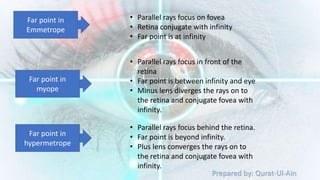
Far point in
Emmetrope
• Parallel rays focus on fovea
• Retina conjugate with infinity
• Far point is at infinity
Far point in
myope
• Parallel rays focus in front of the
retina
• Far point is between infinity and eye
• Minus lens diverges the rays on to
the retina and conjugate fovea with
infinity.
Far point in
hypermetrope
• Parallel rays focus behind the retina.
• Far point is beyond infinity.
• Plus lens converges the rays on to
the retina and conjugate fovea with
infinity.
Prepared by: Qurat-Ul-Ain
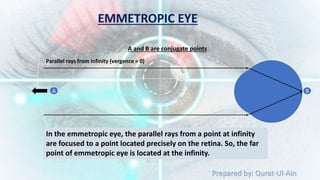
A B
A and B are conjugate points
Parallel rays from infinity (vergence = 0)
In the emmetropic eye, the parallel rays from a point at infinity
are focused to a point located precisely on the retina. So, the far
point of emmetropic eye is located at the infinity.
EMMETROPIC EYE
Prepared by: Qurat-Ul-Ain
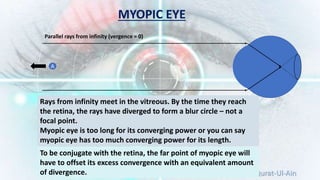
Rays from infinity meet in the vitreous. By the time they reach
the retina, the rays have diverged to form a blur circle – not a
focal point.
Myopic eye is too long for its converging power or you can say
myopic eye has too much converging power for its length.
A
Parallel rays from infinity (vergence = 0)
To be conjugate with the retina, the far point of myopic eye will
have to offset its excess convergence with an equivalent amount
of divergence.
MYOPIC EYE
Prepared by: Qurat-Ul-Ain
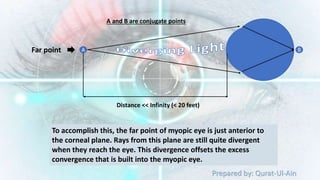
A B
Far point
Distance << Infinity (< 20 feet)
A and B are conjugate points
To accomplish this, the far point of myopic eye is just anterior to
the corneal plane. Rays from this plane are still quite divergent
when they reach the eye. This divergence offsets the excess
convergence that is built into the myopic eye.
Prepared by: Qurat-Ul-Ain
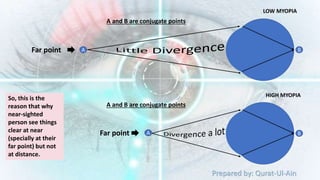
A B
Far point
A and B are conjugate points
LOW MYOPIA
A B
Far point
A and B are conjugate points
HIGH MYOPIA
So, this is the
reason that why
near-sighted
person see things
clear at near
(specially at their
far point) but not
at distance.
Prepared by: Qurat-Ul-Ain
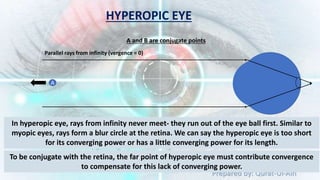
A
A and B are conjugate points
Parallel rays from infinity (vergence = 0)
In hyperopic eye, rays from infinity never meet- they run out of the eye ball first. Similar to
myopic eyes, rays form a blur circle at the retina. We can say the hyperopic eye is too short
for its converging power or has a little converging power for its length.
To be conjugate with the retina, the far point of hyperopic eye must contribute convergence
to compensate for this lack of converging power.
HYPEROPIC EYE
Prepared by: Qurat-Ul-Ain
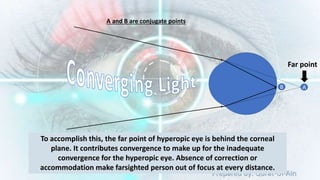
A
B
Far point
A and B are conjugate points
To accomplish this, the far point of hyperopic eye is behind the corneal
plane. It contributes convergence to make up for the inadequate
convergence for the hyperopic eye. Absence of correction or
accommodation make farsighted person out of focus at every distance.
Prepared by: Qurat-Ul-Ain

FAR POINT.pptx

  • 1.
    Prepared by: Qurat-Ul-Ain FARPOINT Presentation by: QURAT-UL-AIN
  • 2.
    Prepared by: Qurat-Ul-Ain FarPoint • It is defined as the point in space that is conjugate with the fovea when accommodation is relaxed. • Means, light coming from the far point forms a clear and focused image on the fovea when accommodation is relaxed. So, the far point has same optical characteristics as the fovea when eye is relaxed that’s why we can say that the far point is the point in space that optically resembles with the point of fovea when accommodation is relaxed. • If far point does not conjugate with fovea it gives rise to refractive errors. So, the state of eye is depends on the location of the far point of the eye.
  • 3.
    Prepared by: Qurat-Ul-Ain Farpoint in Emmetrope • Parallel rays focus on fovea • Retina conjugate with infinity • Far point is at infinity Far point in myope • Parallel rays focus in front of the retina • Far point is between infinity and eye • Minus lens diverges the rays on to the retina and conjugate fovea with infinity. Far point in hypermetrope • Parallel rays focus behind the retina. • Far point is beyond infinity. • Plus lens converges the rays on to the retina and conjugate fovea with infinity.
  • 4.
    Prepared by: Qurat-Ul-Ain AB A and B are conjugate points Parallel rays from infinity (vergence = 0) In the emmetropic eye, the parallel rays from a point at infinity are focused to a point located precisely on the retina. So, the far point of emmetropic eye is located at the infinity. EMMETROPIC EYE
  • 5.
    Prepared by: Qurat-Ul-Ain Raysfrom infinity meet in the vitreous. By the time they reach the retina, the rays have diverged to form a blur circle – not a focal point. Myopic eye is too long for its converging power or you can say myopic eye has too much converging power for its length. A Parallel rays from infinity (vergence = 0) To be conjugate with the retina, the far point of myopic eye will have to offset its excess convergence with an equivalent amount of divergence. MYOPIC EYE
  • 6.
    Prepared by: Qurat-Ul-Ain AB Far point Distance << Infinity (< 20 feet) A and B are conjugate points To accomplish this, the far point of myopic eye is just anterior to the corneal plane. Rays from this plane are still quite divergent when they reach the eye. This divergence offsets the excess convergence that is built into the myopic eye.
  • 7.
    Prepared by: Qurat-Ul-Ain AB Far point A and B are conjugate points LOW MYOPIA A B Far point A and B are conjugate points HIGH MYOPIA So, this is the reason that why near-sighted person see things clear at near (specially at their far point) but not at distance.
  • 8.
    Prepared by: Qurat-Ul-Ain A Aand B are conjugate points Parallel rays from infinity (vergence = 0) In hyperopic eye, rays from infinity never meet- they run out of the eye ball first. Similar to myopic eyes, rays form a blur circle at the retina. We can say the hyperopic eye is too short for its converging power or has a little converging power for its length. To be conjugate with the retina, the far point of hyperopic eye must contribute convergence to compensate for this lack of converging power. HYPEROPIC EYE
  • 9.
    Prepared by: Qurat-Ul-Ain A B Farpoint A and B are conjugate points To accomplish this, the far point of hyperopic eye is behind the corneal plane. It contributes convergence to make up for the inadequate convergence for the hyperopic eye. Absence of correction or accommodation make farsighted person out of focus at every distance.
  • 10.