
CATARACT
By: Qurat-ul-ain
Ophthalmic Medical
Technologist/ MBA Health &
Hospital management
CATARACT
CLASSIFICATION OF CATARACT
• According to location
• According to age at onset
• According to degree of opacity present
• According to rate of development
• On the basis of bi-microscopic appearance
• On the basis of any systemic disorder
It is a cloudiness or opacity in
the normally transparent
crystalline lens of the eye. Its
cloudiness can cause a
decrease in vision and may
lead to eventual blindness.
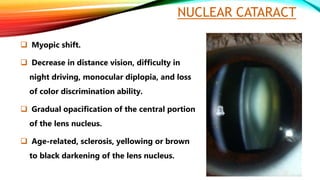
NUCLEAR CATARACT
 Myopic shift.
 Decrease in distance vision, difficulty in
night driving, monocular diplopia, and loss
of color discrimination ability.
 Gradual opacification of the central portion
of the lens nucleus.
 Age-related, sclerosis, yellowing or brown
to black darkening of the lens nucleus.
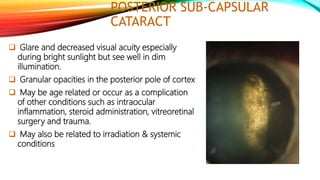
POSTERIOR SUB-CAPSULAR
CATARACT
 Glare and decreased visual acuity especially
during bright sunlight but see well in dim
illumination.
 Granular opacities in the posterior pole of cortex
 May be age related or occur as a complication
of other conditions such as intraocular
inflammation, steroid administration, vitreoretinal
surgery and trauma.
 May also be related to irradiation & systemic
conditions
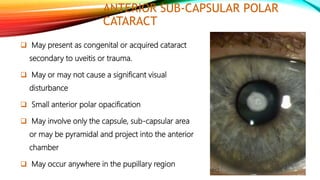
ANTERIOR SUB-CAPSULAR POLAR
CATARACT
 May present as congenital or acquired cataract
secondary to uveitis or trauma.
 May or may not cause a significant visual
disturbance
 Small anterior polar opacification
 May involve only the capsule, sub-capsular area
or may be pyramidal and project into the anterior
chamber
 May occur anywhere in the pupillary region
CORTICAL
CATARACT
 Most common form of senile cataract
 Minimal symptoms of decreased VA
 Mild to severe glare and night vision difficulties
and may impair driving.
 When the lens opacities are in the visual axis
patient may complain of monocular diplopia.
 Opacities located in the cortical layer and starts
from the lower portion of the lens.
 Early stage – water clefts and vacuoles,
resulting in irreversible opacities.
 Advance stage – spoke like or wedge shape
peripheral opacities progress circumferentially.
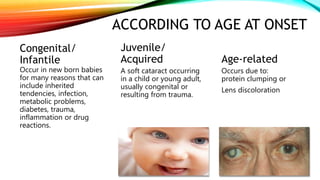
ACCORDING TO AGE AT ONSET
Congenital/
Infantile
Occur in new born babies
for many reasons that can
include inherited
tendencies, infection,
metabolic problems,
diabetes, trauma,
inflammation or drug
reactions.
Juvenile/
Acquired
A soft cataract occurring
in a child or young adult,
usually congenital or
resulting from trauma.
Age-related
Occurs due to:
protein clumping or
Lens discoloration
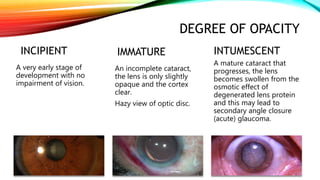
DEGREE OF OPACITY
INCIPIENT
A very early stage of
development with no
impairment of vision.
IMMATURE
An incomplete cataract,
the lens is only slightly
opaque and the cortex
clear.
Hazy view of optic disc.
INTUMESCENT
A mature cataract that
progresses, the lens
becomes swollen from the
osmotic effect of
degenerated lens protein
and this may lead to
secondary angle closure
(acute) glaucoma.
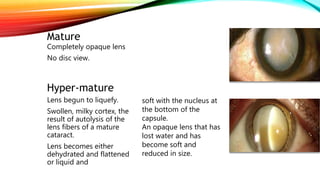
Mature
Completely opaque lens
No disc view.
Hyper-mature
Lens begun to liquefy.
Swollen, milky cortex, the
result of autolysis of the
lens fibers of a mature
cataract.
Lens becomes either
dehydrated and flattened
or liquid and
soft with the nucleus at
the bottom of the
capsule.
An opaque lens that has
lost water and has
become soft and
reduced in size.
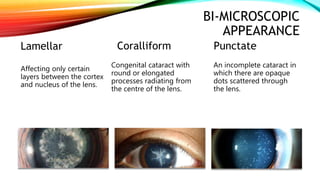
BI-MICROSCOPIC
APPEARANCE
Lamellar
Affecting only certain
layers between the cortex
and nucleus of the lens.
Coralliform
Congenital cataract with
round or elongated
processes radiating from
the centre of the lens.
Punctate
An incomplete cataract in
which there are opaque
dots scattered through
the lens.
ETIOLOGY
• Aging
• Congenital disorders
• Genetic abnormalities
• Maternal rubella during 1st trimester
• Traumatic
• Glaucoma
• Retinal detachment
• Diabetes mellitus
• Retinitis pigmentosa
• Hypo-parathyroidism
• Myotonic dystrophy
• Atopic dermatitis
• Exposure to ionizing radiation or infrared rays
DRUGS TOXIC
TO LENS
• Prednisone
• Ergot alkaloids
• Di-nitro phenol
• Naphthalene
• Phenothiazines
• Pilocarpine
• Exposure to ultraviolet rays
THANK YOU!

12. Cataract.pptx

  • 1.
  • 2.
    CATARACT CLASSIFICATION OF CATARACT •According to location • According to age at onset • According to degree of opacity present • According to rate of development • On the basis of bi-microscopic appearance • On the basis of any systemic disorder It is a cloudiness or opacity in the normally transparent crystalline lens of the eye. Its cloudiness can cause a decrease in vision and may lead to eventual blindness.
  • 3.
    NUCLEAR CATARACT  Myopicshift.  Decrease in distance vision, difficulty in night driving, monocular diplopia, and loss of color discrimination ability.  Gradual opacification of the central portion of the lens nucleus.  Age-related, sclerosis, yellowing or brown to black darkening of the lens nucleus.
  • 4.
    POSTERIOR SUB-CAPSULAR CATARACT  Glareand decreased visual acuity especially during bright sunlight but see well in dim illumination.  Granular opacities in the posterior pole of cortex  May be age related or occur as a complication of other conditions such as intraocular inflammation, steroid administration, vitreoretinal surgery and trauma.  May also be related to irradiation & systemic conditions
  • 5.
    ANTERIOR SUB-CAPSULAR POLAR CATARACT May present as congenital or acquired cataract secondary to uveitis or trauma.  May or may not cause a significant visual disturbance  Small anterior polar opacification  May involve only the capsule, sub-capsular area or may be pyramidal and project into the anterior chamber  May occur anywhere in the pupillary region
  • 6.
    CORTICAL CATARACT  Most commonform of senile cataract  Minimal symptoms of decreased VA  Mild to severe glare and night vision difficulties and may impair driving.  When the lens opacities are in the visual axis patient may complain of monocular diplopia.  Opacities located in the cortical layer and starts from the lower portion of the lens.  Early stage – water clefts and vacuoles, resulting in irreversible opacities.  Advance stage – spoke like or wedge shape peripheral opacities progress circumferentially.
  • 7.
    ACCORDING TO AGEAT ONSET Congenital/ Infantile Occur in new born babies for many reasons that can include inherited tendencies, infection, metabolic problems, diabetes, trauma, inflammation or drug reactions. Juvenile/ Acquired A soft cataract occurring in a child or young adult, usually congenital or resulting from trauma. Age-related Occurs due to: protein clumping or Lens discoloration
  • 8.
    DEGREE OF OPACITY INCIPIENT Avery early stage of development with no impairment of vision. IMMATURE An incomplete cataract, the lens is only slightly opaque and the cortex clear. Hazy view of optic disc. INTUMESCENT A mature cataract that progresses, the lens becomes swollen from the osmotic effect of degenerated lens protein and this may lead to secondary angle closure (acute) glaucoma.
  • 9.
    Mature Completely opaque lens Nodisc view. Hyper-mature Lens begun to liquefy. Swollen, milky cortex, the result of autolysis of the lens fibers of a mature cataract. Lens becomes either dehydrated and flattened or liquid and soft with the nucleus at the bottom of the capsule. An opaque lens that has lost water and has become soft and reduced in size.
  • 10.
    BI-MICROSCOPIC APPEARANCE Lamellar Affecting only certain layersbetween the cortex and nucleus of the lens. Coralliform Congenital cataract with round or elongated processes radiating from the centre of the lens. Punctate An incomplete cataract in which there are opaque dots scattered through the lens.
  • 11.
    ETIOLOGY • Aging • Congenitaldisorders • Genetic abnormalities • Maternal rubella during 1st trimester • Traumatic • Glaucoma • Retinal detachment • Diabetes mellitus • Retinitis pigmentosa • Hypo-parathyroidism • Myotonic dystrophy • Atopic dermatitis • Exposure to ionizing radiation or infrared rays
  • 12.
    DRUGS TOXIC TO LENS •Prednisone • Ergot alkaloids • Di-nitro phenol • Naphthalene • Phenothiazines • Pilocarpine • Exposure to ultraviolet rays
  • 13.