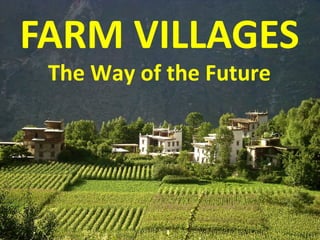
FARM VILLAGES
The Way of the Future
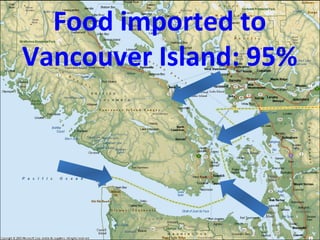
Food imported to
Vancouver Island: 95%
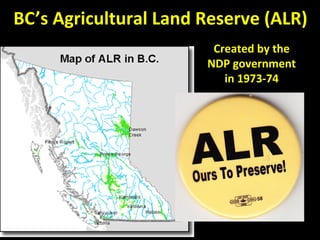
BC’s Agricultural Land Reserve (ALR)
Created by the
NDP government
in 1973-74
The Agricultural Land Reserve is a provincial zone in
which agriculture is recognized as the priority use.
Farming is encouraged and non-agricultural uses
are controlled.
It covers approximately 4.7 million hectares,
including private and public lands that may be
farmed, forested or vacant land.
The ALR’s Mission is to preserve agricultural land
and encourage and enable farm businesses
throughout British Columbia.
The purpose of the Agricultural Land Commission is:
• to preserve agricultural land;
• to encourage farming in collaboration with other
communities of interest;
• to encourage local governments, First Nations, and
government agencies to enable and accommodate farm
use of agricultural land and other uses compatible with
agriculture in plans, bylaws and policies.
The Commission expects to achieve its mission
through the realization of
four complementary goals:
1. Preservation of agricultural land.
2. Encouraging and enabling farm businesses.
3. A provincial land reserve system that considers
community interests.
4. Sound governance and organizational excellence.
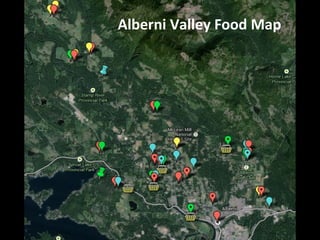
Alberni Valley Food Map
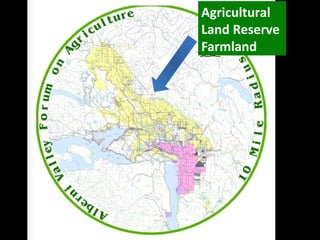
Agricultural
Land Reserve
Farmland
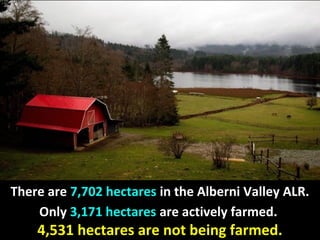
There are 7,702 hectares in the Alberni Valley ALR.
Only 3,171 hectares are actively farmed.
4,531 hectares are not being farmed.
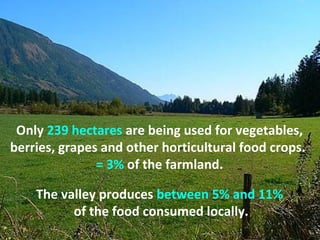
Only 239 hectares are being used for vegetables,
berries, grapes and other horticultural food crops.
= 3% of the farmland.
The valley produces between 5% and 11%
of the food consumed locally.
89-95% of Port Alberni’s food
is being imported…
Gross farm receipts average
$61,797 per farm
The average farmer keeps about
8 cents of every dollar sold
– an average annual income of
$4,606 per farm
to cover all overhead costs.
Alberni Valley Agricultural Plan, 2011-2031
5,184 hectares could be improved to
prime capability with irrigation
The average farm operator is 55 years old.
It is expensive and time consuming to
convert to higher valued crops, so
long term farmers are resisting changing.
Alberni Valley Agricultural Plan, 2011-2031
“Despite this, demand for local food has never been
stronger. Consumers want to buy food they trust
from people they trust.
The Alberni Valley has experienced farmers and
quality soils. There are opportunities to increase
direct-marketed products to local consumer and
tourists.
… food for thought for developing a vision and plan
for agriculture in the Alberni Valley.”
Alberni Valley Agricultural Plan, 2011-2031
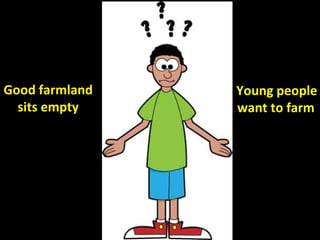
Good farmland
sits empty
Young people
want to farm
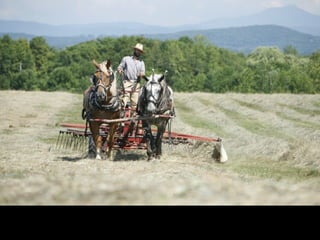
And a lot of Vancouver Island farmland is just growing hay
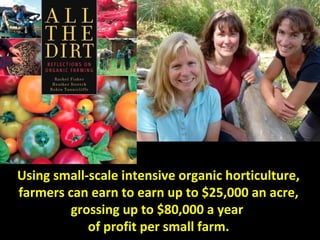
Using small-scale intensive organic horticulture,
farmers can earn to earn up to $25,000 an acre,
grossing up to $80,000 a year
of profit per small farm.
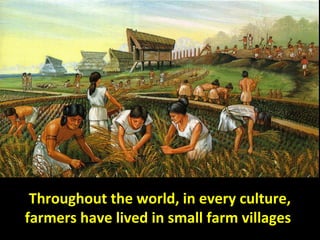
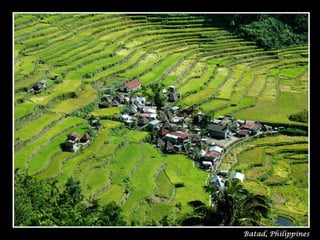
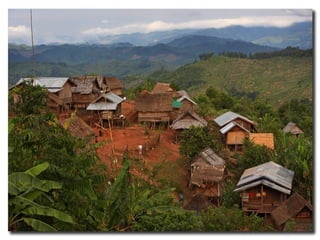
Throughout the world, in every culture,
farmers have lived in small farm villages
Gimmelwald Village, Switzerland
Imagine…
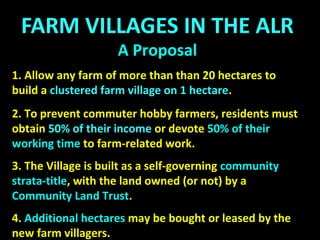
The Basic Idea:
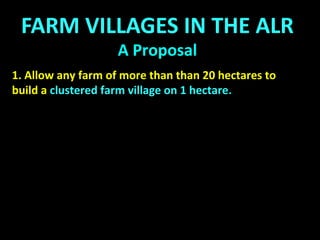
On any farm of more than 40 hectares (eg)
1 hectare may be rezoned as a Community Farm
Village, with additional acreage being leased or sold
to Community Farm Villagers for farming purposes.
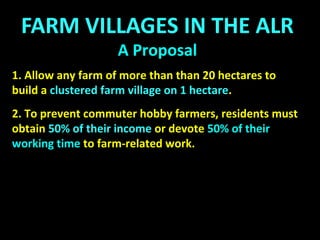
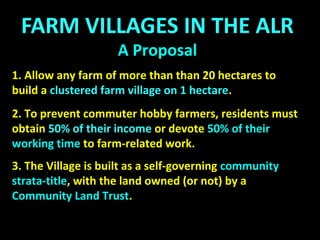
FARM VILLAGES
A Proposal
A Community Farmland Zone
The Zone would allow the development of a clustered Farm
Village, with controls to ensure that the land is farmed:
A: A Community Farmland Zone Bylaw
B: A covenant registered with the land
C: Strata Farm Fees that do not apply if the land is farmed
D: Registration of a Housing Agreement, restricting
residential units to farmers and their families.
FARM VILLAGES
A Proposal
The Village is a self-governing community strata-title, with
the land owned privately, cooperatively, or by a Land Trust.
The Farm Village can be created in three ways:
(a) By successful application to the local Council by a group
of would-be farmers for Community Farmland Zoning, on
a farm they intend to buy.
(b) By successful application to the local Council by an
existing farmer with land outside the ALR.
(c) By successful application to the local Council and to the
Agricultural Land Commission by an existing farmer with
land inside the ALR.
Either: A farm for sale, and a group of would-be
Farm Villagers apply for Community Farmland Zoning.
Or: A farmer who supports the idea, backed by would-be
Village Farmers, applies for Community Farmland Zoning.
43 acres $564,900
160 acres $629,900
56 acres $950,000
43 acres $955,000
56 acres $1,098,000
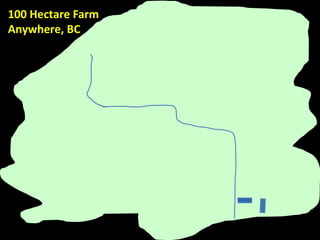
100 Hectare Farm
Anywhere, BC
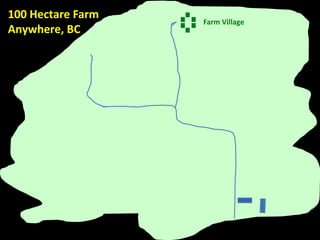
100 Hectare Farm
Anywhere, BC
Farm Village
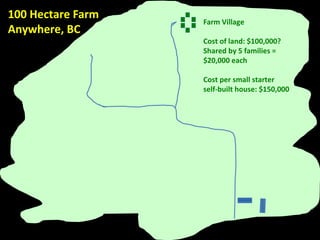
100 Hectare Farm
Anywhere, BC
Farm Village
Cost of land: $100,000?
Shared by 5 families =
$20,000 each
Cost per small starter
self-built house: $150,000
100 Hectare Farm
Anywhere, BC
Farm Village
Cost of land: $100,000?
Shared by 5 families =
$20,000 each
Cost per small starter
self-built house: $150,000
Leased
or
purchased
100 Hectare Farm
Anywhere, BC
Farm Village
Cost of land: $100,000?
Shared by 5 families =
$20,000 each
Cost per small starter
self-built house: $150,000
Four levels of protection,
to ensure that the Zone is not abused:
1. The new Community Farm Zone Bylaw
2. A Covenant attached to the land
3. Strata Council Farm Fees
4. A Registered Housing Agreement
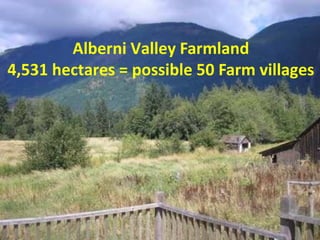
Alberni Valley Farmland
4,531 hectares = possible 50 Farm villages
FARM VILLAGES
A Proposal
1: Community Farmland Zoning Bylaw
Principal use agriculture. Residential use ancillary, homes
limited (eg) to 1500 sq ft.
‘Farming’ defined to exclude principally forage or hay.
The first acre per household not for forage, horses or hay.
On subsequent acres, no more than 50% of the land can be
used for horses, forage or hay.
FARM VILLAGES
A Proposal
2: Community Farmland Covenant
Registration of a restrictive covenant to the effect that the
land will be used for farming, signed by a third party (eg a
Farmland Trust) which would monitor the lands, and ensure
they are used for farming.
The owners would be unable to break the covenant, since
the role of the third-party covenant holder would be to
uphold the covenant.
FARM VILLAGES
A Proposal
3: Strata Farm Fees
The strata council (required by covenant) will oversee the
farming operations, with forgivable strata fees for farming.
If the owners choose not to farm, significant strata fees will
be charged and used to pay for others to farm the land.
Strata fees will also be collected to fund common facilities,
green houses, irrigation, cool storage, processing kitchen,
farm worker accommodation, etc.
FARM VILLAGES
A Proposal
4: A Housing Agreement
Registration of a Housing Agreement. In British Columbia,
the Local Government Act enables local governments to
register housing agreements which can restrict housing to
“classes of persons” (sec 905 2) b), LGA).
This may be used to restrict the residential units to
“farmers” and their families.
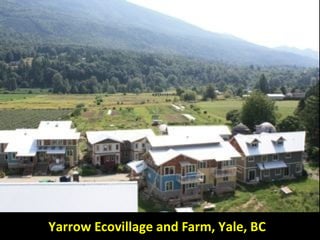
Yarrow Ecovillage and Farm, Yale, BC
HOW COULD IT HAPPEN?
1. It is legally possible to create such a new Zone, both
inside and outside the ALR.
HOW COULD IT HAPPEN?
1. It is legally possible to create such a new Zone, both
inside and outside the ALR.
2. A non-profit obtains a grant to develop the idea.
HOW COULD IT HAPPEN?
1. It is legally possible to create such a new Zone, both
inside and outside the ALR.
2. A non-profit obtains a grant to develop the idea.
3. Talk to local planners and ALR Commissioners.
HOW COULD IT HAPPEN?
1. It is legally possible to create such a new Zone, both
inside and outside the ALR.
2. A non-profit obtains a grant to develop the idea.
3. Talk to local planners and ALR Commissioners.
4. Create a website to gather input from future
farmers
HOW COULD IT HAPPEN?
1. It is legally possible to create such a new Zone, both
inside and outside the ALR.
2. A non-profit obtains a grant to develop the idea.
3. Talk to local planners and ALR Commissioners.
4. Create a website to gather input from future
farmers
5. Seek would-be Village Farmers.
HOW COULD IT HAPPEN?
1. It is legally possible to create such a new Zone, both
inside and outside the ALR.
2. A non-profit obtains a grant to develop the idea.
3. Talk to local planners and ALR Commissioners.
4. Create a website to gather input from future
farmers
5. Seek would-be Village Farmers.
6. Seek existing farmers who might be interested to
sell some of their land for a Farmland Village.
HOW COULD IT HAPPEN?
1. It is legally possible to create such a new Zone, both
inside and outside the ALR.
2. A non-profit obtains a grant to develop the idea.
3. Talk to local planners and ALR Commissioners.
4. Create a website to gather input from future
farmers
5. Seek would-be Village Farmers.
6. Seek existing farmers who might be interested to
sell some of their land for a Farmland Village.
7. Create the first Community Farmland Village.
WANTED: Future farmers to form Community Farm
Village. Buy land, build our homes, farm the land.
Contact Jason 250-456-7899 Jason@gmail.com
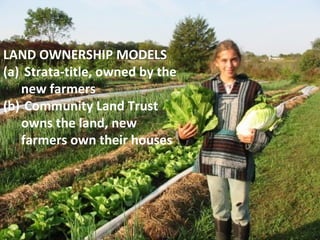
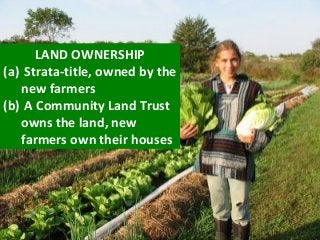
LAND OWNERSHIP
(a) Strata-title, owned by the
new farmers
(b) A Community Land Trust
owns the land, new
farmers own their houses
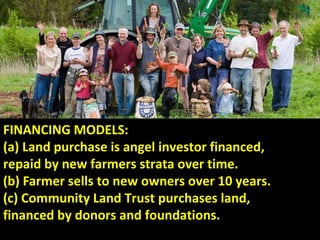
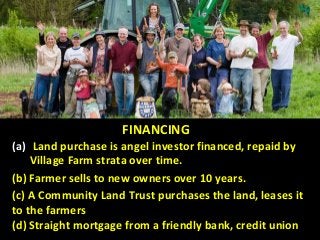
FINANCING
(a) Land purchase is angel investor financed, repaid by
Village Farm strata over time.
(b) Farmer sells to new owners over 10 years.
(c) A Community Land Trust purchases the land, leases it
to the farmers
(d) Straight mortgage from a friendly bank, credit union
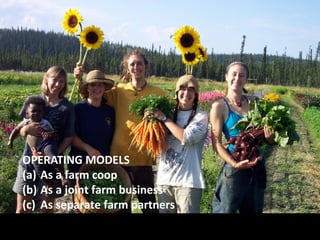
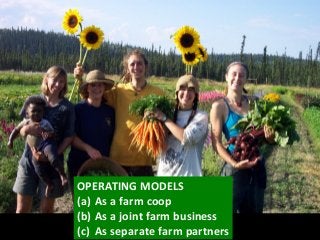
OPERATING MODELS
(a) As a farm coop
(b) As a joint farm business
(c) As separate farm partners
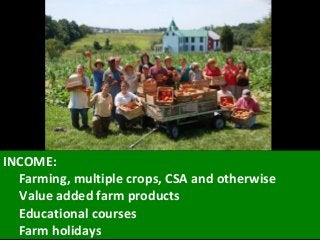
INCOME:
Farming, multiple crops, CSA and otherwise
Value added farm products
Educational courses
Farm holidays
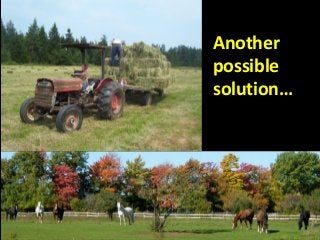
Another
possible
solution…
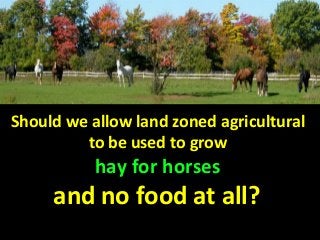
Should we allow land zoned agricultural
to be used to grow
hay for horses
and no food at all?
Land zoned agricultural should carry
the requirement applying future owners,
from the time of purchase, that at least
10% of the land be used to grow food …
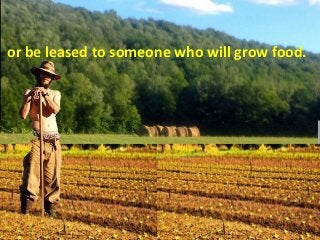
or be leased to someone who will grow food.
WANTED: Young farmers to grow food on good
farmland in Central Saanich to meet zoning
requirement. Willing to help with irrigation,
equipment, farm housing. Farmer Jones, 250-998-
7653. farmerjones@gmail.com
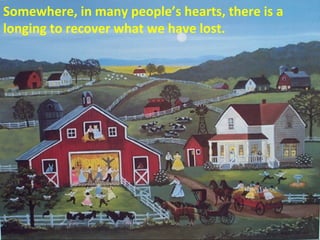
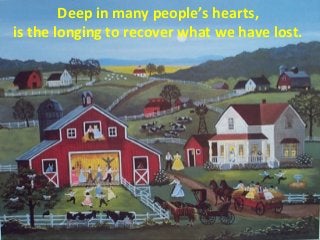
Deep in many people’s hearts,
is the longing to recover what we have lost.
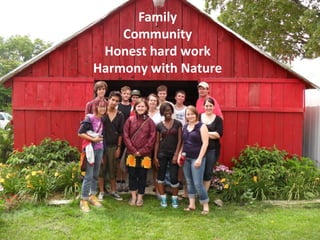
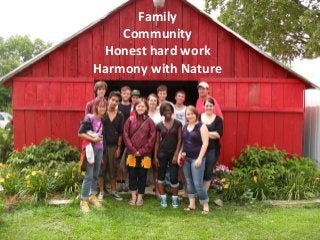
Family
Community
Honest hard work
Harmony with Nature
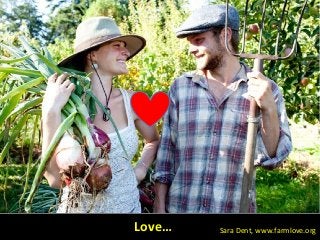
Sara Dent, www.farmlove.orgLove…
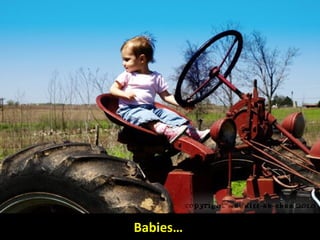
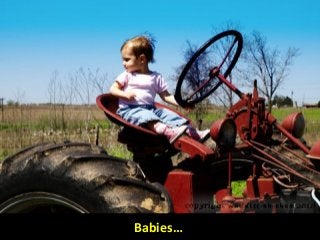
Babies…
School...
Sara Dent, www.farmlove.org
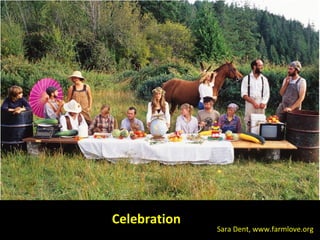
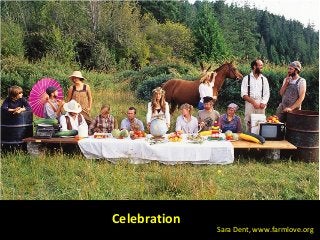
Celebration
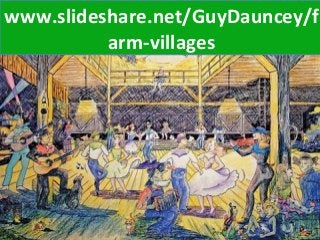
www.slideshare.net/GuyDauncey/f
arm-villages
Guy Dauncey
www.earthfuture.com

Farm Villages - The Way of the Future

  • 1.
    FARM VILLAGES The Wayof the Future
  • 2.
  • 3.
    BC’s Agricultural LandReserve (ALR) Created by the NDP government in 1973-74
  • 4.
    The Agricultural LandReserve is a provincial zone in which agriculture is recognized as the priority use. Farming is encouraged and non-agricultural uses are controlled. It covers approximately 4.7 million hectares, including private and public lands that may be farmed, forested or vacant land.
  • 5.
    The ALR’s Missionis to preserve agricultural land and encourage and enable farm businesses throughout British Columbia. The purpose of the Agricultural Land Commission is: • to preserve agricultural land; • to encourage farming in collaboration with other communities of interest; • to encourage local governments, First Nations, and government agencies to enable and accommodate farm use of agricultural land and other uses compatible with agriculture in plans, bylaws and policies.
  • 6.
    The Commission expectsto achieve its mission through the realization of four complementary goals: 1. Preservation of agricultural land. 2. Encouraging and enabling farm businesses. 3. A provincial land reserve system that considers community interests. 4. Sound governance and organizational excellence.
  • 8.
  • 9.
  • 10.
    There are 7,702hectares in the Alberni Valley ALR. Only 3,171 hectares are actively farmed. 4,531 hectares are not being farmed.
  • 11.
    Only 239 hectaresare being used for vegetables, berries, grapes and other horticultural food crops. = 3% of the farmland. The valley produces between 5% and 11% of the food consumed locally.
  • 12.
    89-95% of PortAlberni’s food is being imported…
  • 13.
    Gross farm receiptsaverage $61,797 per farm The average farmer keeps about 8 cents of every dollar sold – an average annual income of $4,606 per farm to cover all overhead costs. Alberni Valley Agricultural Plan, 2011-2031
  • 14.
    5,184 hectares couldbe improved to prime capability with irrigation The average farm operator is 55 years old. It is expensive and time consuming to convert to higher valued crops, so long term farmers are resisting changing. Alberni Valley Agricultural Plan, 2011-2031
  • 15.
    “Despite this, demandfor local food has never been stronger. Consumers want to buy food they trust from people they trust. The Alberni Valley has experienced farmers and quality soils. There are opportunities to increase direct-marketed products to local consumer and tourists. … food for thought for developing a vision and plan for agriculture in the Alberni Valley.” Alberni Valley Agricultural Plan, 2011-2031
  • 16.
    Good farmland sits empty Youngpeople want to farm
  • 17.
    And a lotof Vancouver Island farmland is just growing hay
  • 19.
    Using small-scale intensiveorganic horticulture, farmers can earn to earn up to $25,000 an acre, grossing up to $80,000 a year of profit per small farm.
  • 20.
    Throughout the world,in every culture, farmers have lived in small farm villages
  • 24.
  • 25.
  • 26.
    The Basic Idea: Onany farm of more than 40 hectares (eg) 1 hectare may be rezoned as a Community Farm Village, with additional acreage being leased or sold to Community Farm Villagers for farming purposes.
  • 27.
    FARM VILLAGES A Proposal ACommunity Farmland Zone The Zone would allow the development of a clustered Farm Village, with controls to ensure that the land is farmed: A: A Community Farmland Zone Bylaw B: A covenant registered with the land C: Strata Farm Fees that do not apply if the land is farmed D: Registration of a Housing Agreement, restricting residential units to farmers and their families.
  • 28.
    FARM VILLAGES A Proposal TheVillage is a self-governing community strata-title, with the land owned privately, cooperatively, or by a Land Trust. The Farm Village can be created in three ways: (a) By successful application to the local Council by a group of would-be farmers for Community Farmland Zoning, on a farm they intend to buy. (b) By successful application to the local Council by an existing farmer with land outside the ALR. (c) By successful application to the local Council and to the Agricultural Land Commission by an existing farmer with land inside the ALR.
  • 29.
    Either: A farmfor sale, and a group of would-be Farm Villagers apply for Community Farmland Zoning.
  • 30.
    Or: A farmerwho supports the idea, backed by would-be Village Farmers, applies for Community Farmland Zoning.
  • 31.
  • 32.
  • 33.
  • 34.
  • 35.
  • 37.
  • 38.
  • 39.
    100 Hectare Farm Anywhere,BC Farm Village Cost of land: $100,000? Shared by 5 families = $20,000 each Cost per small starter self-built house: $150,000
  • 40.
    100 Hectare Farm Anywhere,BC Farm Village Cost of land: $100,000? Shared by 5 families = $20,000 each Cost per small starter self-built house: $150,000 Leased or purchased
  • 41.
    100 Hectare Farm Anywhere,BC Farm Village Cost of land: $100,000? Shared by 5 families = $20,000 each Cost per small starter self-built house: $150,000 Four levels of protection, to ensure that the Zone is not abused: 1. The new Community Farm Zone Bylaw 2. A Covenant attached to the land 3. Strata Council Farm Fees 4. A Registered Housing Agreement
  • 42.
    Alberni Valley Farmland 4,531hectares = possible 50 Farm villages
  • 43.
    FARM VILLAGES A Proposal 1:Community Farmland Zoning Bylaw Principal use agriculture. Residential use ancillary, homes limited (eg) to 1500 sq ft. ‘Farming’ defined to exclude principally forage or hay. The first acre per household not for forage, horses or hay. On subsequent acres, no more than 50% of the land can be used for horses, forage or hay.
  • 44.
    FARM VILLAGES A Proposal 2:Community Farmland Covenant Registration of a restrictive covenant to the effect that the land will be used for farming, signed by a third party (eg a Farmland Trust) which would monitor the lands, and ensure they are used for farming. The owners would be unable to break the covenant, since the role of the third-party covenant holder would be to uphold the covenant.
  • 45.
    FARM VILLAGES A Proposal 3:Strata Farm Fees The strata council (required by covenant) will oversee the farming operations, with forgivable strata fees for farming. If the owners choose not to farm, significant strata fees will be charged and used to pay for others to farm the land. Strata fees will also be collected to fund common facilities, green houses, irrigation, cool storage, processing kitchen, farm worker accommodation, etc.
  • 46.
    FARM VILLAGES A Proposal 4:A Housing Agreement Registration of a Housing Agreement. In British Columbia, the Local Government Act enables local governments to register housing agreements which can restrict housing to “classes of persons” (sec 905 2) b), LGA). This may be used to restrict the residential units to “farmers” and their families.
  • 47.
    Yarrow Ecovillage andFarm, Yale, BC
  • 60.
    HOW COULD ITHAPPEN? 1. It is legally possible to create such a new Zone, both inside and outside the ALR.
  • 61.
    HOW COULD ITHAPPEN? 1. It is legally possible to create such a new Zone, both inside and outside the ALR. 2. A non-profit obtains a grant to develop the idea.
  • 62.
    HOW COULD ITHAPPEN? 1. It is legally possible to create such a new Zone, both inside and outside the ALR. 2. A non-profit obtains a grant to develop the idea. 3. Talk to local planners and ALR Commissioners.
  • 63.
    HOW COULD ITHAPPEN? 1. It is legally possible to create such a new Zone, both inside and outside the ALR. 2. A non-profit obtains a grant to develop the idea. 3. Talk to local planners and ALR Commissioners. 4. Create a website to gather input from future farmers
  • 64.
    HOW COULD ITHAPPEN? 1. It is legally possible to create such a new Zone, both inside and outside the ALR. 2. A non-profit obtains a grant to develop the idea. 3. Talk to local planners and ALR Commissioners. 4. Create a website to gather input from future farmers 5. Seek would-be Village Farmers.
  • 65.
    HOW COULD ITHAPPEN? 1. It is legally possible to create such a new Zone, both inside and outside the ALR. 2. A non-profit obtains a grant to develop the idea. 3. Talk to local planners and ALR Commissioners. 4. Create a website to gather input from future farmers 5. Seek would-be Village Farmers. 6. Seek existing farmers who might be interested to sell some of their land for a Farmland Village.
  • 66.
    HOW COULD ITHAPPEN? 1. It is legally possible to create such a new Zone, both inside and outside the ALR. 2. A non-profit obtains a grant to develop the idea. 3. Talk to local planners and ALR Commissioners. 4. Create a website to gather input from future farmers 5. Seek would-be Village Farmers. 6. Seek existing farmers who might be interested to sell some of their land for a Farmland Village. 7. Create the first Community Farmland Village.
  • 67.
    WANTED: Future farmersto form Community Farm Village. Buy land, build our homes, farm the land. Contact Jason 250-456-7899 Jason@gmail.com
  • 68.
    LAND OWNERSHIP (a) Strata-title,owned by the new farmers (b) A Community Land Trust owns the land, new farmers own their houses
  • 69.
    FINANCING (a) Land purchaseis angel investor financed, repaid by Village Farm strata over time. (b) Farmer sells to new owners over 10 years. (c) A Community Land Trust purchases the land, leases it to the farmers (d) Straight mortgage from a friendly bank, credit union
  • 70.
    OPERATING MODELS (a) Asa farm coop (b) As a joint farm business (c) As separate farm partners
  • 71.
    INCOME: Farming, multiple crops,CSA and otherwise Value added farm products Educational courses Farm holidays
  • 72.
  • 73.
    Should we allowland zoned agricultural to be used to grow hay for horses and no food at all?
  • 74.
    Land zoned agriculturalshould carry the requirement applying future owners, from the time of purchase, that at least 10% of the land be used to grow food …
  • 75.
    or be leasedto someone who will grow food.
  • 76.
    WANTED: Young farmersto grow food on good farmland in Central Saanich to meet zoning requirement. Willing to help with irrigation, equipment, farm housing. Farmer Jones, 250-998- 7653. farmerjones@gmail.com
  • 78.
    Deep in manypeople’s hearts, is the longing to recover what we have lost.
  • 79.
  • 80.
  • 81.
  • 82.
  • 85.
  • 87.
  • 88.

Editor's Notes

  • #89 <number>