Landscape Approaches: The Place
of Agroforestry, afforestation and
   Agroforestry
     reforestation in REDD+
 Peter A Minang, Meine van Noordwijk and Valentina
                      Robiglio

   ASB Partnership at World Agroforestry Centre (ICRAF) and
      International Institute for Tropical Agriculture (IITA)
               Forest Day 5, Durban South Africa
                       04 December 2011


 The Starting Point!!!!
                               • Agroforestry,
                                 reforestation and
                                 afforestation constitute
                                 very relevant strategies
                                 for alleviating
                                 pressures on f forests
                                                     t
                                 and significantly
                                 contributing to REDD+
                                 co-benefits in a
                                 landscape approach to
                                          p pp
                                 REDD+.
Mosaic Landscapes in Indonesia and
 Kenya: The dominant Reality
         h d             l


 Landscape Approaches
• For Analyzing and           • For Planning and
  Understanding                 Implementing REDD+
  REDD+                         • Jurisdictional
     • Drivers off                Implementation
       deforestation beyond       (Province- DRC; District-
       the forests                Vietnam; Around
                                  protected Areas
                                             Areas,
     • Interactions at
                                  Community Forests-
       various scales-
                                  Kisagau, Kenya)
       Individuals,
         d dua s,
       “communities”, sub-      • Bundled ecosystem
       national, national,        services e.g. watersheds-
       global trade etc           CARE Ulugurus in
                                  Tanzania
Discussion Point No. 1
                  No
 • Agroforestry
   Agroforestry,
   Afforestation and
   Reforestation can
   be part of REDD+
   depending on the
   definition of
   forest in a given
   country


 Forest Definition Vs
 Agroforests
 Parameters:                        • Natural Forest TO logging
   Minimum tree crown                 TO into fastwood plantations
                                       = NO Deforestation
    cover between 10 and
    30%
                                     • Most tree crop production
                                                         d    i
   Minimum tree height
                                       and agroforestry systems do
    between 2 and 5 m                  meet the minimum
   Minimum land area                  requirements of forest;
    between 0.05 and 1.0
    hectare                          • Swiddening and shifting
   T
    Temporarily unstocked
               il     t k d            cultivation not a d i
                                          l i  i         driver of
                                                                 f
    areas (without time limit to       deforestation, as long as the
    ‘temporarily’) remain              fallow phase can be expected
    ‘forest’ as long as a forester
     forest                            to reach minimum tree
    thinks they will, can or           height and crown cover;
    should return to tree cover
    conditions.
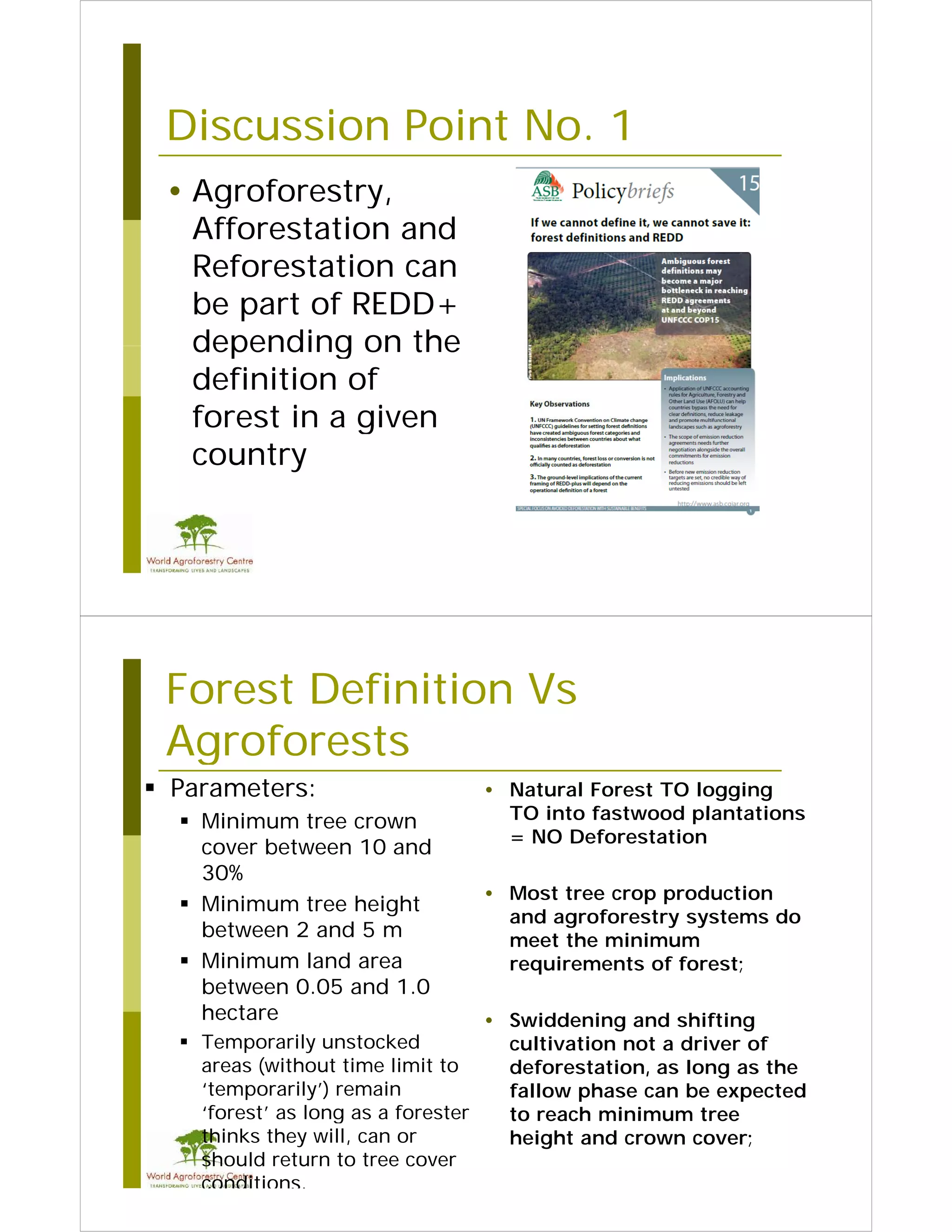
10%                                       20%


6700 km2 = 2.8% of land area           36,000 km2 = 14.9% of land area

                               30%

    Implications
    of forest
    definition 1-
    A/R Uganda

                                                        Zomer et al. 2008

                      69,300 km2 = 28.6% of land area
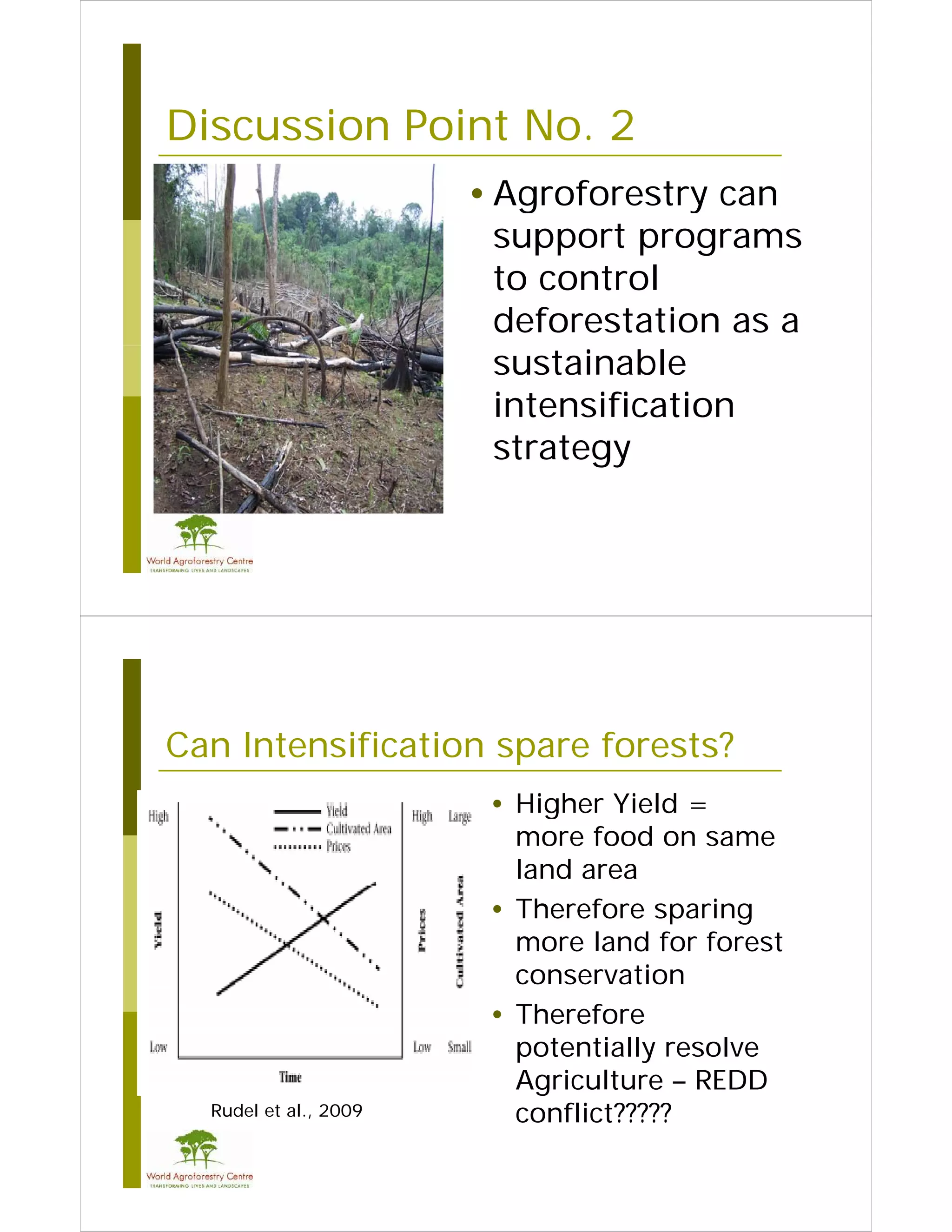
Discussion Point No. 2
                 No
                       • Agroforestry can
                         support programs
                         to
                         t control
                               t l
                         deforestation as a
                         sustainable
                         intensification
                         strategy


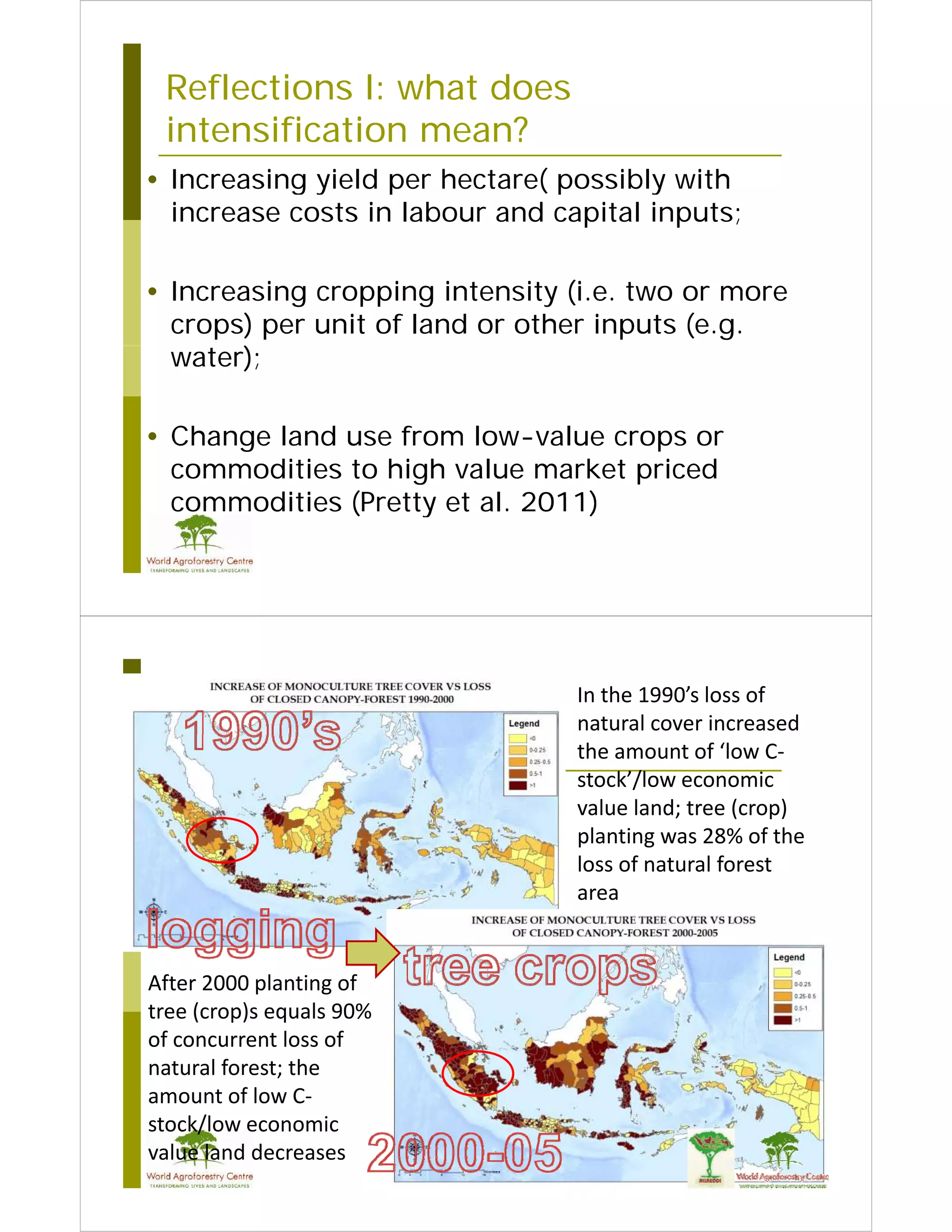
Can I
C Intensification spare forests?
        ifi i           f      ?
                        • Higher Yield =
                          more food on same
                          land area
                        • Therefore sparing
                          more land for forest
                          conservation
                        • Therefore
                          potentially resolve
                                 i ll     l
                          Agriculture – REDD
  Rudel et al., 2009
           al             conflict?????
Reflections I: what does
 intensification mean?
 i     ifi i          ?
• Increasing yield per hectare( possibly with
  increase costs in labour and capital inputs;

• Increasing cropping intensity (i.e. two or more
  crops) per unit of land or other inputs (e.g.
  water);
       )

• Change land use from low-value crops or
  commodities to high value market priced
  commodities (Pretty et al 2011)
                         al.


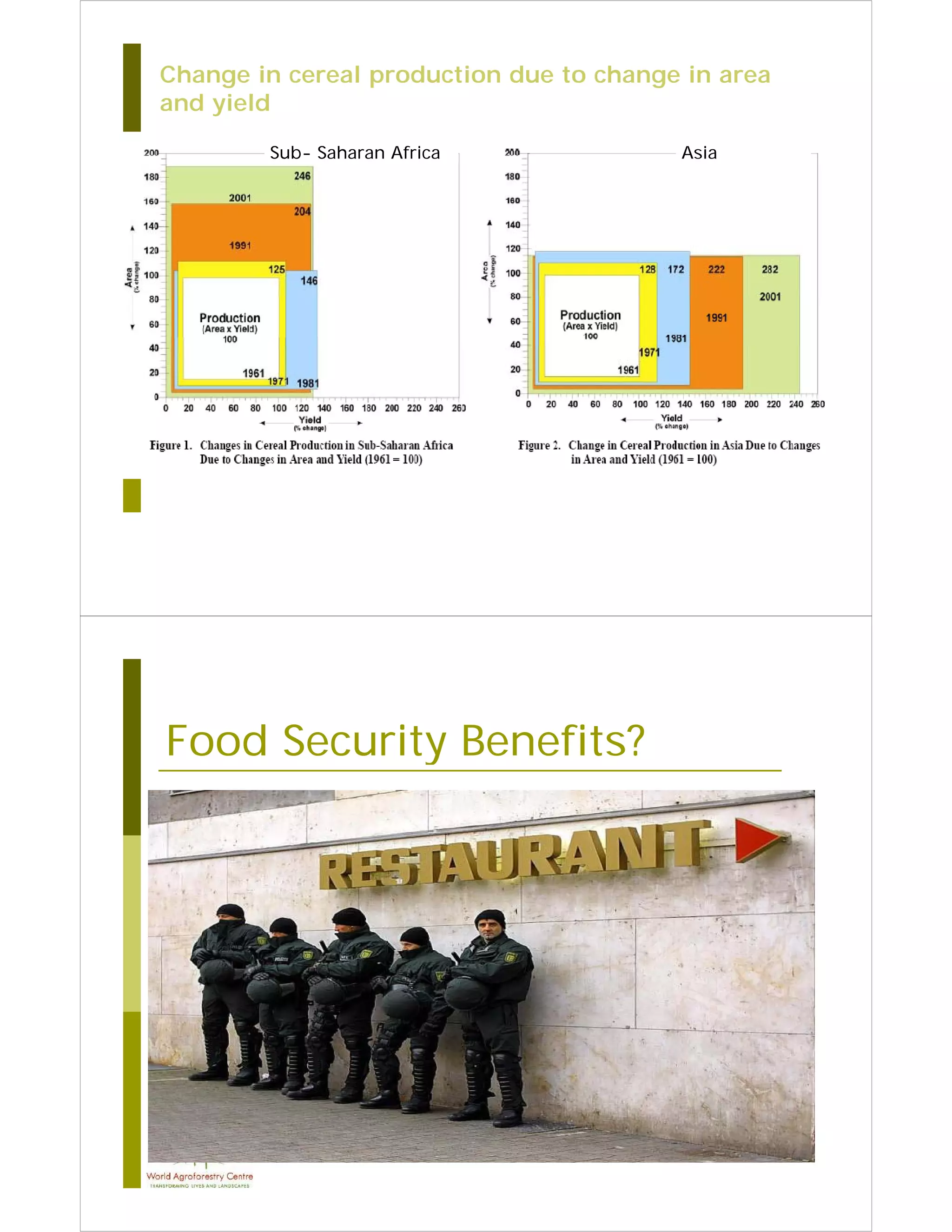
                                 In the 1990’s loss of 
                                 natural cover increased 
                                 the amount of ‘low C‐
                                 stock’/low economic 
                                 value land; tree (crop) 
                                 value land; tree (crop)
                                 planting was 28% of the 
                                 loss of natural forest 
                                 area


After 2000 planting of 
tree (crop)s equals 90% 
of concurrent loss of 
of concurrent loss of
natural forest; the 
amount of low C‐
stock/low economic 
value land decreases
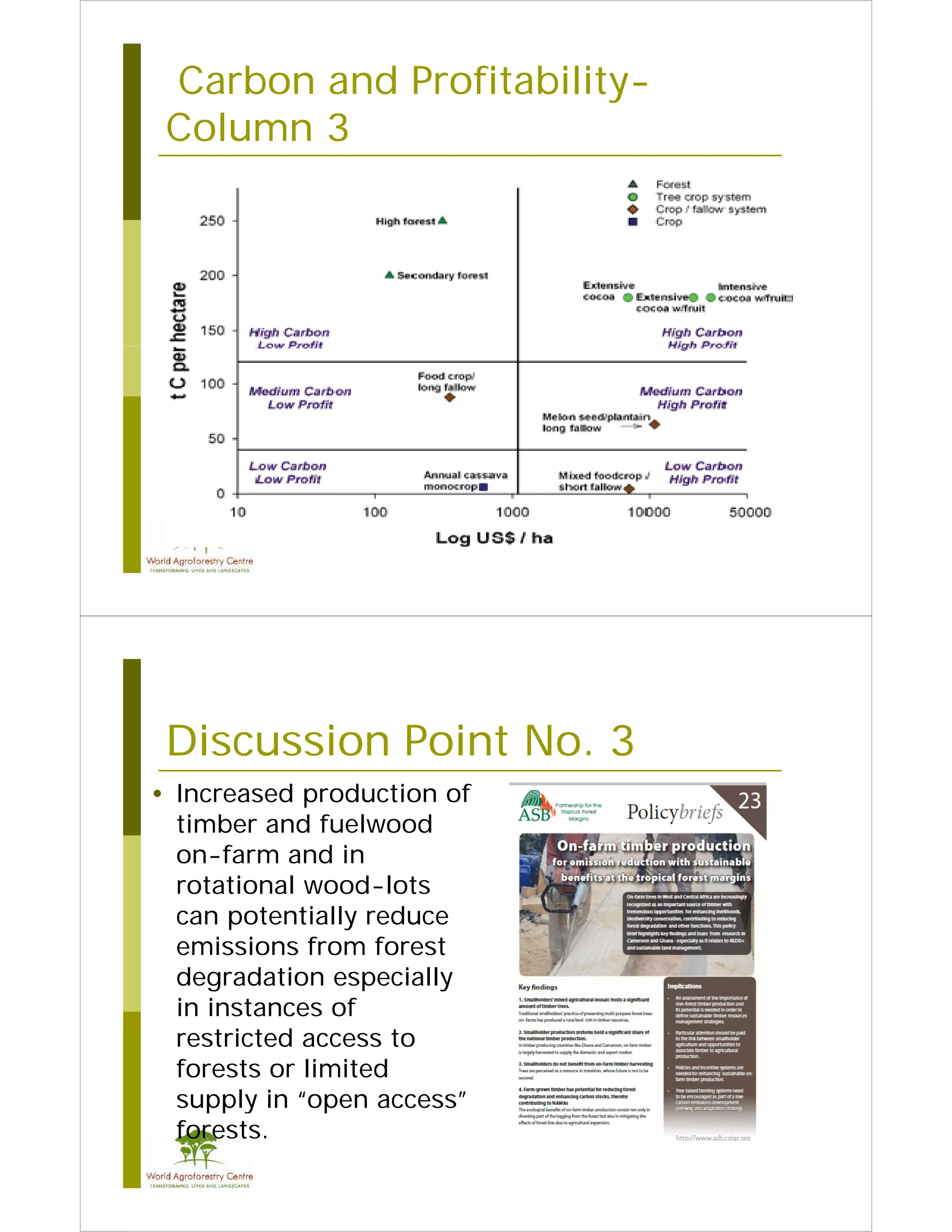
Change in cereal production due to change in area
and yield

        Sub- Saharan Africa              Asia


Food Security Benefits?
Carbon and Profitability-
 Column 3
 C l


 Discussion Point No. 3
                  No
• Increased production of
  timber and fuelwood
  on-farm and in
  rotational wood-lots
  can potentially reduce
  emissions from forest
  degradation especially
  in instances of
  restricted access to
  forests or limited
  supply in “open access”
     pp y      p
  forests.
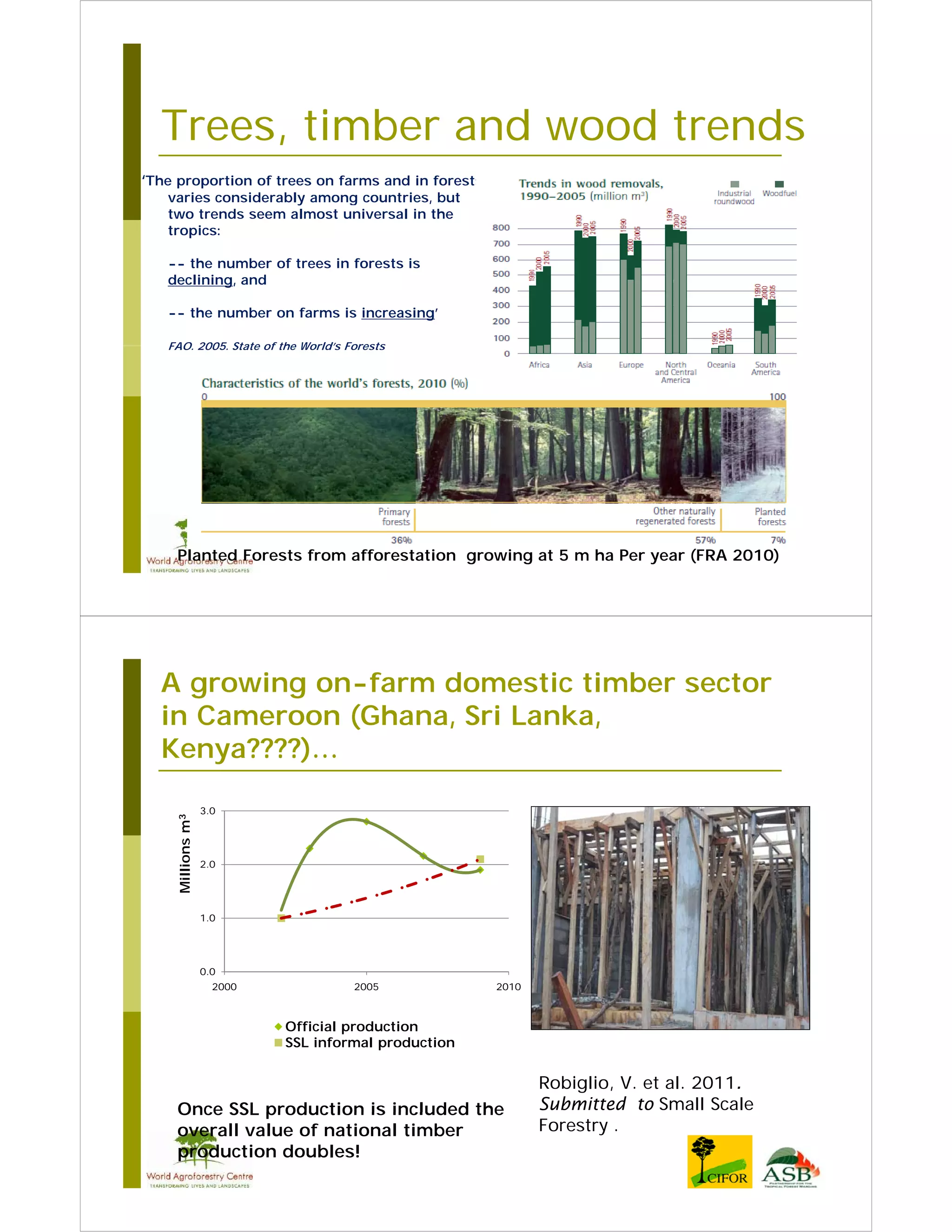
Trees,
  Trees timber and wood trends
‘The proportion of trees on farms and in forests
   varies considerabl among countries, but
    aries considerably      co ntries b t
   two trends seem almost universal in the
   tropics:

   -- the number of trees in forests is
   declining, and

   -- the number on farms is increasing’

   FAO. 2005.
   FAO 2005 State of the World’s Forests
                         World s


     Planted Forests from afforestation growing at 5 m ha Per year (FRA 2010)


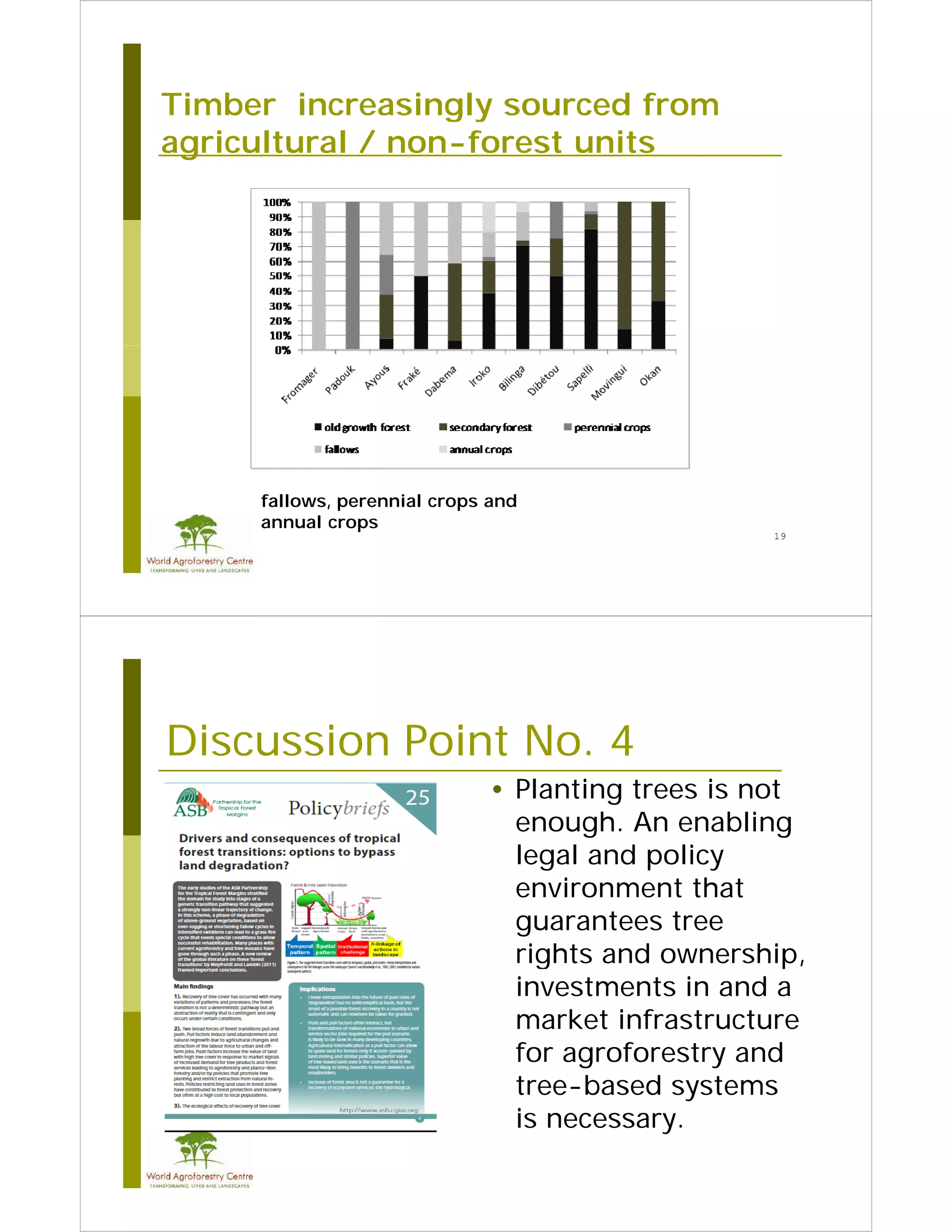
  A growing on-farm domestic timber sector
  in Cameroon (Ghana, Sri Lanka,
  Kenya????)…

                  3.0
                  30
    Millions m3


                  2.0
    M


                  1.0


                  0.0
                    2000            2005             2010


                           Official production
                           SSL informal production
                                 f     l    d


                                                            Robiglio, V. et al. 2011.
     Once SSL production is included the                    Submitted to Small Scale
     overall value of national timber                       Forestry .
     production doubles!                                                                18
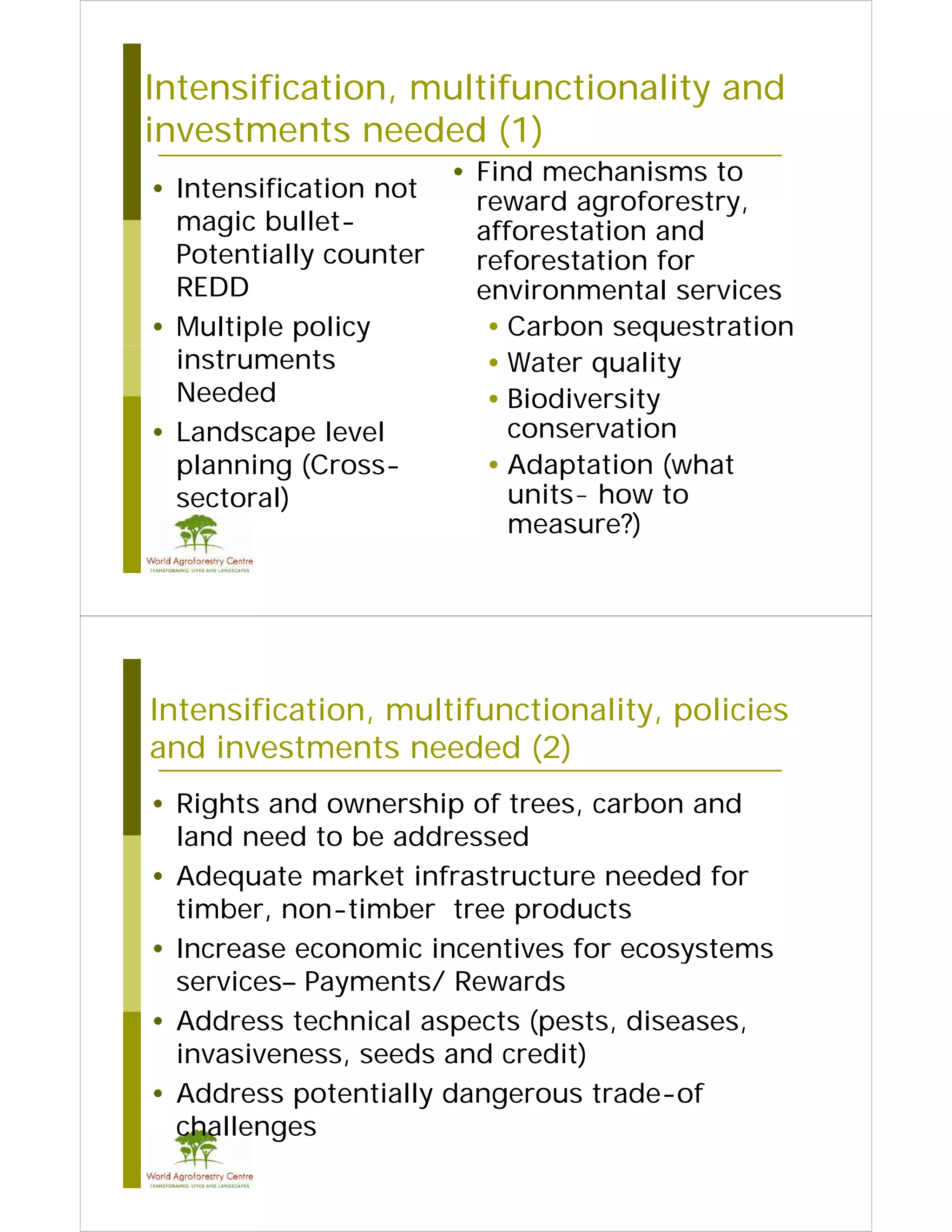
Timber increasingly sourced from
                  gy
agricultural / non-forest units


     fallows, perennial crops and
     f ll           i l         d
     annual crops
                                                 19


Discussion Point No. 4
                 No
                             • Planting trees is not
                               enough. An enabling
                               legal and policy
                               environment that
                               guarantees tree
                               rights and ownership,
                               investments in and a
                               market infrastructure
                               for agroforestry and
                               tree-based systems
                               is necessary.
Intensification, multifunctionality and
investments needed (1)
i                d d
                        • Find mechanisms to
• Intensification not     reward agroforestry,
                                d      f    t
  magic bullet-           afforestation and
  Potentially counter     reforestation for
  REDD                    environmental services
• Multiple policy          • Carbon sequestration
  instruments              • Water quality
  Needed                   • Biodiversity
•L d
  Landscape l level
                  l          conservation
                                      ti
  planning (Cross-         • Adaptation (what
  sectoral)                  units
                             units- how to
                             measure?)


Intensification, multifunctionality, policies
and investments needed ( )
   d                  d d (2)
• Rights and ownership of trees, carbon and
  land need to be addressed
• Adequate market infrastructure needed for
      q
  timber, non-timber tree products
                                        y
• Increase economic incentives for ecosystems
  services– Payments/ Rewards
• Address technical aspects (pests, diseases,
  invasiveness, seeds and credit)
• Address potentially dangerous trade-of
  challenges
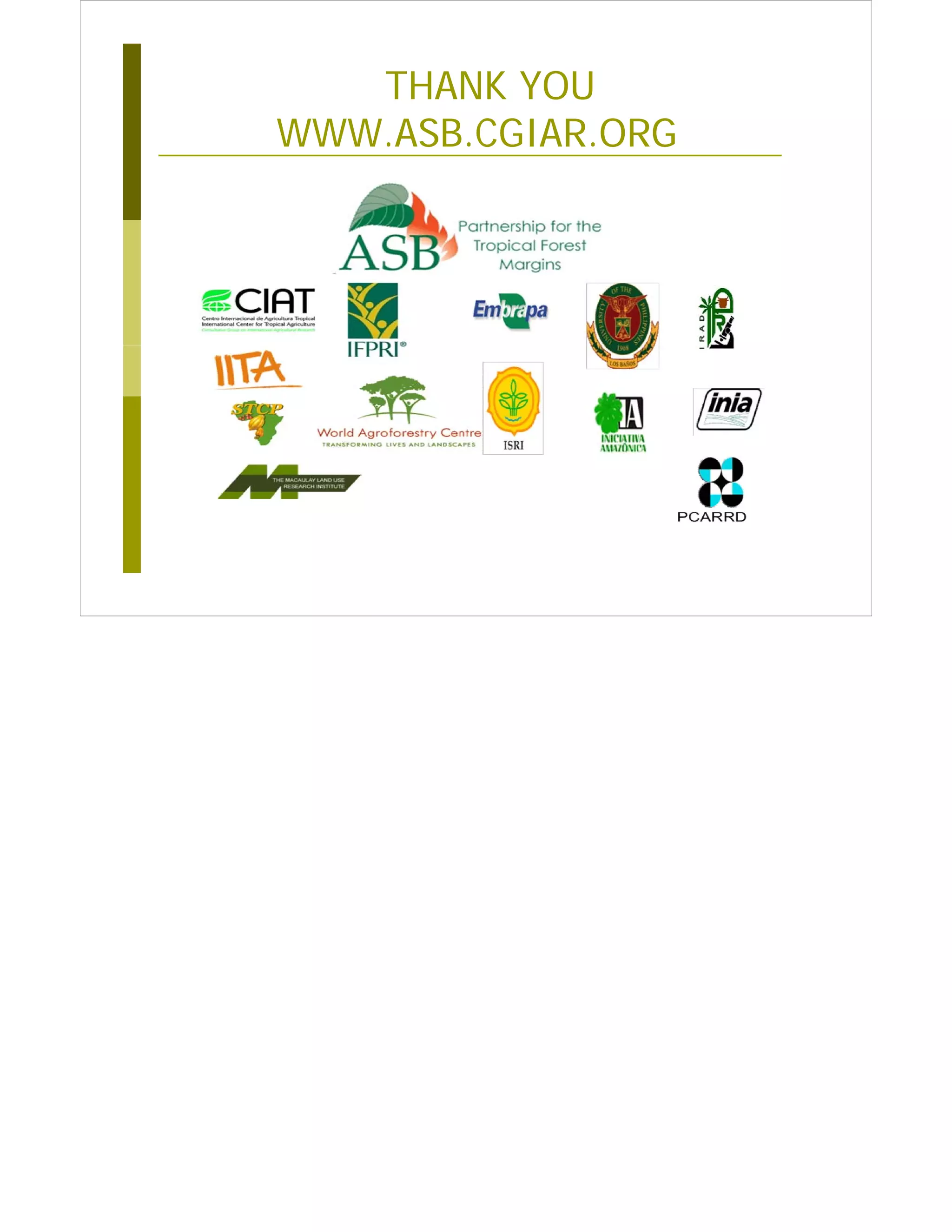
THANK YOU
WWW.ASB.CGIAR.ORG
WWW ASB CGIAR ORG

Landscape Aproaches: The place of Agroforestry, afforestation and reforestation in REDD+

  • 1.
    Landscape Approaches: ThePlace of Agroforestry, afforestation and Agroforestry reforestation in REDD+ Peter A Minang, Meine van Noordwijk and Valentina Robiglio ASB Partnership at World Agroforestry Centre (ICRAF) and International Institute for Tropical Agriculture (IITA) Forest Day 5, Durban South Africa 04 December 2011 The Starting Point!!!! • Agroforestry, reforestation and afforestation constitute very relevant strategies for alleviating pressures on f forests t and significantly contributing to REDD+ co-benefits in a landscape approach to p pp REDD+.
  • 2.
    Mosaic Landscapes inIndonesia and Kenya: The dominant Reality h d l Landscape Approaches • For Analyzing and • For Planning and Understanding Implementing REDD+ REDD+ • Jurisdictional • Drivers off Implementation deforestation beyond (Province- DRC; District- the forests Vietnam; Around protected Areas Areas, • Interactions at Community Forests- various scales- Kisagau, Kenya) Individuals, d dua s, “communities”, sub- • Bundled ecosystem national, national, services e.g. watersheds- global trade etc CARE Ulugurus in Tanzania
  • 3.
    Discussion Point No.1 No • Agroforestry Agroforestry, Afforestation and Reforestation can be part of REDD+ depending on the definition of forest in a given country Forest Definition Vs Agroforests  Parameters: • Natural Forest TO logging  Minimum tree crown TO into fastwood plantations = NO Deforestation cover between 10 and 30% • Most tree crop production d i  Minimum tree height and agroforestry systems do between 2 and 5 m meet the minimum  Minimum land area requirements of forest; between 0.05 and 1.0 hectare • Swiddening and shifting  T Temporarily unstocked il t k d cultivation not a d i l i i driver of f areas (without time limit to deforestation, as long as the ‘temporarily’) remain fallow phase can be expected ‘forest’ as long as a forester forest to reach minimum tree thinks they will, can or height and crown cover; should return to tree cover conditions.
  • 4.
    10% 20% 6700 km2 = 2.8% of land area 36,000 km2 = 14.9% of land area 30% Implications of forest definition 1- A/R Uganda Zomer et al. 2008 69,300 km2 = 28.6% of land area
  • 5.
    Discussion Point No.2 No • Agroforestry can support programs to t control t l deforestation as a sustainable intensification strategy Can I C Intensification spare forests? ifi i f ? • Higher Yield = more food on same land area • Therefore sparing more land for forest conservation • Therefore potentially resolve i ll l Agriculture – REDD Rudel et al., 2009 al conflict?????
  • 6.
    Reflections I: whatdoes intensification mean? i ifi i ? • Increasing yield per hectare( possibly with increase costs in labour and capital inputs; • Increasing cropping intensity (i.e. two or more crops) per unit of land or other inputs (e.g. water); ) • Change land use from low-value crops or commodities to high value market priced commodities (Pretty et al 2011) al. In the 1990’s loss of  natural cover increased  the amount of ‘low C‐ stock’/low economic  value land; tree (crop)  value land; tree (crop) planting was 28% of the  loss of natural forest  area After 2000 planting of  tree (crop)s equals 90%  of concurrent loss of  of concurrent loss of natural forest; the  amount of low C‐ stock/low economic  value land decreases
  • 7.
    Change in cerealproduction due to change in area and yield Sub- Saharan Africa Asia Food Security Benefits?
  • 8.
    Carbon and Profitability- Column 3 C l Discussion Point No. 3 No • Increased production of timber and fuelwood on-farm and in rotational wood-lots can potentially reduce emissions from forest degradation especially in instances of restricted access to forests or limited supply in “open access” pp y p forests.
  • 9.
    Trees, Treestimber and wood trends ‘The proportion of trees on farms and in forests varies considerabl among countries, but aries considerably co ntries b t two trends seem almost universal in the tropics: -- the number of trees in forests is declining, and -- the number on farms is increasing’ FAO. 2005. FAO 2005 State of the World’s Forests World s Planted Forests from afforestation growing at 5 m ha Per year (FRA 2010) A growing on-farm domestic timber sector in Cameroon (Ghana, Sri Lanka, Kenya????)… 3.0 30 Millions m3 2.0 M 1.0 0.0 2000 2005 2010 Official production SSL informal production f l d Robiglio, V. et al. 2011. Once SSL production is included the Submitted to Small Scale overall value of national timber Forestry . production doubles! 18
  • 10.
    Timber increasingly sourcedfrom gy agricultural / non-forest units fallows, perennial crops and f ll i l d annual crops 19 Discussion Point No. 4 No • Planting trees is not enough. An enabling legal and policy environment that guarantees tree rights and ownership, investments in and a market infrastructure for agroforestry and tree-based systems is necessary.
  • 11.
    Intensification, multifunctionality and investmentsneeded (1) i d d • Find mechanisms to • Intensification not reward agroforestry, d f t magic bullet- afforestation and Potentially counter reforestation for REDD environmental services • Multiple policy • Carbon sequestration instruments • Water quality Needed • Biodiversity •L d Landscape l level l conservation ti planning (Cross- • Adaptation (what sectoral) units units- how to measure?) Intensification, multifunctionality, policies and investments needed ( ) d d d (2) • Rights and ownership of trees, carbon and land need to be addressed • Adequate market infrastructure needed for q timber, non-timber tree products y • Increase economic incentives for ecosystems services– Payments/ Rewards • Address technical aspects (pests, diseases, invasiveness, seeds and credit) • Address potentially dangerous trade-of challenges
  • 12.