Family
It is a group of biologically related
persons living together and sharing
the common kitchen and purse
Household
 Biologically nonrelated persons, as
servants or any persons from the same
place of origin may also stay.
Family as a unit
 Social Unit:
Members have common physical and
social environment
 Biological Unit:
Members share common genes
 Cultural Unit:
It determines their attitude and behaviour
Family as a unit
 Fundamental Unit:
Of the nation for all practical purposes
 Epidemiological Unit:
To the health worker
 End Unit:
Where comprehensive social and health
care can be delivered
Family as a unit
 Consumer Unit:
At the base of the society
Family Pattern
 Family of origin: Where one
is born
 Family of procreation: setup
after marriage
Family Types
I Nuclear or Unitary or Single Family :
Married couples with their dependent
children
II Joint Family:
More than one married couple live with
their children
IIIThree generation family
Representation of the three generations live
together.
Stages of Family
Four stages (sometimes intermingle with
or overlap one another):
1. Stage of Formation:
Began with marriage
2. Stage of Growth:
Starts with birth of children
Stages of Family
3. Stage of retraction:
When grown-up children marry and
start their own family or migrate to
other places.
4. Stage of Disintegration:
Begins with the death of parents
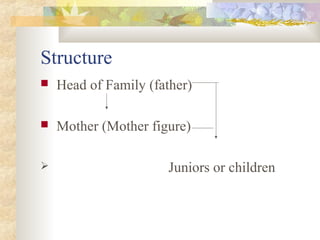
Structure
 Head of Family (father)
 Mother (Mother figure)
 Juniors or children
Family Functions
A. Provide residence is the first function
(it may be paternal, maternal, or
independent)
B. Family maintains an Economic
Security
C. Division of Labour
D. Rearing and Upbringing of children
E. As a social and Cultural Bridge, it
transmits the Social values from one
generation to other
Family Functions
F. Care & Protection especially to children
& aged
G. Family regulates the Marital relations and
Sexual activities
H. Family act as a Buffer during the ups-
downs of the individual and collective
life.
Pathogenic Family Structure
1. : Discordant and Disturbed Families
(a) One or both of the parents is not gaining
satisfaction from the relationship and
 May express feelings of frustration and
disillusionment in hostile ways such as;
 Nagging, belittling &
 Doing things purposefully to annoy the other
person.
(b) Value differences.
Pathogenic Family Structure - Discordant and
Disturbed Families
Complications:
Children find difficult to establish and
maintain marital and other intimate
relationship.
Pathogenic Family Structure
2. Disturbed
 One or both of the parents behave in
grossly Eccentric or Abnormal ways
and may keep the home; in constant
Emotional Turmoil
(a) Parents who are fighting to maintain
their own equilibrium and are unable to
give the child needed love and
guidance;
Pathogenic Family Structure
2. Disturbed
(b) Gross irrationally in communication
patterns as well as faulty parental
models;
(c) Almost in vitality, the enmeshment of the
child in the emotional conflicts of the
parents.
I. Marital Schism
II. Marital Skew
Pathogenic Family Structure
2. Disturbed
I. Marital Schism:
Both parents are constantly embroiled in deep
seated conflict;
II. Marital Skew:
Healthier marital partner in the interest of
minimizing open disharmony, essentially
accepts and support the frequently bizarre
beliefs and behaviours of the spouse.
Pathogenic Family Structure
3. Disrupted
 Incomplete, whether as a result of death,
divorce, separation or some other
circumstance:- following effects
a. Traumatic effects on a child
b. Feeling of insecurity & rejection
 Absence of father has adverse effect on
the formation of a secure gender identity
for both girls and boys.
Pathogenic Family Structure
4. Inadequate Families:
 Inability to cope with the ordinary problems of
Family living
 It lacks the resources, physical or psychological
for meeting demands with which most families
can satisfactorily cope.
 The incompetence of such a family may stem
from immaturity, lack of education, mental
retardation, or other short coming of the parents.
Pathogenic Family Structure
4. Inadequate Families:
Effects:
 Cannot give its children the feeling of
safety and security they need or
 Adequately guide them in the
development of essential competencies
Pathogenic Family Structure
5. Ant-Social families
 Parents are overtly or covertly engaged in
behaviour that violates the standard and
interests of society (anti-social) and
 They may be chronically in difficulty with
the law.
 Such anti-social values usually handicap
relationship within the family, as well as
provide undesirable models for child.
Family
Family
Family
Family
Family

Family

  • 1.
    Family It is agroup of biologically related persons living together and sharing the common kitchen and purse
  • 2.
    Household  Biologically nonrelatedpersons, as servants or any persons from the same place of origin may also stay.
  • 3.
    Family as aunit  Social Unit: Members have common physical and social environment  Biological Unit: Members share common genes  Cultural Unit: It determines their attitude and behaviour
  • 4.
    Family as aunit  Fundamental Unit: Of the nation for all practical purposes  Epidemiological Unit: To the health worker  End Unit: Where comprehensive social and health care can be delivered
  • 5.
    Family as aunit  Consumer Unit: At the base of the society
  • 6.
    Family Pattern  Familyof origin: Where one is born  Family of procreation: setup after marriage
  • 7.
    Family Types I Nuclearor Unitary or Single Family : Married couples with their dependent children II Joint Family: More than one married couple live with their children IIIThree generation family Representation of the three generations live together.
  • 8.
    Stages of Family Fourstages (sometimes intermingle with or overlap one another): 1. Stage of Formation: Began with marriage 2. Stage of Growth: Starts with birth of children
  • 9.
    Stages of Family 3.Stage of retraction: When grown-up children marry and start their own family or migrate to other places. 4. Stage of Disintegration: Begins with the death of parents
  • 10.
    Structure  Head ofFamily (father)  Mother (Mother figure)  Juniors or children
  • 11.
    Family Functions A. Provideresidence is the first function (it may be paternal, maternal, or independent) B. Family maintains an Economic Security C. Division of Labour D. Rearing and Upbringing of children E. As a social and Cultural Bridge, it transmits the Social values from one generation to other
  • 12.
    Family Functions F. Care& Protection especially to children & aged G. Family regulates the Marital relations and Sexual activities H. Family act as a Buffer during the ups- downs of the individual and collective life.
  • 13.
    Pathogenic Family Structure 1.: Discordant and Disturbed Families (a) One or both of the parents is not gaining satisfaction from the relationship and  May express feelings of frustration and disillusionment in hostile ways such as;  Nagging, belittling &  Doing things purposefully to annoy the other person. (b) Value differences.
  • 14.
    Pathogenic Family Structure- Discordant and Disturbed Families Complications: Children find difficult to establish and maintain marital and other intimate relationship.
  • 15.
    Pathogenic Family Structure 2.Disturbed  One or both of the parents behave in grossly Eccentric or Abnormal ways and may keep the home; in constant Emotional Turmoil (a) Parents who are fighting to maintain their own equilibrium and are unable to give the child needed love and guidance;
  • 16.
    Pathogenic Family Structure 2.Disturbed (b) Gross irrationally in communication patterns as well as faulty parental models; (c) Almost in vitality, the enmeshment of the child in the emotional conflicts of the parents. I. Marital Schism II. Marital Skew
  • 17.
    Pathogenic Family Structure 2.Disturbed I. Marital Schism: Both parents are constantly embroiled in deep seated conflict; II. Marital Skew: Healthier marital partner in the interest of minimizing open disharmony, essentially accepts and support the frequently bizarre beliefs and behaviours of the spouse.
  • 18.
    Pathogenic Family Structure 3.Disrupted  Incomplete, whether as a result of death, divorce, separation or some other circumstance:- following effects a. Traumatic effects on a child b. Feeling of insecurity & rejection  Absence of father has adverse effect on the formation of a secure gender identity for both girls and boys.
  • 19.
    Pathogenic Family Structure 4.Inadequate Families:  Inability to cope with the ordinary problems of Family living  It lacks the resources, physical or psychological for meeting demands with which most families can satisfactorily cope.  The incompetence of such a family may stem from immaturity, lack of education, mental retardation, or other short coming of the parents.
  • 20.
    Pathogenic Family Structure 4.Inadequate Families: Effects:  Cannot give its children the feeling of safety and security they need or  Adequately guide them in the development of essential competencies
  • 21.
    Pathogenic Family Structure 5.Ant-Social families  Parents are overtly or covertly engaged in behaviour that violates the standard and interests of society (anti-social) and  They may be chronically in difficulty with the law.  Such anti-social values usually handicap relationship within the family, as well as provide undesirable models for child.