Family types , functions – Family in
health and disease
• Dr. vanitha ,
• Dept. of community Medicine
Objectives
• Definition of family
• To know about the various types of families
• To understand the functions of family
• To understand the role of family in health and
disease
Introduction
Family - primary unit of all society - derived from
Roman word 'famulus' which means 'servant'
Different aspect of family
 As a biological unit ---- share a pool of genes
 As a social units - common physical & social
environment
 As cultural unit ---- it reflects culture of wider
society
 Epidemiological unit ---- for providing social
services & medical care
Family Definition
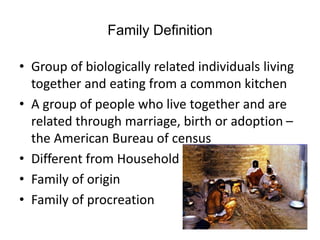
• Group of biologically related individuals living
together and eating from a common kitchen
• A group of people who live together and are
related through marriage, birth or adoption –
the American Bureau of census
• Different from Household
• Family of origin
• Family of procreation
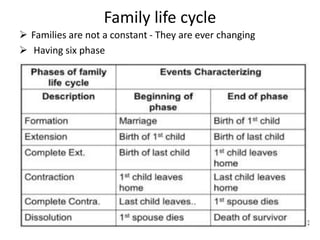
Family life cycle
 Families are not a constant - They are ever changing
 Having six phase
Family cycle
• The family life cycle is one way to look at the
roles and responsibilities of parenting
• Applicable in areas of low mortality
• ‘leaving home’ – American/ European concept
• Variations/exceptions- divorce, childlessness,
early death of children
Family cycle and stress
• Structure- cycle/non-transitional
• Childhood
• Adolescence
• Parenthood
• Aging
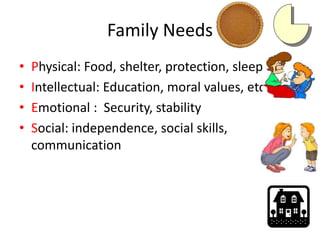
Family Needs
• Physical: Food, shelter, protection, sleep
• Intellectual: Education, moral values, etc
• Emotional : Security, stability
• Social: independence, social skills,
communication
Types of family
On the basis of structure:
Nuclear, Joint & 3- generation
 On the basis of authority:
Patriarchal & Matriarchal
On the basis of residence:
Patri local & Matrilocal
 On the basis of marriage:
Monogamous , polygamous & polyandrous
 On the basis of ancestry:
Matrilineal & patrilineal
Nuclear family
Also known as "Elementary family”
Definition - Consists of married couple & their
dependent children . Industrialization,
urbanization & employment pattern are the
compelling reasons for nuclear family
 They tend to occupy the same dwelling place
 Husband usually plays the dominant role
 Absence of relatives- grand parents, uncle, aunt
New families - This term is used for nuclear
families less than 10 years old - concept is
important in view of studies relating to family
planning
Classification of Family : Nuclear
• Merits: Husband and wife relationship more
intimate
• Demerits: Stress and strain of bringing up
children very high especially when both
parents are employed
Joint Family – also called Extended family
• Number of married couples &their children live
together in a same household &share common
kitchen
• All men related by blood & women of household
are their wives, unmarried girls &widows of family
kinsmen
• All property is held in common - common family
purse --- all income goes and expenditures met
• All the authority is vested in senior male member
of family - He is most dominant member and
control all internal and external affairs of family
• The familial relations are enjoy primacy over
marital relations
Classification of Family : Joint
• Merits
• Based on Motto “union is strength”
• Economic and social security to old, helpless and
unemployed, Care to young children, old, physically
handicapped, widow/ widowers etc
• Division of labour
• Social virtues (Cooperation, affection, sacrifice etc.)
• Pooling of income makes rearing of children,
arranging marriages, caring for the old easy job
Classification of Family : Joint
• Demerits
• Lack of privacy among couples
• Home for idlers
• Not favourable to save money
• Uncontrolled procreation
• Encourages litigation and leads to quarrel
Three generation family
It is fairly common in west
 There are representative of three generations in the
same family
Definition
 It occurs usually when young couples are unable to
find separate accommodation and continue to live with
their parents and have their own children
 They are related to each other by direct descent live
together
Classification of Family :
Single parent
• Children may be cared for by one parent
• May be due to : Separation of parents,
divorce, death of one parent , unmarried
mothers, work commitments which means
one parent may need to live away from home
Problem family
• Poor standard of life
• Unable to discharge minimum family
obligations
• Home life in unsatisfactory
Classification of Family : Others
• Stepparent Families
• Children are related through birth or adoption
to one parent only.
• Extended Families
• In some cultures families may include
grandparents and other close relatives
Household
• House : Structure with a single roof, where
one or more than one family may be residing
• Household: Group of individuals who live
together and would take meals from a
common kitchen, they are not blood related
Functions of Family
Residence
 To provide clean and descent home to its member
 In west when men marries he separate with his parents and sets up
his own home
 In India (Hindus) married couple should resides in the house of the
parent
 Two types of residency:
 Patrilocal residency
 Matrilocal residency
Division of labour
 The male had the sloe duty to earn a living and support the family
 The female had total responsibility for day to day care of children
and running of household
Cont.....
 Now a days there are less difference between function of
men and women ---- the coming together and sharing
responsibility
Reproduction and bringing up of children
 This is very important function
 The mother take absolute care of infant and children
during certain age
 The father provides for education and teaches the social
tradition and customs
Socialization:
 The family is bridge between generations and between
father and son
 The cultural pattern relating to eating, cleanliness, dress,
speech, language, behavior and attitude transmitted
through the family
Cont...
Economic function:
 The family hold the properties and ownership
like farms, shop, dwelling are handed down to
the children
Social care:
 The family provides social care by....
 Giving status in society
 Protecting its member from insult
 Regulating marital activities of its members
 Regulating to a certain extent political , religion and
general social activities
 Regulating sex relations through incest-taboos
Family in Health and Disease
• Child rearing
• Socialisation
• Personality formation
• Care of dependents
• Familial susceptibility to disease
• Non-functional
Role of family in health and disease
 The family is ultimately the unit with which one has to deal if
concerned with medicine or public health
 There are certain function which are related with health and
health behavior
Child rearing:
 One of the important function
 Physical care of dependent young ---- survive to adulthood
 The child rearing may differ from society to society and from
time to time
 It is important to note the pattern of child care (feeding,
nutrition, hygiene, sleep, clothing, habit training)
 Passing from one generation to another
Cont...
Socialization
 It refer to process by whereby individuals develop
qualities essential for functioning effectively in the
society ......it is a latent f unction
 Teaching the young, the values of the society and
transmitting information, culture, belief , conducts by
citing examples
 Introduction of young in to adult society
 In some societies the young are given freedom to
develop into individuals --- to take initiative
Personality formation
 The capacity of individual to withstand stress and strain
 The way he interact with other people
 Family acts as the ''placenta'' to filter off ill influences
Cont...
Care of dependent adults:
Care of sick and injured:
So adult become dependent either through
injury, illness or because of biological limitation
In some society there is great deal of harshness in
respect to those who are sufferer
Sometimes individual are excluded from full
range of benefits
The kind of illness is important ---- attitude of
society
The family acts like the cushion and gives the
front-line care for such individuals
Cont....
Care of women during Pregnancy
 In term of financial help, maternity leave, diet and
nutrition supplement and decrease workload to the
women
Stabilization of adult personality:
 The family is like "shock absorber" --- stress and strain
of life
 The stress could be injury, illness, birth, death, tension,
worry, anxiety etc
 The family provide opportunity to release tension ----
individual --- mental equilibrium
 Alcoholics and narcotics are reflection of this trend
 Stress disease --- peptic ulcer, colitis, high B.P.
Cont...
Familial susceptibility to disease:
• The member of family share a pool of genes, common
environment ---- decide their susceptibility of disease
• Certain disease such as haemophilia, colour blindness,
D.M., mental illness known to run through families
• Could be a playground for communicable disease viz.
TB, measles etc
Broken family
• Where the parents are separated or where death of
one or both parents
• Importantly, the victims of the broken family in
younger years were found to be displaying
psychopathic behavior, immature personality etc.
• They may drift to anti social activities like prostitution ,
gambling, crime and vagrancy
Cont....
Problem family:
• Those families who lag behind the rest of the
community
• The standard of the life are far below the accepted
minimum and parents are unable to meet physical and
emotional need of their children
• The underlying f actors are backwardness, poverty,
illness , mental and emotional instability, character
defects and marital disharmony
• The problem families found in all social class but more
common in LSEC
• The children reared in such environment ----- crime,
prostitution and vagrancy
Temporary social groups
• Crowd:
– lacks internal organization, no leader
• Mob:
– Presence of leader but not internal organization,
more emotional than a crowd
• Herd:
– presence of leader, members follow leader
without question
Permanent social groups
• The Band:
– Few families living together. E.g. gypsies
• Village
– Small collection of people
– Permanently settled
– 6,38,000 villages exist in India (2001)
Permanent social groups
• Town and cities
– Large, dense, permanent settlement of
heterogeneous individuals.
– There are 5545 towns in India (2001)
• State
– Ecological social group
Government and political organization
• Government
– Supreme agent authorized to regulate the
balanced social life in the interests of the public
• Types of government
– Democracy- E.g. India
– Autocracy- E.g. Jordan
– Monarchy – E.g. Nepal
– Socialistic- E.g. China
– Oligarchy – E.g. Saudi Arabia
Social problems
Definition
• Any deviant behaviour in a disapproved
direction of such a degree that it exceeds the
tolerance limit of the community - Lundberg
A few Social Problems
• Delinquency
• Dowry system
• Drug addiction including alcoholism
• Prostitution
Thank you

Family ppt.pptx

  • 1.
    Family types ,functions – Family in health and disease • Dr. vanitha , • Dept. of community Medicine
  • 2.
    Objectives • Definition offamily • To know about the various types of families • To understand the functions of family • To understand the role of family in health and disease
  • 3.
    Introduction Family - primaryunit of all society - derived from Roman word 'famulus' which means 'servant' Different aspect of family  As a biological unit ---- share a pool of genes  As a social units - common physical & social environment  As cultural unit ---- it reflects culture of wider society  Epidemiological unit ---- for providing social services & medical care
  • 4.
    Family Definition • Groupof biologically related individuals living together and eating from a common kitchen • A group of people who live together and are related through marriage, birth or adoption – the American Bureau of census • Different from Household • Family of origin • Family of procreation
  • 5.
    Family life cycle Families are not a constant - They are ever changing  Having six phase
  • 6.
    Family cycle • Thefamily life cycle is one way to look at the roles and responsibilities of parenting • Applicable in areas of low mortality • ‘leaving home’ – American/ European concept • Variations/exceptions- divorce, childlessness, early death of children
  • 7.
    Family cycle andstress • Structure- cycle/non-transitional • Childhood • Adolescence • Parenthood • Aging
  • 8.
    Family Needs • Physical:Food, shelter, protection, sleep • Intellectual: Education, moral values, etc • Emotional : Security, stability • Social: independence, social skills, communication
  • 9.
    Types of family Onthe basis of structure: Nuclear, Joint & 3- generation  On the basis of authority: Patriarchal & Matriarchal On the basis of residence: Patri local & Matrilocal  On the basis of marriage: Monogamous , polygamous & polyandrous  On the basis of ancestry: Matrilineal & patrilineal
  • 10.
    Nuclear family Also knownas "Elementary family” Definition - Consists of married couple & their dependent children . Industrialization, urbanization & employment pattern are the compelling reasons for nuclear family  They tend to occupy the same dwelling place  Husband usually plays the dominant role  Absence of relatives- grand parents, uncle, aunt New families - This term is used for nuclear families less than 10 years old - concept is important in view of studies relating to family planning
  • 11.
    Classification of Family: Nuclear • Merits: Husband and wife relationship more intimate • Demerits: Stress and strain of bringing up children very high especially when both parents are employed
  • 12.
    Joint Family –also called Extended family • Number of married couples &their children live together in a same household &share common kitchen • All men related by blood & women of household are their wives, unmarried girls &widows of family kinsmen • All property is held in common - common family purse --- all income goes and expenditures met • All the authority is vested in senior male member of family - He is most dominant member and control all internal and external affairs of family • The familial relations are enjoy primacy over marital relations
  • 13.
    Classification of Family: Joint • Merits • Based on Motto “union is strength” • Economic and social security to old, helpless and unemployed, Care to young children, old, physically handicapped, widow/ widowers etc • Division of labour • Social virtues (Cooperation, affection, sacrifice etc.) • Pooling of income makes rearing of children, arranging marriages, caring for the old easy job
  • 14.
    Classification of Family: Joint • Demerits • Lack of privacy among couples • Home for idlers • Not favourable to save money • Uncontrolled procreation • Encourages litigation and leads to quarrel
  • 15.
    Three generation family Itis fairly common in west  There are representative of three generations in the same family Definition  It occurs usually when young couples are unable to find separate accommodation and continue to live with their parents and have their own children  They are related to each other by direct descent live together
  • 16.
    Classification of Family: Single parent • Children may be cared for by one parent • May be due to : Separation of parents, divorce, death of one parent , unmarried mothers, work commitments which means one parent may need to live away from home
  • 17.
    Problem family • Poorstandard of life • Unable to discharge minimum family obligations • Home life in unsatisfactory
  • 18.
    Classification of Family: Others • Stepparent Families • Children are related through birth or adoption to one parent only. • Extended Families • In some cultures families may include grandparents and other close relatives
  • 19.
    Household • House :Structure with a single roof, where one or more than one family may be residing • Household: Group of individuals who live together and would take meals from a common kitchen, they are not blood related
  • 20.
    Functions of Family Residence To provide clean and descent home to its member  In west when men marries he separate with his parents and sets up his own home  In India (Hindus) married couple should resides in the house of the parent  Two types of residency:  Patrilocal residency  Matrilocal residency Division of labour  The male had the sloe duty to earn a living and support the family  The female had total responsibility for day to day care of children and running of household
  • 21.
    Cont.....  Now adays there are less difference between function of men and women ---- the coming together and sharing responsibility Reproduction and bringing up of children  This is very important function  The mother take absolute care of infant and children during certain age  The father provides for education and teaches the social tradition and customs Socialization:  The family is bridge between generations and between father and son  The cultural pattern relating to eating, cleanliness, dress, speech, language, behavior and attitude transmitted through the family
  • 22.
    Cont... Economic function:  Thefamily hold the properties and ownership like farms, shop, dwelling are handed down to the children Social care:  The family provides social care by....  Giving status in society  Protecting its member from insult  Regulating marital activities of its members  Regulating to a certain extent political , religion and general social activities  Regulating sex relations through incest-taboos
  • 23.
    Family in Healthand Disease • Child rearing • Socialisation • Personality formation • Care of dependents • Familial susceptibility to disease • Non-functional
  • 24.
    Role of familyin health and disease  The family is ultimately the unit with which one has to deal if concerned with medicine or public health  There are certain function which are related with health and health behavior Child rearing:  One of the important function  Physical care of dependent young ---- survive to adulthood  The child rearing may differ from society to society and from time to time  It is important to note the pattern of child care (feeding, nutrition, hygiene, sleep, clothing, habit training)  Passing from one generation to another
  • 25.
    Cont... Socialization  It referto process by whereby individuals develop qualities essential for functioning effectively in the society ......it is a latent f unction  Teaching the young, the values of the society and transmitting information, culture, belief , conducts by citing examples  Introduction of young in to adult society  In some societies the young are given freedom to develop into individuals --- to take initiative Personality formation  The capacity of individual to withstand stress and strain  The way he interact with other people  Family acts as the ''placenta'' to filter off ill influences
  • 26.
    Cont... Care of dependentadults: Care of sick and injured: So adult become dependent either through injury, illness or because of biological limitation In some society there is great deal of harshness in respect to those who are sufferer Sometimes individual are excluded from full range of benefits The kind of illness is important ---- attitude of society The family acts like the cushion and gives the front-line care for such individuals
  • 27.
    Cont.... Care of womenduring Pregnancy  In term of financial help, maternity leave, diet and nutrition supplement and decrease workload to the women Stabilization of adult personality:  The family is like "shock absorber" --- stress and strain of life  The stress could be injury, illness, birth, death, tension, worry, anxiety etc  The family provide opportunity to release tension ---- individual --- mental equilibrium  Alcoholics and narcotics are reflection of this trend  Stress disease --- peptic ulcer, colitis, high B.P.
  • 28.
    Cont... Familial susceptibility todisease: • The member of family share a pool of genes, common environment ---- decide their susceptibility of disease • Certain disease such as haemophilia, colour blindness, D.M., mental illness known to run through families • Could be a playground for communicable disease viz. TB, measles etc Broken family • Where the parents are separated or where death of one or both parents • Importantly, the victims of the broken family in younger years were found to be displaying psychopathic behavior, immature personality etc. • They may drift to anti social activities like prostitution , gambling, crime and vagrancy
  • 29.
    Cont.... Problem family: • Thosefamilies who lag behind the rest of the community • The standard of the life are far below the accepted minimum and parents are unable to meet physical and emotional need of their children • The underlying f actors are backwardness, poverty, illness , mental and emotional instability, character defects and marital disharmony • The problem families found in all social class but more common in LSEC • The children reared in such environment ----- crime, prostitution and vagrancy
  • 30.
    Temporary social groups •Crowd: – lacks internal organization, no leader • Mob: – Presence of leader but not internal organization, more emotional than a crowd • Herd: – presence of leader, members follow leader without question
  • 31.
    Permanent social groups •The Band: – Few families living together. E.g. gypsies • Village – Small collection of people – Permanently settled – 6,38,000 villages exist in India (2001)
  • 32.
    Permanent social groups •Town and cities – Large, dense, permanent settlement of heterogeneous individuals. – There are 5545 towns in India (2001) • State – Ecological social group
  • 33.
    Government and politicalorganization • Government – Supreme agent authorized to regulate the balanced social life in the interests of the public • Types of government – Democracy- E.g. India – Autocracy- E.g. Jordan – Monarchy – E.g. Nepal – Socialistic- E.g. China – Oligarchy – E.g. Saudi Arabia
  • 34.
  • 35.
    Definition • Any deviantbehaviour in a disapproved direction of such a degree that it exceeds the tolerance limit of the community - Lundberg
  • 36.
    A few SocialProblems • Delinquency • Dowry system • Drug addiction including alcoholism • Prostitution
  • 37.