Factual:
Idea Development and Planning
Ben manby
Task 2: Idea Development and Planning U9 2.1
You could create a mood board of images related to your product. They could be inspirational or visually interesting.
Analyse what you have gathered.
Decide on content and think about how you will structure your piece – consider the conventions of your chosen
style/genre, think about the best methods to appeal to your audience.
Finally work out a production schedule for the project. Once you have a final proposal, begin to plan how you intend to
realise your project and what you will need to create/collect.
Planning will vary depending on if you are doing a web series, podcast or a fanzine.
Web-series: A script, storyboard, organisational docs and clearance forms for your contributors/sources.
Fanzine: Content outline, visual style, pagination, organisational documents.
Podcast: Script, organisational docs, clearance forms for your contributors/sources.
General ideas:
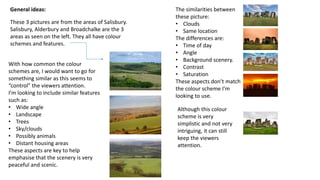
These 3 pictures are from the areas of Salisbury.
Salisbury, Alderbury and Broadchalke are the 3
areas as seen on the left. They all have colour
schemes and features.
With how common the colour
schemes are, I would want to go for
something similar as this seems to
“control” the viewers attention.
I’m looking to include similar features
such as:
• Wide angle
• Landscape
• Trees
• Sky/clouds
• Possibly animals
• Distant housing areas
These aspects are key to help
emphasise that the scenery is very
peaceful and scenic.
The similarities between
these picture:
• Clouds
• Same location
The differences are:
• Time of day
• Angle
• Background scenery.
• Contrast
• Saturation
These aspects don’t match
the colour scheme I’m
looking to use.
Although this colour
scheme is very
simplistic and not very
intriguing, it can still
keep the viewers
attention.
Mood board
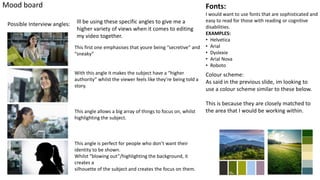
Possible Interview angles:
Fonts:
I would want to use fonts that are sophisticated and
easy to read for those with reading or cognitive
disabilities.
EXAMPLES:
• Helvetica
• Arial
• Dyslexie
• Arial Nova
• Roboto
Colour scheme:
As said in the previous slide, im looking to
use a colour scheme similar to these below.
This is because they are closely matched to
the area that I would be working within.
This first one emphasises that youre being “secretive” and
“sneaky”
With this angle it makes the subject have a “higher
authority” whilst the viewer feels like they’re being told a
story.
This angle allows a big array of things to focus on, whilst
highlighting the subject.
This angle is perfect for people who don’t want their
identity to be shown.
Whilst “blowing out”/highlighting the background, it
creates a
silhouette of the subject and creates the focus on them.
Ill be using these specific angles to give me a
higher variety of views when it comes to editing
my video together.
Content:
My documentary will contain the conventional aspects such
as, an over-view at the beginning, b-roll with a voiceover,
interviews and
b-roll. I may also include some animation within, such as
when the subjects name pops up on the screen or with the
intro and outro.
This seems to be the most commonly used and best method
for interviews and documentaries.
My style will be simple, but with enough detail to keep my
viewers attention, I believe this is an effective aspect as this
feature is used often throughout documentaries. There are
not many videos on the internet with extreme properties.
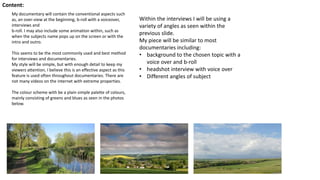
The colour scheme with be a plain simple palette of colours,
mainly consisting of greens and blues as seen in the photos
below.
Within the interviews I will be using a
variety of angles as seen within the
previous slide.
My piece will be similar to most
documentaries including:
• background to the chosen topic with a
voice over and b-roll
• headshot interview with voice over
• Different angles of subject
Planning:
Questions:
• What do you think the Stonehenge was for? And why?
• Who/what do you think built the Stonehenge?
• Do you think that similar structures were built with the same purpose?
• Do you think conspiracies about the Stonehenge are true? If so, why?
• Which conspiracies about the Stonehenge, do you think are true? And why?
• Could there be a change your perspective if given proven facts?
There more than likely be more questions added soon.
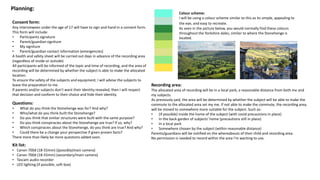
Colour scheme:
I will be using a colour scheme similar to this as its simple, appealing to
the eye, and easy to recreate.
As seen in the picture below, you would normally find these colours
throughout the Yorkshire dales, similar to where the Stonehenge is
located.
Consent form:
Any interviewees under the age of 17 will have to sign and hand in a consent form.
This form will include:
• Participants signature
• Parent/guardian signiture
• My signiture
• Parent/guardian contact information (emergencies)
A health and safety sheet will be carried out days in advance of the recording area
(regardless of inside or outside)
All participants will be informed of the topic and time of recording, and the area of
recording will be determined by whether the subject is able to make the allocated
location.
To ensure the safety of the subjects and equipment, I will advise the subjects to
leave the preparation to me.
If parents and/or subjects don’t want their identity revealed, then I will respect
that decision and conform to their choice and hide their identity.
Recording area:
The allocated area of recording will be in a local park, a reasonable distance from both me and
my subjects.
As previously said, the area will be determined by whether the subject will be able to make the
commute to the allocated area set my me. If not able to make the commute, the recording area,
will be moved to somewhere more suitable for the subject. Such as:
• (if possible) inside the home of the subject (with covid precautions in place)
• In the back-garden of subjects' home (precautions still in place)
• In a local park
• Somewhere chosen by the subject (within reasonable distance)
Parents/guardians will be notified on the whereabouts of their child and recording area.
No permission is needed to record within the area I'm wanting to use.
Kit list:
• Canon 700d (18-55mm) ((possibly)main camera)
• Canon 700d (18-55mm) (secondary/main camera)
• Tascam audio recorder
• LED lighting (if possible, soft-box)
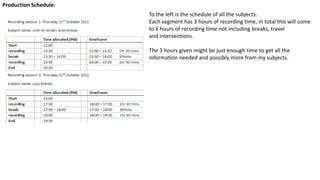
Production Schedule:
To the left is the schedule of all the subjects.
Each segment has 3 hours of recording time, in total this will come
to 6 hours of recording time not including breaks, travel
and interventions.
The 3 hours given might be just enough time to get all the
information needed and possibly more from my subjects.

Factual development and planning pro forma

  • 1.
  • 2.
    Task 2: IdeaDevelopment and Planning U9 2.1 You could create a mood board of images related to your product. They could be inspirational or visually interesting. Analyse what you have gathered. Decide on content and think about how you will structure your piece – consider the conventions of your chosen style/genre, think about the best methods to appeal to your audience. Finally work out a production schedule for the project. Once you have a final proposal, begin to plan how you intend to realise your project and what you will need to create/collect. Planning will vary depending on if you are doing a web series, podcast or a fanzine. Web-series: A script, storyboard, organisational docs and clearance forms for your contributors/sources. Fanzine: Content outline, visual style, pagination, organisational documents. Podcast: Script, organisational docs, clearance forms for your contributors/sources.
  • 3.
    General ideas: These 3pictures are from the areas of Salisbury. Salisbury, Alderbury and Broadchalke are the 3 areas as seen on the left. They all have colour schemes and features. With how common the colour schemes are, I would want to go for something similar as this seems to “control” the viewers attention. I’m looking to include similar features such as: • Wide angle • Landscape • Trees • Sky/clouds • Possibly animals • Distant housing areas These aspects are key to help emphasise that the scenery is very peaceful and scenic. The similarities between these picture: • Clouds • Same location The differences are: • Time of day • Angle • Background scenery. • Contrast • Saturation These aspects don’t match the colour scheme I’m looking to use. Although this colour scheme is very simplistic and not very intriguing, it can still keep the viewers attention.
  • 4.
    Mood board Possible Interviewangles: Fonts: I would want to use fonts that are sophisticated and easy to read for those with reading or cognitive disabilities. EXAMPLES: • Helvetica • Arial • Dyslexie • Arial Nova • Roboto Colour scheme: As said in the previous slide, im looking to use a colour scheme similar to these below. This is because they are closely matched to the area that I would be working within. This first one emphasises that youre being “secretive” and “sneaky” With this angle it makes the subject have a “higher authority” whilst the viewer feels like they’re being told a story. This angle allows a big array of things to focus on, whilst highlighting the subject. This angle is perfect for people who don’t want their identity to be shown. Whilst “blowing out”/highlighting the background, it creates a silhouette of the subject and creates the focus on them. Ill be using these specific angles to give me a higher variety of views when it comes to editing my video together.
  • 5.
    Content: My documentary willcontain the conventional aspects such as, an over-view at the beginning, b-roll with a voiceover, interviews and b-roll. I may also include some animation within, such as when the subjects name pops up on the screen or with the intro and outro. This seems to be the most commonly used and best method for interviews and documentaries. My style will be simple, but with enough detail to keep my viewers attention, I believe this is an effective aspect as this feature is used often throughout documentaries. There are not many videos on the internet with extreme properties. The colour scheme with be a plain simple palette of colours, mainly consisting of greens and blues as seen in the photos below. Within the interviews I will be using a variety of angles as seen within the previous slide. My piece will be similar to most documentaries including: • background to the chosen topic with a voice over and b-roll • headshot interview with voice over • Different angles of subject
  • 6.
    Planning: Questions: • What doyou think the Stonehenge was for? And why? • Who/what do you think built the Stonehenge? • Do you think that similar structures were built with the same purpose? • Do you think conspiracies about the Stonehenge are true? If so, why? • Which conspiracies about the Stonehenge, do you think are true? And why? • Could there be a change your perspective if given proven facts? There more than likely be more questions added soon. Colour scheme: I will be using a colour scheme similar to this as its simple, appealing to the eye, and easy to recreate. As seen in the picture below, you would normally find these colours throughout the Yorkshire dales, similar to where the Stonehenge is located. Consent form: Any interviewees under the age of 17 will have to sign and hand in a consent form. This form will include: • Participants signature • Parent/guardian signiture • My signiture • Parent/guardian contact information (emergencies) A health and safety sheet will be carried out days in advance of the recording area (regardless of inside or outside) All participants will be informed of the topic and time of recording, and the area of recording will be determined by whether the subject is able to make the allocated location. To ensure the safety of the subjects and equipment, I will advise the subjects to leave the preparation to me. If parents and/or subjects don’t want their identity revealed, then I will respect that decision and conform to their choice and hide their identity. Recording area: The allocated area of recording will be in a local park, a reasonable distance from both me and my subjects. As previously said, the area will be determined by whether the subject will be able to make the commute to the allocated area set my me. If not able to make the commute, the recording area, will be moved to somewhere more suitable for the subject. Such as: • (if possible) inside the home of the subject (with covid precautions in place) • In the back-garden of subjects' home (precautions still in place) • In a local park • Somewhere chosen by the subject (within reasonable distance) Parents/guardians will be notified on the whereabouts of their child and recording area. No permission is needed to record within the area I'm wanting to use. Kit list: • Canon 700d (18-55mm) ((possibly)main camera) • Canon 700d (18-55mm) (secondary/main camera) • Tascam audio recorder • LED lighting (if possible, soft-box)
  • 7.
    Production Schedule: To theleft is the schedule of all the subjects. Each segment has 3 hours of recording time, in total this will come to 6 hours of recording time not including breaks, travel and interventions. The 3 hours given might be just enough time to get all the information needed and possibly more from my subjects.

Editor's Notes

  • #4 You could create a mood board of images related to your product. They could be inspirational or visually interesting. Analyse what you have gathered.
  • #6 Decide on content and think about how you will structure your piece – consider the conventions of your chosen style/genre, think about the best methods to appeal to your audience.
  • #7 Planning will vary depending on if you are doing a web series, podcast or a fanzine. Web-series: A script, storyboard, organisational docs and clearance forms for your contributors/sources. Fanzine: Content outline, visual style, pagination, organisational documents. Podcast: Script, organisational docs, clearance forms for your contributors/sources.
  • #8 Finally work out a production schedule for the project. Once you have a final proposal, begin to plan how you intend to realise your project and what you will need to create/collect.