Factors AffectingFactors Affecting
Synaptic TransmissionSynaptic Transmission
S.RAYYAN.SS.RAYYAN.S
ROLL # 23ROLL # 23
MBBS/2MBBS/2ndnd
PROFFPROFF
KMU-IMS,KOHATKMU-IMS,KOHAT
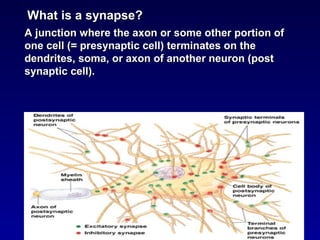
What is a synapse?What is a synapse?
A junction where the axon or some other portion ofA junction where the axon or some other portion of
one cell (= presynaptic cell) terminates on theone cell (= presynaptic cell) terminates on the
dendrites, soma, or axon of another neuron (postdendrites, soma, or axon of another neuron (post
synaptic cell).synaptic cell).
1.Synaptic Fatigue1.Synaptic Fatigue
• Exhaustion of nerve transmitters.Exhaustion of nerve transmitters.
• If the pre synaptic neurons are continuously
stimulated there may be an exhaustion of the
neurotransmitter. Resulting is stoppage of
synaptic transmission.
• The post synaptic membrane become less
sensitive to the neurotransmitter.
Synaptic FatigueSynaptic Fatigue
• The development of fatigue is a protective
mechanism against excess neuronal
activity.
• For example, fatigue is probably the mostFor example, fatigue is probably the most
important means by which the excessimportant means by which the excess
excitability of the brain during an epilepticexcitability of the brain during an epileptic
seizure is finally subdued so that the seizureseizure is finally subdued so that the seizure
ceases.ceases.
Synaptic FatigueSynaptic Fatigue
Part of the fatigue process probably results
from two other factors as well:
•1. Progressive inactivation of many of the
postsynaptic membrane receptors.
•2. Slow development of abnormal
concentrations of ions inside the postsynaptic
neuronal cell.
2. Synaptic delay2. Synaptic delay
Is the minimum time required forIs the minimum time required for
transmission across the synapse.transmission across the synapse.
This time is taken byThis time is taken by
Discharge of transmitter substance by pre-synapticDischarge of transmitter substance by pre-synaptic
terminalterminal
Diffusion of transmitter to post-synaptic membraneDiffusion of transmitter to post-synaptic membrane
Action of transmitter on its receptorAction of transmitter on its receptor
Action of transmitter toAction of transmitter to ↑↑ membrane permeabilitymembrane permeability
Increased diffusion of Na+ toIncreased diffusion of Na+ to ↑↑ post-synapticpost-synaptic
potentialpotential
It is about 0.5 millisecondIt is about 0.5 millisecond
FACTORS EFFECTING SYNAPATICFACTORS EFFECTING SYNAPATIC
TRANSMISSION: ALKALOSISTRANSMISSION: ALKALOSIS
• Normally, alkalosis greatly increases neuronal excitability.
• For instance, a rise in arterial blood pH from the 7.4 norm to
7.8 to 8.0 often causes cerebral epileptic seizures because of
increased excitability of some or all of the cerebral neurons.
• This can be demonstrated especially well by asking a person
who is predisposed to epileptic seizures to overbreathe.
• The overbreathing blows off carbon dioxide and therefore
elevates the pH of the blood momentarily.
FACTORS EFFECTING SYNAPATICFACTORS EFFECTING SYNAPATIC
TRANSMISSION:TRANSMISSION: ACIDOSISACIDOSIS
• Conversely, acidosis greatly depresses neuronal
activity;
• A fall in pH from 7.4 to below 7.0 usually causes
a comatose state.
• For instance, in very severe diabetic or uremic
acidosis, coma virtually always develops.
FACTORS EFFECTING SYNAPATICFACTORS EFFECTING SYNAPATIC
TRANSMISSION:TRANSMISSION: IONSIONS
• Ca2+ and Mg2+ Concentrations also influence the synaptic transmissions
• The release of neurotransmitter is dependent upon the entry of Ca2+ to the
presynaptic terminal.
• If the Ca2+ concentration is reduced or the Mg2+ concentration is
increased, the amplitude of the synaptic potential is progressively reduced.
FACTORS EFFECTING SYNAPATICFACTORS EFFECTING SYNAPATIC
TRANSMISSION:TRANSMISSION: HYPOXIAHYPOXIA
• Neuronal excitability is also highly dependent on an
• adequate supply of oxygen.
• Cessation of oxygen for only a few seconds can
cause complete inexcitability of some neurons.
• This is observed when the brain blood flow is
temporarily interrupted, because within 3 to 7
seconds, the person becomes unconscious.
FACTORS EFFECTING SYNAPATICFACTORS EFFECTING SYNAPATIC
TRANSMISSION:TRANSMISSION: DRUGSDRUGS
• Many drugs are known to increase the excitability of
neurons, and others are known to decrease excitability.
• For instance,
 Caffeine,
 Theophyline,
 Theobromine, which are found in coffee, tea, and cocoa,
respectively,
• All increase neuronal excitability, presumably by
reducing the threshold for excitation of neurons.
FACTORS EFFECTING SYNAPATICFACTORS EFFECTING SYNAPATIC
TRANSMISSION:TRANSMISSION: DRUGSDRUGS
• Strychnine, is one of the best known of all agents that
increase excitability of neurons.
• However, it does not do this by reducing the threshold for
excitation of the neurons; instead, it inhibits the action of
some normally inhibitory transmitter substances,
• especially the inhibitory effect of glycine in the spinal cord.
• Therefore, the effects of the excitatory transmitters become
overwhelming,
• and the neurons become so excited that they go into rapidly
repetitive discharge, resulting in severe tonic muscle
spasms.
FACTORS EFFECTING SYNAPATICFACTORS EFFECTING SYNAPATIC
TRANSMISSION:TRANSMISSION: ANESTHETICSANESTHETICS
• Most anesthetics increase the neuronal membrane
threshold for excitation and thereby decrease synaptic
transmission at many points in the nervous system.
• Because many of the anesthetics are especially lipid
soluble, it has been reasoned that some of them might
change the physical characteristics of the neuronal
membranes, making them less responsive to
excitatory agents.
Factors affecting synaptic transmission

Factors affecting synaptic transmission

  • 1.
    Factors AffectingFactors Affecting SynapticTransmissionSynaptic Transmission S.RAYYAN.SS.RAYYAN.S ROLL # 23ROLL # 23 MBBS/2MBBS/2ndnd PROFFPROFF KMU-IMS,KOHATKMU-IMS,KOHAT
  • 2.
    What is asynapse?What is a synapse? A junction where the axon or some other portion ofA junction where the axon or some other portion of one cell (= presynaptic cell) terminates on theone cell (= presynaptic cell) terminates on the dendrites, soma, or axon of another neuron (postdendrites, soma, or axon of another neuron (post synaptic cell).synaptic cell).
  • 3.
    1.Synaptic Fatigue1.Synaptic Fatigue •Exhaustion of nerve transmitters.Exhaustion of nerve transmitters. • If the pre synaptic neurons are continuously stimulated there may be an exhaustion of the neurotransmitter. Resulting is stoppage of synaptic transmission. • The post synaptic membrane become less sensitive to the neurotransmitter.
  • 4.
    Synaptic FatigueSynaptic Fatigue •The development of fatigue is a protective mechanism against excess neuronal activity. • For example, fatigue is probably the mostFor example, fatigue is probably the most important means by which the excessimportant means by which the excess excitability of the brain during an epilepticexcitability of the brain during an epileptic seizure is finally subdued so that the seizureseizure is finally subdued so that the seizure ceases.ceases.
  • 5.
    Synaptic FatigueSynaptic Fatigue Partof the fatigue process probably results from two other factors as well: •1. Progressive inactivation of many of the postsynaptic membrane receptors. •2. Slow development of abnormal concentrations of ions inside the postsynaptic neuronal cell.
  • 6.
    2. Synaptic delay2.Synaptic delay Is the minimum time required forIs the minimum time required for transmission across the synapse.transmission across the synapse. This time is taken byThis time is taken by Discharge of transmitter substance by pre-synapticDischarge of transmitter substance by pre-synaptic terminalterminal Diffusion of transmitter to post-synaptic membraneDiffusion of transmitter to post-synaptic membrane Action of transmitter on its receptorAction of transmitter on its receptor Action of transmitter toAction of transmitter to ↑↑ membrane permeabilitymembrane permeability Increased diffusion of Na+ toIncreased diffusion of Na+ to ↑↑ post-synapticpost-synaptic potentialpotential It is about 0.5 millisecondIt is about 0.5 millisecond
  • 7.
    FACTORS EFFECTING SYNAPATICFACTORSEFFECTING SYNAPATIC TRANSMISSION: ALKALOSISTRANSMISSION: ALKALOSIS • Normally, alkalosis greatly increases neuronal excitability. • For instance, a rise in arterial blood pH from the 7.4 norm to 7.8 to 8.0 often causes cerebral epileptic seizures because of increased excitability of some or all of the cerebral neurons. • This can be demonstrated especially well by asking a person who is predisposed to epileptic seizures to overbreathe. • The overbreathing blows off carbon dioxide and therefore elevates the pH of the blood momentarily.
  • 8.
    FACTORS EFFECTING SYNAPATICFACTORSEFFECTING SYNAPATIC TRANSMISSION:TRANSMISSION: ACIDOSISACIDOSIS • Conversely, acidosis greatly depresses neuronal activity; • A fall in pH from 7.4 to below 7.0 usually causes a comatose state. • For instance, in very severe diabetic or uremic acidosis, coma virtually always develops.
  • 9.
    FACTORS EFFECTING SYNAPATICFACTORSEFFECTING SYNAPATIC TRANSMISSION:TRANSMISSION: IONSIONS • Ca2+ and Mg2+ Concentrations also influence the synaptic transmissions • The release of neurotransmitter is dependent upon the entry of Ca2+ to the presynaptic terminal. • If the Ca2+ concentration is reduced or the Mg2+ concentration is increased, the amplitude of the synaptic potential is progressively reduced.
  • 10.
    FACTORS EFFECTING SYNAPATICFACTORSEFFECTING SYNAPATIC TRANSMISSION:TRANSMISSION: HYPOXIAHYPOXIA • Neuronal excitability is also highly dependent on an • adequate supply of oxygen. • Cessation of oxygen for only a few seconds can cause complete inexcitability of some neurons. • This is observed when the brain blood flow is temporarily interrupted, because within 3 to 7 seconds, the person becomes unconscious.
  • 11.
    FACTORS EFFECTING SYNAPATICFACTORSEFFECTING SYNAPATIC TRANSMISSION:TRANSMISSION: DRUGSDRUGS • Many drugs are known to increase the excitability of neurons, and others are known to decrease excitability. • For instance,  Caffeine,  Theophyline,  Theobromine, which are found in coffee, tea, and cocoa, respectively, • All increase neuronal excitability, presumably by reducing the threshold for excitation of neurons.
  • 12.
    FACTORS EFFECTING SYNAPATICFACTORSEFFECTING SYNAPATIC TRANSMISSION:TRANSMISSION: DRUGSDRUGS • Strychnine, is one of the best known of all agents that increase excitability of neurons. • However, it does not do this by reducing the threshold for excitation of the neurons; instead, it inhibits the action of some normally inhibitory transmitter substances, • especially the inhibitory effect of glycine in the spinal cord. • Therefore, the effects of the excitatory transmitters become overwhelming, • and the neurons become so excited that they go into rapidly repetitive discharge, resulting in severe tonic muscle spasms.
  • 13.
    FACTORS EFFECTING SYNAPATICFACTORSEFFECTING SYNAPATIC TRANSMISSION:TRANSMISSION: ANESTHETICSANESTHETICS • Most anesthetics increase the neuronal membrane threshold for excitation and thereby decrease synaptic transmission at many points in the nervous system. • Because many of the anesthetics are especially lipid soluble, it has been reasoned that some of them might change the physical characteristics of the neuronal membranes, making them less responsive to excitatory agents.