1/11/13
CHM 101

          Chapter 1: Matter & Measurement
                      Part B
Scientific Notation

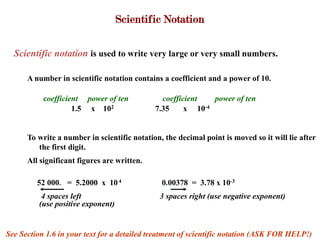
  Scientific notation is used to write very large or very small numbers.

      A number in scientific notation contains a coefficient and a power of 10.

           coefficient power of ten            coefficient   power of ten
                    1.5 x 10²                7.35     x 10-4


      To write a number in scientific notation, the decimal point is moved so it will lie after
         the first digit.
      All significant figures are written.

         52 000. = 5.2000 x 10 4               0.00378 = 3.78 x 10⁻³
           4 spaces left                      3 spaces right (use negative exponent)
          (use positive exponent)


See Section 1.6 in your text for a detailed treatment of scientific notation (ASK FOR HELP!)
Units of Measurement

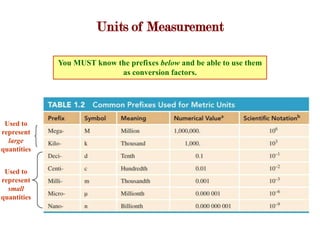
             You MUST know the prefixes below and be able to use them
                            as conversion factors.


 Used to
represent
  large
quantities


 Used to
represent
  small
quantities
Equalities
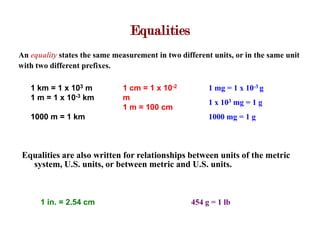
An equality states the same measurement in two different units, or in the same unit
with two different prefixes.

   1 km = 1 x 10³ m           1 cm = 1 x 10⁻²           1 mg = 1 x 10⁻³ g
   1 m = 1 x 10⁻³ km          m
                                                        1 x 10³ mg = 1 g
                              1 m = 100 cm
   1000 m = 1 km                                        1000 mg = 1 g


 Equalities are also written for relationships between units of the metric
   system, U.S. units, or between metric and U.S. units.


      1 in. = 2.54 cm                              454 g = 1 lb
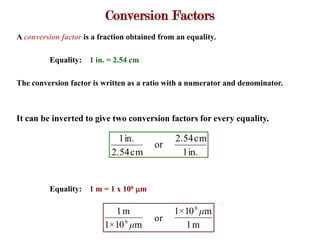
Conversion Factors
A conversion factor is a fraction obtained from an equality.

         Equality: 1 in. = 2.54 cm

The conversion factor is written as a ratio with a numerator and denominator.


It can be inverted to give two conversion factors for every equality.

                              1 in.            2.54 cm
                                         or
                            2.54 cm              1 in.


         Equality: 1 m = 1 x 106 mm

                            1m                 1×10 6 μm
                                         or
                          1×10 6 μm              1m
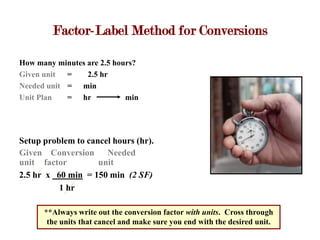
Factor-Label Method for Conversions

How many minutes are 2.5 hours?
Given unit =     2.5 hr
Needed unit = min
Unit Plan   = hr            min


Setup problem to cancel hours (hr).
Given Conversion Needed
unit factor         unit
2.5 hr x 60 min = 150 min (2 SF)
          1 hr

      **Always write out the conversion factor with units. Cross through
       the units that cancel and make sure you end with the desired unit.
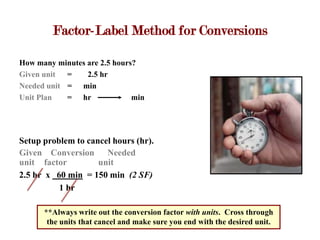
Factor-Label Method for Conversions

How many minutes are 2.5 hours?
Given unit =     2.5 hr
Needed unit = min
Unit Plan   = hr              min


Setup problem to cancel hours (hr).
Given Conversion Needed
unit factor         unit
2.5 hr x 60 min = 150 min (2 SF)
          1 hr

      **Always write out the conversion factor with units. Cross through
       the units that cancel and make sure you end with the desired unit.
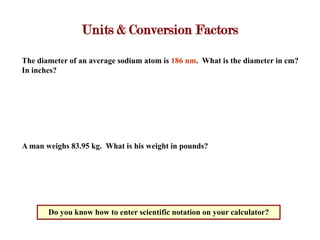
Units & Conversion Factors

The diameter of an average sodium atom is 186 nm. What is the diameter in cm?
In inches?


A man weighs 83.95 kg. What is his weight in pounds?


       Do you know how to enter scientific notation on your calculator?
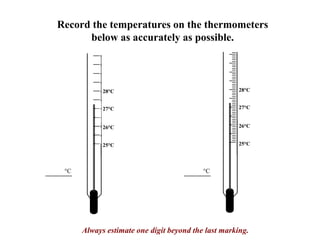
Record the temperatures on the thermometers
      below as accurately as possible.


            28°C                                     28°C


            27°C                                     27°C


            26°C                                     26°C


            25°C                                     25°C


 °C                                       °C


      Always estimate one digit beyond the last marking.
Now Let’s Practice Measuring and Converting
   Units using the Factor-Label Method

Ch. 1 lecture b

  • 1.
    1/11/13 CHM 101 Chapter 1: Matter & Measurement Part B
  • 2.
    Scientific Notation Scientific notation is used to write very large or very small numbers. A number in scientific notation contains a coefficient and a power of 10. coefficient power of ten coefficient power of ten 1.5 x 10² 7.35 x 10⁻⁴ To write a number in scientific notation, the decimal point is moved so it will lie after the first digit. All significant figures are written. 52 000. = 5.2000 x 10 4 0.00378 = 3.78 x 10⁻³ 4 spaces left 3 spaces right (use negative exponent) (use positive exponent) See Section 1.6 in your text for a detailed treatment of scientific notation (ASK FOR HELP!)
  • 3.
    Units of Measurement You MUST know the prefixes below and be able to use them as conversion factors. Used to represent large quantities Used to represent small quantities
  • 4.
    Equalities An equality statesthe same measurement in two different units, or in the same unit with two different prefixes. 1 km = 1 x 10³ m 1 cm = 1 x 10⁻² 1 mg = 1 x 10⁻³ g 1 m = 1 x 10⁻³ km m 1 x 10³ mg = 1 g 1 m = 100 cm 1000 m = 1 km 1000 mg = 1 g Equalities are also written for relationships between units of the metric system, U.S. units, or between metric and U.S. units. 1 in. = 2.54 cm 454 g = 1 lb
  • 5.
    Conversion Factors A conversionfactor is a fraction obtained from an equality. Equality: 1 in. = 2.54 cm The conversion factor is written as a ratio with a numerator and denominator. It can be inverted to give two conversion factors for every equality. 1 in. 2.54 cm or 2.54 cm 1 in. Equality: 1 m = 1 x 106 mm 1m 1×10 6 μm or 1×10 6 μm 1m
  • 6.
    Factor-Label Method forConversions How many minutes are 2.5 hours? Given unit = 2.5 hr Needed unit = min Unit Plan = hr min Setup problem to cancel hours (hr). Given Conversion Needed unit factor unit 2.5 hr x 60 min = 150 min (2 SF) 1 hr **Always write out the conversion factor with units. Cross through the units that cancel and make sure you end with the desired unit.
  • 7.
    Factor-Label Method forConversions How many minutes are 2.5 hours? Given unit = 2.5 hr Needed unit = min Unit Plan = hr min Setup problem to cancel hours (hr). Given Conversion Needed unit factor unit 2.5 hr x 60 min = 150 min (2 SF) 1 hr **Always write out the conversion factor with units. Cross through the units that cancel and make sure you end with the desired unit.
  • 8.
    Units & ConversionFactors The diameter of an average sodium atom is 186 nm. What is the diameter in cm? In inches? A man weighs 83.95 kg. What is his weight in pounds? Do you know how to enter scientific notation on your calculator?
  • 9.
    Record the temperatureson the thermometers below as accurately as possible. 28°C 28°C 27°C 27°C 26°C 26°C 25°C 25°C °C °C Always estimate one digit beyond the last marking.
  • 10.
    Now Let’s PracticeMeasuring and Converting Units using the Factor-Label Method