ROCKS
CLASSIFICATION
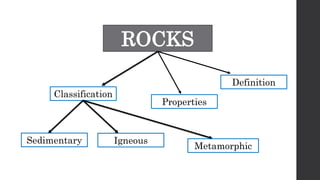
ROCKS
Classification
Properties
Definition
Sedimentary Igneous
Metamorphic
ROCKS
---the aggregates of minerals.
--- it helps us decipher the
Earth’s past and
understand the processes
that have shaped our
planet.
Petrology
--- the study of rocks..
Back
Properties of Rocks
1. As to color
--- it maybe dark, light,
reddish, gray, brown,
yellow or even block.
2. As to texture
--- some are fine, others are
rough.
3. As to appearance
--- it maybe smooth or
glossy to touch.
4. As to hardness
--- most rocks are hard
others are brittle. Back
Classification of Rocks
1. Igneous Rock
2. Sedimentary Rock
3. Metamorphic Rock
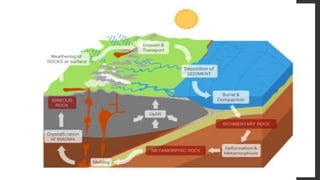
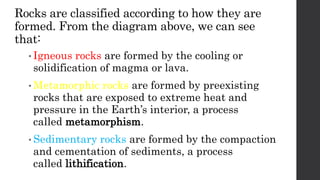
Rocks are classified according to how they are
formed. From the diagram above, we can see
that:
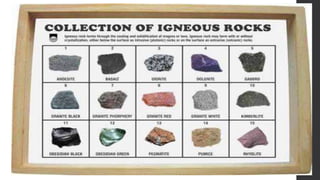
• Igneous rocks are formed by the cooling or
solidification of magma or lava.
• Metamorphic rocks are formed by preexisting
rocks that are exposed to extreme heat and
pressure in the Earth’s interior, a process
called metamorphism.
• Sedimentary rocks are formed by the compaction
and cementation of sediments, a process
called lithification.
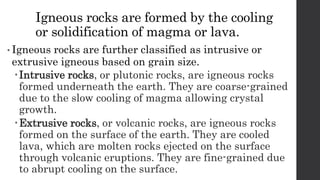
Igneous rocks are formed by the cooling
or solidification of magma or lava.
• Igneous rocks are further classified as intrusive or
extrusive igneous based on grain size.
Intrusive rocks, or plutonic rocks, are igneous rocks
formed underneath the earth. They are coarse-grained
due to the slow cooling of magma allowing crystal
growth.
Extrusive rocks, or volcanic rocks, are igneous rocks
formed on the surface of the earth. They are cooled
lava, which are molten rocks ejected on the surface
through volcanic eruptions. They are fine-grained due
to abrupt cooling on the surface.
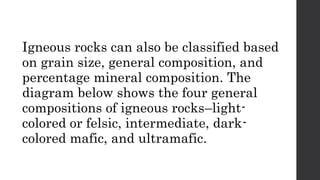
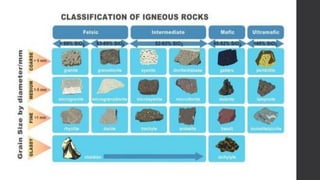
Igneous rocks can also be classified based
on grain size, general composition, and
percentage mineral composition. The
diagram below shows the four general
compositions of igneous rocks–light-
colored or felsic, intermediate, dark-
colored mafic, and ultramafic.
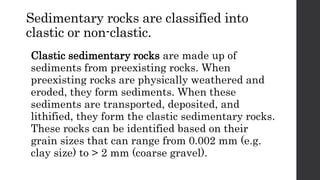
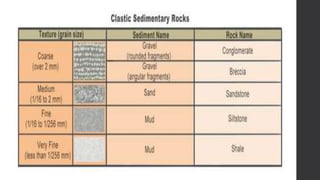
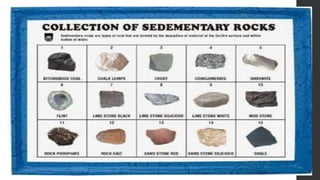
Sedimentary rocks are classified into
clastic or non-clastic.
Clastic sedimentary rocks are made up of
sediments from preexisting rocks. When
preexisting rocks are physically weathered and
eroded, they form sediments. When these
sediments are transported, deposited, and
lithified, they form the clastic sedimentary rocks.
These rocks can be identified based on their
grain sizes that can range from 0.002 mm (e.g.
clay size) to > 2 mm (coarse gravel).
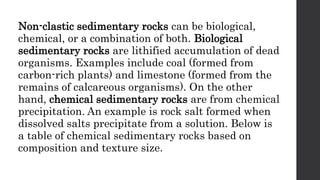
Non-clastic sedimentary rocks can be biological,
chemical, or a combination of both. Biological
sedimentary rocks are lithified accumulation of dead
organisms. Examples include coal (formed from
carbon-rich plants) and limestone (formed from the
remains of calcareous organisms). On the other
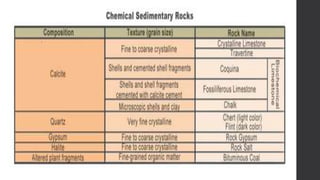
hand, chemical sedimentary rocks are from chemical
precipitation. An example is rock salt formed when
dissolved salts precipitate from a solution. Below is
a table of chemical sedimentary rocks based on
composition and texture size.
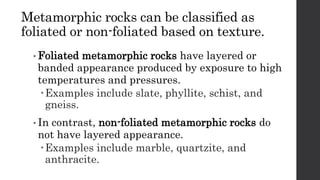
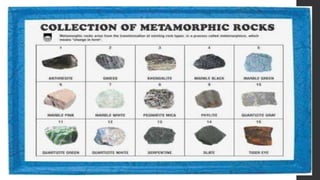
Metamorphic rocks can be classified as
foliated or non-foliated based on texture.
• Foliated metamorphic rocks have layered or
banded appearance produced by exposure to high
temperatures and pressures.
Examples include slate, phyllite, schist, and
gneiss.
• In contrast, non-foliated metamorphic rocks do
not have layered appearance.
Examples include marble, quartzite, and
anthracite.
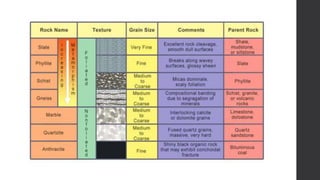
Foliated and non-foliated metamorphic rocks
can be further classified based on their parent
rocks. However, such classification can be
difficult because of the rock alteration during
metamorphism. The table below shows the
parent rocks of different foliated and non-
foliated rocks.
CLASSIFICATION OF ROCKS

CLASSIFICATION OF ROCKS

  • 1.
  • 2.
  • 3.
    ROCKS ---the aggregates ofminerals. --- it helps us decipher the Earth’s past and understand the processes that have shaped our planet.
  • 4.
    Petrology --- the studyof rocks.. Back
  • 5.
    Properties of Rocks 1.As to color --- it maybe dark, light, reddish, gray, brown, yellow or even block. 2. As to texture --- some are fine, others are rough.
  • 6.
    3. As toappearance --- it maybe smooth or glossy to touch. 4. As to hardness --- most rocks are hard others are brittle. Back
  • 8.
    Classification of Rocks 1.Igneous Rock 2. Sedimentary Rock 3. Metamorphic Rock
  • 9.
    Rocks are classifiedaccording to how they are formed. From the diagram above, we can see that: • Igneous rocks are formed by the cooling or solidification of magma or lava. • Metamorphic rocks are formed by preexisting rocks that are exposed to extreme heat and pressure in the Earth’s interior, a process called metamorphism. • Sedimentary rocks are formed by the compaction and cementation of sediments, a process called lithification.
  • 10.
    Igneous rocks areformed by the cooling or solidification of magma or lava. • Igneous rocks are further classified as intrusive or extrusive igneous based on grain size. Intrusive rocks, or plutonic rocks, are igneous rocks formed underneath the earth. They are coarse-grained due to the slow cooling of magma allowing crystal growth. Extrusive rocks, or volcanic rocks, are igneous rocks formed on the surface of the earth. They are cooled lava, which are molten rocks ejected on the surface through volcanic eruptions. They are fine-grained due to abrupt cooling on the surface.
  • 11.
    Igneous rocks canalso be classified based on grain size, general composition, and percentage mineral composition. The diagram below shows the four general compositions of igneous rocks–light- colored or felsic, intermediate, dark- colored mafic, and ultramafic.
  • 13.
    Sedimentary rocks areclassified into clastic or non-clastic. Clastic sedimentary rocks are made up of sediments from preexisting rocks. When preexisting rocks are physically weathered and eroded, they form sediments. When these sediments are transported, deposited, and lithified, they form the clastic sedimentary rocks. These rocks can be identified based on their grain sizes that can range from 0.002 mm (e.g. clay size) to > 2 mm (coarse gravel).
  • 15.
    Non-clastic sedimentary rockscan be biological, chemical, or a combination of both. Biological sedimentary rocks are lithified accumulation of dead organisms. Examples include coal (formed from carbon-rich plants) and limestone (formed from the remains of calcareous organisms). On the other hand, chemical sedimentary rocks are from chemical precipitation. An example is rock salt formed when dissolved salts precipitate from a solution. Below is a table of chemical sedimentary rocks based on composition and texture size.
  • 17.
    Metamorphic rocks canbe classified as foliated or non-foliated based on texture. • Foliated metamorphic rocks have layered or banded appearance produced by exposure to high temperatures and pressures. Examples include slate, phyllite, schist, and gneiss. • In contrast, non-foliated metamorphic rocks do not have layered appearance. Examples include marble, quartzite, and anthracite.
  • 18.
    Foliated and non-foliatedmetamorphic rocks can be further classified based on their parent rocks. However, such classification can be difficult because of the rock alteration during metamorphism. The table below shows the parent rocks of different foliated and non- foliated rocks.