






















Facilitating the Development
               of
   Clinical Reasoning
I What is clinical reasoning?

II Why is it important?

III Reflective exercise

IV Strategies to develop reasoning
What is
clinical reasoning?
clinical reasoning?
diagnostic reasoning?
     clinical reasoning?
professional reasoning?
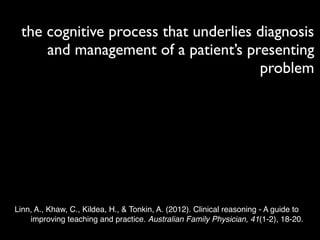
the cognitive process that underlies diagnosis
     and management of a patient’s presenting
                                      problem


Linn, A., Khaw, C., Kildea, H., & Tonkin, A. (2012). Clinical reasoning - A guide to
    improving teaching and practice. Australian Family Physician, 41(1-2), 18-20.
cognitive process
         diagnosis
    management
          patients
         problem
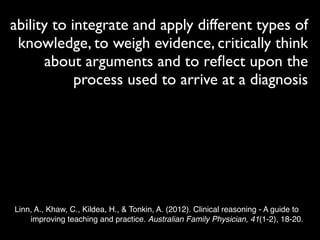
ability to integrate and apply different types of
 knowledge, to weigh evidence, critically think
      about arguments and to reflect upon the
            process used to arrive at a diagnosis


Linn, A., Khaw, C., Kildea, H., & Tonkin, A. (2012). Clinical reasoning - A guide to
    improving teaching and practice. Australian Family Physician, 41(1-2), 18-20.
cognitive process
                      diagnosis
                 management
                       patients
                      problem
           integrate and apply
different types of knowledge
               weigh evidence
                think critically
                         reflect
cognitive process
                                      diagnosis
                                 management
       p lex                           patients
 c om          rc es                  problem
           sou
    tiple                  integrate and apply
mul             different types of knowledge
                               weigh evidence
                                think critically
                                         reflect
...practice skills and knowledge
...reasoning
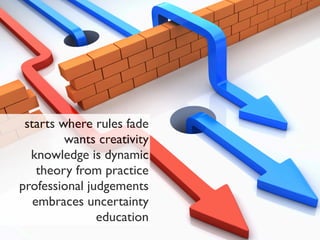
technical rational
     professional artistry


Fish, D. (1995). Quality Mentoring for Student Teachers: A
   Principled Approach to Practice. London: David Fulton.
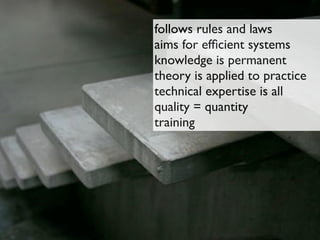
follows rules and laws
aims for efficient systems
knowledge is permanent
theory is applied to practice
technical expertise is all
quality = quantity
training
starts where rules fade
         wants creativity
  knowledge is dynamic
    theory from practice
professional judgements
   embraces uncertainty
               education
technical rational
     professional artistry


Fish, D. (1995). Quality Mentoring for Student Teachers: A
   Principled Approach to Practice. London: David Fulton.
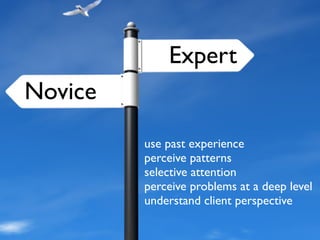
Expert
Novice
Expert
Novice
         use past experience
         perceive patterns
         selective attention
         perceive problems at a deep level
         understand client perspective
clinical education
clinical education
clinical reasoning
strands of reflection


  Fish, D. (1991). Developing a theoretical framework. In D. Fish, S. Twinn & B. Purr (Eds.), Promoting
Reflection: Improving the Supervision of Practice in Health Visiting and Initial Teacher Training (pp. 17-31).
                           London: West London Institute of Higher Education.
factual

retrospective

sub-stratum

connective
factual
reconstructing the experience, drawing
mainly on procedural knowledge of it
retrospective
developing a wholist theory about, and a
critique of, the entire experience, drawing
mainly on procedural knowledge of it
sub-stratum
uncovering and exploring critically the
personal theory which underlies the
experience, and considering how it relates to
and might be helped by formal theory
sub-stratum
uncovering and exploring critically the
personal theory which underlies the
experience, and considering how it relates to
and might be helped by formal theory
connective
considering how the experience might relate
to future experiences
factual

retrospective

sub-stratum

connective
Strategies to develop


           s
  clinical reasoning
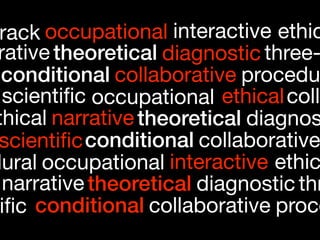
Shared language
rack occupational interactive ethic
 rative theoretical diagnostic three-
  conditional collaborative procedu
  scientific occupational ethical colla
 thical narrative theoretical diagnos
 scientific conditional collaborative
dural occupational interactive ethic
  narrative theoretical diagnostic thr
  ific conditional collaborative proce
Dedicated time
Model
Beware: tacit knowledge


        Model
Vary expectations
35
experience = learning


                        35
experience
+ reflection
 learning


               35
reflection


             35
reflection
prospective / spective / retrospective


                                  35
articulation


               36
written    verbal        role play


          articulation


                                36
articulation
problem representation


                         37
prioritise problem lists


                           38
provide feedback


                   39
read widely


              40
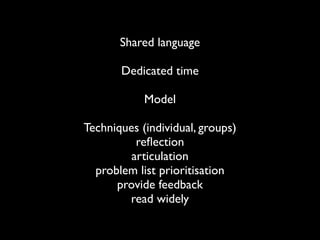
Shared language

       Dedicated time

            Model

Techniques (individual, groups)
          reflection
         articulation
  problem list prioritisation
      provide feedback
        read widely
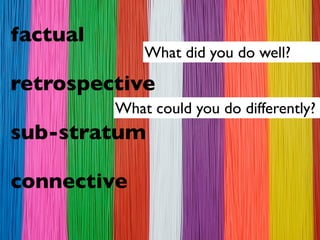
factual

retrospective

sub-stratum

connective
factual
              What did you do well?

retrospective
          What could you do differently?
sub-stratum

connective
2
actions as a result of this session
Facilitating the development of clinical reasoning

Facilitating the development of clinical reasoning