
Clinical Reasoning

        Jorge E. Valdez MD,MA.
                 Dean
School of Medicine and Health Sciences
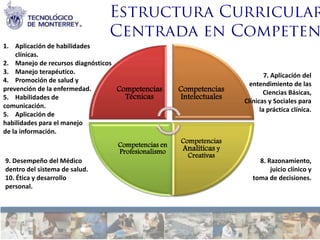
1. Aplicación de habilidades
    clínicas.
2. Manejo de recursos diagnósticos
3. Manejo terapéutico.
                                                                           7. Aplicación del
4. Promoción de salud y
                                                                     entendimiento de las
prevención de la enfermedad.       Competencias    Competencias           Ciencias Básicas,
5. Habilidades de                    Técnicas      Intelectuales
                                                                   Clínicas y Sociales para
comunicación.
                                                                         la práctica clínica.
5. Aplicación de
habilidades para el manejo
de la información.
                                                   Competencias
                                 Competencias en
                                 Profesionalismo   Analíticas y
                                                     Creativas
9. Desempeño del Médico                                                 8. Razonamiento,
dentro del sistema de salud.                                                juicio clínico y
10. Ética y desarrollo                                                toma de decisiones.
personal.
Objectives

• By the end of this lecture, students should be
  able to:
  – • Understand the need for clinical reasoning
  – • Define clinical reasoning
  – • Understand the clinical reasoning process
Need for clinical reasoning

• People live longer with more chronic and complex
  problems.
• Health professionals are expected to be more
  responsible, to work with diverse teams, and to make
  more independent judgements and decisions.
• There is information overload because of instant access
  to information through computers.
• Doctors are frequently involved in complex situations,
  which require an increasing level of responsibility
Definition:
• The thinking and/or decision-making
  processes that are used in clinical practice
  Higgs and Jones 2000, Edwards et al 2004

              Goal = “Wise Action”
Clinical Reasoning
• Refers to a process in which the therapist,
  interacting with the patient, structures meaning,
  goals & health management strategies based on
  clinical data, client choices, professional judgment
  & knowledge (Higgs and Jones 2000)
• –Hypothesis oriented, collaborative and reflective
• –Knowledge and organization of knowledge are
  important
Process of Clinical Reasoning
Theoretical Models of Reasoning
1.Knowledge -Reasoning Integration (Schmidt et al
  1990)
2.Integrated Patient Centered Model (Higgs and
  Jones 1995)
3.Hypothetic–Deductive (Elsteinet al 1978)
4.Pattern Recognition (Barrows &Feltovich1987)
Knowledge –Reasoning Integration
• CR is not separate skill from knowledge and
  clinical skills
• Important for knowledge to be domain-
  specific
• With increasing knowledge and reasoning
  skills –knowledge structure changes (towards
  illness scripts)
                                (Schmidt et al 1990)
Developing Expertise

• Knowledge acquisition and
  clinical reasoning go hand in
  hand.
• Occurs in stages
• Novice →Intermediate
  →Experts
Developing Expertise
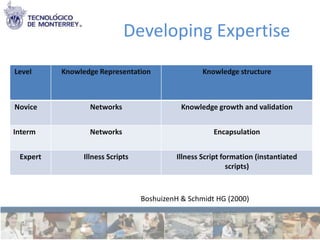
Level     Knowledge Representation                Knowledge structure


Novice           Networks                   Knowledge growth and validation


Interm           Networks                            Encapsulation


 Expert        Illness Scripts            Illness Script formation (instantiated
                                                           scripts)


                                 BoshuizenH & Schmidt HG (2000)
Developing Expertise
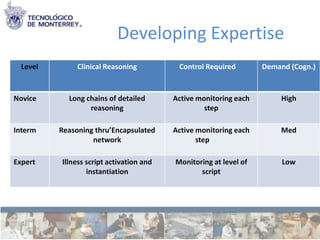
  Level        Clinical Reasoning          Control Required        Demand (Cogn.)


Novice      Long chains of detailed       Active monitoring each        High
                  reasoning                        step

Interm    Reasoning thru’Encapsulated     Active monitoring each        Med
                   network                       step

Expert    Illness script activation and   Monitoring at level of        Low
                  instantiation                  script
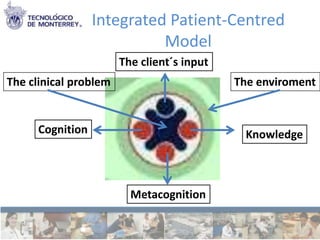
Integrated Patient-Centred
                        Model
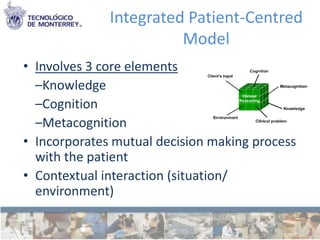
• Involves 3 core elements
  –Knowledge
  –Cognition
  –Metacognition
• Incorporates mutual decision making process
  with the patient
• Contextual interaction (situation/
  environment)
Knowledge
•   Biomedical knowledge
•   Clinical knowledge
•   Everyday knowledge
•   Increase growth of knowledge
    needs to be organized to be
    useful
Cognition

• Perception of relevant from
  irrelevant information
• Interpretation of information
  and hypothesis testing
• Inquiry strategies (hypothesis
  testing)
• Weighting and synthesis of
  information
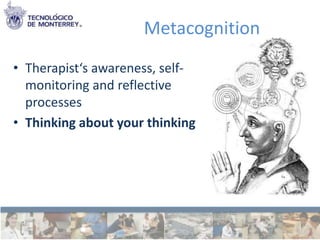
Metacognition
• Therapist‘s awareness, self-
  monitoring and reflective
  processes
• Thinking about your thinking
Reflection

“To be conscience that you are
 ignorant is a great step to
 knowledge”

           Benjamin Disraeli (1835-1910)
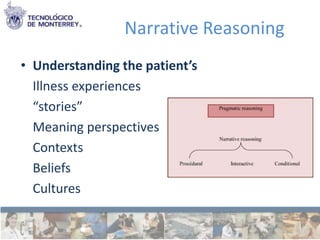
Narrative Reasoning
• Understanding the patient’s
  Illness experiences
  “stories”
  Meaning perspectives
  Contexts
  Beliefs
  Cultures
Using Narrative Reasoning
• Patient wants to return to his job
• Shows up for all clinical appointments and does
  everything that is asked of him during
  appointment
• Does not “get around”to doing the exercises at
  home
• Without exercises, treatment will not be
  successful
• How do we proceed?
Integrated Patient-Centred
                            Model
                       The client´s input
The clinical problem                        The enviroment


      Cognition                              Knowledge


                         Metacognition
Integrated Patient-Centred
          Model
Hypothetico-Deductive
                     Reasoning
• Analytic process of reasoning (Eva 2004)
• “Backward Reasoning”
• Relation between the signs and symptoms and
  diagnosis
Hypothetico-Deductive
                     Reasoning

• Hypothesis generating and testing involves
  both inductive and deductive reasoning
• –Induction -to generate the hypothesis
• –Deductive -to test hypothesis
Hypothetico-Deductive
                         Reasoning
Pros                      Cons
• Thorough                • Slow
• Organized               • Too much data can
• Appears to be a skill     leave reasoner without
  that can be taught to     a direction.
  novice clinicians
Collaborative reasoning
• Shared decision making between the therapist
  and the client
• Client’s opinion actively sought and utilized
Pattern Recognition
• Direct automatic retrieval of information from
  a well organized knowledge base
• Seeing a case that strongly resembles a case
  seen in the past
Pattern Recognition
• Direct automatic retrieval of information from
  a well organized knowledge base
• Seeing a case that strongly resembles a case
  seen in the past
Pattern Recognition
•   Non-analytic process of reasoning
•   “Forward Reasoning”
•   Illness Scripts
•   Intuition
•   Tends to occur unconsciously
Pattern Recognition
Pros                       Cons
•Fast                      •Lacks certainty
•Conclusions can be        •Need exposure to
  reached with imprecise     pattern in order to
  data                       recognize
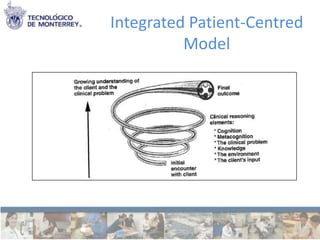
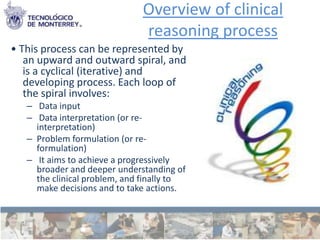
Overview of clinical
                              reasoning process
• This process can be represented by
   an upward and outward spiral, and
   is a cyclical (iterative) and
   developing process. Each loop of
   the spiral involves:
   – Data input
   – Data interpretation (or re-
     interpretation)
   – Problem formulation (or re-
     formulation)
   – It aims to achieve a progressively
     broader and deeper understanding of
     the clinical problem, and finally to
     make decisions and to take actions.
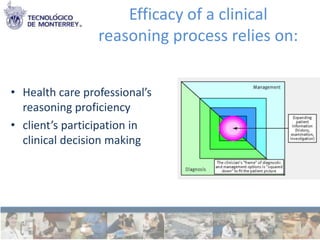
Efficacy of a clinical
                 reasoning process relies on:


• Health care professional’s
  reasoning proficiency
• client’s participation in
  clinical decision making
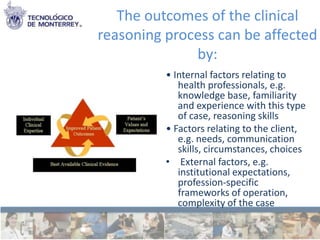
The outcomes of the clinical
reasoning process can be affected
              by:
          • Internal factors relating to
             health professionals, e.g.
             knowledge base, familiarity
             and experience with this type
             of case, reasoning skills
          • Factors relating to the client,
             e.g. needs, communication
             skills, circumstances, choices
          • External factors, e.g.
             institutional expectations,
             profession-specific
             frameworks of operation,
             complexity of the case
Thank You

Jorge.valdez@itesm.mx

Clinical reasoning apao

  • 1.
    Clinical Reasoning Jorge E. Valdez MD,MA. Dean School of Medicine and Health Sciences
  • 2.
    1. Aplicación dehabilidades clínicas. 2. Manejo de recursos diagnósticos 3. Manejo terapéutico. 7. Aplicación del 4. Promoción de salud y entendimiento de las prevención de la enfermedad. Competencias Competencias Ciencias Básicas, 5. Habilidades de Técnicas Intelectuales Clínicas y Sociales para comunicación. la práctica clínica. 5. Aplicación de habilidades para el manejo de la información. Competencias Competencias en Profesionalismo Analíticas y Creativas 9. Desempeño del Médico 8. Razonamiento, dentro del sistema de salud. juicio clínico y 10. Ética y desarrollo toma de decisiones. personal.
  • 3.
    Objectives • By theend of this lecture, students should be able to: – • Understand the need for clinical reasoning – • Define clinical reasoning – • Understand the clinical reasoning process
  • 4.
    Need for clinicalreasoning • People live longer with more chronic and complex problems. • Health professionals are expected to be more responsible, to work with diverse teams, and to make more independent judgements and decisions. • There is information overload because of instant access to information through computers. • Doctors are frequently involved in complex situations, which require an increasing level of responsibility
  • 5.
    Definition: • The thinkingand/or decision-making processes that are used in clinical practice Higgs and Jones 2000, Edwards et al 2004 Goal = “Wise Action”
  • 6.
    Clinical Reasoning • Refersto a process in which the therapist, interacting with the patient, structures meaning, goals & health management strategies based on clinical data, client choices, professional judgment & knowledge (Higgs and Jones 2000) • –Hypothesis oriented, collaborative and reflective • –Knowledge and organization of knowledge are important
  • 7.
    Process of ClinicalReasoning Theoretical Models of Reasoning 1.Knowledge -Reasoning Integration (Schmidt et al 1990) 2.Integrated Patient Centered Model (Higgs and Jones 1995) 3.Hypothetic–Deductive (Elsteinet al 1978) 4.Pattern Recognition (Barrows &Feltovich1987)
  • 8.
    Knowledge –Reasoning Integration •CR is not separate skill from knowledge and clinical skills • Important for knowledge to be domain- specific • With increasing knowledge and reasoning skills –knowledge structure changes (towards illness scripts) (Schmidt et al 1990)
  • 9.
    Developing Expertise • Knowledgeacquisition and clinical reasoning go hand in hand. • Occurs in stages • Novice →Intermediate →Experts
  • 10.
    Developing Expertise Level Knowledge Representation Knowledge structure Novice Networks Knowledge growth and validation Interm Networks Encapsulation Expert Illness Scripts Illness Script formation (instantiated scripts) BoshuizenH & Schmidt HG (2000)
  • 11.
    Developing Expertise Level Clinical Reasoning Control Required Demand (Cogn.) Novice Long chains of detailed Active monitoring each High reasoning step Interm Reasoning thru’Encapsulated Active monitoring each Med network step Expert Illness script activation and Monitoring at level of Low instantiation script
  • 12.
    Integrated Patient-Centred Model • Involves 3 core elements –Knowledge –Cognition –Metacognition • Incorporates mutual decision making process with the patient • Contextual interaction (situation/ environment)
  • 13.
    Knowledge • Biomedical knowledge • Clinical knowledge • Everyday knowledge • Increase growth of knowledge needs to be organized to be useful
  • 14.
    Cognition • Perception ofrelevant from irrelevant information • Interpretation of information and hypothesis testing • Inquiry strategies (hypothesis testing) • Weighting and synthesis of information
  • 15.
    Metacognition • Therapist‘s awareness,self- monitoring and reflective processes • Thinking about your thinking
  • 16.
    Reflection “To be consciencethat you are ignorant is a great step to knowledge” Benjamin Disraeli (1835-1910)
  • 17.
    Narrative Reasoning • Understandingthe patient’s Illness experiences “stories” Meaning perspectives Contexts Beliefs Cultures
  • 18.
    Using Narrative Reasoning •Patient wants to return to his job • Shows up for all clinical appointments and does everything that is asked of him during appointment • Does not “get around”to doing the exercises at home • Without exercises, treatment will not be successful • How do we proceed?
  • 19.
    Integrated Patient-Centred Model The client´s input The clinical problem The enviroment Cognition Knowledge Metacognition
  • 20.
  • 21.
    Hypothetico-Deductive Reasoning • Analytic process of reasoning (Eva 2004) • “Backward Reasoning” • Relation between the signs and symptoms and diagnosis
  • 22.
    Hypothetico-Deductive Reasoning • Hypothesis generating and testing involves both inductive and deductive reasoning • –Induction -to generate the hypothesis • –Deductive -to test hypothesis
  • 23.
    Hypothetico-Deductive Reasoning Pros Cons • Thorough • Slow • Organized • Too much data can • Appears to be a skill leave reasoner without that can be taught to a direction. novice clinicians
  • 24.
    Collaborative reasoning • Shareddecision making between the therapist and the client • Client’s opinion actively sought and utilized
  • 25.
    Pattern Recognition • Directautomatic retrieval of information from a well organized knowledge base • Seeing a case that strongly resembles a case seen in the past
  • 26.
    Pattern Recognition • Directautomatic retrieval of information from a well organized knowledge base • Seeing a case that strongly resembles a case seen in the past
  • 27.
    Pattern Recognition • Non-analytic process of reasoning • “Forward Reasoning” • Illness Scripts • Intuition • Tends to occur unconsciously
  • 28.
    Pattern Recognition Pros Cons •Fast •Lacks certainty •Conclusions can be •Need exposure to reached with imprecise pattern in order to data recognize
  • 29.
    Overview of clinical reasoning process • This process can be represented by an upward and outward spiral, and is a cyclical (iterative) and developing process. Each loop of the spiral involves: – Data input – Data interpretation (or re- interpretation) – Problem formulation (or re- formulation) – It aims to achieve a progressively broader and deeper understanding of the clinical problem, and finally to make decisions and to take actions.
  • 30.
    Efficacy of aclinical reasoning process relies on: • Health care professional’s reasoning proficiency • client’s participation in clinical decision making
  • 31.
    The outcomes ofthe clinical reasoning process can be affected by: • Internal factors relating to health professionals, e.g. knowledge base, familiarity and experience with this type of case, reasoning skills • Factors relating to the client, e.g. needs, communication skills, circumstances, choices • External factors, e.g. institutional expectations, profession-specific frameworks of operation, complexity of the case
  • 32.