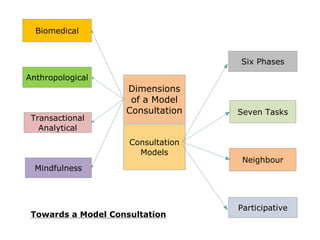
Biomedical Karl Popper’s ideas better reflect the  reality of biomedical consultations,  because clinicians are seeking to  disconfirm their working diagnoses  (falsificationism). Diagnosis is  verisimilitudinal:  it only approximates to  reality until a better diagnosis is available  (e.g. diagnostic drift).  Basic premise: Illness is a function of  disease. Diagnosis directs treatment. This logic underpins the tenets of  Evidenced Based Medicine.  However, biomedical reasoning fails to  address patients’ fears, hopes and  expectations.  The process is primarily inductive: History Examination Making Provisional Diagnosis Testing the Hypothesis And thereby deducing a definitive diagnosis. Elstein  et al  1978 in praxis the provisional diagnosis is made early within the consultation. Thus clinicians are using history and examination to validate their working diagnosis. Elstein  et al  (1978)  Medical Problem  Solving: an analysis of clinical reasoning.  Cambridge MA: Harvard University Press.
Anthropological Approach Anthropologists observe different  cultures and then seek to make  sense of their observations. Their observations is that the healing ritual  is a function of making a diagnosis,  prescribing a remedy and pronouncing the  problem cured! The patient plays the sick role to  the doctors healing role.  Aesculapean Authority Patient’s beliefs are based on the  charismatic nature of their healers (and politicians?).  Healers are all knowing Healing is vocational Healing is magic. There are some assumptions  here, but sapiential, moral and  charismatic authority would increase  the placebo response. Patient  expectations are being met. However, this therapeutic alliance  is not sustainable, but (rarely) it may be appropriate to play the role of healer  for an individual patient.
Transactional Approach Parent – directive controlling nurturing Adult – logically processes information Child has an intuitive grasp of enjoying life Understand your role and that of the patient  within an enacted  consultative game.   An Exemplar There are many types of  games played, such as the critique of a course of action  as to why a plan will not work –  thus seeking to protect child  from lifestyle changes. The move  to co-create the management  plans enables clinicians to  influence and negotiate a  therapeutic alliance, where all  parties to a consultation work  synergistically. If you are directive  of management plans you are  playing parent to the patients child.
Mindfulness Michael Balint worked with GPs to raise  their emotional awareness of the  dynamics within consultations. His approach may ask the doctor to interpret  their emotional reaction to a  patients story (flash technique).  Psychoanalysis gives useful insight into The nature of trust and dependency within  relationships’. Including understanding of  trust and dependency within the  consultative therapeutic alliance The therapist skill is to pace the  psychodynamic so to as enable the  analysand to be able to grow to emotional  maturity at a sustainable pace.  Psychoanalysis has a huge  Literature and has evolved  to being more about the co- construction of meaning,  rather than being interpretive.  Michael Jacobs (1998) The  Presenting Past. The core  of psychodynamic counselling and therapy  2 nd  Ed. Maidenhead Open University  Press is an accessible introduction to this  topic. General practitioners can catalyse  meaningful insight for their patients by  being more emotionally intelligent within  their  ultra-short  consultations over the  ultra-long  time of their careers.
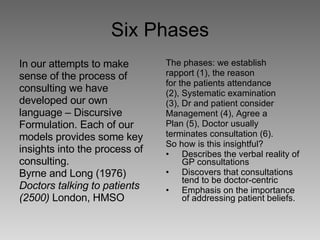
Six Phases In our attempts to make sense of the process of  consulting we have  developed our own  language – Discursive  Formulation. Each of our models provides some key  insights into the process of  consulting. Byrne and Long (1976)  Doctors talking to patients  (2500)  London, HMSO The phases: we establish  rapport (1), the reason  for the patients attendance  (2), Systematic examination  (3), Dr and patient consider  Management (4), Agree a  Plan (5), Doctor usually  terminates consultation (6). So how is this insightful? Describes the verbal reality of GP consultations Discovers that consultations tend to be doctor-centric Emphasis on the importance of addressing patient beliefs.
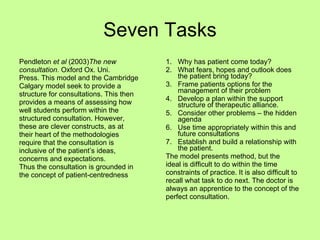
Seven Tasks Pendleton  et al  (2003) The new  consultation.  Oxford Ox. Uni. Press. This model and the Cambridge  Calgary model seek to provide a  structure for consultations. This then  provides a means of assessing how  well students perform within the  structured consultation. However,  these are clever constructs, as at  their heart of the methodologies  require that the consultation is  inclusive of the patient’s ideas,  concerns and expectations. Thus the consultation is grounded in  the concept of patient-centredness Why has patient come today? What fears, hopes and outlook does the patient bring today? Frame patients options for the management of their problem Develop a plan within the support structure of therapeutic alliance. Consider other problems – the hidden agenda Use time appropriately within this and future consultations Establish and build a relationship with the patient. The model presents method, but the  ideal is difficult to do within the time  constraints of practice. It is also difficult to  recall what task to do next. The doctor is  always an apprentice to the concept of the  perfect consultation.
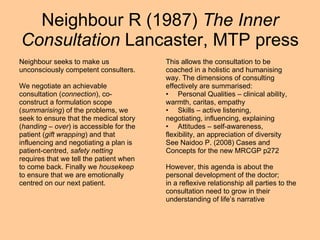
Neighbour R (1987)  The Inner Consultation  Lancaster, MTP press Neighbour seeks to make us unconsciously competent consulters.  We negotiate an achievable  consultation ( connection ), co- construct a formulation scope  ( summarising ) of the problems, we  seek to ensure that the medical story  ( handing – over ) is accessible for the  patient ( gift wrapping ) and that  influencing and negotiating a plan is  patient-centred,  safety netting  requires that we tell the patient when  to come back. Finally we  housekeep   to ensure that we are emotionally  centred on our next patient.  This allows the consultation to be  coached in a holistic and humanising  way. The dimensions of consulting  effectively are summarised:  Personal Qualities – clinical ability, warmth, caritas, empathy Skills – active listening,  negotiating, influencing, explaining Attitudes – self-awareness,  flexibility, an appreciation of diversity See Naidoo P. (2008) Cases and  Concepts for the new MRCGP p272 However, this agenda is about the  personal development of the doctor;  in a reflexive relationship all parties to the  consultation need to grow in their  understanding of life’s narrative
Participative – Launer J. (2002)  Narrative-Based Primary Care  Oxford, Radcliffe   M P Patients and doctors tell stories.  Traditionally a doctor seeks to  understand the patient’s story  from a diagnostic standpoint;  in narrative based medicine the  doctors seeks to help the patient  reframe their life-narrative.  An exemplar, rituals (Obsessive  Compulsive Disorder) can be  seen as a learnt behaviour to help the heroic patient deal with the  impossibility of their life situation.  The effect can be make consulting  become ultra short therapy over all too  shorter career (sorry a highly personal  view).  Sharing Cs:  Conversation  is  dialogical, problems are dissolved  rather than solved. You need to  have a  committed  interest to the  patients emotional agenda and  their use of language.  Circularity  tracks the way interactions with  families evolve and transform.  Contexts  situate narrative to  places. The overarching aim is to  co-create  a better story, but also  to exercise  caution  in respecting the  way patients set realistic life goals.  The methodology is suited to practitioners  who seek  to ask how can I help this  patient? There is a consultation space that  accommodates life’s complexity.

Modelling Consultations

  • 1.
  • 2.
    Biomedical Karl Popper’sideas better reflect the reality of biomedical consultations, because clinicians are seeking to disconfirm their working diagnoses (falsificationism). Diagnosis is verisimilitudinal: it only approximates to reality until a better diagnosis is available (e.g. diagnostic drift). Basic premise: Illness is a function of disease. Diagnosis directs treatment. This logic underpins the tenets of Evidenced Based Medicine. However, biomedical reasoning fails to address patients’ fears, hopes and expectations. The process is primarily inductive: History Examination Making Provisional Diagnosis Testing the Hypothesis And thereby deducing a definitive diagnosis. Elstein et al 1978 in praxis the provisional diagnosis is made early within the consultation. Thus clinicians are using history and examination to validate their working diagnosis. Elstein et al (1978) Medical Problem Solving: an analysis of clinical reasoning. Cambridge MA: Harvard University Press.
  • 3.
    Anthropological Approach Anthropologistsobserve different cultures and then seek to make sense of their observations. Their observations is that the healing ritual is a function of making a diagnosis, prescribing a remedy and pronouncing the problem cured! The patient plays the sick role to the doctors healing role. Aesculapean Authority Patient’s beliefs are based on the charismatic nature of their healers (and politicians?). Healers are all knowing Healing is vocational Healing is magic. There are some assumptions here, but sapiential, moral and charismatic authority would increase the placebo response. Patient expectations are being met. However, this therapeutic alliance is not sustainable, but (rarely) it may be appropriate to play the role of healer for an individual patient.
  • 4.
    Transactional Approach Parent– directive controlling nurturing Adult – logically processes information Child has an intuitive grasp of enjoying life Understand your role and that of the patient within an enacted consultative game. An Exemplar There are many types of games played, such as the critique of a course of action as to why a plan will not work – thus seeking to protect child from lifestyle changes. The move to co-create the management plans enables clinicians to influence and negotiate a therapeutic alliance, where all parties to a consultation work synergistically. If you are directive of management plans you are playing parent to the patients child.
  • 5.
    Mindfulness Michael Balintworked with GPs to raise their emotional awareness of the dynamics within consultations. His approach may ask the doctor to interpret their emotional reaction to a patients story (flash technique). Psychoanalysis gives useful insight into The nature of trust and dependency within relationships’. Including understanding of trust and dependency within the consultative therapeutic alliance The therapist skill is to pace the psychodynamic so to as enable the analysand to be able to grow to emotional maturity at a sustainable pace. Psychoanalysis has a huge Literature and has evolved to being more about the co- construction of meaning, rather than being interpretive. Michael Jacobs (1998) The Presenting Past. The core of psychodynamic counselling and therapy 2 nd Ed. Maidenhead Open University Press is an accessible introduction to this topic. General practitioners can catalyse meaningful insight for their patients by being more emotionally intelligent within their ultra-short consultations over the ultra-long time of their careers.
  • 6.
    Six Phases Inour attempts to make sense of the process of consulting we have developed our own language – Discursive Formulation. Each of our models provides some key insights into the process of consulting. Byrne and Long (1976) Doctors talking to patients (2500) London, HMSO The phases: we establish rapport (1), the reason for the patients attendance (2), Systematic examination (3), Dr and patient consider Management (4), Agree a Plan (5), Doctor usually terminates consultation (6). So how is this insightful? Describes the verbal reality of GP consultations Discovers that consultations tend to be doctor-centric Emphasis on the importance of addressing patient beliefs.
  • 7.
    Seven Tasks Pendleton et al (2003) The new consultation. Oxford Ox. Uni. Press. This model and the Cambridge Calgary model seek to provide a structure for consultations. This then provides a means of assessing how well students perform within the structured consultation. However, these are clever constructs, as at their heart of the methodologies require that the consultation is inclusive of the patient’s ideas, concerns and expectations. Thus the consultation is grounded in the concept of patient-centredness Why has patient come today? What fears, hopes and outlook does the patient bring today? Frame patients options for the management of their problem Develop a plan within the support structure of therapeutic alliance. Consider other problems – the hidden agenda Use time appropriately within this and future consultations Establish and build a relationship with the patient. The model presents method, but the ideal is difficult to do within the time constraints of practice. It is also difficult to recall what task to do next. The doctor is always an apprentice to the concept of the perfect consultation.
  • 8.
    Neighbour R (1987) The Inner Consultation Lancaster, MTP press Neighbour seeks to make us unconsciously competent consulters. We negotiate an achievable consultation ( connection ), co- construct a formulation scope ( summarising ) of the problems, we seek to ensure that the medical story ( handing – over ) is accessible for the patient ( gift wrapping ) and that influencing and negotiating a plan is patient-centred, safety netting requires that we tell the patient when to come back. Finally we housekeep to ensure that we are emotionally centred on our next patient. This allows the consultation to be coached in a holistic and humanising way. The dimensions of consulting effectively are summarised: Personal Qualities – clinical ability, warmth, caritas, empathy Skills – active listening, negotiating, influencing, explaining Attitudes – self-awareness, flexibility, an appreciation of diversity See Naidoo P. (2008) Cases and Concepts for the new MRCGP p272 However, this agenda is about the personal development of the doctor; in a reflexive relationship all parties to the consultation need to grow in their understanding of life’s narrative
  • 9.
    Participative – LaunerJ. (2002) Narrative-Based Primary Care Oxford, Radcliffe M P Patients and doctors tell stories. Traditionally a doctor seeks to understand the patient’s story from a diagnostic standpoint; in narrative based medicine the doctors seeks to help the patient reframe their life-narrative. An exemplar, rituals (Obsessive Compulsive Disorder) can be seen as a learnt behaviour to help the heroic patient deal with the impossibility of their life situation. The effect can be make consulting become ultra short therapy over all too shorter career (sorry a highly personal view). Sharing Cs: Conversation is dialogical, problems are dissolved rather than solved. You need to have a committed interest to the patients emotional agenda and their use of language. Circularity tracks the way interactions with families evolve and transform. Contexts situate narrative to places. The overarching aim is to co-create a better story, but also to exercise caution in respecting the way patients set realistic life goals. The methodology is suited to practitioners who seek to ask how can I help this patient? There is a consultation space that accommodates life’s complexity.